
Real estate needs cybersecurity because every transaction, tenant relationship, and revenue stream your firm depends on is a target. Wire fraud, ransomware, and business email compromise (BEC) are not abstract IT problems — they are direct threats to deal closings, rent collections, and the building systems your tenants rely on every day. Three realities make this urgent right now:
- Transaction integrity and payment protection. A single redirected wire instruction or fraudulent payoff letter can cost hundreds of thousands of dollars in a matter of hours, with little legal recourse once funds clear.
- Operational continuity for building systems and tenant services. Smart building technology — HVAC, access control, lighting — runs on networks that attackers can reach. When those systems go down, tenants notice, and leases are at risk.
- Legal, financial, and reputational exposure from data loss. Brokers and property managers hold Social Security numbers, financial statements, and lease terms. State breach-notification laws, Gramm-Leach-Bliley Act obligations for firms handling financial data, and NAR professional standards all create liability when that data is compromised.
The National Association of Realtors and industry analysts at RSM have both flagged real estate as a high-value target precisely because transactions are large, timelines are compressed, and verification shortcuts are common. The sections below map the specific threats, their mechanics, and the controls that actually reduce exposure.
Table of Contents
- Why real estate faces unique cybersecurity threats
- How attacks actually unfold in real estate transactions
- What a cyber incident actually costs your firm
- Practical controls every real estate firm should put in place
- Building an incident response playbook your team will actually use
- Contracts, compliance, and cyber insurance: what to check
- What the research says about cyber resilience in CRE
- Your 30/60/90-day action plan for brokers and property managers
- Key Takeaways
- The 247techify team’s perspective on cybersecurity as transaction discipline
- Authoritative sources and further reading
- FAQ
Why real estate faces unique cybersecurity threats
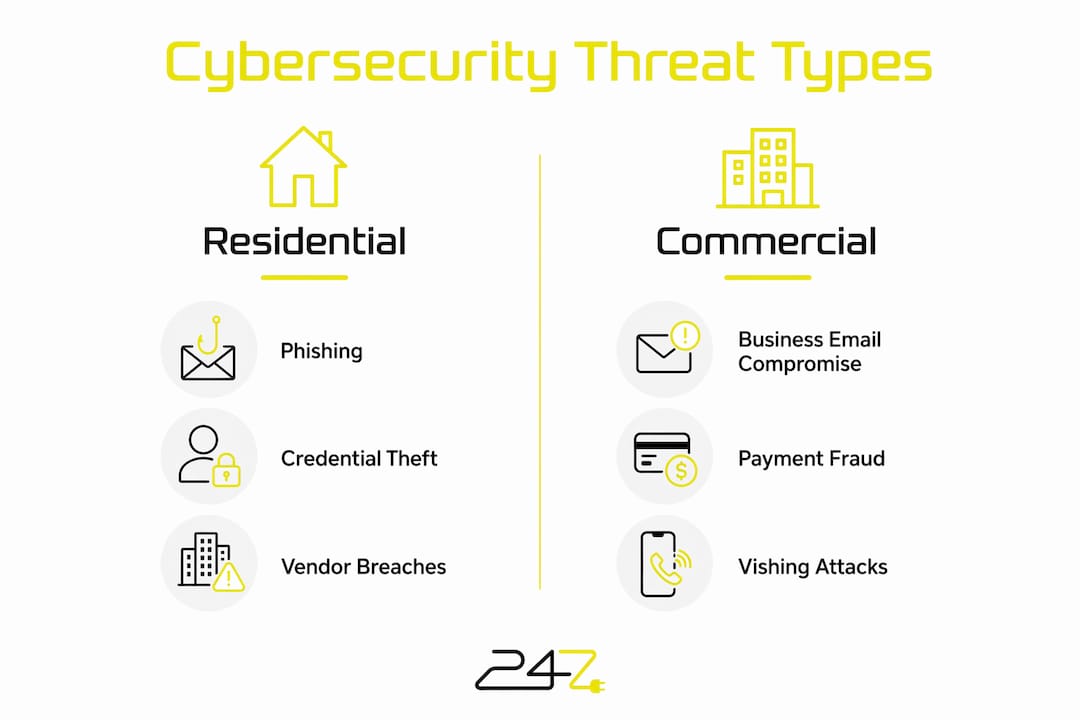
Residential brokers and commercial property managers face overlapping but distinct threat profiles. Residential attacks tend to target individual buyers and sellers — intercepting wire instructions at closing is the classic example. Commercial real estate (CRE) attacks are broader: they target transaction integrity, recurring revenue, and the operational systems that keep multi-tenant buildings running.

Ransomware is the most disruptive threat category. A successful ransomware deployment can encrypt lease management systems, tenant portals, and accounting platforms simultaneously, halting rent collection and maintenance dispatch for days or weeks. BEC attacks are subtler but often more immediately costly — an attacker who has compromised a broker’s email account can redirect a $2 million wire with a single convincing message.
Phishing and vishing (voice phishing) feed both ransomware and BEC. Payment and check fraud is a persistent, lower-tech threat that remains surprisingly effective: 63% of organizations reported check fraud in a recent AFP Payments Fraud and Control Survey. Stolen or lost devices carrying unencrypted lease files and client financial data create a different exposure entirely. Then there are IoT and building-automation attacks, which are less common today but growing as smart building deployments expand.
Stat callout: 63% of organizations reported check fraud in a recent payments-fraud survey — making checks the payment method most vulnerable to fraud in commercial real estate.
Supply-chain and vendor breaches round out the picture. A single misconfigured vendor credential can expose multiple properties at once, because property management platforms, title companies, and lenders are all interconnected. The BOMA/Siemens white paper on CRE cybersecurity documents how a vendor-level breach can cascade through connected systems across an entire portfolio.
How attacks actually unfold in real estate transactions
Most real estate cyberattacks start with a low-tech move: a well-crafted phishing email or a phone call. The attacker impersonates a title officer, lender, or property manager and requests a document, a credential reset, or a payment confirmation. Once an employee clicks a malicious link or reads back a verification code, the attacker has a foothold.

From there, the escalation is methodical. Credential access lets the attacker monitor email threads for weeks, learning deal timelines, counterparty names, and expected wire amounts. When closing day approaches, they send a spoofed email with updated wire instructions — often from a domain that differs from the real one by a single character. The buyer or tenant wires funds to a controlled account. By the time anyone notices, the money is gone.
BEC and AI-enabled phishing were reported as the top methods of payment fraud in recent industry analysis. AI-generated phishing emails now pass basic grammar and tone checks that used to catch fraudulent messages. Deepfake audio can replicate a known executive’s voice on a verification call. These tools lower the skill barrier for attackers and raise the convincing power of every social-engineering attempt.
Transaction periods are especially dangerous. Stewart’s analysis of CRE cyber risk identifies manipulated rent rolls, altered payoff letters, and entity-authority fraud as specific transaction-integrity risks that accelerate when deal teams prioritize speed over verification. Ownership transitions are a known high-risk window: criminals monitor public records for property transfers, then impersonate the new management company to redirect recurring payments from tenants.
Vishing attacks bypass many technical controls entirely. The Cushman & Wakefield incident, widely covered in the CRE press, demonstrated that social engineering over the phone can defeat even organizations with mature technical defenses. Compromised vendor credentials are equally dangerous: a property management software vendor with weak access controls becomes a master key to every property on its platform.
What a cyber incident actually costs your firm
The financial damage from a real estate cyber incident arrives in waves. Direct costs hit first: forensic investigation, system restoration, ransom payment (if paid), and legal counsel. The average cost of a data breach across U.S. industries exceeded $9.36 million according to the BOMA/Siemens white paper — a figure that reflects enterprise-scale incidents but illustrates the order of magnitude at stake.
Stat callout: The average U.S. data breach cost exceeded $9.36 million per incident, per the BOMA/Siemens CRE cybersecurity white paper — a benchmark that underscores why prevention and resilience planning are both necessary.
Operational impacts compound the direct costs. When ransomware encrypts a building management system, access control and HVAC can go offline. Tenants who cannot badge into their space or who work in an uncontrolled thermal environment will escalate to their landlord immediately. Prolonged disruptions affect lease renewal decisions. The BOMA/Siemens research is explicit: tenant confidence and retention are materially affected by reliable, secure building operations, and incidents that disrupt those systems can trigger lease nonrenewal and asset devaluation.
Recovery timelines follow a predictable arc: detection and initial containment typically takes several days for a well-prepared firm; full eradication and system restoration can take multiple weeks depending on backup quality and the scope of the compromise; legal notification to affected parties under state breach-notification laws must often happen promptly after discovery; and litigation or regulatory review can extend costs for over a year. Reputational damage is harder to quantify but real — a broker whose client wired funds to a fraudster faces a relationship that rarely recovers.
Practical controls every real estate firm should put in place
The most effective controls address the highest-frequency attack vectors first. Here is a prioritized list, ordered by impact-to-effort ratio:
- Multi-factor authentication (MFA) on every account. Email, property management software, accounting platforms, and VPN access all need MFA enabled. This single control stops the majority of credential-based attacks.
- Payment verification workflows with mandatory callbacks. Before any wire transfer or payment-instruction change is processed, require a callback to a known-good phone number — not a number provided in the request itself. Daily reconciliation, payment limits, and multi-person approval for high-value disbursements materially reduce successful fraud.
- Encrypted communications for sensitive documents. Lease agreements, financial statements, and closing documents should travel over encrypted channels, not standard email attachments. Platforms designed for HOA and tenant communication security offer purpose-built encryption and audit trails for exactly this use case.
- Endpoint protection and timely patching. Every device that touches your network needs up-to-date endpoint detection and response (EDR) software. Unpatched systems are the most common entry point for ransomware.
- Segregated, immutable backups. Backups stored on the same network as production systems are encrypted alongside them in a ransomware attack. Offline or cloud-isolated backup and disaster recovery with tested restoration procedures is the only reliable recovery path.
- Vendor due diligence and contract security clauses. Require written security attestations from property management software vendors, title companies, and any third party with network access. Contracts should specify breach-notification timelines (72 hours or less), data-handling limits, and a right-to-audit clause.
- Network segmentation between building systems and corporate networks. OT systems — HVAC controllers, access control panels, lighting systems — should sit on isolated network segments that cannot directly reach email servers or financial platforms. This limits lateral movement if either side is compromised.
- Secure defaults and patching for IoT devices. Building automation devices often ship with default credentials and receive infrequent firmware updates. Change default passwords at installation, disable unused remote-access ports, and establish a patching schedule specific to OT devices, which have longer lifecycles than standard IT equipment.
- Staff training with phishing and vishing simulations. Technical controls fail when employees are deceived. Regular cybersecurity training that includes simulated phishing emails and scripted vishing calls builds the muscle memory to pause and verify before acting.
- Least-privilege access controls. No employee or vendor should have broader system access than their role requires. Quarterly access reviews catch stale permissions before attackers exploit them.
Pro Tip: The most overlooked verification gap in real estate is the ownership-transition window. When a property changes hands or switches management companies, criminals monitor public records and impersonate the new entity to redirect tenant payments. Build a written, step-by-step changeover protocol that requires dual-channel identity verification before any payment routing is updated.
For real estate IT support needs that span both corporate and building-system environments, the controls above apply across both layers — but the implementation sequence matters. Start with MFA and payment verification (highest fraud ROI), then move to segmentation and OT hardening.
Building an incident response playbook your team will actually use
A written incident response (IR) playbook is not a compliance checkbox. It is the document your property manager opens at 2 AM when the access control system stops responding. Without it, the first 30 minutes of an incident are wasted on confusion about who calls whom.
A functional real estate IR playbook covers five phases:
- Identification. Define what constitutes a security incident (unusual login, payment-instruction change request, building system anomaly) and who is responsible for initial triage.
- Containment. Isolate affected systems — disconnect compromised endpoints from the network, suspend suspicious accounts, place holds on pending wire transfers.
- Eradication. Remove malware, revoke compromised credentials, patch the exploited vulnerability. Engage a forensic firm if the scope is unclear.
- Recovery. Restore from clean backups, validate system integrity, resume operations in a controlled sequence. IT support for property management that includes 24/7 monitoring can compress this phase significantly.
- Post-incident review and notification. Document what happened, how it was detected, and what failed. Notify affected parties per applicable state breach-notification laws, which typically require disclosure within 30–72 hours of confirmed breach discovery.
Tabletop exercises are the mechanism that makes playbooks real. Run one scenario per quarter with your leadership team: a ransomware event that encrypts the property management platform, a BEC attack that nearly redirects a $500,000 wire, and a vishing call that tricks a leasing agent into resetting a password. Each exercise should validate who holds payment-authorization authority, who contacts vendors and tenants, and where the known-good contact list is stored (not in the compromised email system). Engage a forensic or legal advisor before an incident, not after — pre-established relationships compress response time when hours matter.
Contracts, compliance, and cyber insurance: what to check
Real estate firms operate under a patchwork of data-protection obligations. The FTC’s Disposal Rule requires proper disposal of consumer report information. The Gramm-Leach-Bliley Act applies to firms that provide financial services, including mortgage brokerage. NAR’s cybersecurity best practices checklist outlines professional obligations for protecting client data, including encrypted email for document sharing and offline backups for ransomware recovery. State breach-notification laws vary, but most require prompt disclosure to affected individuals and, in many states, to the state attorney general.
Vendor contracts are a primary risk-transfer lever. Require the following from every vendor with access to your systems or client data:
- Written confirmation of security controls (encryption at rest and in transit, MFA enforcement, annual penetration testing)
- Breach notification within 72 hours of confirmed discovery
- Data-handling limits specifying what data the vendor may retain and for how long
- A right-to-audit clause allowing your firm to verify compliance
- Indemnification language covering costs arising from vendor-caused breaches
Cyber liability insurance has become a practical necessity for real estate firms. When evaluating policies, check for: ransomware coverage (including extortion payment and restoration costs), social-engineering and BEC coverage (many base policies exclude it — it requires a specific endorsement), forensic and legal cost coverage, notification and credit-monitoring cost coverage, and policy limits that reflect your probable maximum loss. A $1 million policy sounds substantial until you account for a $9 million average breach cost. Work with a broker who specializes in technology or professional-liability coverage to right-size limits and confirm that social-engineering endorsements are included.
What the research says about cyber resilience in CRE
The data from authoritative industry sources converges on a clear message: prevention alone is insufficient, and the firms that manage cyber risk best are those that plan to maintain operations through an incident, not just prevent one.
| Source | Key Finding | Implication for CRE |
|---|---|---|
| AFP Payments Fraud Survey | 63% of organizations reported check fraud | Checks and analog payment methods remain the highest-fraud-risk payment type |
| BOMA/Siemens White Paper | Average U.S. breach cost exceeded $9.36 million | OT/IT convergence amplifies financial exposure across entire portfolios |
| RSM 2026 CRE Snapshot | Industry shifting from prevention to cyber resilience | Maintaining transactions and tenant services during incidents is now a primary objective |
| J.P. Morgan CRE Cybersecurity | BEC and AI-enabled phishing are top fraud vectors | Verification workflows and callback procedures are the highest-ROI controls |
| Stewart CRE Cyber Risk | Transaction-integrity risks include manipulated rent rolls and altered payoff letters | Speed without verification is the primary exposure driver in deal workflows |
The RSM finding on resilience deserves particular attention. The shift from “prevent all attacks” to “maintain operations when attacked” reflects a maturation in how CRE leadership thinks about risk. It also has direct budget implications: resilience spending (backups, IR planning, tabletop exercises, monitoring) competes with prevention spending (firewalls, endpoint protection), and the research suggests both are necessary.
For CRE firms specifically, the BOMA/Siemens OT/IT convergence finding means that building automation systems are no longer an isolated facilities concern. They are a cybersecurity attack surface with direct consequences for tenant retention, asset valuation, and insurance premiums.
Recommended next moves based on the research:
- Migrate high-value payments away from checks to validated digital payment rails with dual-approval controls
- Commission an OT/IT network segmentation assessment if your building systems share infrastructure with corporate networks
- Schedule an annual tabletop exercise that includes a building-systems disruption scenario, not just a data-breach scenario
- Review cyber insurance policy language for social-engineering exclusions before the next renewal
Your 30/60/90-day action plan for brokers and property managers
-
Days 1–30: Secure accounts and payment workflows. Enable MFA on all email, property management, and financial accounts. Audit and document your current wire-transfer and payment-change procedures, then add a mandatory callback-verification step to every payment-instruction change. Brief all staff on vishing and phishing tactics — a 30-minute session with real examples is enough to raise awareness. Start daily bank reconciliations if you are not already running them.
-
Days 31–60: Harden infrastructure and test backups. Segment building automation systems from corporate networks if they currently share the same VLAN or flat network. Enforce a patching schedule for all endpoints and OT devices. Restore a backup in a test environment to confirm recovery procedures actually work — many firms discover their backups are incomplete or corrupted only during an actual incident. Conduct vendor security audits: send a written questionnaire to your top five vendors and review their responses against your contract requirements.
-
Days 61–90: Build resilience and governance. Run a tabletop exercise with your leadership team using a ransomware or BEC scenario. Review your cyber insurance policy for social-engineering coverage gaps and adjust limits if needed. Implement a security information and event management (SIEM) tool or engage a managed security provider to monitor for anomalous payment activity and unauthorized access attempts. Assign clear ownership for cybersecurity governance — a named individual (or a managed service partner) responsible for ongoing monitoring, patch compliance, and incident response readiness.
Key Takeaways
Real estate cybersecurity protects transactions, tenant services, and recurring revenue — and the firms that treat it as operational discipline, not an IT afterthought, are the ones that survive incidents without losing clients or deals.
| Point | Details |
|---|---|
| Payment fraud is the highest-frequency risk | 63% of organizations reported check fraud; callback verification and dual-approval controls are the fastest ROI. |
| OT/IT convergence expands your attack surface | Building systems on shared networks can be taken offline, disrupting tenants and triggering lease nonrenewal. |
| Breach costs are severe | The average U.S. data breach exceeded $9.36 million; cyber insurance with social-engineering coverage is a necessary transfer mechanism. |
| Resilience, not just prevention, is the goal | RSM’s CRE research shows the industry is shifting to maintaining operations during incidents, not only preventing them. |
| First action: MFA and payment verification | Enable MFA everywhere and add callback verification to all payment-instruction changes — these two controls address the majority of real estate fraud vectors. |
The 247techify team’s perspective on cybersecurity as transaction discipline
The framing that resonates most with real estate professionals is this: cybersecurity is not a technology problem sitting in an IT closet. It is a transaction discipline and an operational management function, the same way title insurance and property inspection are disciplines. Every deal workflow, every tenant payment cycle, and every building system handoff is a moment where a control either holds or fails.
What the industry tends to underestimate is the compounding effect of small verification gaps. A broker who skips the callback on a wire change “just this once” because the closing is in two hours has not made a minor shortcut — they have handed an attacker the exact window they were waiting for. The cybersecurity and customer trust relationship in real estate is direct: a client whose funds were redirected does not distinguish between “the attacker was sophisticated” and “my broker was careless.” The outcome is the same.
247techify’s approach to this problem is built around 24/7 monitoring, a sub-30-minute response commitment, and managed security through CybrXPRT — because the window between an attacker gaining access and executing a fraudulent transfer can be measured in minutes, not days. For real estate firms that prefer to keep internal IT staff but want security expertise layered on top, co-managed IT services provide exactly that structure. For firms that want a fully managed security posture, managed IT services cover monitoring, endpoint protection, backup, and incident response under a single plan.
The 30/60/90-day checklist above is a starting point. The firms that execute it fully — and then build ongoing governance around it — are the ones that close deals without losing money to fraud and retain tenants without losing them to building-system failures.

Authoritative sources and further reading
- AFP Payments Fraud and Control Survey — Primary data source on check fraud prevalence and payment-control effectiveness; essential for quantifying payment risk in CRE.
- BOMA/Siemens — Cybersecurity in Commercial Real Estate — Definitive white paper on OT/IT convergence, smart building attack surfaces, and asset-value implications; required reading for commercial property managers.
- RSM — 2026 Cybersecurity Snapshot for Real Estate — Industry-specific research on the shift from prevention to resilience; useful for framing board-level conversations.
- J.P. Morgan — Cybersecurity for Commercial Real Estate — Practical guidance on BEC, AI-enabled fraud, and payment-control strategies from a major financial institution.
- Stewart — Navigating Cyber Risk in Commercial Real Estate — Transaction-integrity focus: rent-roll manipulation, payoff-letter fraud, and ownership-transition risks.
- NAR — Cybersecurity Checklist for Real Estate Professionals — Professional obligations and technical best practices; the baseline standard for brokers and agents.
- Propmodo — The Cushman & Wakefield Cyberattack — Case study on how vishing defeated technical controls at a major CRE firm; illustrates why human-layer defenses matter.
- FTC — Gramm-Leach-Bliley Act Guidance — Regulatory obligations for firms handling consumer financial data, including mortgage brokers.
- FTC — Disposal Rule — Requirements for proper disposal of consumer report information held by real estate professionals.
- IC3 — FBI Internet Crime Report — Annual data on BEC losses and real estate wire fraud complaints; useful for quantifying national-scale exposure.
FAQ
What makes real estate a high-value target for cybercriminals?
Real estate transactions involve large wire transfers, compressed timelines, and multiple parties sharing sensitive documents — conditions that create predictable fraud windows. Criminals exploit the urgency of closing deadlines to bypass verification steps.
What is the most common cyber threat in commercial real estate?
Business email compromise and payment fraud are the most frequently reported threats, with 63% of organizations reporting check fraud in recent surveys. BEC attacks that redirect wire transfers remain the highest-dollar-loss vector.
What do hackers hate the most in a real estate environment?
Mandatory callback verification to known-good phone numbers is the single control that most reliably stops payment fraud, because it requires out-of-band confirmation that no email compromise can intercept. Combined with MFA, it eliminates the two most common attack paths.
How does cybersecurity protect real estate data specifically?
Encryption, access controls, and secure document-sharing platforms prevent unauthorized access to lease agreements, financial statements, and client identification data. State breach-notification laws and NAR professional standards both require these protections for client data held by brokers and property managers.
What is the 5 C’s framework in cybersecurity, and does it apply to real estate?
Definitions of the “5 C’s” vary across sources; a common version covers Change, Compliance, Cost, Continuity, and Coverage. For real estate firms, the most directly applicable dimensions are Continuity (keeping building systems and transactions running during an incident) and Compliance (meeting state breach-notification and FTC data-protection obligations).