
A cyber threat is defined as any circumstance, event, or action that can negatively impact the confidentiality, integrity, or availability of digital systems or data. NIST frames this precisely: exploitation of these threats causes total loss of service, data theft, regulatory fines, and lasting reputational damage. For Canadian businesses operating in regulated industries like healthcare and finance, the stakes are not abstract. A single successful attack can trigger HIPAA or PCI-DSS violations, freeze operations, and destroy client trust overnight. Understanding what a cyber threat actually is, how it differs from related concepts, and how to counter it is the foundation of any serious security posture.
What is a cyber threat, and why does it matter?
A cyber threat is any potential malicious event targeting digital infrastructure, data, or users. The word “potential” carries weight here. A threat does not need to succeed to cause harm. The mere existence of a credible threat forces organizations to spend resources on defense, insurance, and compliance. When a threat does materialize into an actual attack, the consequences scale quickly: stolen credentials, encrypted files, downed servers, and regulatory investigations.
Cybersecurity as a discipline exists specifically to reduce the probability and impact of these threats. The three core values it protects are confidentiality (keeping data private), integrity (keeping data accurate), and availability (keeping systems running). Every cyber threat targets at least one of these three pillars. Recognizing which pillar a specific threat targets helps organizations prioritize their defenses correctly.

What are the most common types of cyber threats?
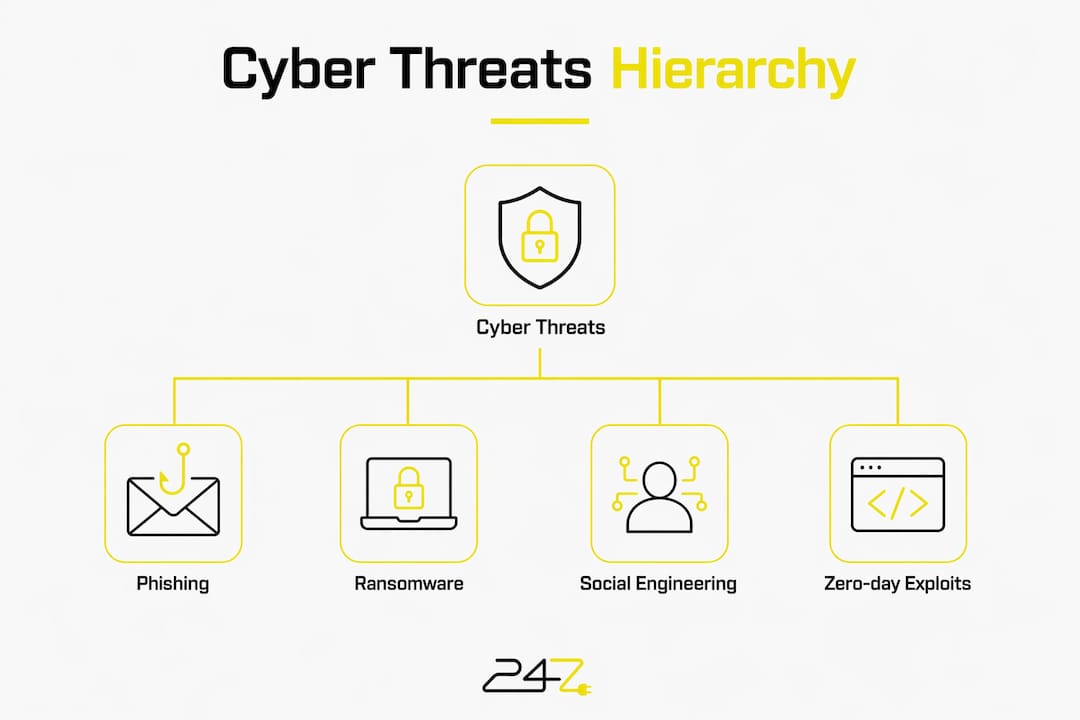
Common cyber threats include phishing, ransomware, malware, and distributed denial-of-service attacks. Each exploits a different weakness, but all share one goal: gaining unauthorized access to systems or data.
- Phishing uses deceptive emails or messages to trick users into revealing passwords, financial details, or other sensitive information. Attackers often impersonate trusted brands or internal IT teams to lower the victim’s guard.
- Ransomware encrypts a victim’s files and demands payment for the decryption key. Healthcare organizations are frequent targets because downtime directly endangers patients, which increases pressure to pay.
- Malware is a broad category covering viruses, trojans, spyware, and worms. Each variant enters a system through a different vector, from infected USB drives to malicious email attachments.
- Distributed denial-of-service (DDoS) attacks flood a server or network with traffic until it collapses under the load. These attacks target availability and are often used to extort businesses or distract IT teams while a secondary breach occurs.
- Zero-day exploits target software vulnerabilities that the vendor has not yet patched. Because no fix exists at the time of attack, these are among the most dangerous threat vectors.
| Threat type | Primary method | Core target | Potential impact |
|---|---|---|---|
| Phishing | Deceptive messages | Credentials | Data theft, account takeover |
| Ransomware | File encryption | Availability | Operational shutdown, extortion |
| Malware | Malicious code | All three pillars | Data loss, system compromise |
| DDoS | Traffic flooding | Availability | Service outage, revenue loss |
| Zero-day exploit | Unpatched vulnerability | Integrity | Full system compromise |
Pro Tip: Segment your network so that a successful phishing attack on one endpoint cannot spread laterally to critical systems. This single architectural decision limits blast radius significantly.
How is the cyber threat landscape changing in 2026?
AI-driven attacks now automate vulnerability scanning, social engineering, and credential stuffing at a scale no human attacker could match. Attackers use AI to rapidly identify weaknesses across thousands of targets simultaneously. That shift transforms cyber threats from targeted, manual operations into commoditized, automated campaigns.
Several emerging threat categories demand attention in 2026:
- AI-generated social engineering: Deepfake audio and video now impersonate executives convincingly enough to authorize fraudulent wire transfers.
- Insider threats: Employees, contractors, and vendors with legitimate access cause breaches through both malicious intent and accidental error. Organizations frequently underestimate how often internal actors are the source of a breach.
- State-sponsored attacks: Nation-state actors target critical infrastructure, supply chains, and government contractors with resources and patience that outpace most private-sector defenses.
- DNS tunneling: Attackers encode malicious data inside DNS queries to exfiltrate information through a protocol most firewalls treat as trusted.
Automated global scanning continuously targets organizations of all sizes. The assumption that small businesses are too minor to attract attention is demonstrably false. Threat actors do not manually select victims. Bots probe every IP address on the internet, and any unpatched system becomes a target regardless of company size.
Pro Tip: Subscribe to threat intelligence feeds from CISA and the Canadian Centre for Cyber Security. Both publish free advisories that give your team early warning of active campaigns targeting your industry.
Cyber threat vs. cyber risk vs. cyber attack: what is the difference?
A cyber threat is a potential malicious event), while cyber risk measures the likelihood and business impact of that event occurring. A cyber attack is the realized action: the moment a threat actor successfully exploits a vulnerability. Confusing these three terms leads to misallocated budgets and incomplete defenses.
| Term | Definition | Example |
|---|---|---|
| Cyber threat | A potential harmful event or circumstance | A known ransomware group targeting healthcare |
| Cyber risk | Likelihood and impact of a threat materializing | High risk if systems are unpatched and backups are absent |
| Cyber attack | The active exploitation of a vulnerability | Ransomware deployed, files encrypted, operations halted |
| Vulnerability | A weakness that a threat can exploit | Unpatched VPN software with a known CVE |
| Threat actor | The individual or group behind the threat | Nation-state group, criminal syndicate, or malicious insider |
Understanding this distinction improves how organizations allocate security resources. A business that treats every threat as an equally likely attack will exhaust its budget on low-probability scenarios. Proper threat vs. risk analysis) directs spending toward the vulnerabilities most likely to be exploited given the organization’s specific profile.
Pro Tip: Build a threat register that lists known threats against your environment, scores each by likelihood and impact, and reviews it quarterly. This turns abstract threat awareness into a prioritized action list.
How do you identify and mitigate cyber threats in your organization?
Human factors remain the weakest security link in most organizations. Social engineering, insider mistakes, and misconfigurations cause more breaches than sophisticated technical exploits. That fact reframes the mitigation problem: technology alone cannot solve it.
A practical mitigation program combines people, process, and technology in the following sequence:
- Conduct a threat and vulnerability assessment. Map your attack surface, identify unpatched systems, and catalog all user accounts with privileged access. You cannot defend what you have not inventoried.
- Train every employee, not just IT staff. Employee cybersecurity training reduces phishing susceptibility and teaches staff to recognize social engineering attempts before they succeed.
- Apply patch management consistently. Zero-day exploits are dangerous precisely because no patch exists. But the majority of successful attacks exploit known vulnerabilities that were never patched. A disciplined patch cycle closes most of that exposure.
- Enforce least-privilege access controls. Every user account should have only the permissions required for their role. When an account is compromised, limited permissions limit the damage.
- Deploy continuous monitoring. Cyber Threat Management (CTM)) moves beyond periodic risk assessments to real-time, automated detection. It provides situational awareness that static reviews cannot match.
- Test your incident response plan. A plan that has never been exercised will fail under pressure. Run tabletop exercises at least twice a year to identify gaps before an actual attack does.
- Follow established frameworks. The NIST Cybersecurity Framework and ISO 27001 provide structured approaches to identifying, protecting, detecting, responding to, and recovering from threats. For regulated industries, aligning with these frameworks also satisfies HIPAA and PCI-DSS audit requirements.
Cybersecurity has become essential for business survival, not just an IT concern. Organizations that treat it as a quarterly checkbox rather than a continuous operational discipline will face a breach eventually. The question is whether they will be prepared when it happens.
Pro Tip: Use a network security checklist tailored to your business size as a baseline audit tool. It surfaces configuration gaps that internal teams often overlook because they are too close to the environment.
Key Takeaways
Cyber threats are continuous, automated, and increasingly AI-driven, making proactive Cyber Threat Management the only defense posture that reliably protects confidentiality, integrity, and availability across modern IT environments.
| Point | Details |
|---|---|
| Definition is precise | A cyber threat targets confidentiality, integrity, or availability. Knowing which pillar is at risk guides your defense. |
| Human error is the top vector | Social engineering and insider mistakes cause more breaches than technical exploits. Training is not optional. |
| Threat differs from risk | A threat is potential. Risk measures likelihood and impact. Conflating them misallocates your security budget. |
| No organization is too small | Automated global scanning targets every IP address. Size provides no protection against commoditized attacks. |
| CTM beats static reviews | Continuous Threat Management delivers real-time detection. Periodic risk assessments leave gaps that attackers exploit. |
The uncomfortable truth about cyber threats most businesses miss
The 247techify team has worked with Canadian businesses across healthcare, finance, and professional services for years. The pattern we see most often is not a lack of technology. Organizations invest in firewalls, endpoint protection, and email filters, and then get breached through a phishing email that an untrained employee clicked on a Tuesday afternoon.
The uncomfortable truth is that most organizations treat cybersecurity as an infrastructure problem when it is fundamentally a human and operational problem. A misconfigured cloud storage bucket left open by a junior developer is more dangerous than a sophisticated nation-state attack in most business environments. The attacker does not need to be clever if the target is careless.
The second misconception we encounter regularly is the belief that a breach is a one-time event you recover from and move on. In reality, attackers often maintain persistent access for months before triggering the visible payload. By the time ransomware encrypts your files, the attacker may have been inside your network since the previous quarter, exfiltrating data and mapping your systems. That reality demands continuous monitoring, not incident response after the fact.
Integrating cybersecurity into your overall business strategy, not just your IT budget, is the shift that separates organizations that survive breaches from those that do not. For businesses in regulated industries, that integration also directly affects compliance standing under HIPAA and PCI-DSS. Cybersecurity is not a cost center. It is a business continuity requirement.
— 247techify Team
How 247techify protects your business from evolving cyber threats
Cyber threats are not slowing down, and neither is 247techify’s response to them.

247techify’s AI-native cybersecurity services deliver continuous threat monitoring, automated detection, and a response time of under 30 minutes, built specifically for Canadian businesses in regulated industries. Whether your concern is ransomware, insider threats, or compliance gaps under HIPAA or PCI-DSS, the CybrXPRT platform provides the situational awareness and expert support your team needs. For organizations that want shared responsibility without full outsourcing, co-managed IT services let your internal team retain control while 247techify fills the gaps. With a 98% client satisfaction rate, the commitment to your security is measurable.
FAQ
What is a cyber threat in simple terms?
A cyber threat is any event or circumstance that could harm your digital systems, data, or operations. It includes attacks like phishing and ransomware, as well as insider errors and misconfigurations.
What are the most common cyber threats in 2026?
Phishing and ransomware remain the top attack methods, alongside AI-driven social engineering, zero-day exploits, and insider threats. Automated scanning makes every organization a potential target regardless of size.
How do cyber threats differ from cyber risks?
A cyber threat is a potential harmful event, while cyber risk measures how likely that event is to occur and what damage it would cause. A cyber attack is the realized exploitation of a threat.
How can a business identify cyber threats early?
Continuous monitoring through Cyber Threat Management (CTM) provides real-time detection of anomalies before they escalate. Pairing automated tools with regular cybersecurity policy reviews gives organizations the earliest possible warning.
Are small businesses really at risk from cyber threats?
Automated global scanning targets every internet-connected system, making company size irrelevant to attackers. Small businesses often have fewer defenses, which makes them easier targets, not safer ones.