
Employee cybersecurity training is defined as a structured, continuous process that builds security awareness, reduces human error, and satisfies regulatory obligations across every role in an organization. Human error causes over 62% of data breaches, making your workforce both the greatest vulnerability and the most powerful line of defense you have. Frameworks like CMMC, HIPAA, and PCI-DSS all require documented, trackable training programs. Following clear employee cybersecurity training steps is not optional for regulated industries. It is the foundation of a defensible security posture.
What are the essential employee cybersecurity training steps?
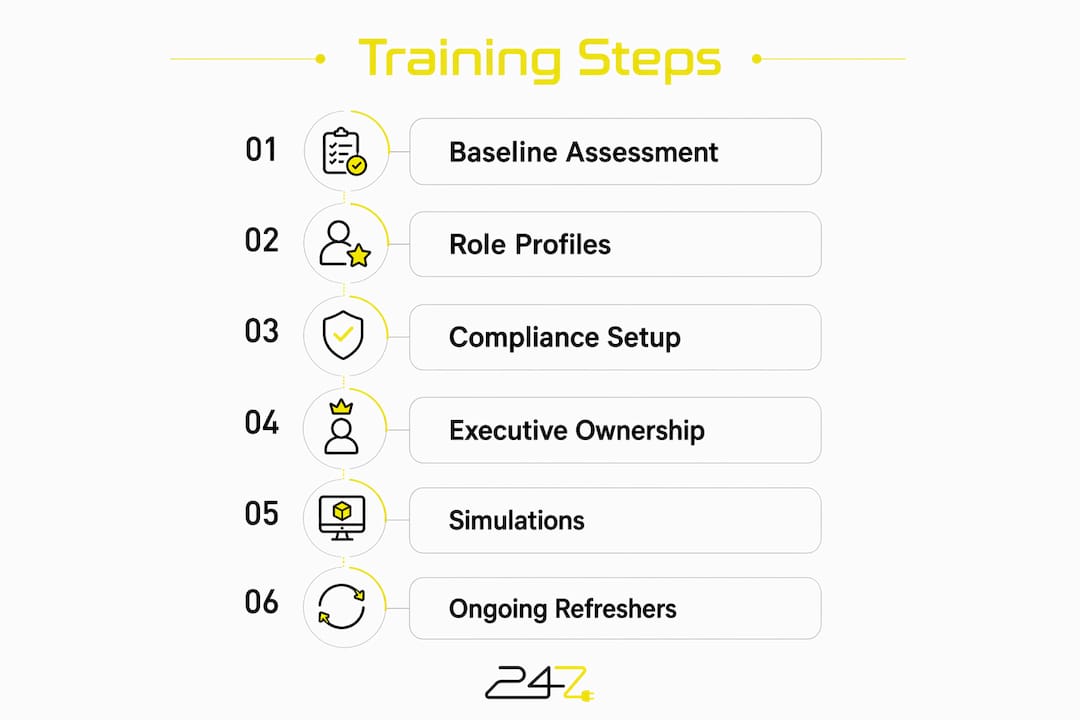
Before designing a single module, you need a clear picture of where your organization stands. A baseline security assessment covers three areas: a phishing simulation to measure current click rates, a policy audit to identify gaps in written procedures, and a role inventory to map which employees face which threats. Without this baseline, you are training blind.
Defining role-specific risk profiles is the step most organizations skip. Remote workers, executives, and IT administrators face fundamentally different attack vectors. Behavior-based, role-specific training outperforms generic content because it addresses the actual threats each group encounters. An accounts payable clerk needs deep training on business email compromise. A system administrator needs training on credential hygiene and Active Directory privilege abuse.

Compliance requirements shape your program’s structure from day one. Training programs must be documented, trackable, and audit-ready to satisfy CMMC, HIPAA, and PCI-DSS. Review your applicable frameworks before writing a single learning objective. Your compliance auditing obligations determine minimum training frequency, content requirements, and record-keeping standards.
Establish executive ownership before launch. Executive ownership and governance precede every successful training initiative. When a CISO or COO visibly sponsors the program, employee participation rates rise and the program survives budget cycles.
Pro Tip: Run your baseline phishing simulation before announcing any training program. The unprimed click rate gives you an honest starting benchmark that post-announcement simulations cannot replicate.
How to design and develop a cybersecurity training program
A well-structured employee security training program has four layers: universal baseline training, role-based modules, ongoing simulations, and a formal training calendar.
Universal baseline training
Every employee, from the receptionist to the CEO, completes the same foundational content. This covers password hygiene, multi-factor authentication, phishing recognition, safe browsing, and incident reporting procedures. Keep each module under 15 minutes. Attention drops sharply beyond that threshold.
Role-based specialized modules
High-risk functions require additional depth. Finance teams train on wire transfer fraud and invoice manipulation. Executives train on spear-phishing and pretexting. IT staff train on privileged access management and secure configuration. This layered approach reflects the reality that a single generic module cannot address the full attack surface of a modern organization.
Simulation across channels
Phishing is not the only simulation channel worth running. Vishing (voice phishing) and smishing (SMS phishing) are growing attack vectors that most programs ignore. Rotating simulations across email, phone, and text builds broader detection instincts. CISA’s Learning Platform offers free on-demand training covering incident response scenarios that complement your internal simulations.
Training calendar structure
A practical cybersecurity training calendar looks like this:
- Onboarding: Complete baseline training within the first week of employment.
- Monthly: Short microlearning modules (5–10 minutes) on current threats and one simulated phishing or smishing attempt.
- Quarterly: Role-based refresher modules and a review of recent incident trends.
- Annual: Full program review, updated content aligned to new threat intelligence, and compliance documentation refresh.
Effective cybersecurity awareness training follows exactly this cadence. The structure prevents knowledge decay and keeps security behaviors active rather than dormant.
Pro Tip: Integrate CISA’s free on-demand modules into your quarterly refreshers. They cover incident response scenarios your internal team may not have the resources to build from scratch.
How to implement training delivery and measure its effectiveness
Delivery method determines whether training changes behavior or just fills a compliance checkbox. The most effective programs use platforms that automate scheduling, track completion, and generate audit-ready reports. Manual tracking via spreadsheets fails at scale and creates compliance risk.
Ongoing phishing simulations are the single most measurable component of any program. Run them monthly, vary the pretext, and deliver immediate micro-coaching to anyone who clicks. The micro-coaching moment, delivered within seconds of a failed simulation, is when the lesson lands hardest. Delayed feedback loses its impact entirely.
Track these four metrics consistently:
- Phishing click rate: The percentage of employees who click simulated phishing links. A declining rate over time confirms behavioral change.
- Time to report: How quickly employees report suspicious messages. Faster reporting reduces breach dwell time.
- Training completion rate: The percentage of employees who finish assigned modules on schedule.
- Assessment scores: Pre- and post-training quiz results that measure knowledge gain per module.
Translating security metrics into business risk language is what gets board-level attention. A phishing click rate of 18% means roughly 1 in 5 employees would open the door to a credential-harvesting attack. Frame it that way in your board report.
| Metric | What it measures | Reporting audience |
|---|---|---|
| Phishing click rate | Behavioral susceptibility to email attacks | Board, CISO |
| Time to report | Speed of threat detection by employees | Security operations team |
| Training completion rate | Program compliance and participation | HR, compliance officer |
| Assessment scores | Knowledge retention per module | Training manager |
A no-blame reporting culture turns employees into detection assets. Reward reporting, including false alarms. An employee who reports a legitimate email as suspicious is doing exactly what you trained them to do.
Pro Tip: Present phishing click rates to your board as a financial exposure metric, not a technical one. Tie the rate to the average breach cost of $4.44 million and the conversation changes immediately.
What are the common challenges in cybersecurity training programs?
The most damaging mistake organizations make is treating annual training as sufficient. Annual knowledge dumps are obsolete. The forgetting curve erases most of what employees learn within days of a single session. Monthly microlearning modules combat this directly by reinforcing behaviors through spaced repetition.
Tailoring content to a diverse workforce is harder than it looks. Remote employees face different threat surfaces than office-based staff. Executives resist training they perceive as beneath their level. Frontline workers disengage from content that feels irrelevant to their daily tasks. The solution is segmentation: build separate learning tracks and use role-relevant scenarios in every simulation.
A critical blind spot in most programs is the continued reliance on content-based phishing cues. Employees are taught to look for spelling errors, suspicious sender addresses, and urgent language. AI-generated phishing attacks now produce grammatically perfect, contextually accurate messages that bypass every content-based flag. Process-based verification is the correct defense. Train employees to verify requests through independent channels, such as calling a colleague directly, rather than trusting the message itself.
“The attackers have the keys when your employees trust the message over the process. Teaching verification behavior, not just content recognition, is the only defense that holds against AI-generated attacks.”
Resistance and fear are real obstacles. Employees who fail simulations often feel embarrassed or targeted. Address this by framing every simulation failure as a learning event, not a disciplinary one. Positive reinforcement for correct behavior, such as reporting a suspicious message, builds the psychological safety that makes a security culture sustainable.
Key Takeaways
A structured, continuous employee cybersecurity training program is the single most effective control for reducing human-error-driven breaches and satisfying CMMC, HIPAA, and PCI-DSS compliance requirements.
| Point | Details |
|---|---|
| Start with a baseline assessment | Run phishing simulations and policy audits before designing any training content. |
| Build role-specific training tracks | Remote workers, executives, and IT admins face different threats and need tailored modules. |
| Use spaced repetition, not annual dumps | Monthly microlearning prevents knowledge decay and builds lasting security behaviors. |
| Measure behavior, not just completion | Track phishing click rates and time-to-report to prove real risk reduction. |
| Document everything for compliance | Audit-ready records satisfy CMMC, HIPAA, and PCI-DSS requirements and protect your organization. |
The uncomfortable truth about cybersecurity training programs
Most organizations treat cybersecurity awareness training as a compliance exercise. They assign the annual module, collect completion certificates, and file them away. That approach produces documentation. It does not produce security.
What we have seen working with Canadian businesses across healthcare, finance, and professional services is that the programs producing measurable risk reduction share one trait: executive sponsorship that is visible and sustained. When a CEO completes the same phishing simulation as a junior employee and talks about it openly, the cultural signal is unmistakable. Training becomes something the organization does, not something done to employees.
The shift toward AI-generated attacks changes the training calculus significantly. Content-based recognition skills are becoming obsolete faster than most training programs can update their materials. The organizations ahead of this curve are already teaching process verification as a primary behavior. They are also using AI-assisted training tools to personalize threat scenarios based on each employee’s role and past simulation performance.
Compliance and security are not the same goal, but they are not incompatible either. A well-designed program satisfies HIPAA or PCI-DSS documentation requirements while also producing a measurable drop in phishing susceptibility. The key is building the program around risk reduction first and letting compliance documentation follow from that structure, not the reverse.
The organizations that will face the most damaging breaches in the next three years are the ones still running checkbox training today. The cost of a breach, averaging $4.44 million, dwarfs the cost of a continuous, well-managed training program by an order of magnitude.
— 247techify Team
How 247techify supports your cybersecurity training program
Building and maintaining an effective employee security training program requires more than good intentions. It requires technical infrastructure, compliance expertise, and ongoing threat intelligence.
247techify delivers end-to-end cybersecurity services designed specifically for Canadian businesses operating in regulated industries. From designing role-based training programs to maintaining audit-ready compliance documentation for HIPAA, PCI-DSS, and CMMC, 247techify’s team provides the structure and support your organization needs. With a 98% client satisfaction rate and a response time under 30 minutes, 247techify acts as a dependable partner for organizations that cannot afford to treat security as an afterthought. Contact 247techify to build a training program that reduces real risk, not just paperwork.
FAQ
What is the first step in employee cybersecurity training?
The first step is a baseline security assessment that includes a phishing simulation, a policy audit, and a role-based risk inventory. This gives you the data needed to design training that addresses your organization’s actual vulnerabilities.
How often should employees receive cybersecurity training?
Effective programs run onboarding training on day one, monthly microlearning modules, quarterly role-based refreshers, and an annual full program review. Annual-only training is insufficient because the forgetting curve erases most knowledge within days.
What metrics prove cybersecurity training is working?
The four key metrics are phishing click rate, time-to-report suspicious messages, training completion rate, and assessment scores. A declining phishing click rate over time is the clearest evidence of behavioral change.
Does cybersecurity training satisfy HIPAA and PCI-DSS requirements?
Yes, provided the program is documented, trackable, and audit-ready. CMMC, HIPAA, and PCI-DSS all require formal training records. A program without documentation does not satisfy these frameworks regardless of its quality.
How do you train employees to defend against AI-generated phishing?
Teach process-based verification rather than content-based recognition. Employees should confirm sensitive requests through an independent channel, such as a direct phone call, rather than trusting the content of any message, however legitimate it appears.