
The cybersecurity threat landscape in 2026 is defined by AI-powered autonomous attacks that compress vulnerability exploitation from months to minutes. These are not incremental upgrades to familiar threats. Autonomous agents now find, weaponize, and deploy exploits at machine speed, while non-human identities outnumber human users across enterprise environments. Business leaders who still rely on legacy identity and access management (IAM) frameworks or manual patch cycles are operating with a security posture built for a threat environment that no longer exists.
What is the cybersecurity threat landscape in 2026?
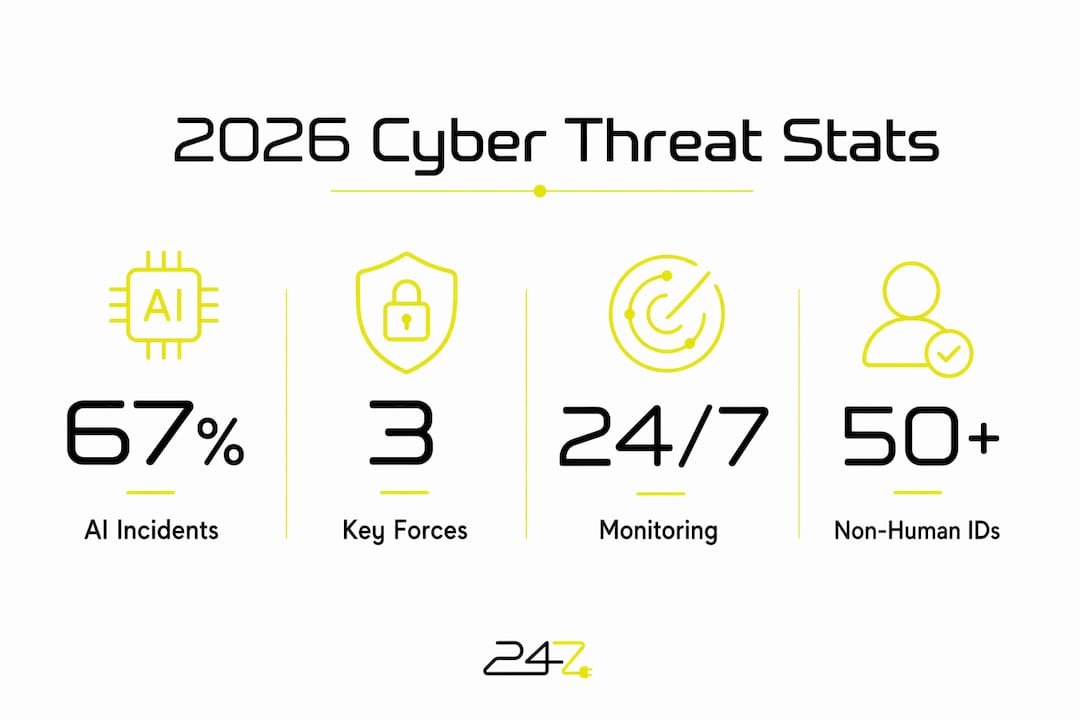
The 2026 cyber threat landscape is characterized by three converging forces: AI-driven autonomous attack agents, a collapse of traditional identity perimeters, and fragmented technology stacks driven by digital sovereignty demands. Each force amplifies the others. Together, they create an attack surface that grows faster than most organizations can govern.
AI-related security incidents surged 67% in 2026, driven by autonomous agents that identify and exploit vulnerabilities without human direction. That figure is not a projection. It reflects confirmed incidents where AI agents compressed the window between vulnerability discovery and active exploitation from months to minutes.

The standard industry term for this environment is the “cyber threat landscape,” and in 2026 it carries a specific technical meaning. It encompasses every attack vector, threat actor, and systemic vulnerability that an organization faces at a given point in time. What makes 2026 distinct is that the landscape now includes autonomous machine actors operating independently of human operators, targeting everything from cloud APIs to industrial control systems.
Zero-trust architecture, agent-specific IAM, and continuous automated vulnerability operations (VulnOps) are the three foundational responses. Organizations that have not begun building toward these capabilities are already behind.
How are AI and autonomous agents reshaping cybersecurity threats?
Autonomous AI agents represent the most disruptive shift in offensive cybersecurity since the rise of ransomware-as-a-service. These agents do not wait for a human attacker to issue commands. They scan, probe, and exploit in real time, adapting their approach based on what they encounter.
Nation-state actors now use AI models to automate cyber espionage and attacks at a scale and speed that human operators cannot match. This means the threat is no longer limited to well-funded adversaries with large teams. A single actor with access to an autonomous agent platform can execute campaigns that previously required dozens of specialists.
The credential threat has also evolved in a specific and alarming direction. Infostealers now target AI memory files and chat histories, infecting over 1 million machines and selling session cookies on dark-web markets to bypass multi-factor authentication (MFA). Researchers identified more than 49,700 active AI-platform session cookies on dark-web markets. Each cookie represents a live authenticated session that an attacker can hijack without ever cracking a password.
A technique called “vibe hacking” takes this further. It manipulates AI prompt context to execute malicious commands inside an AI agent’s workflow without the user or the system detecting the intrusion. This makes protecting AI memory files and prompt libraries a first-order security priority, not an afterthought.
Key attack patterns business leaders should understand:
- Autonomous exploit chaining: Agents link multiple low-severity vulnerabilities into a single high-impact attack path without human direction.
- Session cookie harvesting: Infostealers extract authenticated session tokens from AI platforms, rendering MFA ineffective.
- Vibe hacking: Prompt injection attacks manipulate AI agents into executing attacker-controlled commands.
- AI-accelerated phishing: Generative AI produces highly personalized spear-phishing content at industrial scale.
- Credential-free lateral movement: Agents use stolen session tokens to move across environments without triggering password-based detection.
Pro Tip: Audit your organization’s AI tool usage and identify every platform where employees store session data or chat histories. These are now primary infostealer targets, and most organizations have no visibility into them.
Why are legacy identity and patch management approaches failing?
Traditional IAM was designed for human users authenticating through defined access points. It was not designed for AI agents that operate continuously, autonomously, and across multiple systems simultaneously. Forrester identifies agent-specific IAM and digital sovereignty as foundational 2026 cybersecurity requirements. Legacy IAM cannot govern what it was never built to see.
The patch management problem is equally structural. Not all systems can be patched on the same timeline, and some cannot be patched at all.
- Browser-based and cloud-native systems update continuously and can be patched within hours of a disclosed vulnerability.
- Enterprise software and operating systems require testing cycles that typically run days to weeks, creating a window of exposure.
- Industrial control systems and operational technology often run on proprietary firmware with no vendor patch support, leaving organizations permanently exposed.
- Medical devices and embedded systems face regulatory constraints that prevent rapid patching even when patches exist.
Legacy industrial systems are frequently unpatchable, creating prolonged vulnerability windows that autonomous agents are specifically effective at exploiting. The implication is direct: organizations must segment and isolate these assets rather than waiting for patches that will never arrive.
“AI-driven threats will not create permanent defense asymmetry if organizations adopt continuous, automated defensive testing and rapid patching of easy targets. The asymmetry only becomes permanent when organizations fail to act.” — Schneier on Security
Continuous automated testing through VulnOps is now the operational standard for organizations that need to match machine-speed attacks. Defensive AI agents test exploits repeatedly to confirm vulnerabilities and verify that fixes hold. This is not a luxury for large enterprises. It is the minimum viable defense posture for any organization running critical systems.
AI agents acting as shadow operators require dedicated identity and threat governance platforms that go beyond traditional security controls. Agent-specific identity controls assign provenance, scope, and lifecycle governance to every non-human actor in your environment, the same way IAM governs human users.
How do supply chains, sovereignty, and non-human identities expand your attack surface?
The 2026 attack surface extends well beyond your organization’s own infrastructure. Three external forces are expanding it in ways that most security teams have not fully mapped.
Digital sovereignty and fragmented tech stacks
Digital sovereignty initiatives force enterprises to use region-specific technology providers, fragmenting what were once unified technology stacks. Each fragment introduces new integration points, new vendors, and new compliance obligations. Forrester recommends treating sovereignty-driven providers as supply chain risks, subject to the same stress tests and risk controls as any third-party vendor.
Non-human identities and machine credentials
Non-human identities, including AI agents, service accounts, and machine credentials, now outnumber human users in most enterprise environments. KPMG identifies full lifecycle governance of both human and non-human actors as a core resilience requirement. Without it, organizations have no reliable way to detect when a machine credential has been compromised or when an AI agent has been hijacked.
| Identity type | Governance requirement | Primary risk |
|---|---|---|
| Human users | Standard IAM with MFA | Credential theft, phishing |
| Service accounts | Scoped permissions, rotation | Privilege escalation |
| AI agents | Agent-specific provenance controls | Shadow operation, prompt injection |
| IoT and OT devices | Network segmentation, monitoring | Unpatchable exploit exposure |
Pro Tip: Build an inventory of every non-human identity in your environment before you build any other control. You cannot govern what you have not counted.
AI software supply chain risk
AI models and the pipelines that train them introduce a new category of supply chain risk. An AI-BOM (AI Bill of Materials) documents every model, dataset, and dependency in your AI stack, the same way a software bill of materials documents code dependencies. Organizations without AI-BOM transparency cannot assess whether a compromised upstream model has affected their own systems. Secure architectures in 2026 require mesh-based designs with continuous monitoring across cyber-physical boundaries, combined with supply chain risk assessments that include AI components.
What are the strategic cybersecurity priorities for business leaders in 2026?
The technical picture above translates into a specific set of leadership decisions. These are not IT department concerns. They are board-level risk management questions that require budget, governance, and organizational commitment.
- Adopt zero-trust architecture across all access layers. Zero-trust eliminates implicit trust for every user, device, and agent. A network security checklist built on zero-trust principles gives your team a concrete starting point for implementation.
- Implement agent-specific IAM governance. Every AI agent in your environment needs a defined identity, scoped permissions, and a lifecycle that includes decommissioning. Treat agents as you would privileged human users.
- Invest in automated detection and response. Human analysts cannot match machine-speed attacks. Automated detection tools that trigger responses in seconds, not hours, are the operational baseline for 2026.
- Segment and isolate unpatchable assets. Industrial control systems, legacy medical devices, and end-of-life infrastructure cannot be patched. They must be isolated from internet-facing systems and monitored continuously.
- Stress-test your supply chain. Every third-party vendor, sovereignty-driven provider, and AI model supplier is a potential attack vector. Conduct regular supply chain risk assessments and require AI-BOM documentation from AI vendors.
- Embed VulnOps into procurement. Automated vulnerability operations should be a procurement requirement, not a post-deployment addition. Require vendors to demonstrate continuous testing pipelines before contracts are signed.
- Protect the cognitive layer. AI memory files, prompt libraries, and chat histories are now primary attack targets. Classify them as sensitive assets and apply the same access controls you use for financial data. Reviewing financial data security threats alongside AI-specific risks gives leaders a fuller picture of where sensitive data exposure concentrates.
- Build security culture at the leadership level. Employee cybersecurity training must extend to executives who make procurement and architecture decisions, not just frontline staff.
247techify’s perspective on the 2026 threat environment
The most dangerous assumption we see business leaders make is that AI threats are a future problem. They are a present operational reality. The 67% surge in AI-related incidents is not a forecast. It is a confirmed measurement from the first half of 2026 alone.
What concerns us most is not the sophistication of the attacks. It is the speed at which organizations are still making decisions. Procurement cycles that run six to twelve months cannot respond to a threat environment that changes in minutes. The organizations that will maintain resilience in 2026 are the ones that have already embedded automated VulnOps into their architecture and governance processes, not the ones planning to do so next fiscal year.
Human expertise is not being replaced by AI in defense. It is being amplified. But that amplification only works if your team has the tools, the visibility, and the authority to act at machine speed. Leadership that treats cybersecurity as a compliance checkbox rather than an operational priority will find that the gap between their posture and the threat environment widens every quarter.
The cognitive layer, meaning the AI memory files, prompt contexts, and session data that your teams generate daily, is now a primary attack surface. Most organizations have no controls on it at all. That is the gap we would address first.
— 247techify Team
How 247techify helps Canadian businesses defend against 2026 threats
Canadian businesses face the full weight of the 2026 threat environment while also managing HIPAA, PCI-DSS, and provincial compliance obligations. 247techify’s AI-native cybersecurity services are built specifically to address autonomous agent threats, agent-specific identity controls, and continuous vulnerability operations.

247techify delivers 24/7 monitoring with a response time under 30 minutes, giving your team the speed needed to match machine-driven attacks. From supply chain risk assessments to VulnOps automation and compliance auditing, 247techify’s managed IT services give business leaders a security posture that keeps pace with the threat environment, not one that lags behind it. With a 98% client satisfaction rate, the team brings both technical depth and clear communication to every engagement.
FAQ
What is the cybersecurity threat landscape in 2026?
The 2026 cybersecurity threat landscape is defined by AI-powered autonomous attacks, non-human identity sprawl, and fragmented supply chains. Autonomous agents now exploit vulnerabilities at machine speed, compressing response windows from months to minutes.
How do autonomous AI agents differ from traditional malware?
Autonomous AI agents adapt their behavior in real time, chain multiple vulnerabilities together without human direction, and can hijack browser sessions to bypass MFA. Traditional malware follows fixed logic; autonomous agents make decisions.
Why is legacy IAM insufficient against 2026 threats?
Legacy IAM was designed for human users at defined access points. Agent-specific identity controls are required to govern AI agents that operate continuously and autonomously across multiple systems simultaneously.
What is VulnOps and why does it matter?
VulnOps is continuous automated vulnerability testing and patching, where defensive AI agents repeatedly confirm vulnerabilities and verify fixes. It is the operational response to machine-speed exploits that manual patch cycles cannot match.
How does digital sovereignty increase cybersecurity risk?
Digital sovereignty requirements force organizations to use region-specific technology providers, fragmenting their technology stacks and introducing new integration points. Each new vendor connection is a potential supply chain attack vector that requires its own risk assessment and stress testing.
Key takeaways
The 2026 cybersecurity threat landscape requires organizations to govern machine-speed autonomous agents, unpatchable legacy assets, and non-human identities with the same rigor they apply to human users and known vulnerabilities.
| Point | Details |
|---|---|
| AI incidents surged 67% | Autonomous agents now exploit vulnerabilities in minutes, not months, demanding automated defenses. |
| Legacy IAM is insufficient | Agent-specific identity controls are required to govern AI shadow operators at machine speed. |
| Unpatchable assets need isolation | Industrial and legacy systems that cannot be patched must be segmented and continuously monitored. |
| Non-human identities outnumber humans | Full lifecycle governance of machine credentials and AI agents is a core resilience requirement. |
| VulnOps is the new baseline | Continuous automated vulnerability testing must be embedded in procurement and architecture decisions. |