
Telehealth cybersecurity is defined as the set of technical, administrative, and physical controls that protect telehealth platforms, patient communications, and protected health information (PHI) from unauthorized access, data breaches, and cyberattacks. Healthcare administrators and IT teams now operate under a significantly expanded attack surface, since every video visit, remote monitoring session, and digital intake form creates a new potential entry point for threat actors. Regulatory bodies including the Department of Health and Human Services (HHS) and the Office for Civil Rights (OCR) treat telehealth security as a direct extension of HIPAA obligations. Understanding what telehealth cybersecurity requires, technically and administratively, is the first step toward protecting your patients and your organization.
What is telehealth cybersecurity and why does it matter?
Telehealth cybersecurity is the discipline of securing telehealth infrastructure, endpoints, and data flows against the same threat categories that target traditional clinical networks, plus new risks unique to remote care delivery. Telehealth platforms extend a provider’s attack surface, and failure to segment them from main clinical networks exposes the entire organization to attackers. That single architectural gap has allowed ransomware groups to pivot from a compromised video platform into core electronic health record (EHR) systems.
The importance of telehealth cybersecurity goes beyond regulatory compliance. Patient trust depends on visible, functioning security controls. Visible security measures such as secure portals and clear consent processes directly increase patient willingness to share accurate health data. When patients believe their data is safe, clinical outcomes improve because providers receive complete information.
The three control categories that define telehealth security are technical controls (encryption, authentication, network segmentation), administrative controls (policies, training, Business Associate Agreements), and physical controls (device management, screen locks, secure workspaces). All three must work together. A strong encryption standard means nothing if a clinician leaves a session open on an unattended laptop in a public space.
What are the essential cybersecurity measures specific to telehealth platforms?
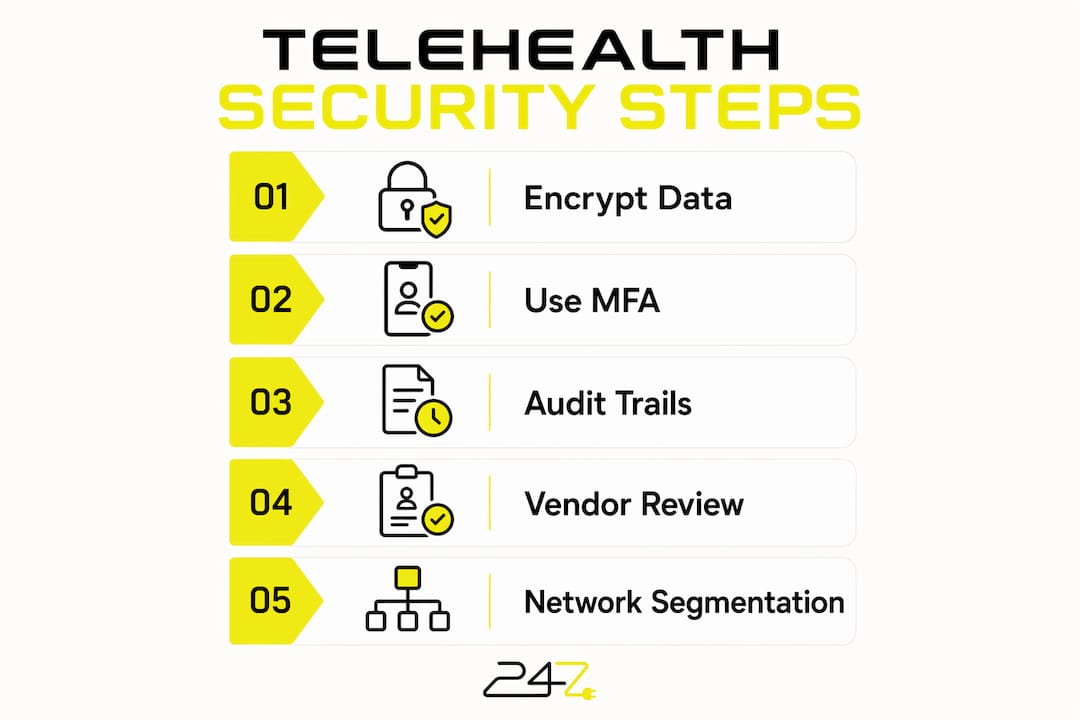
Effective telehealth security measures start with encryption at every layer. Data in transit must use TLS 1.2 or higher, and AES-256 encryption is the standard for stored telehealth data including session transcripts, recordings, and screenshots in cloud environments. These are not optional configurations. The 2026 HIPAA Security Rule updates treat encryption at rest as effectively required for telehealth data, not merely addressable.
Authentication is the second critical control. Phishing-resistant MFA such as hardware security keys or time-based one-time password (TOTP) apps is now required. SMS-based MFA is considered weak by OCR enforcement standards and should be replaced immediately on any system that accesses PHI.

The table below maps the core technical controls to their compliance function:
| Control | Standard or Requirement | Purpose |
|---|---|---|
| Encryption in transit | TLS 1.2+ | Protects data moving between patient and provider |
| Encryption at rest | AES-256 | Secures stored session data, transcripts, recordings |
| Multi-factor authentication | Phishing-resistant MFA (TOTP, hardware keys) | Blocks unauthorized access to clinical systems |
| Session logging and audit trails | HIPAA 6-year retention requirement | Supports breach investigation and compliance audits |
| Network segmentation | HHS and NIST guidance | Isolates telehealth systems from core clinical networks |
| Business Associate Agreements | HIPAA Privacy and Security Rules | Governs vendor handling of PHI |
Session logging and audit trails must cover every telehealth interaction, and HIPAA requires those records to be retained for six years. Annual BAA verification is now a compliance expectation, not a one-time task. Vendor relationships change, and an outdated Business Associate Agreement leaves your organization exposed when a subcontractor relationship shifts.
Pro Tip: Map every third-party telehealth vendor against your current BAA inventory at least once per year. Treat any vendor without a current, signed BAA as a compliance gap that requires immediate remediation before the next OCR audit cycle.
Network segmentation is the architectural control that limits blast radius. Placing telehealth systems on isolated network segments means a compromised patient-facing platform cannot reach your EHR, billing systems, or internal Active Directory. For guidance on segmenting clinical networks effectively, the architecture principles apply directly to telehealth environments.
How do regulatory updates and HIPAA guidelines impact telehealth cybersecurity in 2026?
The 2026 HIPAA Security Rule updates represent the most significant shift in compliance expectations for telehealth providers in over a decade. Four changes carry the most operational weight:
- Encryption at rest is effectively required. The addressable designation that previously allowed organizations to document alternatives no longer provides practical cover for telehealth data. OCR enforcement actions have consistently treated unencrypted stored PHI as a violation.
- BYOD enforcement now demands technical controls. A written policy is insufficient. Devices that access PHI must carry full-disk encryption, mandatory screen locks, and antivirus, and organizations must maintain a technical asset inventory of every device in use.
- Risk assessments must include telehealth workflows. Generic enterprise risk assessments that ignore video visit platforms, remote monitoring tools, and patient-facing portals fail the specificity standard OCR now applies during investigations.
- Breach notification timelines are under tighter scrutiny. OCR has shortened its practical tolerance for delayed breach reporting, and organizations without documented incident response plans face compounded penalties.
“Healthcare organizations that treat telehealth as a separate, lower-risk environment from their core clinical systems are operating on a false assumption. OCR does not distinguish between a breach that originates in an EHR and one that originates in a video platform. The liability is identical.” — HHS Office for Civil Rights enforcement guidance context
The practical implication is that your IT compliance and auditing program must now explicitly include telehealth systems in scope. Risk assessments, penetration testing, and policy reviews all need to treat telehealth as a first-class clinical environment.
What emerging challenges affect telehealth cybersecurity and how can they be addressed?
The most underestimated risk in telehealth security today is the patient’s home network. Hospital-at-Home (HaH) programs place clinical-grade monitoring equipment inside residential environments where smart speakers, consumer routers, and personal IoT devices share the same network. NIST recommends dedicated network segmentation and strict access controls to isolate medical devices from insecure personal IoT. A smart speaker on the same subnet as a remote cardiac monitor is not a theoretical risk. It is a documented attack vector.
Key emerging challenges and their mitigations include:
- Patient home network exposure: Provide patients with configuration guidance for dedicated IoT network segments, or supply pre-configured hotspot devices for HaH programs.
- BYOD device sprawl: Maintain a technical asset inventory. Every device that touches PHI must be enrolled in a mobile device management (MDM) solution with remote wipe capability.
- Identity verification gaps: Staff must verify patient identity at the start of every telehealth session using at least two data points. Impersonation attacks targeting telehealth platforms are increasing.
- Post-visit data handling: Session recordings, chat logs, and screenshots must be encrypted and stored under the same retention and access controls as any other PHI.
- Incident response readiness: Every telehealth team needs a documented communication plan that specifies who gets notified, in what order, and within what timeframe when a breach is suspected.
Pro Tip: For HaH deployments, consider issuing patients a pre-configured cellular-connected medical hub that operates entirely independently of their home Wi-Fi. This eliminates the home network as an attack surface without requiring patients to reconfigure their personal routers.
Zero-trust architecture addresses the identity verification gap at the network level. Zero-trust treats every connection attempt as untrusted until verified, regardless of whether it originates inside or outside the network perimeter. For telehealth, this means clinicians authenticate at every session, access is scoped to the minimum required for that visit, and continuous monitoring flags anomalous behavior in real time. The importance of securing remote connections applies directly to telehealth workflows where clinicians connect from home offices, clinics, and mobile devices.
How can healthcare organizations implement effective telehealth cybersecurity programs?
Building a telehealth security program requires treating it as a clinical operations function, not an IT side project. The steps below reflect the controls that OCR and HHS guidance consistently identify as foundational:
- Conduct a telehealth-specific risk assessment. Map every platform, integration, and data flow. Identify where PHI is created, transmitted, stored, and deleted. Document threats and vulnerabilities specific to each touchpoint.
- Enforce BYOD policies with technical controls. Enroll every device in MDM. Require full-disk encryption, screen lock timers of 15 minutes or less, and antivirus on all endpoints. Patient data protection tools provide a practical framework for selecting and deploying these controls.
- Replace SMS MFA with phishing-resistant alternatives. Deploy TOTP apps or hardware security keys for all staff accounts. Document the transition and retain evidence for your next HIPAA audit.
- Implement continuous staff training. Lack of formal training is a primary compliance barrier. Training must cover phishing recognition, identity verification protocols, privacy procedures after each visit, and incident reporting steps.
- Review and update vendor agreements annually. Audit your BAA inventory, confirm subcontractor relationships are covered, and retire agreements for vendors no longer in use.
Pro Tip: Run quarterly tabletop exercises that simulate a telehealth-specific breach scenario, such as a compromised clinician account used to access patient session recordings. Tabletop exercises expose gaps in your incident response plan before a real attacker does.
Staff training deserves particular emphasis because it addresses the weakest link in most telehealth security programs. Technical controls stop known attack patterns. Trained staff stop novel ones. A clinician who recognizes a phishing email targeting their telehealth credentials prevents the breach that no firewall rule would have caught.
Key Takeaways
Telehealth cybersecurity requires technical controls, administrative policies, and continuous staff training working together, because no single layer of defense is sufficient against the full range of threats targeting remote care platforms.
| Point | Details |
|---|---|
| Encryption is non-negotiable | AES-256 at rest and TLS 1.2+ in transit are required for all telehealth PHI under 2026 HIPAA updates. |
| SMS MFA is insufficient | Replace SMS-based authentication with TOTP apps or hardware security keys on all systems that access PHI. |
| Home networks are attack surfaces | HaH programs must isolate medical devices from patient IoT using dedicated segments or cellular-connected hubs. |
| BAAs require annual review | Vendor relationships evolve; an outdated Business Associate Agreement creates direct compliance exposure. |
| Training is the weakest link | Formal staff education on phishing, identity verification, and incident reporting closes gaps that technical controls cannot. |
The ecosystem problem most telehealth programs ignore
Working with healthcare organizations on telehealth security, the pattern we see most often is not a failure of technology. It is a failure of scope. Teams deploy a HIPAA-compliant video platform, check the box, and assume the security work is done. The platform is one node in a much larger ecosystem that includes clinician endpoints, patient home networks, third-party integrations, cloud storage, and staff behavior. Securing one node while leaving the others unexamined is the equivalent of installing a deadbolt on the front door and leaving the back door open.
The shift that actually moves the needle is treating telehealth security as an ecosystem-wide discipline that requires zero-trust architecture, continuous monitoring, and regular risk reassessment. Zero-trust is not a product. It is a design philosophy that assumes breach and verifies every access request. Organizations that adopt it stop asking “are we secure?” and start asking “what would an attacker do next?” That is the right question.
Patient trust is also a security outcome, not just a clinical one. When patients see secure portals, clear consent language, and professional handling of their data, they share more accurate information. That information improves care. The organizations that understand this connection invest in visible security controls as a clinical quality measure, not just a compliance requirement. That perspective changes how security budgets get approved and how security programs get built.
— 247techify Team
How 247techify supports telehealth security compliance
Healthcare providers managing telehealth programs face compliance requirements that change faster than most internal IT teams can track.

247techify delivers managed cybersecurity services built specifically for regulated industries, including healthcare providers operating under HIPAA 2026 requirements. The team provides 24/7 monitoring, risk assessments scoped to telehealth workflows, network segmentation design, phishing-resistant MFA deployment, and MDM enrollment for BYOD environments. Response time runs under 30 minutes, and the 98% client satisfaction rate reflects a service model built on clear communication and technical accountability. For healthcare administrators who need a dependable partner to manage telehealth security end to end, 247techify’s managed IT services provide the coverage and compliance expertise your program requires.
FAQ
What is telehealth cybersecurity?
Telehealth cybersecurity is the set of technical, administrative, and physical controls that protect telehealth platforms, patient data, and communications from unauthorized access and cyberattacks. It is governed by HIPAA and enforced by the HHS Office for Civil Rights.
What encryption standard applies to stored telehealth data?
AES-256 is the required encryption standard for telehealth data stored in cloud environments, including session transcripts, recordings, and screenshots, per 2026 HIPAA Security Rule updates.
Is SMS-based MFA acceptable for telehealth systems?
SMS-based MFA is no longer considered adequate by OCR enforcement standards. Telehealth platforms accessing PHI must use phishing-resistant MFA such as TOTP apps or hardware security keys.
How does BYOD affect telehealth data privacy?
BYOD devices that access PHI must be enrolled in an MDM solution with full-disk encryption, screen locks, and antivirus installed. A written policy alone does not satisfy the technical enforcement standard under 2026 HIPAA requirements.
What is the biggest cybersecurity risk in Hospital-at-Home programs?
The primary risk is unsecured patient home networks where personal IoT devices share connectivity with clinical monitoring equipment. NIST recommends dedicated network segmentation to isolate medical devices from consumer IoT in HaH deployments.