
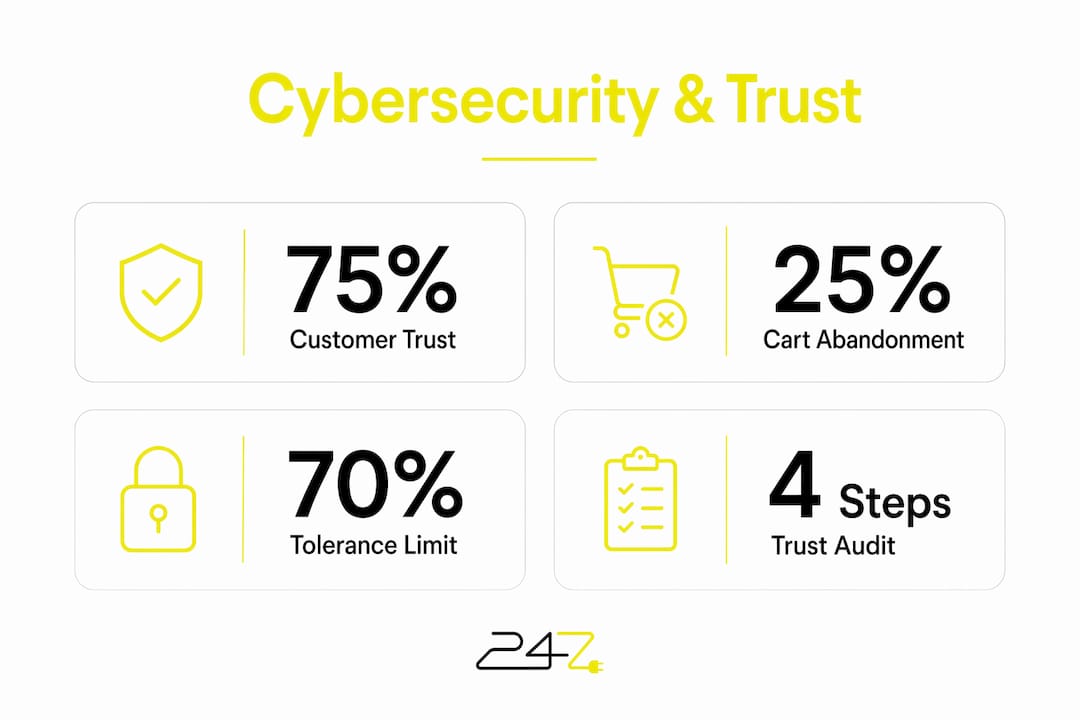
Cybersecurity is the foundational factor that determines whether customers feel confident engaging with your business’s digital services. The role of cybersecurity in customer trust is no longer a background IT concern. It is a front-line business issue that directly shapes purchasing decisions, retention rates, and long-term revenue. 25% of e-commerce customers abandon their shopping carts specifically because they distrust a site’s security. That single data point reveals how quickly weak security translates into lost sales. The perception gap is equally alarming: 77% of IT leaders believe they meet customer expectations for security, yet only 26% of consumers agree. Closing that gap is where business strategy and cybersecurity must meet.
How does cybersecurity influence customer trust and purchasing behavior?
Customer trust is built on perceived safety. When customers land on your website, enter payment details, or share personal information, they are making a split-second judgment about whether your business protects them. That judgment drives behavior more than pricing or brand loyalty in many cases.
The numbers are direct and serious. Cart abandonment averages 76.22% across e-commerce, with security distrust accounting for a significant portion of that figure. A customer who leaves without buying rarely sends a complaint. They simply do not return.
Security failures do not always produce a dramatic exit. Customers rarely abandon a brand immediately after a breach. Instead, they quietly reduce engagement, spend less, and eventually stop altogether. This slow erosion of customer lifetime value is the real cost of a cybersecurity failure, and it is far harder to detect and reverse than a sudden churn spike.
The trust-security gap between IT leaders and consumers is a structural problem. IT teams measure security through technical controls: patch cycles, firewall configurations, and endpoint detection. Customers measure it through experience: did the site load securely, was their data used appropriately, did the company communicate clearly after an incident? These are entirely different metrics, and businesses that only track the technical side miss what customers actually see.
Security failures cause gradual disengagement that erodes brand lifetime value over months, not days. This makes the impact of cybersecurity on trust difficult to see in quarterly reports, which is exactly why executives underestimate it. The damage is real, but it arrives slowly.
- Customers assess security through visible signals: HTTPS indicators, clear privacy policies, and professional site design.
- A single data breach notification can trigger a lasting reduction in purchase frequency, even among loyal customers.
- Businesses in regulated industries, such as healthcare and finance, face compounded risk because compliance failures amplify public distrust.
- Poor security communication after an incident damages trust more than the incident itself in many cases.
What cybersecurity practices build and maintain strong customer trust?
Trust building through cybersecurity requires a combination of technical controls and visible, customer-facing practices. Technical defenses protect data. Visible practices signal to customers that protection is real and ongoing.

The technical foundation includes encryption for data in transit and at rest, multi-factor authentication (MFA) for account access, and network segmentation to limit breach impact. Blockchain-based audit trails are gaining traction in regulated industries as a way to prove data integrity to both regulators and customers. These controls reduce the probability of a breach, but they are largely invisible to customers unless something goes wrong.
Transparency is the bridge between technical security and customer confidence. Companies that are candid about addressing vulnerabilities earn significantly more customer trust than those that stay silent. Publishing security practices, communicating clearly about how customer data is stored and used, and notifying customers promptly after incidents all build the kind of trust that survives adversity.
The Secure Trust-Integration Framework (STIF) formalizes this approach. STIF combines technical controls with structured communication protocols and customer-facing transparency measures. It treats security not as a backend function but as a customer experience layer. Businesses that adopt this kind of integrated approach see measurable improvements in both security posture and customer satisfaction.
- Encryption and MFA: Deploy AES-256 encryption and enforce MFA across all customer-facing systems.
- Privacy policy clarity: Write privacy policies in plain language. Customers read them more often than most executives assume.
- Security certifications: Display SOC 2, ISO 27001, or PCI-DSS compliance badges where customers can see them.
- Incident response plans: Prepare customer communication templates before an incident occurs, not during one.
- Employee training: Cybersecurity awareness training for staff reduces the human error that causes most breaches.
Pro Tip: Run a quarterly “trust audit” from the customer’s perspective. Visit your own site as a first-time user and check every security signal a customer would see: SSL certificate status, cookie consent clarity, and the readability of your privacy policy.
How do privacy and data consent practices impact customer trust and loyalty?
Privacy is now a competitive differentiator, not a compliance checkbox. The shift from data collection at scale to privacy-first personalization defines the next era of customer loyalty.
75% of customers will not buy from brands they do not trust with their data. That figure makes privacy management a direct revenue issue. Businesses that treat customer data as an asset to extract rather than a trust to honor pay for it in churn and reduced lifetime value.
The concept of “permission-based intimacy” captures the right approach. Every data request should come with a clear value exchange: you share your preferences, and we give you a better experience. Customers who understand and control how their data is used become more loyal, not less. They feel respected rather than surveilled.
| Approach | Customer outcome |
|---|---|
| Surveillance-based personalization | Short-term engagement, long-term distrust and churn |
| Permission-based data collection | Higher opt-in rates, stronger loyalty, and better lifetime value |
| No data policy communication | Customer uncertainty, reduced willingness to share, lower conversion |
| Transparent consent with clear value | Trust, repeat purchases, and positive word-of-mouth |
Loyalty programs that expand without strong data protection create significant risk surfaces. Consumer markets invest heavily in cybersecurity primarily to protect the vast personal data stored in loyalty schemes. A breach of a loyalty program does not just expose transaction data. It exposes behavioral profiles, preferences, and contact information, which makes the reputational damage far worse.
Measuring privacy metrics such as opt-in rates and preference engagement predicts future customer lifetime value better than transaction data alone. These are leading indicators of trust. If opt-in rates are falling, trust is eroding before it shows up in revenue.
Pro Tip: Add privacy UX metrics to your marketing dashboard alongside conversion rates. Track opt-in rates, preference center engagement, and data deletion requests monthly. A drop in opt-ins is an early warning signal that your data practices need review.
What is the role of communication and resilience in preserving customer trust during cyber incidents?
Customers judge cybersecurity effectiveness by what they can see and feel, not by what happens in your server room. Service availability is the most visible security signal of all.
70% of customers tolerate no more than a single day of outage before their trust in a business is damaged. That is a narrow window. Businesses that treat resilience as a secondary concern after prevention are misreading what customers actually value. Prevention matters, but recovery speed matters more to the customer experience.
Resilience must be designed into your infrastructure from the start. Cloud backup and disaster recovery systems, failover protocols, and tested incident response plans are the operational backbone of customer-facing resilience. A business that recovers in hours rather than days sends a powerful trust signal, even after a serious incident.
Communication during an incident follows a clear sequence that preserves trust:
- Acknowledge the issue immediately. Customers who hear about a breach from news sources before hearing from you lose trust faster than those notified directly.
- State what you know and what you do not know. Uncertainty is acceptable. Silence is not.
- Describe the specific steps you are taking. Vague reassurances do not rebuild confidence. Specific actions do.
- Set a timeline for updates. Commit to a follow-up communication within 24 hours, then honor it.
- Explain what customers should do. Give clear, specific instructions: change your password, monitor your account, contact support at this number.
Cybersecurity readiness correlates directly with improved financial performance and stakeholder trust. Firms that address security issues openly see better return on assets over time. Resilience is not just a technical achievement. It is a brand asset that pays dividends in customer retention.
Key Takeaways
Strong cybersecurity directly determines customer trust, loyalty, and long-term revenue by closing the gap between what IT teams measure and what customers actually experience.
| Point | Details |
|---|---|
| Security distrust drives abandonment | 25% of cart abandonment links directly to security distrust, making cybersecurity a revenue issue. |
| The IT-consumer perception gap is wide | Only 26% of consumers agree their data is adequately protected, versus 77% of IT leaders who believe it is. |
| Transparency builds more trust than silence | Companies that openly address vulnerabilities earn significantly more customer trust than those that stay quiet. |
| Privacy metrics predict loyalty | Opt-in rates and preference engagement are leading indicators of customer lifetime value. |
| Resilience is the customer-facing metric | 70% of customers lose trust after a single day of outage, making recovery speed a critical trust factor. |
Why cybersecurity is a business strategy issue, not just an IT problem
The 247techify team has worked with Canadian businesses across healthcare, finance, and professional services for years. The pattern we see most often is this: leadership treats cybersecurity as an IT department responsibility, approves a budget, and moves on. Then a breach happens, or a compliance audit reveals gaps, and the conversation suddenly becomes urgent.
The uncomfortable truth is that cybersecurity failures are customer experience failures. When a patient’s health records are exposed, when a client’s financial data is accessed without authorization, the damage is not technical. It is relational. The customer does not care about your firewall configuration. They care that you failed to protect something they trusted you with.
We have seen businesses invest heavily in backend security controls while neglecting the customer-facing signals that actually build confidence: clear privacy policies, transparent breach communication, and visible compliance certifications. The technical work is necessary but not sufficient. Trust requires both the protection and the proof of protection.
The businesses that get this right treat cybersecurity investment as a customer loyalty investment. They measure opt-in rates alongside patch compliance rates. They train customer-facing staff on how to communicate about security, not just their IT teams. They test their incident response plans the same way they test their disaster recovery systems. That integrated approach is what separates businesses that survive a breach from those that do not.
— 247techify Team
How 247techify helps Canadian businesses build customer trust through cybersecurity
Canadian businesses operating in regulated industries face a specific challenge: compliance requirements from HIPAA and PCI-DSS demand rigorous data protection, and customers in those sectors hold businesses to an even higher standard of trust.
247techify’s AI-native cybersecurity services and managed IT support are built to address both the technical and customer-facing dimensions of trust. With a response time under 30 minutes and 24/7 monitoring, 247techify keeps your systems available and your customers confident. The 98% client satisfaction rate reflects a commitment to clear communication and proactive protection, not just reactive fixes. If your business needs a cybersecurity posture that actively builds customer loyalty, contact 247techify to discuss a plan tailored to your industry and risk profile.
FAQ
What is the role of cybersecurity in customer trust?
Cybersecurity directly determines whether customers feel safe sharing data and completing transactions with your business. Weak security signals drive cart abandonment, reduce repeat purchases, and erode long-term loyalty.
How does a data breach affect customer loyalty?
Customers rarely leave immediately after a breach. Instead, they gradually reduce engagement and spending over months, making the long-term revenue impact far larger than the immediate churn suggests.
What cybersecurity measures increase customer confidence most?
Visible measures such as SSL certificates, clear privacy policies, compliance badges like PCI-DSS or SOC 2, and prompt breach communication build customer confidence more effectively than backend technical controls alone.
Why do IT leaders and customers disagree on security adequacy?
IT leaders measure security through technical controls, while customers measure it through experience and communication. Only 26% of consumers believe their data is adequately protected, compared to 77% of IT leaders who believe they meet customer expectations.
How does service resilience affect customer trust?
70% of customers lose trust after a single day of downtime. Fast recovery and clear communication during incidents preserve trust more effectively than prevention alone, making resilience a core customer experience metric.