
Run phishing simulations on a monthly baseline (biweekly for high-risk cohorts), and measure reporting rate and time-to-report ahead of click rate. The learning-first model treats every failed test as a coaching moment, not a disciplinary one. It celebrates the employee who forwards a suspicious message to the SOC in under two minutes, and it quietly escalates repeat clickers into targeted coaching instead of public callouts. Scenarios stay realistic but never exploit fear, health, or job security to manufacture a click.
TL;DR:
- Use a monthly testing cycle for most employees and biweekly for high-risk groups like finance and IT if report rates decline or morale issues arise.
- Prioritize measuring reporting rate and time-to-report over click rate, since they better indicate operational preparedness.
- Focus scenarios on real threat vectors such as credential harvesting, business email compromise, QR codes, and mobile phishing, tailoring difficulty to role and experience.
- Avoid exploitative pretexts like layoffs or health scares to maintain trust and organizational morale, securing legal, HR, and communications approval beforehand.
- Ensure comprehensive technical integration, including SOC tagging and alert suppression, to turn simulation data into actionable security insights.
Table of Contents
- Phishing Simulation Best Practices: The Core Program Elements
- Design Best Practices: Cadence, Difficulty, and Fatigue Prevention
- Ethical Guardrails: Protecting Trust While You Test
- Which Scenarios and Attack Vectors Should You Prioritize?
- Measuring Success: Reporting Rate, Time-to-Report, and Real Transfer
- Rolling Out a Program: Pilot, Scale, Remediate
- Operational Considerations: Integration and Common Pitfalls
- What the Research Actually Shows About Phishing Training
- An Editorial Take: Behavior Change Beats Better Bait
- How 247techify Supports Ethical, Measured Phishing Programs
- Sources
- FAQ
Phishing Simulation Best Practices: The Core Program Elements
A phishing simulation program built without measurable objectives is just an expensive way to embarrass people. Before you schedule a single send, define what “success” looks like in numeric terms: a target reporting rate, a target reduction in time-to-report, or a target drop in credential submissions among a specific department. Skipping this step is the single most common reason programs stall after year one.
Segmentation comes next. Finance and accounts payable face business email compromise pretexts that would never fool an engineer, and your simulation calendar should reflect that. New hires need gentler onboarding scenarios; privileged IT admins need harder, more targeted tests because their credentials carry outsized blast radius. Matching scenario difficulty to role and tenure keeps the exercise relevant instead of generic.
Every simulated failure needs an immediate consequence, but the right kind. A 60 to 90 second micro-lesson delivered the moment someone clicks or submits credentials does more for retention than a quarterly training video ever will. Keep it specific to the lure that caught them, not a generic “spot the phish” refresher.
The plumbing matters as much as the content. A single report button, wired into your SOC ticketing or SIEM, turns every simulation into real operational data instead of an isolated spreadsheet exercise. Microsoft’s own guidance on attack simulation training is blunt about this: click rate alone tells you almost nothing useful, and simulations that don’t feed a reporting workflow waste the exercise’s real value.
Finally, build a multi-channel roadmap rather than defaulting to email forever. Email is the right starting point for maturity level one. Once reporting habits stick, layer in:
- SMS-based smishing tests, since text-based credential harvesting is growing fastest among mobile-first roles.
- QR code (quishing) scenarios, which bypass traditional email link scanning entirely.
- Vishing call simulations, particularly for help desk and finance staff who field urgent phone requests.
- Attachment-based lures, testing whether users open unexpected invoices or shipping documents.
Each channel exposes a different failure mode, and a program that only ever tests email inbox behavior is measuring a shrinking slice of the real threat surface.
Design Best Practices: Cadence, Difficulty, and Fatigue Prevention
Cadence is where most programs either build durable habits or burn out their workforce. A monthly baseline works for the general employee population: frequent enough to keep phishing awareness top of mind, spaced enough to avoid alert fatigue. High-risk cohorts, finance, executive assistants, IT admins with domain privileges, warrant biweekly testing because their exposure to real BEC and credential-theft attempts is disproportionately higher.
Watch for the signals that tell you to pause or slow down: a spike in help desk complaints about “fake” phishing tests, a measurable drop in report rates across the board (a sign of disengagement, not improvement), or feedback from HR that morale is taking a hit. Those are pause conditions, not things to push through.
- Rate every scenario before you send it. Use a simple easy, moderate, hard tiering, similar in spirit to the Phish Scale approach referenced in federal awareness guidance, so you know exactly what you’re testing and can track difficulty-adjusted improvement over time.
- Randomize send timing. Staggering delivery across a business day, and varying which day of the week you send, prevents word-of-mouth leakage (“don’t click the one from IT today”) from skewing your results.
- Pilot every new scenario type on a small group first. Tone-check it with fifteen or twenty volunteers before rolling it out to the full organization, and loop in HR, Legal, and Communications before anything involving sensitive pretexts goes company-wide.
- Rotate and refresh content quarterly. Employees pattern-match faster than most security teams expect; reusing the same three lure templates trains people to recognize your tests specifically, not phishing generally.
Pro Tip: A 2024 study found that delaying training delivery to a less pressured moment, rather than forcing it immediately after a failed click, produced results comparable to embedded, real-time training interventions. If your micro-lessons feel like they’re landing at the worst possible moment for the employee, timing, not content, may be your real problem.
Difficulty tuning and cadence work together. A biweekly cadence of easy scenarios teaches nothing new; a monthly cadence of consistently hard scenarios burns out even your most engaged reporters. The goal is a gradual difficulty curve that tracks improving reporting behavior, not a fixed schedule applied uniformly across every department.
Ethical Guardrails: Protecting Trust While You Test
The fastest way to destroy a security awareness program’s credibility is to run a scenario that exploits genuine fear. Layoff notices, health scares, and personal financial threats (“your paycheck deposit failed”) cross a line that no click-rate improvement justifies. These pretexts generate real anxiety in employees who have no way of knowing, in the moment, that the message is fake. The reputational and morale cost outweighs any data you’d gain.
Before any campaign launches, your organization needs clear, published communication that simulations exist to build skills, not to catch people out. Employees should know upfront that the program exists, roughly how often it runs, and that clicking a simulated lure carries zero disciplinary consequence on its own.
- Publish a short policy statement explaining the program’s learning-first intent, ideally signed off by both Security and HR leadership.
- Report aggregate metrics (department-level click and report rates) to leadership; never publish individual names in shared dashboards.
- Coach repeat clickers one-on-one and privately, framing the conversation around skill-building rather than blame.
- Route every new scenario pretext through a short Legal/HR/Comms sign-off checklist before it reaches employee inboxes.
- Build psychological safety into your reporting culture: a company that treats reporting as valuable, drawing on principles similar to those covered in guidance on building trust with an audience, sees far higher voluntary participation than one that treats every test as a trap.
Governance resources like NIST SP 800-50 Rev.1 exist precisely because awareness programs need documented control mappings, not ad hoc judgment calls made campaign by campaign.
Which Scenarios and Attack Vectors Should You Prioritize?
Start with the attack types most likely to hit your organization for real, not the ones that are easiest to build in your simulation platform. Credential harvesters mimicking internal login pages and business email compromise pretexts impersonating executives or vendors consistently produce the highest financial damage in actual incidents, which makes them the right place to concentrate early simulation cycles. The MITRE ATT&CK T1566 phishing technique category is a useful reference for mapping your scenario library against how real adversaries actually operate.
As program maturity increases, expand the vector list deliberately:
- Attachment-based lures, testing whether fake invoices or shipping notifications get opened without verification.
- Quishing (QR code) tests, which matter increasingly as employees scan codes on printed material, posters, or shared documents without a second thought.
- Smishing campaigns, targeting the mobile-first behaviors that email-only programs miss entirely.
- Vishing simulations, particularly for help desk and finance teams who are trained to be helpful on the phone, which attackers exploit directly.
Every scenario should map to a specific fail condition, and each fail condition deserves a distinct micro-lesson. A click on a link is a different behavior than submitting credentials on a spoofed login page, which is different again from replying to a BEC email with wire instructions. Treating all three as “failed the test” flattens the data and wastes the teaching opportunity each one presents.
Context grafting, weaving in real internal project names, actual vendor relationships, or plausible org-chart references, raises realism without crossing into manipulative territory, as long as the underlying pretext stays professional rather than personal. Our BEC prevention guidance covers how these pretexts play out in real incidents and what response steps typically follow a successful compromise.
Measuring Success: Reporting Rate, Time-to-Report, and Real Transfer
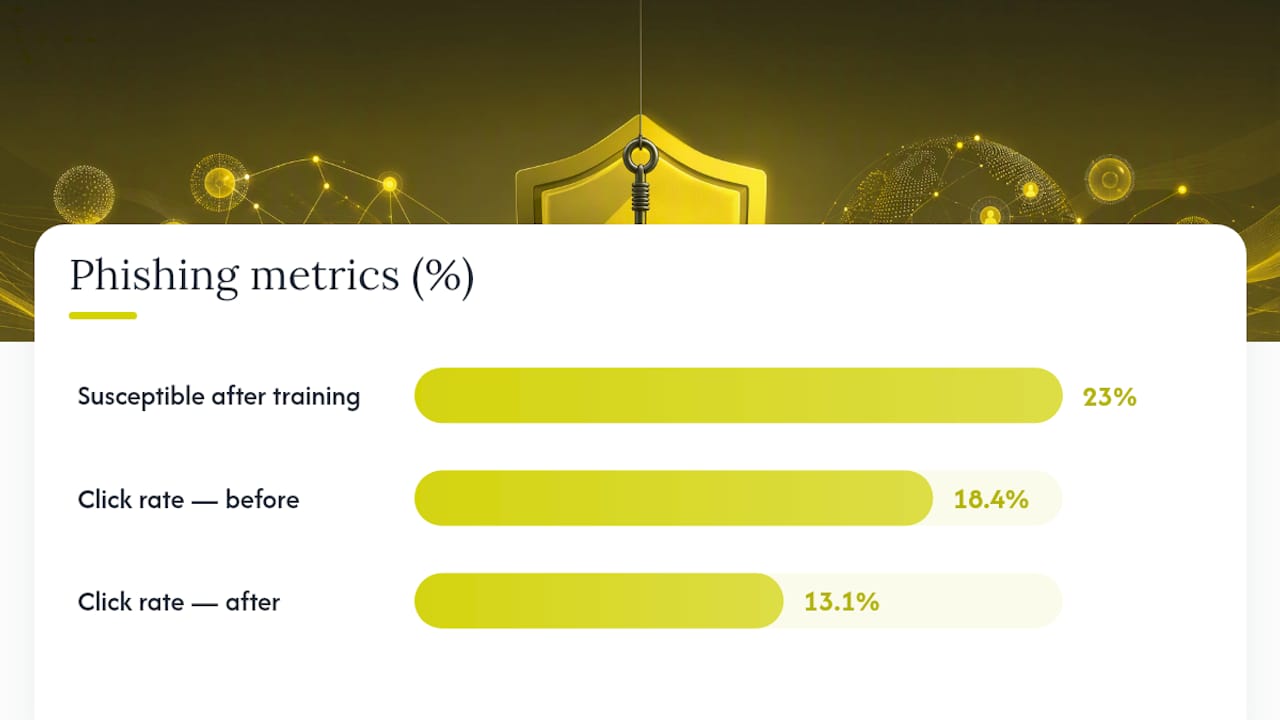
Click rate tells you almost nothing about whether your organization is safer. It’s a lagging, binary signal that treats “clicked and immediately reported” the same as “clicked, entered credentials, and said nothing.” The two metrics that actually predict operational readiness are reporting rate (the percentage of recipients who flag the simulation through the proper channel) and time-to-report (how fast that flag reaches your SOC after delivery).
Baseline both metrics in your first wave, then track the trend across every subsequent campaign, broken out by department and role. A scoping review covering phishing training effectiveness found that roughly 23 percent of users remain susceptible to phishing even after common training interventions, which is precisely why continuous cadence and process-based feedback matter more than a single annual push.
- Track credential-submission rate separately from click rate. Someone who clicks but stops before entering credentials represents a very different risk than someone who typed in a password.
- Weight high-risk role clicks (domain admins, finance approvers, executive assistants) more heavily than general population clicks when reporting to leadership.
- Correlate simulation trends against real incident data, specifically detection time and dwell time on genuine phishing attempts that reach your SOC.
- Set explicit improvement targets per wave (for example, a five-point reporting-rate increase over two quarters) rather than reporting raw numbers with no benchmark.
A note on measurable impact: a randomized field experiment testing embedded micro-training found click rates dropped from 18.4 percent to 13.1 percent after intervention, though the effect varied significantly by lure category and how long participants actually engaged with the training content. That variance is the point: a single aggregate click-rate number hides more than it reveals. Break your metrics down by scenario type and engagement time, or you’re reporting noise dressed up as insight.
Feed these numbers into your existing incident response retainer relationships wherever possible; our incident response retainer checklist outlines how simulation data should tie into broader SOC workflows rather than living in an isolated report nobody reads after the board meeting.
Rolling Out a Program: Pilot, Scale, Remediate
- Run a contained pilot before any organization-wide launch. Pick one department, twenty to fifty people, and validate three things: email deliverability through your existing filters, whether the tone of your scenarios lands the way you intended, and whether your micro-lessons actually get read.
- Handle the technical plumbing before scaling. Set up a dedicated sending domain separate from production mail, allow-list it in your secure email gateway and any URL-rewriting security tools, and tag every simulation message with a custom header your SIEM can recognize and suppress automatically. Skipping this step means your SOC burns analyst hours chasing phantom incidents generated by your own test emails.
- Automate the follow-up loop. Every failed test should trigger an immediate micro-lesson without manual intervention, and repeat clickers, typically anyone who fails three or more consecutive campaigns, should be automatically enrolled in a targeted coaching track rather than simply receiving the same generic training everyone else gets.
- Hold a monthly operations review with Security, HR, Legal, and Communications. Use it to review trend data, greenlight the next wave’s scenarios, and catch tone problems before they become employee complaints. Programs that skip this cross-functional checkpoint tend to drift toward either over-aggressive testing or stagnant, ignored campaigns within two quarters.
Our guide on employee cybersecurity training steps for business leaders walks through how to get executive sponsorship for this kind of cross-functional rollout, which tends to be the hardest part of scaling past a single pilot.
Operational Considerations: Integration and Common Pitfalls
The gap between a phishing simulation program that produces clean data and one that produces noise almost always comes down to integration details nobody thinks about until they cause a problem. Secure email gateways and URL-rewriting tools need explicit allow-listing for your simulation platform’s sending infrastructure, or your test emails either never arrive or get flagged in ways that skew your click data before anyone even sees the message.
Tagging matters just as much on the back end. A custom header on every simulation email lets your SIEM and SOC automatically suppress the alert instead of triggering a real incident response workflow for a test you designed. CISA’s security awareness training resources reinforce this operational discipline as a baseline expectation for any organization running structured testing, not an optional nicety.
- Confirm your report button works identically across desktop Outlook, webmail, and mobile clients, since coverage gaps here silently undercount your reporting rate.
- Verify the report button feeds directly into your SOC ticketing system, not a mailbox nobody monitors in real time.
- Test your landing pages and redirect chains before every campaign launch; a broken landing page after a click means you’ve lost the teaching moment entirely.
- Audit your analytics pipeline quarterly to confirm click, report, and credential-submission events are all being captured and attributed correctly.
Pro Tip: Run a dry-fire test of your own reporting pipeline before every major campaign, forward a mock phishing email through the report button yourself and time how long it takes to appear in your SOC queue. If your own test takes longer than your target time-to-report metric, fix the pipeline before you blame your employees.
What the Research Actually Shows About Phishing Training
The research on phishing simulation effectiveness is more mixed than most vendor marketing suggests, and that nuance matters for how you set expectations internally. Embedded micro-training does reduce click rates, but the effect is lure-dependent: some scenario types respond strongly, others barely move, and engagement time with the actual lesson content moderates the outcome more than the intervention itself does. A separate field experiment found that combining simulated experience with explanatory information didn’t always outperform simulated experience alone, suggesting more training content isn’t automatically better.
The practical takeaway for practitioners: tag every simulation for SOC suppression before launch, prioritize coaching pathways over punitive tracking for repeat clickers, and treat your program as a continuous feedback loop rather than a one-time deployment. Role-specific content slices, the kind covered in our breakdown of measurable security awareness training topics, tend to outperform generic annual modules precisely because they match the lure-dependence the research keeps surfacing.
- Expect variable results across lure categories, and report that variance honestly rather than averaging it into a single flattering number.
- Weight coaching investment toward your highest-risk roles first, since that’s where dwell-time reduction has the biggest real-world payoff.
- Treat any vendor’s case study claims with the same scrutiny you’d apply to your own data before adopting a program wholesale.
An Editorial Take: Behavior Change Beats Better Bait
Most phishing simulation programs optimize for the wrong variable. Teams get pulled into an arms race over crafting trickier lures instead of asking whether their reporting pipeline actually works when someone does the right thing. A monthly cadence with a fast, frictionless report button will outperform a quarterly barrage of elaborate pretexts almost every time, because the second approach teaches fear and the first teaches a habit.
There’s also a point where more simulations stop being the answer. If your click rates plateau despite escalating difficulty, that’s usually a signal to invest in technical mitigations, phishing-resistant MFA, better email filtering, tighter network segmentation, rather than running yet another wave of tests against the same weary population. Simulations expose gaps; they don’t close them on their own. If your team needs help building that layer, reach out and we’ll walk through what fits your environment.
— 247techify Team
How 247techify Supports Ethical, Measured Phishing Programs
Running a phishing simulation program well means owning the plumbing most teams underestimate: SOC tagging, ticketing integration, and a response plan for when a simulation reveals a real gap. 247techify approaches this the same way many managed security engagements are approached, with a focus on cybersecurity and support available around the clock.
Our Managed Detection & Response and penetration testing services integrate directly with the incident response and SOC workflows your simulation program depends on, so a reported phishing test and a real credential-theft attempt get triaged through the same pipeline instead of two disconnected systems. For businesses in regulated industries managing HIPAA or PCI-DSS obligations alongside awareness training, that integration isn’t optional, it’s the difference between a program that produces clean audit trails and one that produces guesswork. If you’re ready to see what a fully integrated setup costs for your organization, check our managed IT and cybersecurity pricing and get a quote built around your current environment.
Sources
- arXiv preprint 2409.01378v1
- Microsoft Defender attack simulation training FAQ
- NIST SP 800-50 Rev.1
- Randomized field experiment on embedded micro-training (2026)
FAQ
How Often Should You Run Phishing Simulations?
A monthly baseline works for most employee populations, with biweekly testing reserved for high-risk cohorts like finance and IT admins. Pause or slow the cadence if report rates drop or help desk complaints spike, since that usually signals fatigue rather than improvement.
What Metrics Matter More Than Click Rate?
Reporting rate and time-to-report are the metrics that actually predict operational readiness, according to Microsoft’s attack simulation guidance. Credential-submission rate matters too, since it distinguishes a near-miss click from an actual compromise.
Are Emotionally Manipulative Phishing Scenarios Ever Acceptable?
No. Pretexts involving layoffs, health scares, or personal financial threats cross an ethical line that damages trust regardless of any data gained, and most mature programs explicitly ban them in policy.
How Should Repeat Clickers Be Handled?
Repeat clickers should get private, targeted coaching rather than public callouts or disciplinary action, since the goal is skill-building, not punishment. Automated enrollment into a coaching track after three or more failed campaigns keeps this consistent and fair.
Can 247techify Help Integrate Phishing Simulations With SOC Workflows?
Yes. 247techify’s managed detection and response and cybersecurity services can integrate simulation reporting and incident response into a single operational pipeline for regulated and non-regulated businesses alike.