
An incident response retainer is a prearranged contract with a digital forensics and incident response (DFIR) firm that guarantees rapid, expert help before a breach happens. The core value is speed: instead of vetting vendors while ransomware spreads through Active Directory, you activate a team already familiar with your environment. Organizations in regulated industries, those without in-house DFIR depth, or anyone facing real ransomware exposure should have one in place before, not after, the incident starts.
TL;DR:
- A prearranged incident response retainer ensures rapid access to forensic experts during a breach, reducing response time and containing damage faster.
- Contracts should explicitly specify triage, forensic scope, reporting standards, evidence handling, and escalation procedures to be effective in crises.
- Pricing models include prepaid hours, tiered subscriptions, hybrid bundles, and pay-as-you-go plans, with costs influenced by incident complexity and scope.
- Strong onboarding, including environment profiling and tabletop exercises, significantly improves response timelines during actual incidents.
- Retainers complement cyber insurance and legal workflows but are operational contracts that must be established before an incident occurs.
Table of Contents
- Why Organizations Buy an Incident Response Retainer
- What Belongs in a Retainer Agreement
- How Retainer Pricing Models Actually Work
- How a Retainer Maps to the Incident Response Lifecycle
- How to Evaluate and Choose an Incident Response Retainer
- Onboarding and What Response Timelines Look Like in Practice
- Retainers, Insurance, and Legal Coordination: Clearing Up the Confusion
- Case Studies: Where Retainers Change the Outcome
- Publisher Perspective: How 247techify Approaches Incident Response Retainers
- Get Ahead of the Next Incident Before It Starts
- Primary Sources and Further Reading
- Sources
- FAQ
Why Organizations Buy an Incident Response Retainer
The math is simple. Every hour a threat actor sits inside your network, encrypting file shares or exfiltrating customer records, costs money and credibility. A retainer compresses the gap between detection and containment because the forensic team is contracted, briefed, and often has already reviewed your network diagrams before anything goes wrong. That head start is the entire value proposition.
Three scenarios drive most retainer purchases:
- Ransomware outbreaks, where negotiation, containment, and recovery need to happen simultaneously under pressure.
- Data breach investigations, where regulators and legal counsel need a defensible forensic timeline, not guesswork.
- Supply-chain compromises, where a vendor’s breach exposes your systems and you need outside eyes fast to determine scope.
Retainers also solve an integration problem. Most midmarket security operations centers (SOCs) are built for detection and alerting, not deep forensic investigation. A SOC flags the anomaly; the retainer team does the credential hash analysis, the memory forensics, and the containment work that a generalist IT staff can’t handle under time pressure. Think of the retainer as the surge capacity your internal team doesn’t have the headcount to justify keeping on payroll year round.
What Belongs in a Retainer Agreement
A retainer is a legal contract, and the fine print determines whether it actually helps you during a crisis. Read the service level agreement (SLA) language carefully. “Response time” usually means the vendor acknowledges your call and begins triage within a set window, typically within a few hours. “Remediation” is a separate, longer clock, and vague contracts blur the two deliberately.
Five things should be explicitly named in the contract, not implied:
- Triage and initial scoping, defining what happens in the first hours of engagement.
- Digital forensics and incident response (DFIR) services, including memory and disk forensic imaging.
- Written reporting, specifying whether reports are litigation-ready or informal.
- Confidentiality and evidence handling, covering chain-of-custody procedures so findings hold up in regulatory or legal review.
- Escalation contacts, naming a single point of contact rather than a generic support queue.
Billing models vary. Some vendors treat scoping calls as free consultation; others start the meter the moment the phone rings. Ask specifically what counts as billable hours versus included readiness work, because that distinction affects your annual retainer cost more than almost any other clause.
Pro Tip: Ask for a sample incident report before signing. If it reads like a marketing summary instead of a forensic document with timestamps, indicators of compromise, and a clear chain-of-custody log, that vendor’s paperwork won’t survive scrutiny from your insurer or a regulator.
How Retainer Pricing Models Actually Work
Vendors package incident response retainer services in a handful of recognizable shapes, and picking the wrong one for your risk profile either wastes budget or leaves you underinsured against your own worst case.
- Prepaid credits or blocks of hours. You purchase a set number of hours upfront, often 20 to 100, that get burned down as incidents occur. Unused hours may roll over, expire, or convert to a discount on future services depending on the vendor.
- Subscription or tiered retainers. A flat annual or monthly fee guarantees a defined SLA and a scope of coverage, similar to a managed IT security retainer, with tiers usually differentiated by response-time guarantees and included readiness hours.
- Hybrid retainers. These bundle proactive work, tabletop exercises, playbook development, and readiness assessments with reactive incident hours, which tends to reduce total incident time because the vendor already understands your environment.
- On-call or pay-as-you-go. No upfront commitment, but response-time guarantees are typically weaker or nonexistent, and pricing per hour runs higher than prepaid models.
Cost drivers beyond the base retainer fee include on-site travel, extended forensic timelines when adversaries have deep persistence, and legal-hold data preservation. A ransomware incident touching hundreds of endpoints costs meaningfully more in labor hours than a contained phishing compromise, and vendors price accordingly.
How a Retainer Maps to the Incident Response Lifecycle
NIST SP 800-61 breaks incident response into five phases: preparation, detection and analysis, containment, eradication and recovery, and post-incident activity. A retainer’s value shows up in nearly every one of them, not just the crisis phase most people picture.
During preparation, retainer vendors run environment profiling, build playbooks, and often facilitate tabletop exercises. CISA treats preparation as the single most important phase, arguing that pre-defined roles and rehearsed procedures are what separate a controlled response from chaos. During containment, eradication, and recovery, the retainer team supplies the forensic manpower most internal teams lack: memory analysis, malware reverse engineering, credential resets across Active Directory, and coordinated recovery sequencing.
A retainer’s real return shows up in two metrics: mean time to acknowledge (MTTA) and mean time to respond (MTTR). Pre-negotiated escalation paths and a single point of contact remove the friction that normally burns hours before anyone qualified even looks at the evidence, a point NIST’s incident response guidance makes explicit when describing effective escalation design.
Post-incident, NIST SP 800-61 revision 3 recommends integrating lessons learned back into governance and detection functions under the broader Cybersecurity Framework (CSF) 2.0, closing the loop rather than treating the incident as a one-off event.
How to Evaluate and Choose an Incident Response Retainer
Vendor marketing pages all sound similar. The differences that matter show up in the answers to specific questions, not the sales deck.
Ask each candidate provider these before signing anything:
- What is the guaranteed acknowledgment time, and is it stated in the SLA or just verbally promised?
- Is remediation time bounded by any SLA, or only the initial response?
- What is included in the base retainer fee versus billed separately?
- Who owns forensic evidence, and what does the chain-of-custody process look like?
- Can you provide a redacted sample incident report?
- Do you have documented experience in our regulatory environment (HIPAA, PCI-DSS, or similar)?
- How many active retainer clients does your team support concurrently?
- What happens if two clients need emergency response at the same time?
- Do unused retainer hours roll over, expire, or convert to credit?
- Will you coordinate directly with our legal counsel and cyber insurer during an incident?
- Do you provide tabletop exercises or playbook development as part of onboarding?
- What’s your average time from acknowledgment to boots-on-ground, virtual or physical?
Score responses against four criteria: speed of guaranteed response, depth of DFIR bench strength versus a single generalist, documented regulatory experience, and transparency of invoicing. A provider that hedges on the invoicing question is telling you something about how billing disputes will go mid-incident.
Pro Tip: Watch for contracts that define “response” as a callback rather than active triage. A vendor that promises to “respond within one hour” but means a phone call, not actual investigative work, is selling you a slower SLA than the language suggests.
Red flags worth walking away from: no named point of contact, refusal to share a sample report, vague language around evidence ownership, and any hesitation to name specific compliance frameworks they’ve supported.
Onboarding and What Response Timelines Look Like in Practice
Onboarding is where a retainer earns its cost. A vendor that skips environment profiling is starting from zero on day one of a real incident, which defeats the entire point of paying in advance.
A solid onboarding checklist includes:
- Network and asset inventory documentation shared in advance.
- Credential handoff procedures agreed upon before they’re needed under pressure.
- Custom playbooks built around your specific systems and compliance obligations.
- At least one tabletop exercise per year, which CISA’s playbook guidance recommends to convert theoretical procedures into rehearsed muscle memory.
Typical SLA timelines generally include acknowledgment within a few hours, initial triage findings within about a day, containment guidance within a few days depending on scope, and a full forensic report within several weeks for complex cases. Vendors with strong onboarding tend to beat these numbers because they aren’t discovering your network topology mid-crisis.
Retainers, Insurance, and Legal Coordination: Clearing Up the Confusion
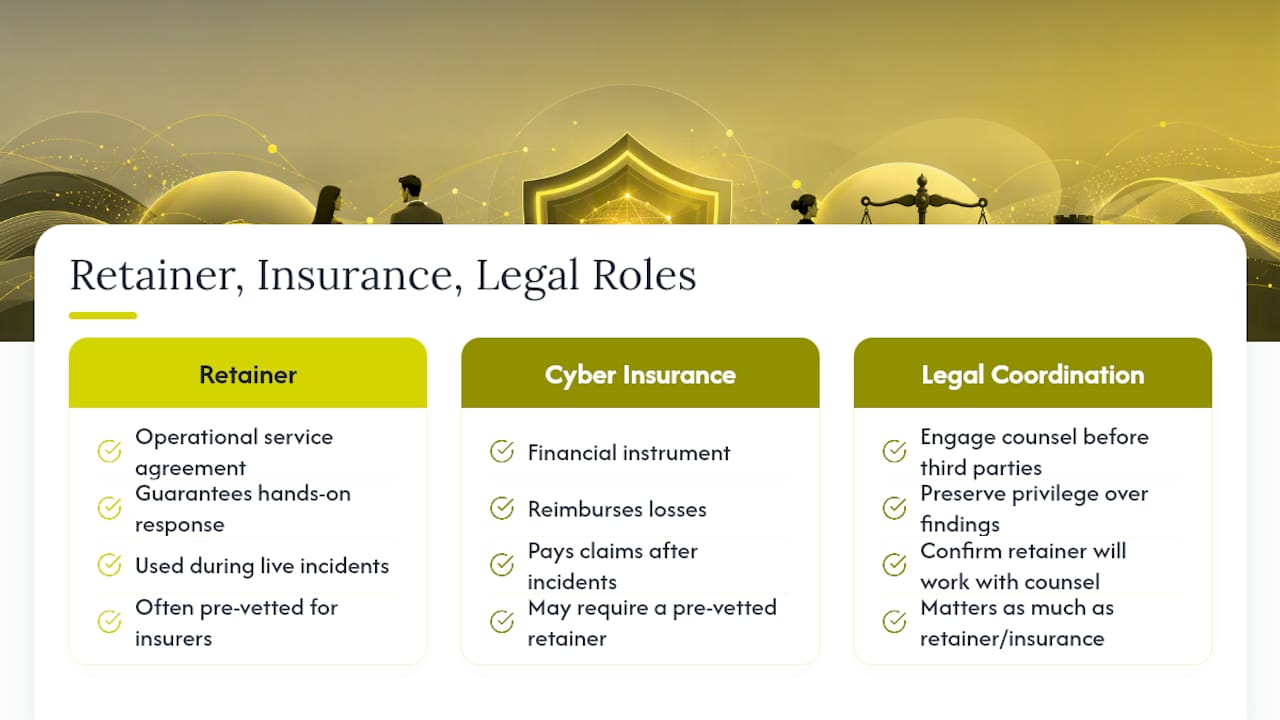
A retainer is not insurance. It’s an operational service agreement that guarantees hands-on response capacity, while cyber insurance is a financial instrument that reimburses losses. The two work together, and many insurers actually require a pre-vetted incident response retainer before they’ll authorize certain claim processes or panel-approved vendor use.
Legal coordination matters just as much. Consult counsel before engaging any third party during a live incident, and confirm in advance that your retainer provider will work directly with your attorneys to preserve privilege over forensic findings where applicable.
Case Studies: Where Retainers Change the Outcome
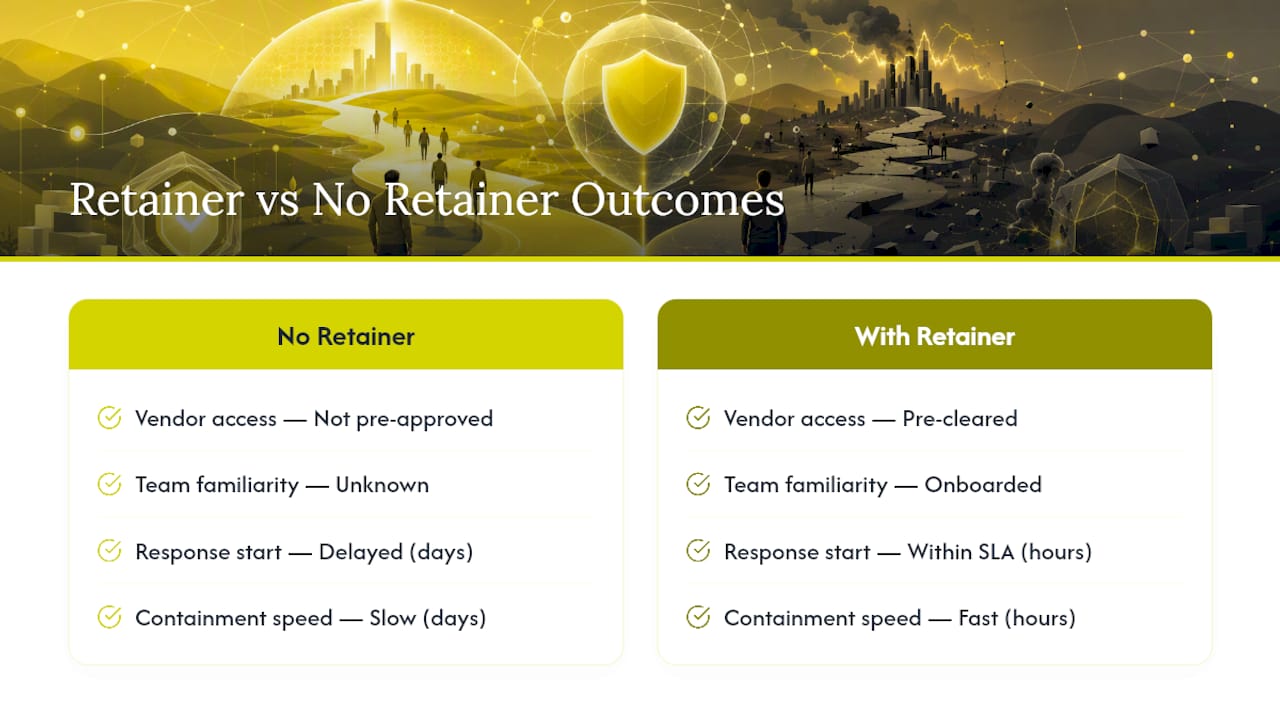
Consider two versions of the same ransomware event. In the first, a mid-sized healthcare clinic without a retainer discovers encrypted file shares on a Friday afternoon. IT staff spend the weekend calling forensic firms, none of whom have ever seen the network before, negotiating scope-of-work contracts while systems stay offline and patient records remain inaccessible. Recovery stretches past two weeks, and the delay itself becomes a HIPAA reporting complication.
In the second version, a similarly sized organization with an active retainer detects the same ransomware strain. The retainer’s pre-cleared team, already familiar with the network from onboarding, begins forensic triage within the SLA window. Playbooks built during onboarding tell IT staff exactly which systems to isolate first. Containment happens in hours instead of days, and the forensic report, built on evidence-handling procedures agreed to months earlier, holds up under regulatory review.
The difference isn’t the sophistication of the attack. Both scenarios can involve identical malware. What changes the outcome is whether specialized help was pre-negotiated or discovered under duress. Financial services firms and healthcare providers report the same pattern repeatedly: the organizations that recover fastest are rarely the ones with the biggest security budgets. They’re the ones that removed vendor selection from the crisis timeline entirely, months before anything happened.
Publisher Perspective: How 247techify Approaches Incident Response Retainers
Some managed IT service providers build incident response into their offerings rather than selling it as a bolt-on. This can mean 24/7 monitoring paired with a rapid response commitment, rather than multi-hour acknowledgment windows common in standalone retainer contracts. For clients in healthcare and finance, onboarding includes compliance groundwork tied to HIPAA and PCI-DSS requirements from day one, not bolted on after an audit finding. The result is a security-first foundation where incident readiness is baked into everyday operations, not purchased separately when it’s already too late.
— 247techify Team
Get Ahead of the Next Incident Before It Starts
Most organizations that suffer through a chaotic breach response share one thing in common: they were shopping for help while the clock was already running. 247techify’s managed security services fold incident response into everyday IT operations, so containment starts in under 30 minutes instead of during a vendor negotiation call.
If your internal team needs backup rather than a full replacement, the co-managed IT model lets your existing staff keep control while 247techify handles the DFIR-heavy lifting. Already mid-breach, or worried a ransomware event is imminent? The emergency ransomware recovery service is built for exactly that scenario. For a broader look at how proactive readiness fits your organization, request an assessment through 247techify’s managed IT services page and get a response plan built before you need one.
Primary Sources and Further Reading
For procurement teams validating vendor claims, NIST’s incident response resources and CISA’s incident response plan guidance remain the authoritative baseline auditors expect referenced.
Sources
- NIST: Incident response resources
- CISA: Incident Response Plan (IRP) basics
- NIST SP 800-61 r3 (Incident response recommendations and CSF 2.0 alignment)
FAQ
What Is an Incident Response Retainer?
It’s a prearranged contract with a DFIR firm guaranteeing rapid, defined-scope access to forensic and containment experts before an incident happens, rather than vendor shopping during an active breach.
What Is the Difference Between a CSIRT and a SOC?
A SOC provides continuous monitoring and detection, while a CSIRT is activated for deeper investigation and remediation once an incident is confirmed, often fed by SOC alerts.
What Are the Five Steps of Incident Response?
Per NIST SP 800-61, the phases are preparation, detection and analysis, containment, eradication and recovery, and post-incident activity, and a retainer supplies specialized support across most of these.
How Much Does an Incident Response Retainer Cost?
Cost varies by model, prepaid hour blocks, tiered subscriptions, or hybrid readiness bundles, with pricing driven by guaranteed response times, included readiness work, and factors like on-site travel or extended forensic timelines.
Is an Incident Response Retainer the Same as Cyber Insurance?
No. A retainer is an operational service guaranteeing hands-on response capacity, while cyber insurance is a financial instrument reimbursing losses, and many insurers require a pre-vetted retainer before approving certain claims.