
Most business email compromise losses are prevented by layered defenses, not a single tool: org-wide phishing-resistant MFA, enforced SPF/DKIM/DMARC, dual approval with out-of-band verification for payments, and continuous monitoring for account takeover signals. MFA alone can block up to 99% of automated account-compromise attempts. Every organization should treat containment readiness (frozen credentials, a bank contact list, preserved headers) as a standing capability, not something built after the fraud wire clears.
TL;DR:
- Enforcing multi-factor authentication with hardware keys or authenticator apps drastically reduces automated account compromises, blocking up to 99% of attempts.
- Moving through the full SPF, DKIM, and DMARC authentication process in phases allows legitimate email flow while identifying unauthorized senders effectively.
- Implementing dual-approval workflows for high-value payments and out-of-band verification significantly disrupts attacker strategies and prevents successful wire fraud.
- Monitoring for signals like new external forwarding rules or unusual login patterns helps detect account takeovers within 24 hours, enabling swift response.
- Partnering with managed security providers ensures continuous threat detection, incident response, and compliance support, especially for small or regulated organizations.
Table of Contents
- How Business Email Compromise Attacks Operate
- Technical Controls That Actually Reduce BEC Risk
- Verification Workflows That Stop Fraudulent Wire Transfers
- What Signals Indicate an Active Account Takeover?
- What to Do in the First Hour of a Suspected BEC Incident
- A 90-Day Rollout Plan With Measurable Checkpoints
- What to Look for in a Managed Security Partner for Email Protection
- What Most Security Teams Get Wrong About BEC Prevention
- Get 24/7 BEC Protection Without Building an In-House Security Team
- Sources
- FAQ
How Business Email Compromise Attacks Operate
Attackers running BEC campaigns rarely deploy malware. They exploit trust, timing, and the way finance teams process routine requests. The goals are consistent across incidents: wire fraud, payroll diversion, vendor-account takeover, and quiet data exfiltration ahead of a bigger extortion play.
The tactics that get them there include:
- Spear phishing targeting specific finance, HR, or executive-assistant roles with context pulled from LinkedIn or public filings.
- Display-name spoofing, where the “From” name reads as the CEO but the underlying address is unrelated.
- Lookalike domains substituting a zero for an “o” or adding a hyphen to a legitimate vendor domain.
- Account takeover, where an attacker gains real access to a mailbox and monitors it before striking.
- Invoice fraud, altering banking details on a legitimate-looking vendor invoice mid-transaction.
BEC bypasses signature-based filters because there’s no malicious attachment or link to fingerprint. It’s plain text, sent from a domain that looks close enough, asking for something an employee has done a hundred times before. That’s exactly why layered email security combining authentication, filtering, DLP, and human verification matters more here than in almost any other attack category.
Technical Controls That Actually Reduce BEC Risk
Technical controls set the floor. Get these wrong and every downstream process control is fighting an uphill battle.
MFA enforcement. Require multi-factor authentication on every account, not just admins. Prioritize phishing-resistant methods, authenticator apps or FIDO2 hardware keys, over SMS codes, which are vulnerable to SIM-swapping and real-time phishing proxies. This single control is the highest-leverage change most organizations can make.
Email authentication. Move your domain through the full SPF, DKIM, and DMARC progression. Start DMARC in monitoring mode (p=none) to see what’s actually sending on your behalf, then graduate to quarantine and eventually reject as your reporting data confirms legitimate senders are covered. Skipping straight to reject without monitoring first will break legitimate mail flow and generate help desk tickets for weeks.
Advanced anti-phishing. Native filters in Microsoft 365 or Google Workspace catch known bad senders and obvious spam. They rarely catch a well-crafted BEC message from a freshly registered domain with no reputation history yet. A secure email gateway adds behavioral detection, URL rewriting that checks links at click-time rather than delivery-time, and sandboxing for attachments.
DLP and encryption. Apply data loss prevention rules to anything touching regulated data, financial records, health information, payment card details, and enforce TLS for transport. For the most sensitive threads, S/MIME or PGP end-to-end encryption adds a layer that survives even if a mailbox is compromised.
Configuration hygiene. Disable legacy authentication protocols that skip MFA entirely, patch email clients on a fixed schedule, and audit service account exceptions quarterly, since those are the accounts attackers look for first.
- MFA: authenticator app or hardware key, not SMS
- DMARC: monitor, then quarantine, then reject
- Gateway: behavioral detection beyond native filtering
- DLP: rules tied to regulated data categories
- Legacy auth: disabled organization-wide
Pro Tip: Pull your DMARC aggregate reports weekly during the first 60 days of rollout. That’s where you’ll spot the internal system, a CRM or invoicing tool, that’s sending mail on your domain’s behalf without proper authentication, before it becomes a support fire drill.
Verification Workflows That Stop Fraudulent Wire Transfers
Technical controls stop the initial compromise. Process controls stop the money from moving once an attacker gets a convincing message in front of the right person. This is where most BEC losses are actually prevented or allowed to happen.
- Design dual-approval payment workflows with monetary tiers. A $2,000 vendor payment might need one approver; a $200,000 wire needs two, from separate departments, with no single person able to both initiate and release funds.
- Mandate out-of-band verification for any payment-detail change. Call the vendor using the number stored in your ERP or vendor master file, never a number supplied in the email requesting the change. This single habit breaks the attacker’s entire strategy, because it removes their only channel of influence.
- Revalidate vendor contacts annually, and re-verify at onboarding before the first payment ever goes out.
- Run targeted phishing simulations for finance staff and executives specifically, since generic company-wide training tends to under-prepare the two groups attackers target most.
- Block automatic external forwarding by policy and audit mailbox rule changes regularly. This is a persistence mechanism, not a productivity feature, for most legitimate use cases.
Pro Tip: Build a payment calendar that raises verification requirements during high-risk windows, end-of-quarter closes, holidays, Friday afternoons, since attackers time requests to when staff are rushed or short-staffed.
What Signals Indicate an Active Account Takeover?
Dwell time, the gap between compromise and detection, is where BEC damage compounds. Watch for a handful of concrete signals rather than trying to monitor everything at once:
- New external forwarding rules appearing on a mailbox, especially auto-forwarding to a personal domain.
- Logins from unusual geographies within a short window of a legitimate login (impossible-travel patterns).
- Rapid, unexplained edits to mailbox rules or folder permissions.
- A sudden spike in outbound message volume from a single account.
- New OAuth application grants that weren’t provisioned through IT.
None of these signals mean much in isolation. Correlating email telemetry with identity and conditional-access logs, plus EDR alerts on the endpoint the account logged in from, turns a single suspicious event into an actionable case. Automate monitoring for newly registered lookalike domains targeting your brand and file abuse takedown requests as soon as one appears. A reasonable starting threshold: flag any account with three or more of these signals within 24 hours for immediate SOC review, not the next-day queue.
What to Do in the First Hour of a Suspected BEC Incident
Speed determines whether funds are recoverable. The playbook has to be rehearsed, not improvised.
- Contact the bank’s wire-fraud or fraud-recovery desk immediately. Financial institutions can sometimes freeze or reverse a transfer if notified within the first hour, and that window closes fast.
- Preserve the emails and full headers before touching anything else. This is evidence, and it’s also how your team will trace the entry point.
- Communicate out-of-band. Never use the potentially compromised mailbox to coordinate the response; use a verified phone number or a separate, known-clean account.
- Contain immediately: force a password reset, revoke all active sessions, remove any malicious forwarding rules or unauthorized OAuth grants, and enable phishing-resistant MFA if it wasn’t already active.
- Report the incident to IC3 or your national equivalent, and notify legal and finance leadership with a documented timeline.
- Run forensic analysis afterward, adjust configurations based on what you find, and notify any vendors whose payment details were part of the scheme. Full incident response workflows matter here as much as the first-hour reaction.
A 90-Day Rollout Plan With Measurable Checkpoints
Prevention work fails when it’s treated as one big project instead of a sequence of smaller, deadline-bound wins.
Days 0 to 30 (quick wins): Enforce MFA across every account, enable external-sender tags so employees see at a glance when a message originates outside the organization, and add a one-click phishing report button, with a documented call-back verification policy.
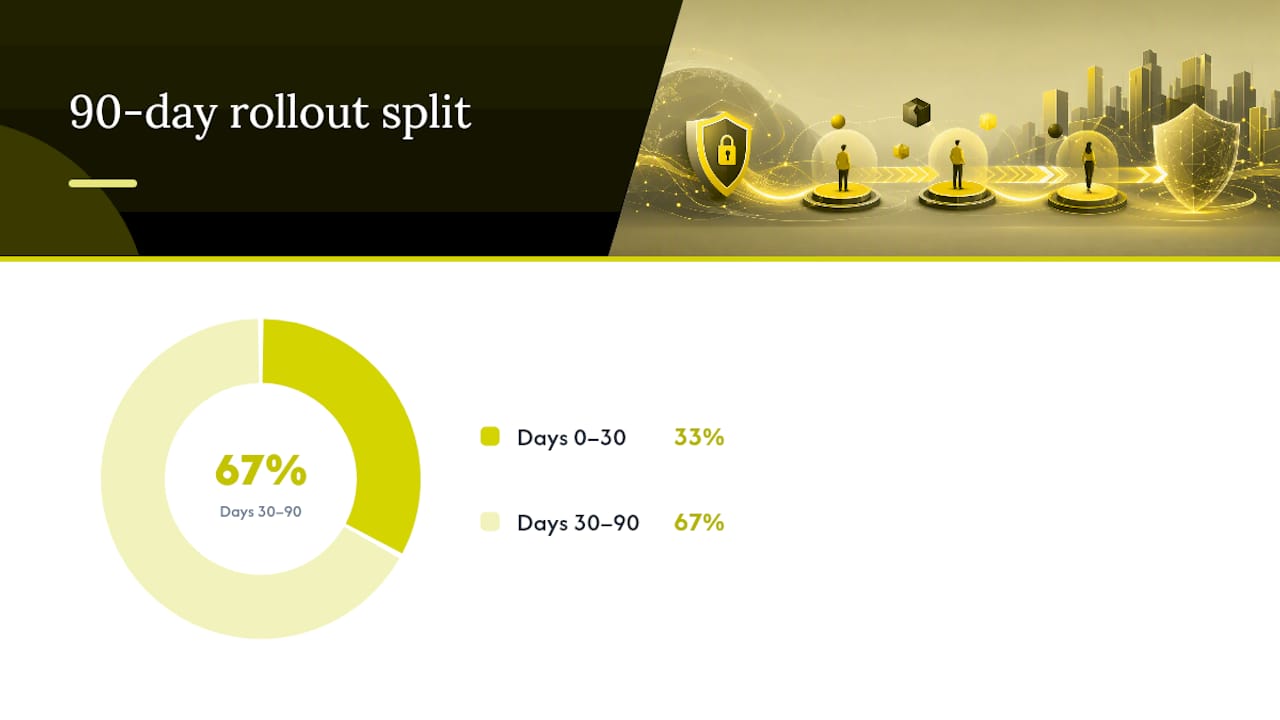
Days 30 to 90 (mid-term): Push DMARC into enforcement, deploy an advanced anti-phishing gateway beyond native filtering, and roll out DLP rules for regulated data categories.
Beyond 90 days (long-term): Build zero trust network segmentation, extend phishing-resistant MFA to every high-risk role (finance, HR, executives), and schedule recurring tabletop exercises so the incident response plan isn’t just a document nobody’s tested.
Track these KPIs monthly:
- Percentage of accounts with MFA enforced (target: 100%)
- Phishing simulation click rate (should trend downward quarter over quarter)
- Time-to-detect for account takeover signals
- Number of fraudulent transfer attempts caught before funds moved
Since phishing-resistant MFA can block roughly 99% of automated compromise attempts, that first KPI alone often produces the sharpest drop in incident volume of anything on this list.
What to Look for in a Managed Security Partner for Email Protection
Running this playbook internally takes dedicated hours most IT teams don’t have spare. Managed security services can cover the ground this article maps out: continuous monitoring for the account-takeover signals described above, endpoint protection tied to identity controls, managed MFA rollout support, DLP policy configuration, and incident response when something does get through.
Worth reading alongside this article: the breakdown of common cybersecurity threats businesses face, the financial data encryption guide for TLS and S/MIME decisions, and measurable security awareness training topics for building out your own phishing simulation program.
When evaluating any managed security provider, check for:
- Documented SLA response times, not vague promises
- Direct experience with your regulatory environment (HIPAA, PCI-DSS, or similar)
- Evidence of tabletop exercise readiness, not just monitoring dashboards
- Client outcomes you can verify, not just marketing claims
What Most Security Teams Get Wrong About BEC Prevention
The conventional advice treats BEC as a training problem: run more phishing simulations, tell people to “verify before you trust,” and hope awareness scores improve. That’s incomplete. Training reduces click rates, but it doesn’t stop a rushed accounts-payable clerk from processing a wire on a Friday afternoon when the message looks exactly like forty other legitimate ones they’ve handled that month.
What actually works is removing the decision from the individual entirely. Dual approval with a hard dollar threshold and mandatory out-of-band call-backs doesn’t rely on someone spotting a subtle red flag under pressure. It makes the fraud structurally difficult regardless of how convincing the message is.
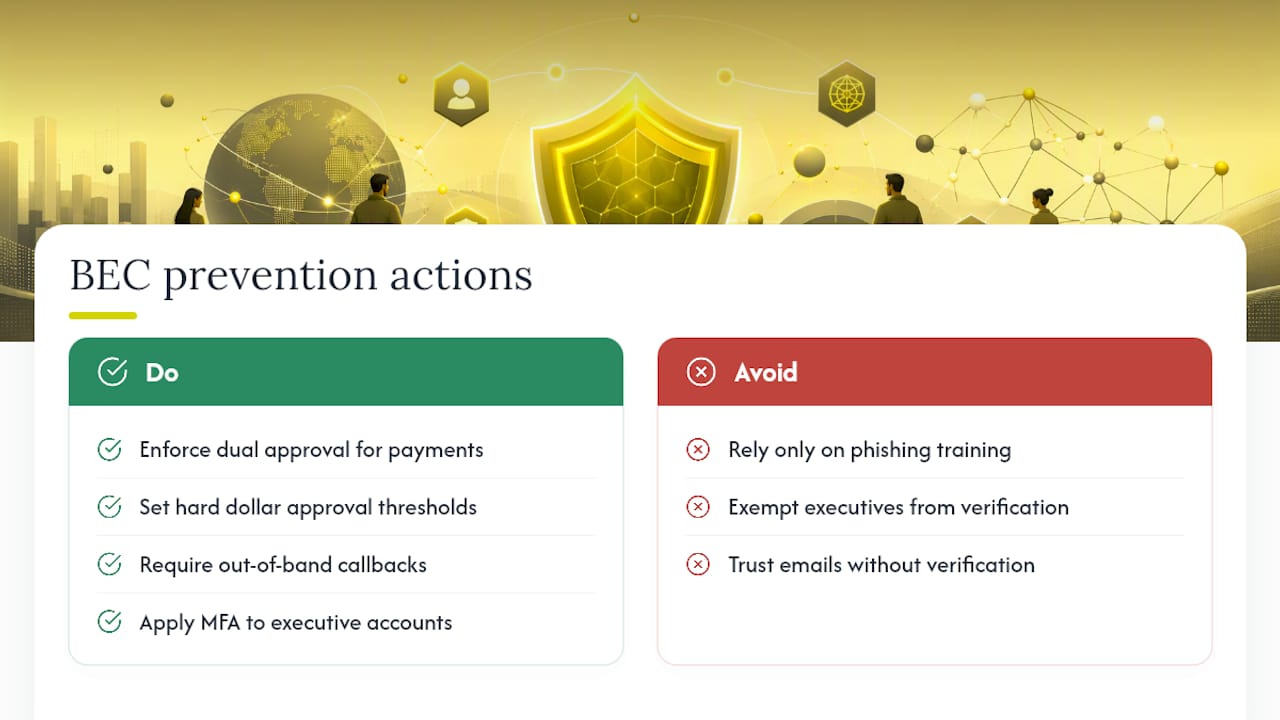
The other gap: executives are frequently the weakest link and the least trained. Spoofed “urgent request from the CEO” messages work precisely because leadership rarely sits through the same phishing simulations as junior staff. Any prevention program that exempts executives from the same verification rules it applies to accounts payable is building a program with a hole in it.
Prioritize MFA and verification workflows first. They’re operational, measurable, and they close the gap training alone leaves open.
— 247techify Team
Get 24/7 BEC Protection Without Building an In-House Security Team
Most businesses trying to implement everything in this playbook, MFA rollout, DMARC enforcement, DLP configuration, 24/7 monitoring, run into the same wall: it takes a dedicated security team most small and mid-sized companies can’t justify staffing full-time. 247techify’s managed IT services build this layered defense as a standing capability rather than a project you have to revisit every time a new threat emerges, with 24/7 monitoring and a response time under 30 minutes when something does slip through.
For businesses in regulated industries, healthcare, finance, legal, that need compliance expertise alongside email security, 247techify’s broader services cover HIPAA and PCI-DSS requirements directly. If your team already has internal IT staff but needs security specialists to own detection and incident response specifically, the co-managed IT model splits that responsibility without replacing your existing team. Reach out for a security assessment of your current email environment and find out exactly which controls in this playbook you’re missing.
Sources
For hands-on implementation guidance beyond this article, these sources carry the technical depth worth bookmarking:
- 18 enterprise email security best practices for 2026 | TechTarget
- Email security best practices — Canadian Centre for Cyber Security
- What is Business Email Compromise (BEC)? | Microsoft Canada
- How to Prevent Business Email Compromise (BEC) Fraud | Adaptive Security
FAQ
How Do You Protect Against Business Email Compromise?
Layer phishing-resistant MFA, enforced SPF/DKIM/DMARC, dual-approval payment workflows with out-of-band verification, and continuous monitoring for account takeover signals. No single control stops every BEC variant, which is why Microsoft and other security authorities frame this as a layered defense problem.
What Is the First Stage of a BEC Attack?
Most BEC attacks begin with reconnaissance: the attacker researches an organization’s structure, vendors, and executive roles through public sources like LinkedIn or company filings before crafting a targeted spear-phishing message or registering a lookalike domain.
Who Is Usually Targeted in a BEC Attack?
Finance staff, accounts payable clerks, HR personnel with payroll access, and executives or executive assistants are the most common targets, since they have direct authority over payments or sensitive data changes.
What’s the Difference Between BEC and Phishing?
Phishing casts a wide net using malicious links or attachments to harvest credentials or deploy malware. BEC is targeted, text-based social engineering with no malicious payload, often impersonating a trusted contact to request a wire transfer or data change, which is exactly why signature-based filters miss it.
How Effective Is MFA at Stopping Account Takeover?
Phishing-resistant MFA can prevent up to 99% of automated account-compromise attempts, making it one of the highest-impact controls an organization can deploy against BEC.