
Effective network segmentation is prioritized, policy-driven, and enforced at Layer 3 chokepoints, not left to VLANs alone. The highest-value targets, domain controllers, backup repositories, and privileged access workstations, get isolated first, with everything documented and continuously monitored. Skip the dependency mapping before you start enforcing deny rules, and you will cause outages instead of stopping attackers.
TL;DR:
- Prioritize isolating critical assets like domain controllers and backup servers first, to prevent the most damaging breach scenarios.
- Map application dependencies thoroughly before enforcing deny-by-default rules to avoid causing network outages or breaking operations.
- Use Layer 3 enforcement points, such as firewalls or routers, since VLANs alone do not control inter-VLAN traffic or prevent lateral movement.
- Conduct quarterly audits of segmentation configurations and monitor flow data to prevent drift and identify orphaned or risky rules.
- Implement a phased rollout beginning with flow collection and isolated enforcement, rather than attempting to redesign the entire network at once.
Table of Contents
- What Network Segmentation Best Practices Actually Mean
- Network Segmentation Best Practices: A Prioritized Checklist
- Implementing Network Segmentation: A Phased Rollout
- Configuration Traps That Undermine Segmentation
- Keeping Segmentation Effective Over Time
- Compliance Mapping and Practical Segmentation Examples
- How 247techify Applies These Practices for Clients
- Your Next 90 Days: A Segmentation Action Plan
- What Fifteen Years of Incident Response Teaches About Segmentation
- Get Help Enforcing Segmentation the Right Way
- Sources
- FAQ
What Network Segmentation Best Practices Actually Mean
Before you touch a switch config, get the vocabulary straight, because these terms get conflated constantly and that confusion drives bad architecture decisions.
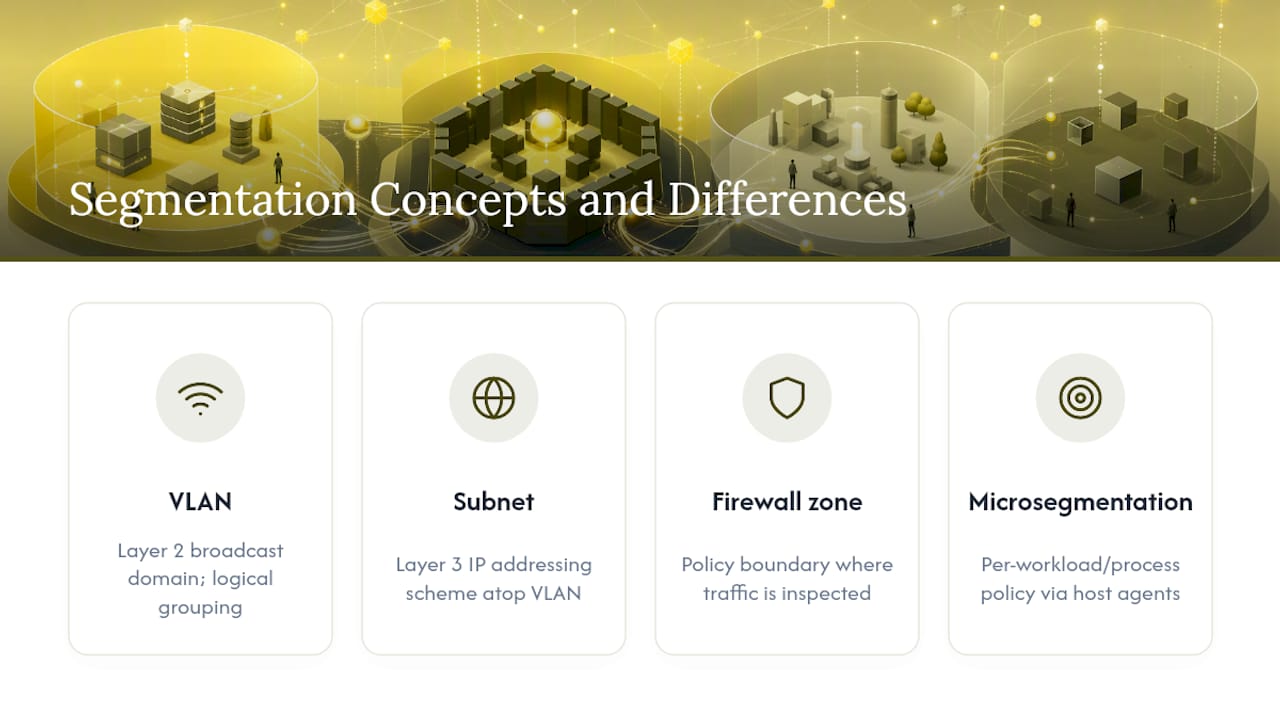
A VLAN (Virtual Local Area Network) is a Layer 2 broadcast domain, a logical grouping of devices that behave as if on the same physical switch, regardless of location. A subnet is the Layer 3 IP addressing scheme layered on top of that VLAN. A firewall zone is a policy construct, a boundary where traffic gets inspected and either permitted or dropped based on rules. Microsegmentation goes further still, enforcing policy down to the individual workload or process level, often inside a single VLAN, using host-based agents or hypervisor-level controls rather than physical network boundaries.
The payoff for getting this right is concrete. Segmentation limits lateral movement, so a compromised marketing laptop cannot pivot straight into your finance server. It reduces blast radius, meaning a ransomware event in one zone does not automatically become a company-wide incident. It supports compliance frameworks that require isolation of sensitive data. And it often improves performance by shrinking broadcast domains and cutting unnecessary chatter.

In practice, most organizations combine several approaches at once: VLANs for logical grouping, subnets and ACLs for addressing and coarse filtering, next-generation firewalls (NGFW) for stateful zone enforcement, and microsegmentation for the handful of assets where workload-level isolation matters most.
Network Segmentation Best Practices: A Prioritized Checklist
The mistake most teams make is treating segmentation as an all-or-nothing project. It is not. Work through this checklist in order, and resist the urge to redesign your entire network before you have secured the assets that matter most.
-
Right-size your segmentation scope. Under-segmentation leaves flat networks where one phished workstation reaches everything. Over-segmentation creates hundreds of micro-zones nobody can manage, which leads to shadow exceptions and broken applications. Aim for segments organized around function and risk, not an arbitrary VLAN-per-department scheme.
-
Identify and isolate your highest-impact assets first. Domain controllers, backup servers, privileged access workstations (PAWs), and payment processing systems belong in their own tightly controlled zones before you worry about anything else. Microsoft’s guidance on segmentation recommends separating user, server, guest, IoT, management, storage, and backup zones as a baseline structure.
-
Map application and protocol dependencies before you change a single rule. Every enterprise network has legacy services and undocumented integrations that will break the moment you flip to deny-by-default. Flow data comes before firewall rules, always.
-
Enforce least privilege and deny-by-default. Every rule should answer “why does this traffic need to exist?” If nobody can answer, block it and watch for complaints.
-
Limit and microsegment third-party and vendor access. Contractors and vendor support tools should reach only the specific systems they service, ideally through a jump host, not a flat VPN drop into your core network.
-
Document VLAN IDs, subnets, owners, and review cadence. A spreadsheet that nobody updates is worse than no documentation, because it creates false confidence. Assign an owner to every segment and a date for the next review.
-
Layer your controls. NGFWs handle stateful zone enforcement, VLANs handle logical separation, and host-based microsegmentation covers the workloads where a breach would be catastrophic even inside an already-segmented zone. OWASP’s Network Segmentation Cheat Sheet recommends at minimum a three-tier architecture, frontend, middleware, backend, with explicit deny between zones unless a rule says otherwise.
-
Visualize your flows and plan for failure. Know what happens to traffic when a firewall fails or a link drops. A segmentation design that fails open under stress is a design flaw, not bad luck.
Implementing Network Segmentation: A Phased Rollout
Trying to segment everything in a single change window is how projects die and networks go down. A phased approach, moving from the assets that matter most toward broader enforcement, keeps risk low while showing measurable progress every month.
-
Phase 1, days 1 to 90: capture flows and isolate the crown jewels. Deploy NetFlow, IPFIX, or sFlow collection across your core switches to build a real picture of who talks to whom. In parallel, isolate domain controllers, backup infrastructure, and PAWs behind interim host-based firewall rules, even before your broader VLAN redesign is finished. This single step closes off the most common ransomware propagation paths fast.
-
Phase 2, months 3 to 6: pilot inter-VLAN firewall enforcement. Start with one non-critical VLAN pair, apply deny-by-default with explicit allow rules built from your flow data, and monitor closely for two to four weeks before expanding. Keep a documented rollback plan for every rule change; the ability to revert in minutes, not hours, is what makes teams confident enough to keep tightening policy.
On technology choice, match the tool to the requirement rather than defaulting to the flashiest option. Layer 3 switch ACLs handle straightforward inter-subnet filtering at wire speed and low cost, fine for guest or IoT isolation. An NGFW earns its keep where you need application-aware inspection, intrusion prevention, and centralized logging, think CDE boundaries or admin zones. Software-defined networking (SDN) makes sense at scale, where policy needs to follow workloads across a dynamic data center or hybrid cloud footprint, but it adds operational complexity most small and mid-sized environments do not need yet.
Configuration Traps That Undermine Segmentation
A well-designed segmentation plan still fails in practice when the underlying switch and firewall configuration has holes. These are the mistakes that show up again and again in audits.
- VLANs only separate broadcast domains at Layer 2. Inter-VLAN traffic must pass through a Layer 3 enforcement point, a firewall or a router with access control lists, or the segmentation exists on paper only.
- Never use VLAN 1 for production traffic. Set an unused, non-routed VLAN as the native VLAN on every trunk, and explicitly allow only the VLANs each trunk actually needs to carry. VP Compass’s guidance on VLAN segmentation flags default native VLAN configurations as a leading cause of VLAN-hopping exposure.
- Isolate your management VLAN completely from user-facing traffic. Switch and firewall management interfaces should never be reachable from a general-purpose subnet.
- Choose your routing approach deliberately: switch virtual interfaces (SVIs) for high-throughput inter-VLAN routing, router-on-a-stick for smaller environments with lighter traffic, or NGFW routing where inspection needs to happen inline. Each trades off speed against visibility.
- VLANs alone cannot satisfy cardholder data environment (CDE) or PHI isolation requirements. Auditors expect a documented Layer 3 enforcement point with logged, reviewable rules between the sensitive zone and everything else, not just a separate VLAN tag.
Pro Tip: Run show vlan brief and show interface trunk on every core switch during your next review, and flag any trunk still carrying VLAN 1 or an unrestricted allowed-VLAN list. It takes ten minutes and routinely turns up the exposure that a full architecture review misses.
Keeping Segmentation Effective Over Time
Segmentation is not a project with an end date. Rules drift, new applications appear, and vendors add flows nobody documented. Without an operational cadence, a well-designed segmentation scheme quietly decays into the flat network it replaced.
- Feed flow data into network detection and response (NDR) tooling and correlate it through your SIEM, so unexpected east-west traffic gets flagged instead of discovered during an incident.
- Run a quarterly rule audit that specifically hunts for orphaned permit rules, the ones nobody remembers the reason for, and unexpected flows crossing zone boundaries.
- Test changes in a lab or staged pilot before production enforcement, and never push a deny-all policy without a tested rollback path.
- Send firewall and switch logs to an isolated, immutable log store. OWASP notes that routing logs to a separate syslog server prevents an attacker who compromises a host from erasing the evidence of how they got there.
Statistic Callout: NIST SP 800-207 identifies continuous monitoring as a core pillar of zero trust architecture alongside asset classification and enforcement points, treating segmentation as an ongoing verification process rather than a one-time deployment.
Compliance Mapping and Practical Segmentation Examples
Auditors do not accept “we have VLANs” as evidence of compliance. They want documented boundaries, explicit rules, and proof of enforcement.
- PCI-DSS requires isolating the cardholder data environment (CDE) from the rest of the network, with firewall rules documented and reviewed on a defined schedule, not just configured once and forgotten.
- HIPAA-adjacent environments benefit from the same logic applied to protected health information (PHI): a separate zone for systems that store or process PHI, with distinct, audited access paths for clinical staff versus administrative systems, an approach covered in more depth in 247techify’s healthcare network security guidance.
- Guest and IoT traffic should sit on a zone with no path to internal resources beyond internet egress.
- Administrative and management traffic deserves its own VLAN, reachable only from designated jump hosts.
- Backup infrastructure needs isolation strong enough that a ransomware event elsewhere on the network cannot reach and encrypt your recovery point.
How 247techify Applies These Practices for Clients
247techify builds segmentation programs around the same prioritization logic covered above: isolate the assets that would cause the most damage first, then expand coverage methodically. For clients in healthcare, finance, and other regulated industries, that means:
- Establishing a documented ownership model where every VLAN and firewall zone has a named accountable party, not a shared mailbox.
- Running dependency mapping before any enforcement change goes live, so client operations never break because of an untested deny rule.
- Setting a recurring review cadence, typically quarterly, for firewall rule audits and segmentation documentation.
- Pairing 24/7 threat monitoring with segmentation enforcement, so an anomalous east-west flow gets flagged and investigated within minutes rather than discovered weeks later.
Your Next 90 Days: A Segmentation Action Plan
Start now: identify your three or four highest-impact assets, enable flow capture across your core, and get backups and PAWs isolated behind interim firewall rules this week. Over the next 90 days, pilot firewall enforcement on one VLAN pair, document every dependency you find, and add host-based controls where a full VLAN redesign is not yet practical. Track success through concrete signals: fewer unexpected east-west flows, every segment assigned an owner, and clean results on your next audit.

What Fifteen Years of Incident Response Teaches About Segmentation
Most segmentation failures we see are not technical, they are cultural. Someone approved a “temporary” flat-network exception for a vendor in 2019, and it is still open. The fix is rarely a bigger firewall. It is a documented owner, a review date, and the discipline to say no to permanent exceptions labeled temporary. Managed monitoring closes the gap between “we wrote the policy” and “we know when it gets violated.”
— 247techify Team
Get Help Enforcing Segmentation the Right Way
Reading a checklist and executing a phased segmentation rollout without breaking production are two very different challenges, and most internal IT teams are stretched too thin to do the flow mapping, staged testing, and quarterly audits this guide calls for on top of daily support tickets. 247techify closes that gap with a cybersecurity-first managed IT model built for regulated Canadian businesses: 24/7 threat monitoring, under-30-minute response times, and hands-on experience isolating CDEs and PHI zones for healthcare and finance clients.
If your segmentation project has stalled at the planning stage, or you need dependency mapping and staged firewall enforcement done without downtime, 247techify’s managed IT services team can run the phased rollout described above from flow capture through documented, audited enforcement. Book a network assessment to see exactly where your current segmentation has gaps before an attacker finds them first.
Sources
- Microsoft guidance — network segmentation and compliance
- NIST SP 800-207 (Zero Trust Architecture)
- OWASP Network Segmentation Cheat Sheet
FAQ
What is the biggest mistake in network segmentation?
Applying deny-by-default firewall rules before mapping application dependencies, which breaks production systems and forces teams to roll back their security gains.
Are VLANs alone enough for network segmentation?
No. VLANs separate broadcast domains at Layer 2, but inter-VLAN traffic still needs to pass a Layer 3 enforcement point like a firewall to actually control access between segments.
How often should segmentation rules be audited?
A quarterly review cadence for firewall rules, VLAN documentation, and ownership records catches drift before it becomes an exposed exception during an actual audit.
Does network segmentation satisfy PCI-DSS or HIPAA requirements on its own?
Segmentation supports compliance by isolating the cardholder data environment or PHI systems, but auditors also require documented firewall rules, defined ownership, and evidence of ongoing review.
How does 247techify help businesses implement segmentation?
247techify runs phased segmentation programs for regulated Canadian businesses, combining dependency mapping, staged firewall enforcement, and 24/7 monitoring so changes go live without disrupting operations.
Recommended
- Network Security Checklist for Small Business: 2026 Guide | 247Techify
- How Network Security Works: A 2026 Guide for IT Teams | 247Techify
- Healthcare Network Security Setup for Hospitals | 247Techify - IT Managed Service Provider Ontario
- How to Secure IT Infrastructure for Your Small Business | 247Techify