
Adopt a risk-based budget that prioritizes detection and response, reserves for incidents, and reallocates legacy tool spend to people and automation. That single sentence is your planning mandate for this cycle. Before you open a spreadsheet, run these immediate actions:
- Calculate expected annual loss (probability × impact) for your top two threat scenarios using conservative assumptions.
- Freeze renewals on licenses with less than 60% utilization until you can justify or retire them.
- Size an incident reserve covering forensics, legal, and temporary staffing for at least one major incident.
- Map your top proposed controls to NIST CSF functions (Identify, Protect, Detect, Respond, Recover) to demonstrate coverage gaps.
- Document every risk you are accepting due to budget constraints, with a named owner and a review date.
- Define three KPIs your CFO can track: mean time to detect (MTTD), mean time to respond (MTTR), and security spend intensity (SSI).
Success this cycle means an approved budget with documented risk-acceptance decisions, measurable KPIs tied to each major line item, and a quarterly review cadence already scheduled before the first dollar is spent.
Key Takeaways
A risk-based IT security budget, built on expected-loss calculations and mapped to NIST CSF functions, is the most defensible structure for gaining executive approval and measuring outcomes.
| Point | Details |
|---|---|
| Lead with expected-loss math | Calculate EAL (frequency × impact) for your top two threats before drafting any line items. |
| Anchor to the SSI benchmark | Axis Intelligence reports a Security Spend Intensity of ~3.91% of total IT spend in 2026; use it as your floor in board conversations. |
| Balance people, process, technology | Allocate to people; a technology-heavy budget without trained operators generates noise, not security outcomes. |
| Build a pre-authorized reserve | Size the incident reserve to cover forensics, legal, PR, and temporary staffing for at least one major incident. |
| 247techify for execution | 247techify’s co-managed and fully managed services provide 24/7 SOC coverage and predictable monthly pricing to execute the plan. |
Table of Contents
- Why does security need its own budget line?
- What line items belong in a complete security budget?
- How do you turn threat risk into a dollar estimate?
- How should you prioritize and allocate the security budget?
- Should you hire staff or buy managed security services?
- What does the annual planning timeline look like?
- What benchmarks should anchor your budget request?
- Where can you cut costs without raising risk?
- How do you structure scenario-based budgets and an incident reserve?
- What templates and tools do you need to finish the budget quickly?
- What are your 30/60/90 day next steps after drafting the budget?
- How does the risk-based budgeting process actually work?
- How do you adjust the budget when threats change mid-cycle?
- How does security budget planning connect to corporate financial planning?
- How do you monitor spending and report ROI after approval?
- What most security budget guides get wrong
- 247techify delivers the SOC capability your budget plan calls for
- Sources
- FAQ
Why does security need its own budget line?
The answer finance needs to hear is not technical. Unmanaged cyber risk directly affects cash flow, insurance premiums, credit access, and business valuation, making cybersecurity financial planning a financial planning exercise as much as a technical one. A ransomware event that locks your ERP system for five days does not just cost the ransom; it costs lost revenue, emergency contractor fees, regulatory notification expenses, and the reputational drag that follows a public disclosure.
Executive talking points that land with boards and CFOs:
- Uptime protection: Security controls are the operational continuity investment. Every hour of downtime in a mid-market firm carries a measurable revenue cost.
- Regulatory readiness: HIPAA, PCI-DSS, and provincial privacy laws carry fines and audit costs that dwarf the preventive spend. Compliance and audit services are cheaper than remediation.
- Insurance leverage: Insurers now require documented controls before issuing or renewing cyber policies. A weak posture means higher premiums or outright denial.
- Valuation protection: Acquirers and investors increasingly run cyber due diligence. An underfunded security program is a disclosed liability that reduces enterprise value.
- Credit and banking: Some lenders now factor cyber posture into covenant reviews for regulated industries.
Statistic callout: Axis Intelligence reports an average breach cost of $4.99M, a figure that reframes a $200K security budget as a risk-transfer investment rather than overhead.
The CISA CISO Handbook provides governance checklists and executive communication templates specifically designed to show leadership how proposed security spend reduces identifiable, named risks. Use it as your board-deck source material.
What line items belong in a complete security budget?
Most budget drafts miss at least three categories. A complete IT security budget planning guide covers five cost families:
People
- Internal security staff salaries and benefits
- Contractor and staff augmentation costs
- Security awareness training for all employees (not just IT)
- Certification and professional development
Technology
- Endpoint detection and response (EDR) licenses
- SIEM/SOAR platform subscriptions
- Identity and access management (IAM) and privileged access management (PAM) tools
- Cloud security posture management (CSPM) and cloud-native monitoring
- Email security and DNS filtering
- Vulnerability management platform
- Backup and disaster recovery infrastructure and testing
Services
- Managed security service provider (MSSP) or managed detection and response (MDR) retainer
- Penetration testing (annual minimum; quarterly for high-risk environments)
- Third-party risk assessments and vendor audits
- Incident response retainer
Process
- Compliance audits and gap assessments
- Tabletop exercises and incident response drills
- Policy development and review
Contingency
- Cyber insurance premium
- Incident reserve (forensics, legal, public relations, customer remediation)
Commonly under-budgeted items deserve a direct call-out. Identity controls, particularly PAM and multi-factor authentication enforcement, are frequently treated as one-time projects rather than ongoing programs. Detection engineering, the work of writing and tuning detection rules, requires dedicated staff time or a managed service. Third-party risk management, reviewing vendor security postures, is almost always underfunded relative to the actual exposure. Cloud-native monitoring costs scale with cloud spend and must be re-estimated every quarter as workloads migrate.
The NIST CSF provides a control-to-function mapping that helps you assign each line item to a measurable outcome, which is exactly the language finance reviewers need to approve spend.
How do you turn threat risk into a dollar estimate?
This is where most security budget requests fail: they list tools without quantifying the risk those tools address. A FAIR-style expected-loss calculation does not require actuarial precision; it requires defensible assumptions.
- Identify your top two threat scenarios. Use your threat intelligence sources and MITRE ATT&CK to name specific adversary techniques relevant to your sector (e.g., ransomware via phishing for healthcare, credential theft for financial services).
- Estimate frequency. How many times per year could this scenario plausibly occur? For ransomware in a mid-market firm, a conservative estimate is once every two to three years, or an annualized rate of 0.4.
- Estimate impact. Include direct costs (recovery, ransom consideration, forensics) and indirect costs (downtime revenue loss, regulatory fines, notification). A $500K impact estimate for a 200-person firm is not aggressive.
- Calculate expected annual loss (EAL). EAL = frequency × impact. At 0.4 × $500K, EAL = $200K per year for that one scenario.
- Estimate control effectiveness. A well-tuned EDR plus MDR service might reduce the probability of successful ransomware execution by 60–70%. That translates to $120K–$140K in annual expected-loss reduction.
- Compare to control cost. If the EDR plus MDR retainer costs $80K annually, the expected-loss reduction exceeds the cost. That is your CFO-ready justification.
Map each proposed control to its NIST CSF function:
- Identify: Asset inventory, risk assessments, third-party risk
- Protect: IAM, endpoint hardening, security awareness training
- Detect: SIEM, EDR, MDR, anomaly detection
- Respond: Incident response retainer, playbooks, tabletop exercises
- Recover: Backup and DR, business continuity planning
A spreadsheet with five columns (scenario, EAL, proposed control, control cost, net risk reduction) is more persuasive to a CFO than a 40-slide deck. Keep the math visible and the assumptions documented.
How should you prioritize and allocate the security budget?
Not every control is equal. A prioritization matrix forces discipline when the budget is constrained, which it always is.
Score each proposed initiative on four dimensions (1–5 scale):
- Business impact if exploited: How severe is the consequence to revenue, operations, or compliance?
- Exploitability: How easy is this attack vector to execute given your current posture?
- Compliance relevance: Does this control satisfy a regulatory requirement or audit finding?
- Cost to mitigate: Lower cost for equivalent risk reduction scores higher.
Sum the scores. Fund the highest-scoring items first. Items that score high on exploitability and compliance relevance simultaneously are almost always must-fund in the first budget cycle.
Illustrative target allocation ranges (adjust for your sector and size):
The most common trap is a technology-heavy budget that neglects people and process. Tools without trained operators generate alert noise, not security outcomes. Forrester’s 2026 planning guidance explicitly recommends treating the security budget as a flexible portfolio, reallocating toward AI/automation and cloud security while maintaining staffing and service investments.
CISA’s Zero Trust Maturity Model recommends staging identity investments across maturity milestones rather than funding a full zero-trust program in year one, which is a practical way to spread PAM and IAM costs across two to three budget cycles without leaving gaps.
Should you hire staff or buy managed security services?
The honest answer depends on three variables: your current internal capability, your risk profile, and your budget predictability requirements.
Hiring internal staff makes sense when you have a mature security program, a large enough team to cover 24/7 monitoring, and the HR infrastructure to recruit and retain specialized talent. The average time to fill a senior security analyst role runs several months, and attrition in the security field is high. Factor in salary, benefits, training, and tooling, and a single senior analyst costs considerably more than the base salary alone.
Managed security services (MSSP/MDR) provide immediate SOC capability, predictable monthly pricing, and access to threat intelligence at scale. The trade-off is less direct control over detection logic and escalation paths. Vendor selection criteria matter enormously:
- Guaranteed response time (under 30 minutes for critical alerts is a reasonable SLA floor)
- SOC hours (24/7/365, not business-hours-only)
- Escalation path and named contacts
- Geographic coverage and data residency (relevant for Canadian privacy law compliance)
- Incident response capability included or available on retainer
- Reporting cadence and format for board-level communication
Co-managed or hybrid models are the right answer for most mid-market organizations. Your internal team handles policy, architecture, and vendor management; the MSSP handles 24/7 monitoring, alert triage, and initial response. This model preserves institutional knowledge while filling the coverage gaps that internal teams cannot sustain. Co-managed IT services give you external SOC depth without surrendering internal control.
Pro Tip: Before signing any MSSP contract, run a tabletop exercise with their team using a realistic scenario from your sector. How they respond under pressure tells you more than their SLA document.
What does the annual planning timeline look like?
A security budget that arrives at finance in October without prior alignment is almost always cut. Build the timeline backward from your organization’s budget submission deadline.
- Months 1–2 (typically July–August): Complete asset inventory refresh and threat landscape review. Identify new cloud workloads, acquired systems, and retired assets. Update your top-threat list using current threat intelligence.
- Month 3 (September): Conduct risk assessment against updated asset inventory. Score top threats using the EAL method. Identify control gaps mapped to NIST CSF functions.
- Month 4 (October): Draft budget with line items, expected-loss justifications, and benchmark comparisons. Circulate to CISO, CIO, legal, and business unit owners for input.
- Month 5 (November): Finance review and CFO briefing. Present the expected-loss math and SSI benchmark. Address questions about ROI and prioritization.
- Month 6 (December): Board or executive approval. Document accepted residual risks with named owners. Finalize vendor contracts and procurement timelines.
Quarterly reviews are not optional. Threat landscapes shift, incidents happen, and new regulatory requirements emerge. Schedule a 90-minute budget review in Q2 and Q3 to assess whether allocations still match the current risk profile. After any significant incident, conduct an emergency re-allocation review within 30 days.
Key stakeholders and their roles: the CISO owns the risk justification and technical prioritization; the CIO owns the IT integration and infrastructure alignment; finance owns the approval process and variance tracking; legal owns compliance mapping and regulatory notification planning; business unit owners provide impact data for the EAL calculations.
What benchmarks should anchor your budget request?
Axis Intelligence calculates a Security Spend Intensity (SSI) of approximately 3.91% of total IT spend for 2026. That figure is your starting anchor, not your ceiling. Sector, regulatory environment, and cloud mix all shift the number materially.
Gartner’s IT spending insights highlight an important denominator problem: when total IT spend grows, a flat security budget looks like a percentage decrease even if the absolute dollar amount held steady. Always report both the absolute dollar figure and the SSI ratio in board materials to prevent misinterpretation.
Key trends affecting 2026 security budgets:
- AI and automation reallocation: Organizations are shifting budget from manual monitoring tasks toward AI-assisted detection and automated response playbooks, reducing analyst workload per alert.
- Cloud security priority: As workloads migrate to AWS, Azure, and Google Cloud, CSPM and cloud-native monitoring costs are growing faster than on-premises security spend.
- Managed services growth: The MSSP and MDR market continues to expand as organizations recognize that 24/7 internal SOC coverage is cost-prohibitive for most mid-market firms.
- Rising breach costs: Axis Intelligence reports an average breach cost of $4.99M, a figure that makes a $300K–$500K annual security budget look like straightforward risk transfer.
Use benchmarks as a floor, not a target.
Where can you cut costs without raising risk?
Cost optimization in security is not about spending less. It is about spending more precisely.
- Consolidate vendors. Most mid-market organizations run 15–30 security tools. Overlapping capabilities in endpoint, email, and network security are common. A platform consolidation exercise often reveals 20–30% of tool spend covering redundant functions.
- Retire unused licenses. Pull utilization reports from every SaaS security tool before renewal. Licenses sitting at under 60% utilization are candidates for right-sizing or elimination.
- Shift to outcomes-based services. Replace time-and-materials security consulting with retainer-based MDR and incident response services that align cost to outcomes rather than hours.
- Invest in detection tuning. A well-tuned SIEM generates fewer false positives, which means fewer analyst hours wasted on noise. The ROI on detection engineering is measurable in hours saved per week.
- Automate repetitive response tasks. SOAR playbooks for common alert types (phishing triage, account lockout investigation) reduce mean time to respond and free analysts for higher-value work.
Pro Tip: Set a baseline KPI for every optimization initiative before you make the change, then schedule a 90-day re-evaluation window. If MTTR has not improved or alert volume has not dropped, the optimization did not deliver. Document it and adjust.
How do you structure scenario-based budgets and an incident reserve?
Three budget scenarios give finance the range they need to make informed decisions and give you the flexibility to respond when the threat environment shifts.
Baseline scenario: Assumes no major incidents, steady-state operations, and no new regulatory requirements. Covers existing tool renewals, staff salaries, annual pen test, and standard training. This is the minimum defensible budget.
Expected scenario: Adds one moderate incident (phishing compromise, ransomware attempt contained at endpoint), one new compliance requirement, and one tool upgrade cycle. Includes incident reserve drawdown and partial replenishment.
Worst-case scenario: Assumes one major incident requiring external forensics, legal counsel, regulatory notification, and temporary staffing. May include a ransom consideration analysis, customer remediation costs, and a post-incident infrastructure rebuild for affected systems.
Sizing the incident reserve: A practical reserve covers the following cost lines for one major incident:
- External forensics firm engagement (typically 200–400 hours at market rates)
- Legal counsel for regulatory notification and potential litigation
- Public relations and crisis communications
- Temporary staffing or contractor support for remediation
- Customer or patient notification and credit monitoring (for regulated industries)
- Infrastructure replacement for compromised systems
Governance for tapping the reserve: The reserve should require dual authorization (CISO plus CFO or CEO) and a written incident declaration. Every drawdown must be documented with the incident timeline, the cost justification, and a post-incident review that feeds the next planning cycle. Residual risks accepted due to budget constraints must be documented with a named owner and a review date, consistent with CISA’s governance guidance.
What templates and tools do you need to finish the budget quickly?
A complete budget workbook contains four sheets:
- Summary sheet: Total ask by category, SSI ratio, year-over-year variance, and top three risk justifications in plain language.
- Line items sheet: Every cost line with vendor name, unit cost, quantity, annual total, NIST CSF function, and priority tier (must-have vs. nice-to-have).
- Expected-loss calculation sheet: Top two threat scenarios with frequency, impact, EAL, proposed control, control cost, and net risk reduction.
- KPI dashboard sheet: Baseline and target values for MTTD, MTTR, detection-to-containment hours, SSI, percentage of IT budget on security, and incidents per year.
Distribute the workbook in CSV or Excel format for finance review and Google Sheets for collaborative editing during the draft phase. The CISA CISO Handbook contains role-based program components you can transpose directly into the summary sheet.
For regulated industries, the CPA firm cybersecurity policy setup guide provides policy-level checklist items that map directly to budget line items in the process and compliance categories.
Pro Tip: Build the KPI dashboard before the budget is approved, not after. Presenting baseline metrics alongside the budget request signals that you intend to measure outcomes, which is the single most effective way to build finance’s confidence in security spend.
What are your 30/60/90 day next steps after drafting the budget?
Moving from draft to approved budget requires a structured sprint with clear owners and deliverables at each milestone.
30-day actions:
- Complete asset inventory refresh and assign a named owner for each asset class.
- Run the EAL calculation for your top two threat scenarios and document assumptions.
- Pull utilization reports for all current security tool licenses.
- Identify the three largest compliance gaps relative to your regulatory requirements.
60-day actions:
- Draft the full budget workbook with all five cost categories and line-item justifications.
- Circulate the draft to CISO, CIO, legal, and business unit owners for review and impact data.
- Schedule the CFO briefing and prepare the one-page expected-loss summary.
- Confirm vendor quotes for any new tools or services in the draft.
90-day actions:
- Deliver the CFO briefing and address finance questions with the EAL math visible.
- Obtain executive or board approval with documented risk-acceptance decisions.
- Execute initial procurement for must-have line items.
- Publish the KPI dashboard baseline and schedule the first quarterly review.
Approval checklist before submission:
- CISO sign-off on technical prioritization
- CIO sign-off on IT integration dependencies
- Legal sign-off on compliance mapping
- Finance sign-off on budget format and variance tracking method
- Documented accepted residual risks with named owners and review dates
- Communication plan for affected business units
After approval, set a quarterly review cadence in the calendar immediately. The network security checklist provides a practical operational checklist that feeds directly into quarterly review agenda items.
How does the risk-based budgeting process actually work?
Risk-based budgeting is not a philosophy; it is a repeatable process with five sequential steps that connect your asset inventory to your final spend priorities.
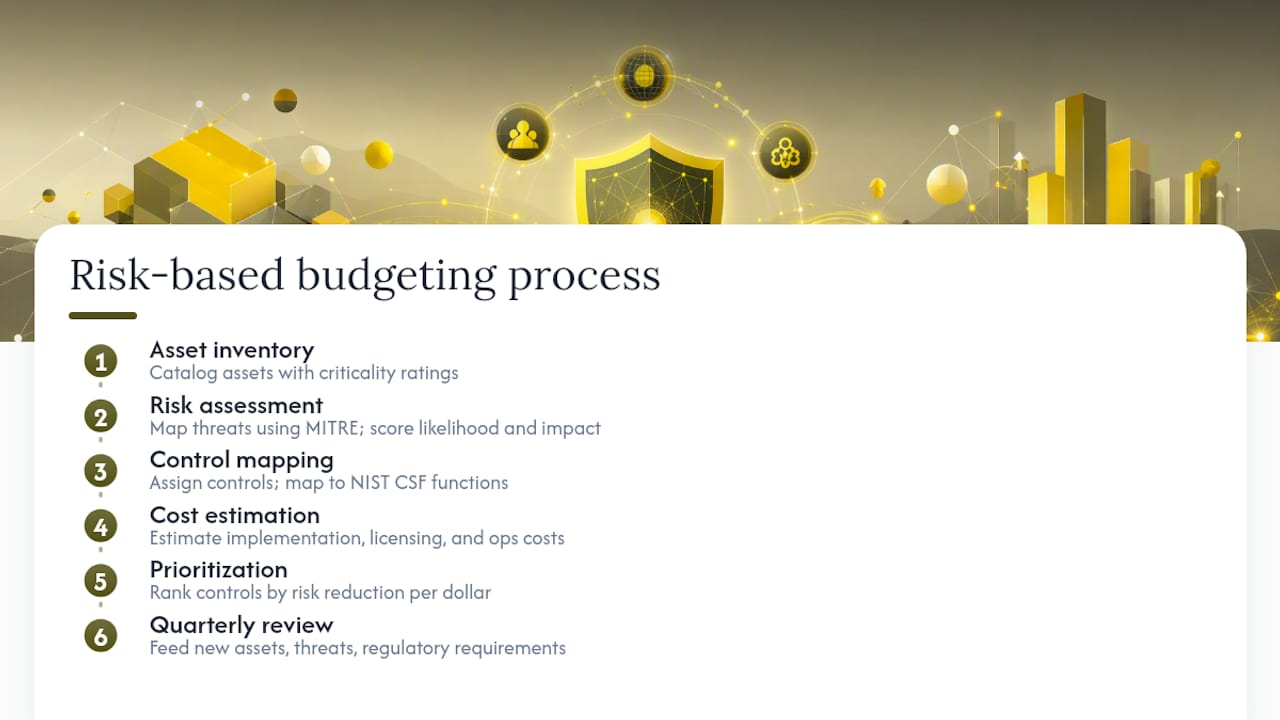
Asset inventory is the foundation. You cannot protect what you have not cataloged. Every device, application, data store, cloud workload, and third-party integration must be documented with its business criticality rating. Systems that touch regulated data or revenue-generating processes get the highest criticality scores.
Risk assessment maps threats to assets. For each high-criticality asset, identify the threat scenarios most likely to affect it, using MITRE ATT&CK as your threat vocabulary. Score each scenario by likelihood and potential impact to produce a ranked risk register.
Control mapping connects the risk register to proposed controls. For each top-ranked risk, identify the control or set of controls that would reduce the likelihood or impact, then map those controls to NIST CSF functions. This step produces the justification structure for the budget request.
Cost estimation assigns a dollar figure to each proposed control, including implementation, licensing, and ongoing operational costs. Where internal staff time is the primary cost, estimate hours and apply a fully loaded labor rate.
Prioritization applies the scoring matrix described earlier to rank controls by risk reduction per dollar spent. Controls that address multiple risks simultaneously score higher. The output is a prioritized list that maps directly to your budget line items.
This process is iterative. New assets, new threats, and new regulatory requirements feed back into step one at each quarterly review.
How do you adjust the budget when threats change mid-cycle?
A static annual budget is a liability in a threat environment that shifts monthly. Three mechanisms keep your budget responsive without requiring a full re-approval cycle.
Document the conditions that trigger a reallocation (a new threat intelligence advisory, a sector-specific attack campaign, a regulatory change) and the approval path (CISO plus CFO sign-off).
Threat-triggered review protocol: When a significant threat emerges, such as a zero-day affecting a widely deployed platform in your environment, convene a 48-hour review to assess exposure, estimate remediation cost, and identify which existing budget lines can absorb the cost or whether a reserve drawdown is warranted.
Incident-driven re-allocation: After any incident that triggers the reserve, conduct a post-incident budget review within 30 days. Assess whether the incident revealed a gap in the current allocation (e.g., insufficient detection coverage, inadequate backup testing) and propose a reallocation for the remainder of the fiscal year. Forrester’s 2026 guidance frames this as treating the security budget as a portfolio that can be rebalanced in response to market conditions, which is exactly the right mental model for finance conversations.
How does security budget planning connect to corporate financial planning?
Security budgeting that happens in isolation from the broader IT and corporate financial planning cycle gets cut first and justified last. Integration requires three specific connection points.
Align with the IT budget cycle. Security spend is a subset of total IT spend, and the SSI benchmark only makes sense in that context. Work with the CIO to ensure security line items appear in the IT budget submission with clear cross-references, so finance can see the security allocation as a percentage of total IT spend without manual calculation.
Connect to enterprise risk management (ERM). Most organizations have an ERM framework that tracks operational, financial, and strategic risks. Cyber risk belongs in that register with a dollar-denominated impact estimate. When the CFO reviews the ERM report, the security budget should appear as the mitigation cost for the cyber risk line items already on the register.
Sync with the insurance renewal cycle. Cyber insurance renewals typically require a security posture questionnaire. The budget planning cycle should produce documentation (control inventory, pen test results, incident response plan) that directly feeds the insurance application. A stronger documented posture often translates to lower premiums, which is a concrete ROI figure you can present to finance. The cybersecurity business priority context reinforces why this integration matters for regulated industries specifically.
How do you monitor spending and report ROI after approval?
Approval is not the finish line. Post-approval execution determines whether the next budget cycle is easier or harder to justify.

Monthly spend tracking: Compare actual spend to budget by category using the line items sheet from the workbook. Underspending on detection and response is as concerning as overspending, because it often signals that planned controls were not implemented on schedule.
Quarterly KPI reporting: Report MTTD, MTTR, detection-to-containment hours, and SSI to the CISO and CIO. Present trends, not just point-in-time values. A declining MTTR over three quarters is a concrete ROI story.
Annual ROI summary for the board: Calculate the expected-loss reduction delivered by controls implemented during the year. Compare the cost of those controls to the EAL reduction they produced. If the math holds, the security program paid for itself in risk transfer terms. If it does not, document why (threat environment changed, controls underperformed) and adjust the next cycle’s assumptions accordingly.
Stakeholder reporting cadence: Monthly spend reports go to the CISO and finance. Quarterly KPI reports go to the CIO and executive team. Annual ROI summaries go to the board or audit committee. Each audience gets a different level of detail, but the underlying data is the same workbook.
What most security budget guides get wrong
Most IT security budget planning guides treat the budget as a procurement exercise: list the tools, add up the costs, submit the request. That framing loses the argument with finance before it starts.
The more defensible position is that a security budget is a risk-transfer instrument. Every dollar spent on detection and response is a dollar that reduces the expected cost of an incident the organization would otherwise absorb entirely. When you present it that way, with the EAL math visible and the NIST CSF mapping showing coverage, finance has a framework to evaluate the request on the same terms they use for any other capital allocation.
The second mistake is treating the budget as an annual document rather than a living portfolio. Threat environments do not follow fiscal years. Organizations that build pre-authorized reallocation bands and quarterly review checkpoints into the approval process are measurably better positioned to respond to mid-cycle threats without emergency budget requests that damage credibility.
Common pitfalls to avoid:
- Tool proliferation: Buying a new tool for every new threat instead of tuning existing platforms is the fastest way to create alert noise and budget waste.
- Under-sized incident reserve: A reserve that covers only forensics but not legal, PR, and customer remediation will be exhausted before the incident is contained.
- Weak vendor SLAs: An MSSP contract without a guaranteed response time and escalation path is not a security control; it is a vendor relationship.
- Missing measurement: A budget line without a KPI attached to it cannot be defended in the next planning cycle.
When presenting to finance, show the expected-loss calculation and the SSI benchmark side by side. The math says the investment is justified; the benchmark says peers agree. Together, they are far more persuasive than a list of tool names.
247techify delivers the SOC capability your budget plan calls for
Planning the budget is one challenge. Executing it without a 24/7 security operations capability is another. 247techify’s managed IT services give Canadian businesses immediate SOC depth, with a guaranteed response time under 30 minutes, predictable monthly pricing, and incident response standby built into the service model.
For organizations that want to keep internal control while adding external monitoring, the co-managed IT model lets your team own architecture and policy while 247techify handles 24/7 alert triage, threat detection, and escalation. That structure maps directly to the hybrid staffing model this guide recommends for most mid-market organizations. If you want to validate your budget sizing and run the expected-loss calculation with a team that does this daily, contact 247techify to schedule a scoping call.
Sources
These sources belong in your board materials when justifying security spend:
- 2026 Boom, Bust, & Baseline Planning For Security Leaders
- Nist
- Cybersecurity Budget Benchmarks 2026: What Enterprises Actually Spend - Axis Intelligence
- Why Cyber Risk Belongs in Financial Planning — The Wealth Threat Most People Still Ignore
This article is general information, not a substitute for advice from a qualified financial advisor. Consult a qualified financial professional about your own circumstances before acting on anything here.
FAQ
What percentage of IT budget should go to security?
Axis Intelligence reports a worldwide Security Spend Intensity of approximately 3.91% of total IT spend in 2026; treat that as a floor, not a ceiling, and adjust for your sector and regulatory environment.
How do you justify a security budget increase to the CFO?
Present an expected-loss calculation showing the annualized cost of your top threat scenarios, then compare the proposed control cost to the expected-loss reduction it produces. Pair that math with the SSI benchmark to show the request is consistent with peer spending.
What is the NIST CSF and why does it matter for budgeting?
The NIST Cybersecurity Framework maps security controls to five functions (Identify, Protect, Detect, Respond, Recover), giving you a structured way to assign each budget line item to a measurable outcome and demonstrate coverage gaps to finance and the board.
Should a mid-market organization hire a security team or use an MSSP?
Most mid-market organizations benefit from a hybrid model: internal staff for architecture, policy, and vendor management, with an MSSP or MDR provider handling 24/7 monitoring and alert triage. This structure delivers coverage without the cost of a fully staffed internal SOC.
How large should an incident reserve be?
Size the reserve to cover at least one major incident, including external forensics, legal counsel, public relations, temporary staffing, and customer notification costs. Document the reserve governance (dual authorization, written incident declaration) during the budget approval process.