
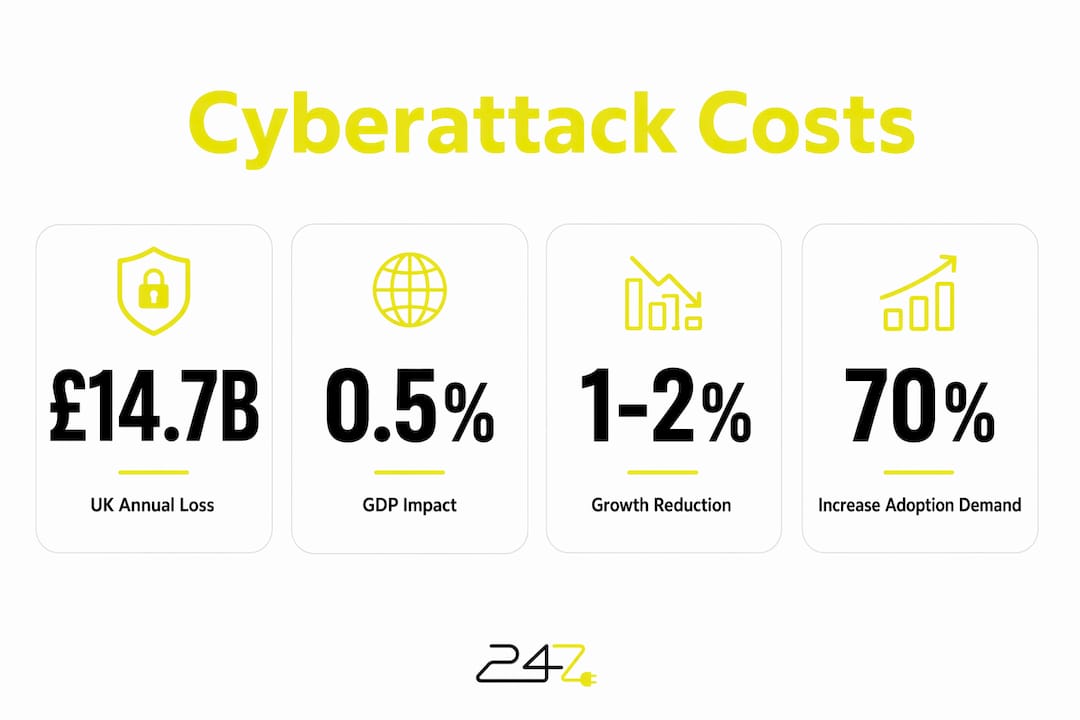
Cybersecurity is defined as the practice of protecting systems, networks, and data from digital attacks that disrupt operations, expose sensitive information, and destroy stakeholder trust. Why cybersecurity is a business priority is no longer a question reserved for IT departments. It sits at the board table alongside revenue targets and market expansion plans. Cybersecurity preparedness correlates with a 1–2 percentage point increase in value-added growth for digitally exposed sectors across 178 countries. That figure alone reframes security from a technical expense into a direct driver of economic performance. Business leaders who treat cyber risk as a governance issue, not a technology problem, position their organizations to grow faster and fail less often.
Why cybersecurity is a business priority for growth and resilience
Cybersecurity does more than block attacks. It creates the conditions under which businesses can adopt new technology, enter new markets, and maintain uninterrupted operations. A company that cannot guarantee the integrity of its systems cannot credibly offer digital services, process sensitive customer data, or pursue partnerships that require due diligence on security posture.
Strong cybersecurity foundations enable faster adoption of AI and expansion into new markets with fewer operational surprises. This matters because AI adoption is no longer optional for competitive businesses. Without a secure infrastructure beneath it, AI deployment introduces new attack surfaces that attackers will exploit before your team detects them.

Embedding cybersecurity at the design stage prevents cascading failures, such as invoice fraud triggered by a compromised employee mailbox. Security integrated into development lifecycles stops small vulnerabilities from becoming enterprise-wide breaches. The cost of fixing a vulnerability after deployment is orders of magnitude higher than catching it during design.
Pro Tip: Map your critical business processes to the systems that support them. Any process that generates revenue or handles regulated data is a priority target. Secure those systems first, then build outward.
The role of cybersecurity in business growth becomes clearest when you examine what operational disruption actually costs:
- Unplanned downtime halts revenue-generating activity and triggers contractual penalties in service-level agreements.
- A breach in a regulated industry like healthcare or finance triggers mandatory reporting under HIPAA or PCI-DSS, adding legal costs on top of remediation expenses.
- Supply chain attacks compromise not just your organization but every partner connected to your network, multiplying reputational damage.
- Recovery from a significant incident typically requires external forensic support, legal counsel, and public relations management simultaneously.
What does a cyberattack actually cost a business?
The financial impact of cyber threats is large enough to register at the national economic level. Significant cyber-attacks cost the UK economy approximately £14.7 billion annually, representing roughly 0.5% of national GDP. That figure reflects direct losses, remediation costs, and productivity damage across public and private sectors combined. For individual businesses, the proportional impact is far more severe.
Board-level governance is the appropriate response to this scale of risk. The National Association of Corporate Directors (NACD) publishes a Cyber Risk Oversight Handbook specifically because cyber risk requires the same governance rigor as financial or legal risk. 72% of corporate directors prioritize technology investments for growth, and 76% expect AI to shape future strategy. Boards that govern digital risk with the same discipline they apply to capital allocation decisions are better positioned to protect those technology investments.
Business leaders who want to build a defensible cyber risk management strategy should work through these four governance steps:
- Classify assets by business criticality. Identify which systems, if compromised, would halt revenue, trigger regulatory penalties, or destroy customer trust. Prioritize protection accordingly.
- Assign board-level ownership. Cyber risk governance must have a named executive sponsor, not just an IT owner. The NACD recommends treating cybersecurity as a strategic risk with C-suite accountability.
- Establish measurable security metrics. Mean time to detect, mean time to respond, and patch compliance rates give leadership quantifiable indicators of security posture. 42% of leaders struggle to demonstrate ROI to executives, which means the shift from activity reporting to outcome metrics is critical.
- Review cyber risk at every board meeting. Cyber risk governance must become a recurring strategic discussion at the board level, linked tightly to business objectives, not treated as a quarterly IT update.
Is cybersecurity a competitive advantage or just a cost?
Cybersecurity is a competitive advantage. The cost-center framing persists because security spending is invisible when it works. The damage is visible only when it fails. That asymmetry distorts how leaders allocate resources.
Companies transparent about cyber risks and their mitigation efforts see higher stakeholder trust and improved financial returns, measured as increased return on assets the following year. Transparency about security posture signals operational maturity to investors, partners, and customers. It is the same logic that makes financial audits valuable: independent verification of controls builds confidence.
Strong cyber hygiene enhances corporate valuation during investment and M&A due diligence by evidencing risk management. Acquirers now conduct detailed cybersecurity assessments before closing deals. A weak security posture can reduce a company’s valuation, delay a transaction, or kill it entirely. Conversely, a mature security program accelerates due diligence and signals that the business is well-managed.
The table below contrasts two organizational postures on cybersecurity investment:
| Dimension | Reactive posture | Proactive posture |
|---|---|---|
| Security timing | Applied after incidents occur | Embedded at design and planning stages |
| Board involvement | Episodic, incident-driven | Recurring agenda item linked to strategy |
| Stakeholder communication | Reactive disclosure | Transparent, proactive reporting |
| M&A and fundraising impact | Delays due diligence, reduces valuation | Accelerates deals, supports higher valuation |
| Technology adoption | Slowed by unresolved vulnerabilities | Enabled by secure infrastructure |
Pro Tip: Before your next board meeting, ask your CISO to present one metric that connects a security investment to a business outcome, such as uptime protected, contracts won due to compliance certification, or regulatory penalties avoided. That framing changes the conversation.
How should leaders integrate cybersecurity into business strategy?
Cybersecurity leadership is relationship-driven. It requires collaboration across internal teams and external ecosystem partners, not just technical expertise inside the security function. CISOs must shift focus from reporting cybersecurity activities to demonstrating business outcomes related to trust, revenue, and operational continuity.
The cybersecurity threat landscape in 2026 demands that leaders align security investments with business objectives, not treat them as separate budget lines. When a company plans to expand into a new market, the security team should be part of that planning from day one, not brought in after contracts are signed.
Cross-functional collaboration is the mechanism that makes this work. Security teams must partner with legal, finance, operations, and HR to identify where sensitive data flows, where third-party risk concentrates, and where regulatory requirements apply. Employee cybersecurity training is one of the highest-return investments a business leader can make, because human error remains the most common entry point for attackers.
Key metrics that leadership teams should track on a recurring basis include:
- Mean time to detect (MTTD): How long does it take your team to identify a threat after it enters the network?
- Mean time to respond (MTTR): How quickly can your team contain and remediate an incident?
- Patch compliance rate: What percentage of known vulnerabilities are addressed within your defined remediation window?
- Security awareness training completion: Are all employees current on phishing recognition and credential hygiene?
- Third-party risk assessment coverage: What percentage of your critical vendors have been assessed for security posture?
These metrics give the C-suite a factual basis for resource allocation decisions and allow the board to hold leadership accountable for security outcomes, not just security spending.
Key Takeaways
Cybersecurity is a direct driver of business growth, financial performance, and stakeholder trust, and organizations that treat it as a strategic priority outperform those that treat it as a cost center.
| Point | Details |
|---|---|
| Cybersecurity drives growth | Preparedness correlates with 1–2 percentage point higher value-added growth in digitally exposed sectors. |
| Cyber risk belongs at the board level | NACD recommends treating cyber risk with the same governance rigor as financial and legal risk. |
| Transparency builds financial returns | Companies that disclose cyber risks clearly see higher return on assets the following year. |
| Proactive security enables M&A success | Strong cyber hygiene accelerates due diligence and supports higher corporate valuations. |
| Metrics connect security to outcomes | Tracking MTTD, MTTR, and patch compliance gives leadership a factual basis for investment decisions. |
The 247techify team’s take: security is a leadership decision, not an IT decision
The most persistent mistake we see among business leaders is treating cybersecurity as something that happens below the executive level. The CISO reports to IT, IT reports to the COO, and the board hears about security only after an incident. That structure guarantees delayed response and misaligned investment.
The leaders who get this right treat their CISO as a business strategist. They ask security teams to speak in the language of revenue, continuity, and risk, not in the language of firewalls and patch cycles. When a security leader can say “this investment protects $4 million in annual contract value from a single regulated client,” the conversation changes immediately.
We have also seen how cybersecurity’s role in customer trust directly affects retention and referral rates, particularly in healthcare and financial services. Clients in regulated industries do not just want a vendor with good technology. They want a partner who can demonstrate compliance with HIPAA, PCI-DSS, and other frameworks on demand. That demonstration is a sales asset, not just a compliance checkbox.
The uncomfortable truth is that cyber risk oversight integrated with enterprise risk management is still rare. Most organizations run security as a parallel track. The ones that integrate it into strategic planning, capital allocation, and M&A evaluation are the ones that grow without catastrophic interruption. That is the standard worth building toward.
— 247techify Team
How 247techify supports your cybersecurity strategy
Business leaders who recognize cybersecurity as a strategic priority need a partner who can execute at that level, not just manage tickets.

247techify delivers a cybersecurity-first approach to managed IT services built specifically for Canadian businesses in regulated industries. The team provides 24/7 monitoring with a response time under 30 minutes, compliance expertise across HIPAA and PCI-DSS, and AI-native cybersecurity services through the CybrXPRT platform. With a 98% client satisfaction rate, 247techify gives leadership teams the security foundation they need to pursue growth without operational risk. If your board is ready to treat cyber risk as a strategic issue, 247techify is the partner to make that transition concrete.
FAQ
Why is cybersecurity considered a business priority?
Cybersecurity directly protects revenue, operational continuity, and stakeholder trust. Research shows that cybersecurity preparedness correlates with measurably higher economic growth in digitally exposed sectors.
What is the financial impact of a cyberattack on a business?
Cyberattacks cost the UK economy approximately £14.7 billion annually, about 0.5% of GDP. For individual businesses, the costs include remediation, legal exposure, regulatory penalties, and reputational damage that affects future revenue.
How does cybersecurity support business growth?
Strong security foundations enable faster AI adoption, smoother market expansion, and higher corporate valuations during M&A due diligence. Business leaders who reframe cybersecurity as a growth enabler pursue new opportunities with greater confidence.
What metrics should business leaders track for cyber risk?
Leaders should monitor mean time to detect, mean time to respond, patch compliance rates, security training completion, and third-party vendor assessment coverage. These metrics connect security investment to measurable business outcomes.
How should boards govern cybersecurity risk?
The NACD recommends treating cybersecurity as a strategic risk with board-level accountability and recurring agenda time. Cyber risk governance must be linked to business objectives, not treated as a standalone IT function.