
Network security is defined as the practice of protecting an organization’s network infrastructure by controlling access, monitoring traffic, and enforcing policies to prevent unauthorized access and data breaches. For IT professionals managing small to mid-sized business environments, understanding how network security works is the foundation of every sound cybersecurity decision. The field draws on three pillars: technology, policy, and procedure. Standards like the Center for Internet Security (CIS) Controls, frameworks like Zero Trust, and technologies like VPNs and firewalls all operate within this structure. Getting these fundamentals right determines whether your organization can withstand a real attack.
How does network security protect an organization’s data and infrastructure?
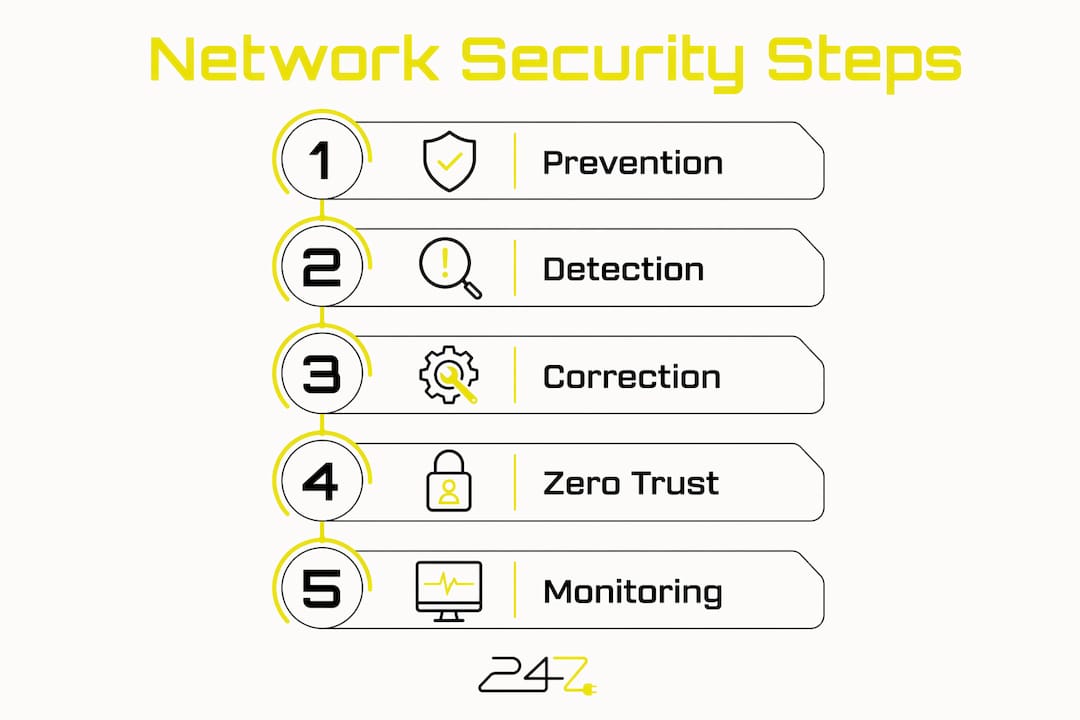
Network security protects data and infrastructure through three categories of controls: preventive, detective, and corrective. Preventive controls stop threats before they enter the network. Detective controls identify threats already inside. Corrective controls contain damage and restore normal operations after an incident.
The core tools in a layered defense model include:
- Firewalls filter traffic between network zones based on defined rules, blocking unauthorized connections at the perimeter and between internal segments.
- VPNs encrypt traffic between remote users and the corporate network, preventing interception over untrusted connections.
- Identity and Access Management (IAM) enforces who can access which systems, applying least-privilege principles to reduce the blast radius of compromised credentials.
- Intrusion Detection Systems (IDS) and Network Detection and Response (NDR) monitor traffic patterns and flag anomalous behavior for investigation.
- Incident response plans define the steps your team takes when a breach occurs, reducing recovery time and limiting data loss.
Email is the number one threat vector in most organizations. That single fact means dedicated email security controls are not optional. They belong in every layered defense model alongside firewalls and endpoint protection.
The concept tying all of these together is defense in depth. No single control stops every attack. Each layer compensates for the weaknesses of the others. When a phishing email bypasses your email filter, your endpoint protection should catch the payload. When the endpoint is compromised, network segmentation should limit how far the attacker can move.

Pro Tip: Map your controls against the three categories — preventive, detective, corrective — and identify gaps. Most SMBs over-invest in prevention and under-invest in detection and response.
What are the key best practices and architectures in modern network security?
Zero Trust is the current industry standard for network security architecture. Traditional perimeter-based security is insufficient because it assumes everything inside the network boundary is safe. Zero Trust eliminates that assumption. Every access request is validated against identity, device posture, and access context before it is granted. No user or device receives implicit trust.
Network segmentation and east-west traffic control
Segmentation divides the network into isolated zones. Traffic between zones must be explicitly permitted. This limits lateral movement: if an attacker compromises one segment, they cannot freely access others. Standardizing network architecture, segmenting east-west traffic, and enforcing identity-based access are the foundational practices that reduce both outages and breach impact. East-west traffic refers to traffic moving between internal systems, as opposed to north-south traffic moving between internal systems and the internet.
Identity-based access and management controls
Management interfaces for routers, switches, and servers should be accessible only from a dedicated management network or jump host. Broad administrative access is one of the most exploited weaknesses in SMB environments. Enforcing multi-factor authentication (MFA) on all privileged accounts closes a significant portion of that exposure.
Continuous monitoring and configuration validation
Security posture degrades over time without active monitoring. Configurations drift, rules accumulate, and exceptions become permanent. Scheduled configuration reviews and continuous traffic monitoring catch these issues before attackers do.
The table below compares traditional perimeter security with Zero Trust across key dimensions:
| Dimension | Traditional perimeter | Zero Trust |
|---|---|---|
| Trust model | Implicit trust inside the perimeter | No implicit trust; verify every request |
| Access control | Network location determines access | Identity and device posture determine access |
| Lateral movement risk | High; attackers move freely once inside | Low; segmentation limits movement |
| Monitoring scope | Perimeter traffic only | All traffic, including east-west |
| Incident containment | Slow; broad access complicates isolation | Fast; segmentation contains the blast radius |
Pro Tip: You do not need to implement Zero Trust overnight. Start with identity-based access on management interfaces and segment your most sensitive data first. Incremental progress beats a stalled full deployment.
What challenges do IT teams face when implementing network security?
Implementation challenges are where most SMB security programs break down. The gap between knowing best practices and executing them consistently is wider than most IT teams expect.
Strict change management and documented firewall and ACL rules prevent the auditability issues that create security gaps. Ad-hoc firewall changes made under pressure, without documentation, accumulate into a ruleset nobody fully understands. Auditing becomes impossible, and removing outdated rules becomes a risk in itself.
Access Control Lists (ACLs) carry a behavior that catches many teams off guard. Every ACL ends with an implicit deny all rule, meaning any traffic not explicitly permitted is dropped by default. This is the correct security posture, but it causes unexpected connectivity failures when new services or segments are added without corresponding permit rules. Understanding ACL order and default behavior is the difference between a controlled rollout and a production outage.
Outbound filtering is the most commonly neglected control in SMB networks. Egress filtering is often overlooked, which allows malware to communicate with command-and-control servers using common ports like 443. Attackers deliberately use trusted ports because most organizations only filter inbound traffic. Explicit outbound rules and logging for egress traffic close this gap.
The following pitfalls appear consistently across SMB environments:
- Relying on a single perimeter firewall with no internal segmentation
- Allowing management access from any internal IP address
- Skipping egress filtering because “outbound traffic is trusted”
- Making firewall changes without a change ticket or rollback plan
- Treating security tools as independent silos rather than an integrated system
Security controls must be integrated to provide shared context for correlated alerts. Attackers use complex, non-linear attack paths that no single tool sees in full. Firewall logs, SIEM platforms, and identity systems must share data to produce alerts that are actually actionable.
Without foundational networking knowledge, configuring complex security controls is ineffective. Understanding the OSI model, TCP/IP stack, IP addressing, ports, and protocols is not optional background knowledge. It is the prerequisite for correctly configuring every tool in your security stack.
How to apply network security best practices in SMB environments
Applying network security in an SMB context requires sequencing. Trying to implement everything at once produces incomplete controls and team burnout. The order below reflects the highest-impact steps first.
-
Segment the network and lock down management access. Create separate VLANs for servers, workstations, IoT devices, and guest traffic. Restrict management interfaces to a dedicated subnet with MFA enforced. This single step limits lateral movement more than any other control. Use your network security checklist to track progress against each requirement.
-
Deploy layered security controls. Install a next-generation firewall with application-layer inspection. Add endpoint detection and response (EDR) on all workstations and servers. Enable DNS filtering to block malicious domains before connections are established.
-
Establish change management. Every firewall rule change, ACL modification, and configuration update requires a change ticket with a documented rollback plan. This is not bureaucracy. It is the only way to maintain an auditable security posture over time.
-
Train your team on email threat defense. Email remains the primary entry point for ransomware and credential theft. Employee cybersecurity training focused on phishing recognition and safe email practices reduces the human-factor risk that technical controls cannot fully eliminate.
-
Build and test an incident response plan. Document the steps your team takes when a breach is detected: isolation, notification, evidence preservation, and recovery. Test the plan with a tabletop exercise at least once per year. A plan that has never been tested will fail under pressure.
-
Review policies and configurations on a scheduled cycle. Quarterly reviews of firewall rules, user access rights, and security configurations catch drift before it becomes a vulnerability. Remote team IT security adds complexity that makes scheduled reviews even more critical for distributed environments.
Pro Tip: Assign a named owner to each security control. Controls without owners degrade silently. Ownership creates accountability and ensures reviews actually happen.
Key Takeaways
Effective network security requires layered controls, Zero Trust architecture, strict change management, and continuous monitoring working together as an integrated system.
| Point | Details |
|---|---|
| Defense in depth is non-negotiable | No single control stops every attack; preventive, detective, and corrective layers must all be present. |
| Zero Trust replaces perimeter security | Every access request requires identity and device validation; implicit trust is the root cause of lateral movement. |
| Egress filtering closes a critical gap | Outbound traffic rules and logging prevent malware from communicating undetected on trusted ports like 443. |
| Change management protects auditability | Every firewall and ACL change needs documentation and a rollback plan to maintain a consistent security posture. |
| Foundational knowledge enables every tool | Understanding OSI, TCP/IP, ports, and protocols is the prerequisite for configuring any security control correctly. |
What we have learned from securing SMB networks
The most persistent mistake we see in SMB network security is the assumption that a perimeter firewall is sufficient. Organizations invest in a capable firewall at the edge, then leave the internal network completely flat. When an attacker gets past the perimeter, which they will, they find no further resistance. The attacker has the keys to every room in the building.
The second mistake is treating security tools as independent products rather than a connected system. A firewall that does not share logs with your SIEM, and a SIEM that does not correlate with your identity platform, produces noise rather than intelligence. Treating controls as integrated systems rather than silos is what separates organizations that detect breaches in hours from those that discover them months later.
The teams that build effective security programs start small and build systematically. They segment the network, lock down management access, document every change, and train their people. They do not wait for a breach to justify the investment. Minimizing attack surface by design is a more durable goal than chasing uptime metrics.
Cross-functional collaboration matters more than most IT leaders expect. Security decisions affect operations, finance, and compliance. Bringing those stakeholders into policy reviews produces better rules and faster approval when changes are needed.
— 247techify Team
How 247techify supports network security for Canadian SMBs
Canadian businesses operating in regulated industries face network security requirements that go beyond general best practices. HIPAA, PCI-DSS, and provincial privacy regulations each impose specific controls on how data moves across your network.

247techify delivers managed cybersecurity services built specifically for SMBs that need continuous monitoring, incident response, and compliance support without building an internal security operations team. With a response time under 30 minutes and 24/7 coverage, 247techify acts as the security layer between your business and the threats targeting it. For organizations that want to augment an existing IT team rather than replace it, co-managed IT services provide the flexibility to fill specific gaps in your network security program.
FAQ
What is network security?
Network security is the practice of protecting a network’s infrastructure, data, and users by controlling access, monitoring traffic, and enforcing security policies. It combines technology, procedures, and standards to prevent unauthorized access and data breaches.
How does Zero Trust differ from traditional network security?
Traditional security trusts everything inside the network perimeter. Zero Trust validates every access request based on identity, device posture, and context, regardless of where the request originates.
What is the most common entry point for network attacks?
Email is the number one threat vector in most organizations. Phishing emails deliver malware, steal credentials, and initiate ransomware attacks, making dedicated email security controls a core component of any network defense.
Why does egress filtering matter for network security?
Egress filtering controls outbound traffic and prevents malware from communicating with external command-and-control servers. Attackers use common ports like 443 specifically because most organizations only filter inbound connections.
What foundational knowledge do IT teams need for network security?
Understanding the OSI model, TCP/IP stack, IP addressing, ports, and protocols is the prerequisite for configuring firewalls, ACLs, and other security controls correctly. Without this foundation, even well-designed tools produce misconfigurations and gaps.