
Client data confidentiality in IT is the active obligation to prevent unauthorized access to sensitive client records through encryption, access controls, contractual restrictions, and documented security processes. This is not a passive policy. Under frameworks like NIST SP 800-53, HIPAA, and the CCPA, and per FTC guidance on data security, businesses carry a legal and operational duty to protect what clients share with them.
Three actions to take immediately:
- Build a data inventory. Map every system that stores or transmits client data before you can protect it.
- Enforce access controls. Apply least-privilege and multi-factor authentication (MFA) to every account touching client records.
- Document an incident response plan. A breach without a written response plan turns a containable event into a regulatory crisis.
Harvard Business School research frames privacy not as a compliance checkbox but as a core driver of customer trust, which means confidentiality failures carry reputational costs that outlast any fine.
Key Takeaways
Client data confidentiality in IT is an active, legally enforceable duty requiring encryption, access controls, vendor contracts, and a documented incident response plan across every system that holds sensitive client records.
| Point | Details |
|---|---|
| Data inventory first | Map every system holding client data before applying any other control. |
| Classify to calibrate controls | Use a four-tier model (public, internal, restricted, regulated) to apply proportional protections. |
| MFA is the highest-impact quick win | Enable MFA on all accounts touching restricted or regulated data immediately. |
| Vendor contracts must include a DPA | Every processor handling client data needs a Data Processing Agreement with audit rights. |
| Incident response plan is mandatory | A written, tested plan reduces containment time and limits regulatory exposure. |
Table of Contents
- What actually counts as confidential client data?
- U.S. legal and ethical duties that make confidentiality an active obligation
- Core technical controls that enforce client data confidentiality
- Policies, contracts, and people controls that enforce confidentiality
- Managing client data across its full lifecycle
- How to manage vendors and cloud processors without losing control
- What to do when a breach occurs: a practical incident checklist
- Which U.S. frameworks should your organization actually use?
- A 90-day roadmap to reach baseline confidentiality controls
- Common mistakes that cause confidentiality failures
- How 247techify approaches client data confidentiality for businesses
- Sources
- FAQ
What actually counts as confidential client data?
Not all data carries the same risk, but the categories below require active protection in virtually every U.S. industry:
- Personally Identifiable Information (PII): Social Security numbers, dates of birth, driver’s license numbers, home addresses, and email addresses.
- Protected Health Information (PHI): Medical records, diagnoses, treatment histories, insurance IDs, and any data linking a person to a health condition.
- Financial data: Bank account numbers, credit/debit card numbers (governed by PCI-DSS), tax IDs, and transaction histories.
- Privileged communications: Attorney-client files, accountant-client records, and any correspondence protected by professional privilege.
- Trade secrets and business intelligence: Pricing models, customer lists, proprietary processes, and unreleased product data.
- Credentials and authentication data: Passwords, API keys, session tokens, and certificate private keys.
The combination problem is often overlooked. A name alone is not sensitive. A name paired with a ZIP code, date of birth, and employer can reconstruct an identity. GitLab’s data classification standard captures this precisely: combining otherwise non-sensitive fields can elevate a record to “restricted” or “regulated” status, requiring stronger controls than either field would demand individually.
For professional services firms, the exposure is acute. A law firm’s matter files, a CPA’s tax workpapers, and a healthcare provider’s patient charts each carry overlapping legal protections that compound the consequences of any unauthorized disclosure.
U.S. legal and ethical duties that make confidentiality an active obligation
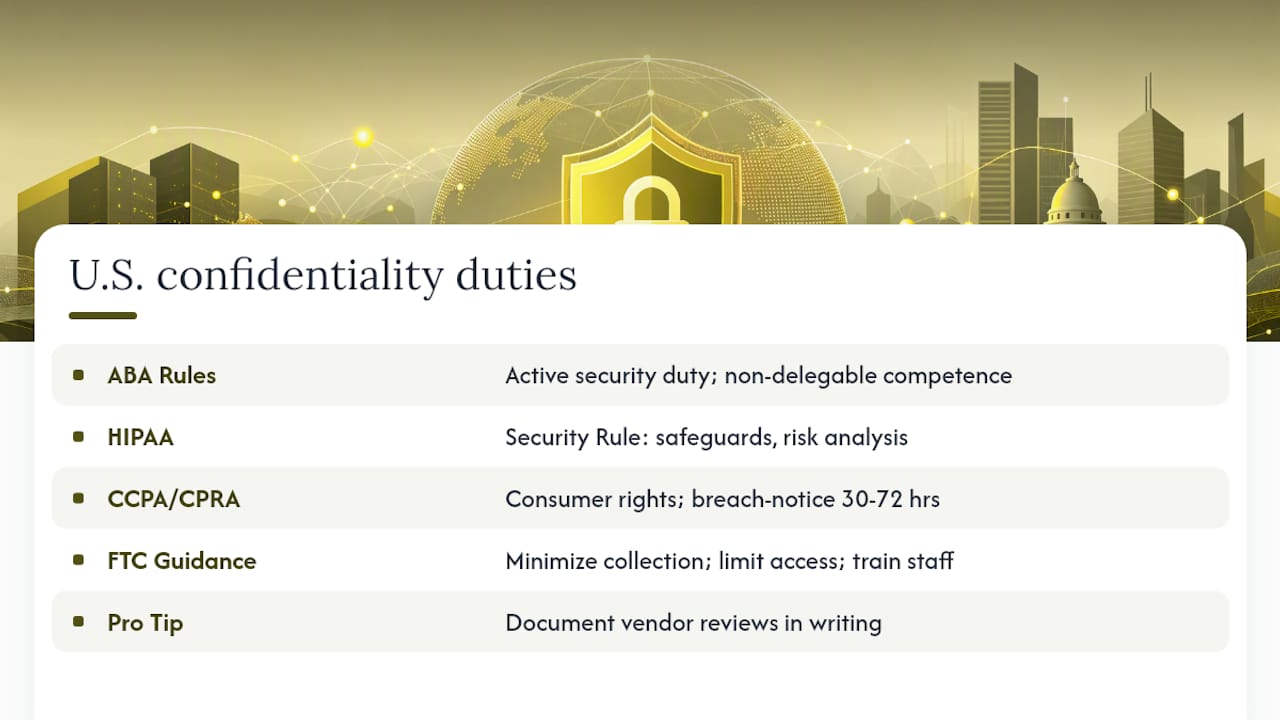
The legal baseline in the United States is not “don’t talk about client data.” It is “take reasonable, documented steps to secure it.”
ABA Model Rule 1.6© requires attorneys to make reasonable efforts to prevent unauthorized disclosure of client information. State variants often go further. Legal scholarship argues that this duty has shifted from passive non-disclosure to an active security obligation requiring documented processes, vendor oversight, and ongoing competence in the technologies attorneys use. The duty of competence under ABA Model Rule 1.1 is non-delegable, meaning an attorney cannot outsource responsibility to a cloud vendor and walk away.
HIPAA (administered by HHS/OCR) requires covered entities and business associates to implement administrative, physical, and technical safeguards for PHI. The Security Rule mandates risk analysis, access controls, audit logs, and workforce training. See how patient data is protected digitally for a technical breakdown of HIPAA-ready controls.
CCPA/CPRA gives California consumers rights over their personal data and imposes security obligations on businesses that collect it. Forty-plus states now have breach-notification laws with varying timelines, typically 30–72 hours for regulated sectors.
FTC guidance applies broadly to businesses outside sector-specific regulation. The FTC’s framework requires minimizing collection, limiting access, training employees, and disposing of data securely.
Pro Tip: Document every vendor-selection decision and security review in writing. If a regulator or bar disciplinary committee asks whether you exercised reasonable care, your paper trail is your defense.
Core technical controls that enforce client data confidentiality
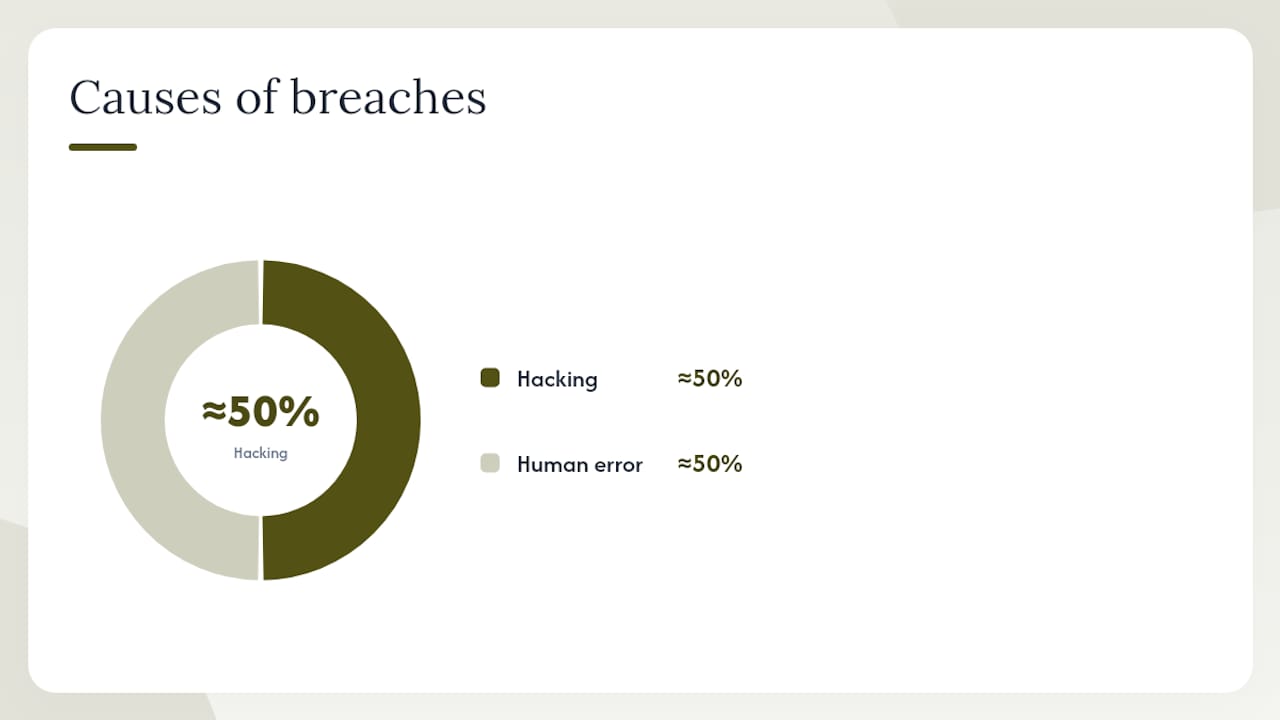
Data confidentiality in IT centers on three pillars: encryption, access control, and auditing. Breaches arrive via hacking and human error in roughly equal measure, so controls must address both.
- Encryption in transit: TLS 1.2 or 1.3 for all data moving across networks. No exceptions for internal traffic on shared Wi-Fi.
- Encryption at rest: AES-256 for stored files, databases, and backups. Encrypt laptops with BitLocker or FileVault.
- MFA everywhere: Enforce MFA on email, VPN, cloud consoles, and any system holding client records. Phishing-resistant methods (FIDO2/WebAuthn) are preferable to SMS codes.
- Role-based access control (RBAC) and least privilege: Grant access only to the data a role requires. Review permissions quarterly.
- Network segmentation: Isolate systems holding sensitive client data from general office traffic. A compromised workstation should not have a direct path to your client database.
- Logging and auditing: Capture authentication events, data exports, and privileged-account activity. Review logs regularly, not just after an incident.
- Data masking and tokenization: Replace live card numbers or SSNs with tokens in non-production environments. This limits exposure during development and testing.
- Secure backups: Maintain encrypted, offsite or cloud backups with tested restoration procedures. Cloud backup and disaster recovery planning is a direct component of confidentiality, not just availability.
Pro Tip: Store cryptographic keys separately from the data they protect. A backup encrypted with a key stored in the same location offers no real protection if that location is compromised.
Policies, contracts, and people controls that enforce confidentiality
Technical controls fail without the human layer. The FTC recommends requiring employee agreements, limiting access, and training staff as foundational protections.
Essential policies every organization needs:
- Confidentiality and NDA agreements signed at hire and updated when roles change.
- Acceptable-use policy covering personal devices, cloud storage, and email.
- BYOD policy specifying MDM enrollment and remote-wipe authority.
- Remote-access policy requiring VPN and MFA for any off-site connection.
- Data retention and disposal policy with documented schedules.
Employee controls that actually reduce risk:
- Role-based access approvals with a named data owner authorizing each request.
- Periodic reauthorization (at minimum annually) to confirm access is still needed.
- Phishing simulations and social-engineering training, not just annual slide decks. See employee cybersecurity training steps for a structured approach.
- Immediate access revocation on offboarding, with a documented checklist.
IT confidentiality agreements should define what counts as confidential, the duration of the obligation, permitted disclosures, and consequences of breach. Vague language (“keep it private”) creates enforcement gaps.
Managing client data across its full lifecycle
Confidentiality obligations attach at collection and don’t end until data is verifiably destroyed.
- Collect only what you need. The FTC is explicit: don’t collect sensitive information you have no legitimate business need for.
- Classify at ingestion. Apply a label (public, internal, restricted, regulated) the moment data enters your systems, using a standard like GitLab’s four-tier model.
- Set retention schedules. Document how long each data category is kept and why. Legal holds override schedules, but they must be declared formally.
- Archive securely. Archived records should carry the same access controls as live data. “Old” does not mean “low risk.”
- Dispose with verification. Use NIST SP 800-88 sanitization methods: cryptographic erasure for SSDs, degaussing or physical destruction for magnetic media, and certified shredding for paper records.
Legal holds require special handling. When litigation or a regulatory inquiry is reasonably anticipated, suspend normal disposal schedules immediately and document the hold in writing.
How to manage vendors and cloud processors without losing control
Every vendor that touches client data extends your attack surface. Contractual controls are not optional.
Contract clauses every vendor agreement must include:
- Data Processing Agreement (DPA) specifying permitted uses, sub-processor restrictions, and data return/deletion on termination.
- Security SLAs with defined patch timelines and incident notification windows (72 hours is a common baseline).
- Right-to-audit clause allowing you to request SOC 2 Type II reports or conduct assessments.
- Flow-down confidentiality obligations binding sub-processors to the same standards.
Vendor due diligence checklist:
- Request the vendor’s current SOC 2 Type II or ISO/IEC 27001 certification.
- Ask for a summary of their most recent penetration test and remediation status.
- Confirm data residency: where is client data stored, and does that jurisdiction create additional legal exposure?
- Verify breach notification procedures and test whether their timeline meets your regulatory obligations.
- Review sub-processor lists annually.
What to do when a breach occurs: a practical incident checklist
Speed and documentation both matter. A disorganized response compounds the legal exposure.
- Detect and confirm. Validate the alert. Distinguish a true breach from a false positive before escalating.
- Contain immediately. Isolate affected systems. Revoke compromised credentials. Do not wipe systems before forensic preservation.
- Preserve evidence. Capture logs, memory images, and network captures. Chain-of-custody documentation starts here.
- Notify legal counsel. Engage counsel before external notifications to preserve privilege over the investigation.
- Assess notification obligations. HIPAA OCR requires covered entities to notify affected individuals within 60 days of discovery. Most state breach-notification laws require notification within 30–72 hours for regulated data. The FTC expects prompt action for businesses under its jurisdiction.
- Notify affected parties. Follow the applicable timeline. Document every notification sent.
- Remediate and review. Fix the root cause. Conduct a post-incident review and update controls and the incident plan.
Rapid-response team composition: legal counsel, IT/security lead, a communications contact, and executive sponsor. Assign roles before an incident, not during one.
Which U.S. frameworks should your organization actually use?
| Framework | Best fit | Core confidentiality contribution |
|---|---|---|
| NIST CSF 2.0 | Any U.S. business | Identify, Protect, Detect, Respond, Recover functions |
| NIST SP 800-53 | Federal contractors, regulated entities | Detailed control catalog for access, audit, and encryption |
| NIST Privacy Framework | Organizations processing personal data | Maps privacy risks to operational controls |
| HIPAA Security Rule | Healthcare covered entities and BAs | PHI safeguards: administrative, physical, technical |
| CCPA/CPRA | Businesses serving California consumers | Consumer rights, security obligations, breach notification |
| PCI-DSS v4.0 | Any entity processing card payments | Cardholder data protection, network segmentation, logging |
| SOC 2 (Type II) | SaaS and service providers | Third-party attestation of security, availability, confidentiality |
| ISO/IEC 27001 | Organizations seeking international recognition | ISMS certification with documented risk treatment |
| FTC Safeguards Rule | Non-bank financial institutions | Specific technical and administrative safeguard requirements |
Start with NIST CSF if you have no existing framework. Layer HIPAA or PCI-DSS on top when sector-specific rules apply. Pursue SOC 2 or ISO 27001 when clients or contracts demand third-party attestation. For IT compliance standards in financial services, PCI-DSS and NIST SP 800-53 are the natural starting points.
A 90-day roadmap to reach baseline confidentiality controls
Days 1–30: Inventory and classify
- Complete a data inventory: every system, database, and file share holding client data.
- Apply a four-tier classification (public, internal, restricted, regulated) to each data store.
- Enable MFA on all accounts with access to restricted or regulated data. This is the highest-impact, lowest-cost action available.
Days 31–60: Harden and document
- Enforce least-privilege access and remove stale accounts.
- Encrypt all laptops and confirm backup encryption is active.
- Draft or update your confidentiality policy, NDA template, and acceptable-use policy.
- Audit vendor agreements and identify those missing a DPA.
Days 61–90: Test and formalize
- Conduct a tabletop incident response exercise.
- Run a phishing simulation and document results.
- Complete a formal risk assessment against your chosen framework (NIST CSF is a practical starting point for SMBs).
- Schedule quarterly log reviews and annual penetration testing.
For SMB infrastructure hardening specifics, the quick-win sequence is MFA, then encryption, then access reviews.
Common mistakes that cause confidentiality failures
- Over-collection of PII. Collecting fields “just in case” multiplies your liability without business justification. Stop collecting what you cannot justify retaining.
- Untreated vendor risk. A vendor breach is your breach if you lack contractual controls. Audit vendor agreements annually.
- Weak or shared credentials. Shared admin accounts make attribution impossible and access revocation ineffective. Enforce individual accounts with MFA.
- No incident response plan. Organizations without a written plan take significantly longer to contain breaches and face higher regulatory scrutiny.
- Insufficient training. Annual slide decks do not change behavior. Phishing simulations and role-specific training do.
- Stale access rights. Former employees and contractors with active credentials are a persistent threat. Offboarding checklists must include immediate access revocation.
Red flags in monitoring: Bulk data exports outside business hours, privileged account logins from unfamiliar IP ranges, and repeated failed authentication attempts on accounts holding client records all warrant immediate investigation.
“Focusing solely on prevention fails to reduce harm when breaches occur. Successful confidentiality programs combine process controls, documented decision chains, and clear incident response procedures.” — Client Confidentiality as Data Security
How 247techify approaches client data confidentiality for businesses
At 247techify, we treat confidentiality as an operational discipline, not a document exercise. Every managed IT engagement starts with a data inventory and classification review, because you cannot protect what you have not mapped. From there, we layer technical controls (MFA, endpoint encryption, network segmentation) with administrative controls (policy templates, vendor DPA reviews, employee training programs) to build a program that holds up under regulatory scrutiny.
For organizations in healthcare, finance, and legal services, we align controls directly to HIPAA, PCI-DSS, and applicable state privacy obligations, and we document the decision chain so your team can demonstrate reasonable care to any auditor or bar committee.
If your organization needs a compliance audit, a risk assessment, or ongoing managed security to protect client data, 247techify’s managed IT services and compliance auditing services are built for exactly this. Contact us to schedule an initial risk scan.
Sources
- Client Confidentiality as Data Security
- Harvard Business School faculty item
- Protecting Personal Information: A Guide for Business | Federal Trade Commission
This article is general information, not a substitute for advice from a qualified lawyer. Consult a qualified legal professional about your own circumstances before acting on anything here.
FAQ
What is client data confidentiality in IT?
Client data confidentiality in IT is the obligation to restrict access to sensitive client records, using encryption, access controls, and contractual safeguards, so only authorized parties can view or use that data.
Which U.S. laws govern client data confidentiality?
HIPAA governs PHI in healthcare, CCPA/CPRA applies to California consumer data, PCI-DSS covers payment card data, and the FTC Safeguards Rule applies to non-bank financial institutions. State breach-notification laws apply broadly across all sectors.
What is the first step to protect client data in IT?
Build a complete data inventory. You cannot classify, encrypt, or control access to data you have not mapped, making inventory the prerequisite for every other confidentiality control.
How does MFA protect client data confidentiality?
MFA requires a second verification factor beyond a password, so stolen credentials alone cannot grant access to client records. It is the single highest-impact, lowest-cost technical control available to most organizations.
What must a vendor contract include to protect client data?
At minimum: a Data Processing Agreement defining permitted uses, security SLAs with incident notification timelines, a right-to-audit clause, and flow-down confidentiality obligations binding any sub-processors the vendor uses.