
Electronic protected health information, known as ePHI, is secured through three core mechanisms: encryption, access controls, and compliance with HIPAA technical safeguards. How patient data is protected digitally has become one of the most pressing questions in healthcare administration, and the answer is no longer simple. The U.S. Department of Health and Human Services Office for Civil Rights (HHS OCR) and the National Institute of Standards and Technology (NIST) set the baseline security standards that every covered entity must meet. Failing to meet those standards does not just create legal exposure. It puts patients at direct risk.
What encryption standards protect patient data digitally?
AES-256 is the required encryption standard for ePHI at rest, and TLS 1.2 or higher is mandatory for data in transit, with TLS 1.3 preferred. These are not optional best practices. They are the floor. Older protocols like SSL v3 and early TLS versions are deprecated by NIST and will fail security audits in 2026. Any healthcare organization still running legacy encryption protocols is operating with a known vulnerability.
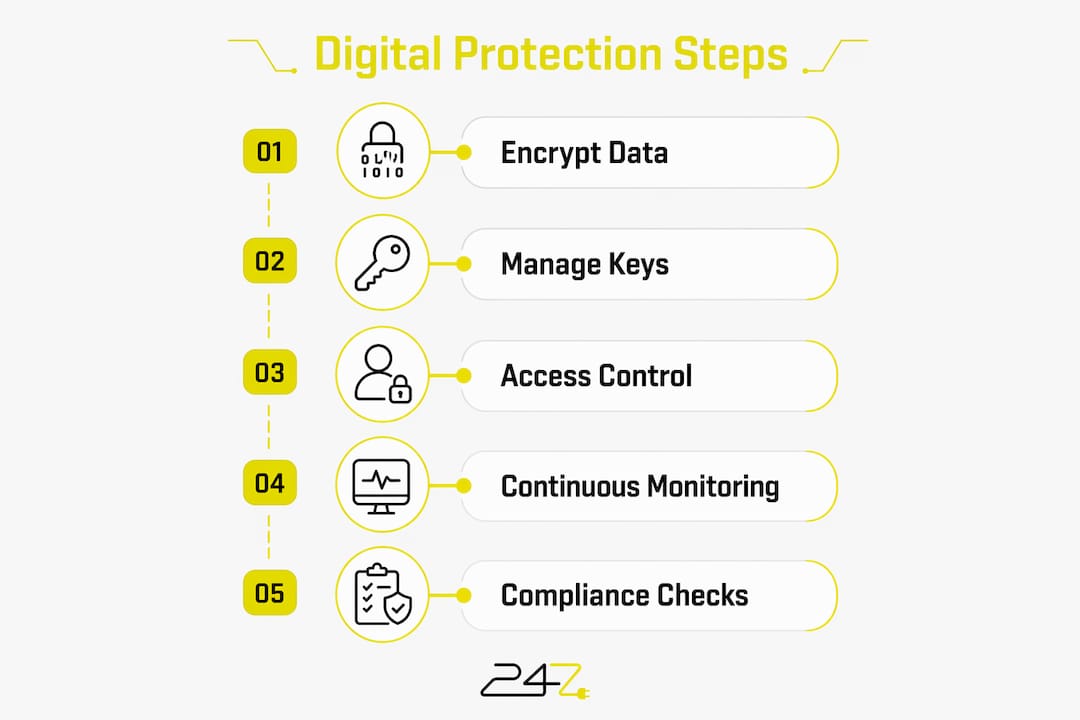
Encryption alone, however, is not sufficient without proper key management. Encryption keys must be stored separately from the data they protect, ideally inside Hardware Security Modules (HSMs) or secure cloud Key Management Services (KMS). Storing keys on the same server as the encrypted data is the equivalent of locking a safe and leaving the combination taped to the door. An attacker who gains server access gets everything.
A more sophisticated approach uses envelope encryption. This method uses two layers: a Data Encryption Key (DEK) encrypts the actual data, and a Key Encryption Key (KEK) encrypts the DEK. Key rotation then re-encrypts the DEK without touching the underlying data, enabling efficient key lifecycle management without operational disruption.
Field-level encryption is also necessary in addition to database-level encryption. Transparent Data Encryption (TDE) does not protect data from users with privileged database accounts or from SQL injection attacks. Sensitive identifiers like Social Security numbers, diagnosis codes, and medication records require encryption at the field level, not just the database level.
- AES-256 for all ePHI stored on servers, workstations, and portable media
- TLS 1.3 for all data transmitted across networks, including internal clinical systems
- HSM or cloud KMS for key storage, never co-located with encrypted data
- Field-level encryption for sensitive identifiers beyond database-level protection
- Key rotation schedules enforced through envelope encryption architecture
Pro Tip: If your organization uses a cloud database, confirm with your vendor that field-level encryption is active for columns containing patient identifiers. Database-level encryption alone will not satisfy a forensic audit after a breach.
Encrypted data loss is generally not a reportable breach if the data remains unreadable, undecipherable, and unusable to unauthorized parties. That single fact is the strongest business case for encryption. It converts a catastrophic breach notification event into a manageable security incident.
How do multi-layered cryptographic architectures improve cloud security?
Cloud environments introduce unique risks for healthcare data because data moves across infrastructure that the covered entity does not fully control. Multi-layered security architectures using Server-Aided Revocable Attribute-Based Encryption (SR-ABE) combined with Haze Optimization significantly lower brute-force risk while maintaining clinical data access latency around 6.6 ms. That latency figure matters because clinicians cannot wait for slow decryption during patient care.
Attribute-Based Encryption (ABE) works by embedding access policies directly within the ciphertext. The data itself carries the rules about who can read it. This architecture defines four distinct roles in a secure medical data environment:
| Role | Function |
|---|---|
| Data Owner | Encrypts patient records and sets access policies |
| Key Authority | Issues attribute-based decryption keys to authorized users |
| Cloud Server | Performs partial decryption to reduce client-side computation |
| Data User | Completes decryption locally using their attribute credentials |

The Cloud Server performs partial decryption, which limits the amount of sensitive data exposed at any single point in the process. Even if the cloud server is compromised, an attacker cannot fully decrypt the data without the Data User’s attribute credentials. This is a meaningful architectural defense against insider threats and cloud-side breaches.
SHA-256 based integrity verification adds another layer by generating unique digital fingerprints for each data record. Any unauthorized manipulation of data during transmission or storage produces a fingerprint mismatch, triggering an alert. This protects data integrity, not just confidentiality.
Pro Tip: When evaluating cloud storage vendors for ePHI, ask specifically whether they support attribute-based access policies at the encryption layer. Generic cloud encryption does not provide the same access granularity as ABE architectures.
High-entropy key generation methods significantly improve resistance to brute-force key recovery while enabling faster, secure clinical workflows. The combination of SR-ABE with high-entropy keys represents the current leading edge of cloud-based ePHI protection.
What operational practices ensure continuous protection of electronic patient data?
Technical encryption is only part of the picture. System hardening establishes the security baseline that makes encryption meaningful. HHS OCR guidance on security baselines covers servers, virtual machines, workstations, mobile devices, and medical devices. Each category requires its own configuration approach.
Medical devices present a particularly difficult challenge. Hardening medical devices requires consulting manufacturer labeling and FDA cybersecurity guidance. Generic OS patching is not sufficient. A cardiac monitor and a Windows workstation require fundamentally different hardening procedures, and applying standard IT configurations to medical devices can create new vulnerabilities rather than close existing ones.
The following operational controls form the foundation of a hardened ePHI environment:
- Implement auto-logoff on all workstations and mobile devices accessing patient records, with session timeouts set to 15 minutes or less of inactivity.
- Enable audit logging on all systems that create, read, update, or delete ePHI, and review logs on a defined schedule.
- Enforce multi-factor authentication (MFA) for all remote access and privileged accounts, including clinical staff accessing records from outside the facility network.
- Segment networks so that medical devices operate on isolated VLANs, preventing lateral movement if a workstation is compromised.
- Conduct device lifecycle reviews at defined intervals to identify end-of-life hardware and software that no longer receives security updates.
- Apply manufacturer-specific configurations for each medical device category, documented and tracked through a formal asset register.
Secure system configurations and continuous lifecycle management are foundational for maintaining ePHI security, especially with legacy and medical devices that do not fit standard IT paradigms. Healthcare administrators who treat device security as a one-time setup task create gaps that attackers exploit. Security is a continuous process, not a project with a completion date.
How do compliance, BAAs, and access controls protect patient data?
HIPAA compliance requires more than technical controls. It requires contractual accountability across every vendor and service provider that touches ePHI. Business Associate Agreements (BAAs) ensure that third-party providers adhere to the same technical standards as the covered entity. Using cloud storage, email services, or telehealth platforms without signed BAAs is one of the most common compliance failures HHS OCR identifies during investigations.
Access controls are the operational mechanism that limits who can reach ePHI and under what conditions. The principle of least privilege applies directly here. A billing administrator does not need access to clinical notes. A nurse does not need access to payroll records. Role-based access control (RBAC) enforces these boundaries at the system level, not just through policy documents.
- Role-based access control (RBAC) assigns permissions based on job function, not individual preference
- Signed BAAs with every cloud provider, email platform, and third-party application handling ePHI
- Regular access audits to revoke permissions for terminated staff and changed roles
- Audit trail logging that records every access event with user identity, timestamp, and action taken
- Encryption complemented by policy to reduce compliance risk when technical controls alone are insufficient
Cybersecurity in healthcare requires proper contracts like BAAs alongside technical controls. Neither element works without the other. A perfectly encrypted database with no BAA in place still creates reportable breach liability if a vendor mishandles data. Conversely, a signed BAA with a vendor using weak encryption provides false assurance.
Healthcare organizations are also adopting privacy-enhancing technologies like differential privacy and federated learning to enable data sharing for AI development without exposing raw patient records. Traditional access controls alone cannot balance data utility and privacy in modern healthcare research environments. These emerging methods represent the next layer of protection beyond standard HIPAA compliance.
Key Takeaways
Digital patient data protection requires AES-256 encryption, field-level key management, system hardening across all device categories, and signed BAAs with every third-party provider handling ePHI.
| Point | Details |
|---|---|
| AES-256 and TLS 1.3 are mandatory | Older protocols fail NIST audits in 2026 and create reportable breach exposure. |
| Keys must be stored separately | HSMs or cloud KMS prevent attackers from accessing both data and decryption keys simultaneously. |
| Field-level encryption closes insider gaps | Database-level encryption alone does not protect against privileged account abuse or SQL injection. |
| BAAs are a compliance requirement | Operating without signed agreements with cloud and email vendors is a documented HIPAA failure point. |
| Medical device hardening is unique | Generic OS patching is insufficient; manufacturer guidance and FDA cybersecurity documentation must inform each device’s configuration. |
The gap most healthcare organizations miss
From the 247techify team’s experience working with regulated healthcare organizations across Canada, the most dangerous assumption we encounter is this: “We have encryption, so we’re covered.” Encryption is the foundation, not the building. The organizations that suffer the most damaging breaches are not the ones with no encryption. They are the ones with encryption and no key management discipline, or encryption and no field-level protection, or encryption and a vendor with no BAA.
The second gap is medical device security. Healthcare administrators often treat clinical devices as outside the IT security scope because they are managed by biomedical teams. That boundary is exactly what attackers exploit. A networked infusion pump with default credentials is a lateral movement opportunity, regardless of how well the EHR system is locked down.
The third gap is treating compliance as a destination. HIPAA audits happen on a schedule. Breaches do not. The organizations that maintain continuous lifecycle management, quarterly access reviews, and ongoing staff training are the ones that contain incidents before they become notifications. Cybersecurity in healthcare is a continuous operational discipline. The compliance auditing process is where most organizations find out how wide those gaps actually are.
— 247techify Team
How 247techify supports healthcare data protection
Healthcare organizations managing ePHI face a security environment that changes faster than most internal IT teams can track.
247techify delivers AI-native cybersecurity services built specifically for regulated industries, including healthcare providers operating under HIPAA and PHIPA. The team handles encryption architecture, access management, BAA vendor reviews, and continuous compliance auditing, with a response time under 30 minutes and a 98% client satisfaction rate. For healthcare administrators who need a dependable partner to close the gaps between technical controls and regulatory requirements, 247techify’s HIPAA-compliant IT support provides the depth and continuity that internal teams alone cannot sustain.
FAQ
What encryption standard does HIPAA require for patient data?
HIPAA requires AES-256 for ePHI at rest and TLS 1.2 or higher for data in transit, with TLS 1.3 preferred. Older protocols like SSL v3 are deprecated by NIST and fail security audits in 2026.
Is encrypted patient data still a reportable breach if lost?
Encrypted data loss is generally not a reportable breach if the data remains unreadable and unusable to unauthorized parties. This makes encryption the single most effective tool for limiting breach notification liability.
What is a Business Associate Agreement and why does it matter?
A Business Associate Agreement (BAA) is a contract requiring third-party vendors handling ePHI to meet the same HIPAA security standards as the covered entity. Operating without signed BAAs is one of the most common compliance failures identified by HHS OCR.
How is patient data secured on medical devices?
Medical device security requires consulting manufacturer labeling and FDA cybersecurity guidance, not just standard OS patching. Each device category needs configurations specific to its hardware and software environment throughout its full lifecycle.
What are privacy-enhancing technologies in healthcare?
Privacy-enhancing technologies like differential privacy and federated learning allow healthcare organizations to share data for research and AI development without exposing raw patient records. They extend protection beyond what standard access controls can provide.
Recommended
- Patient Data Protection Tools for Healthcare: 2026 Guide | 247Techify
- Healthcare Network Security Setup for Hospitals | 247Techify - IT Managed Service Provider Ontario
- Healthcare IT Support Canada — HIPAA & PHIPA Compliant | 247Techify
- Why Remote Team IT Security Matters for Your Business | 247Techify