
Before you onboard your first user, you need four artifacts in place: a published Privacy Policy or Notice, a Record of Processing Activities (ROPA) spreadsheet, signed Data Processing Agreements (DPAs) with every vendor that touches personal data, and a basic breach response and Data Subject Access Request (DSAR) workflow. That is the minimum viable compliance stack, and it applies whether you are building a SaaS product, a consumer app, or a B2B platform. TermsFeed’s MVP checklist confirms that data protection laws apply based on customer location, not business location, so even a two-person team with a beta product is in scope the moment real users sign up.
Day-one artifacts and where to host them:
- Privacy Policy / Notice: Publish in your website footer, app store listing (required by Apple App Store and Google Play), and any onboarding flow that collects data.
- Cookie consent banner: Deploy before any non-essential tracking fires. Tools like Cookiebot or OneTrust’s free tier handle this for small sites.
- ROPA spreadsheet: A private internal document. Columns: data category, source, purpose, lawful basis, retention period, storage location, third-party recipients.
- DPAs with key vendors: Your analytics provider, payment processor, email platform, and cloud host all need signed DPAs. Most publish pre-signed versions on their legal or trust pages.
- privacy@ email address: Create it now. Route it to a monitored inbox. This is your DSAR and breach notification contact.
- Basic incident response checklist: A one-page document covering detect, contain, assess, notify. Store it somewhere the whole team can access.
Immediate actions for the next 24–72 hours:
- Publish your Privacy Policy to your website footer and app store listing.
- Enable HTTPS site-wide and deploy a cookie consent banner before any analytics or ad pixels fire.
- Create privacy@yourdomain.com, start your ROPA spreadsheet, and download DPA templates from your top three vendors’ trust centers.
Key Takeaways
A startup’s minimum viable compliance stack, published before the first user signs up, consists of an accurate Privacy Policy, a ROPA spreadsheet, signed DPAs with all processors, and a documented breach and DSAR workflow.
| Point | Details |
|---|---|
| Publish before launch | Privacy Policy, cookie consent, and privacy@ inbox must be live before onboarding any users. |
| Law follows user location | GDPR applies to EU/EEA users regardless of your company’s location; CCPA/CPRA applies to California residents meeting threshold criteria. |
| DPAs are non-negotiable | Every vendor processing personal data on your behalf requires a signed DPA; most major providers publish pre-signed versions on their trust pages. |
| GDPR breach window is 72 hours | Report qualifying breaches to the relevant supervisory authority within 72 hours of becoming aware; document every incident. |
| Quarterly review cadence | Update your ROPA and vendor register every quarter; schedule an annual legal review of your Privacy Policy. |
Table of Contents
- Which privacy laws apply to your startup?
- What personal data does your startup collect and why does it matter?
- How do you build a startup data protection policy step by step?
- What should your Privacy Policy actually say?
- How do you manage vendors and Data Processing Agreements?
- What operational controls do you need before launch?
- How do you maintain compliance as your startup scales?
- U.S.-focused MVP Privacy Policy checklist and template
- Privacy is a product feature, not a legal formality
- Sources
- FAQ
Which privacy laws apply to your startup?
The answer depends on where your users are located, not where your company is incorporated. GDPR applies to any startup that offers products or services to EU/EEA residents or monitors their behavior online regardless of revenue or employee count. U.S. state privacy laws operate differently: the California Consumer Privacy Act (CCPA) as amended by CPRA applies to for-profit businesses meeting certain thresholds related to revenue, data volume, or revenue from selling personal information. Virginia’s CDPA, Colorado’s CPA, Connecticut’s CTDPA, and Utah’s UCPA each have their own thresholds and trigger conditions, but all share the same geographic logic: if you process data about residents of those states, the law potentially applies to you.
VisionCompliance’s GDPR for startups guide frames this clearly: GDPR is enforceable even against very small startups the moment they process EU resident data, making it one of the most consequential extraterritorial laws a founder will encounter.
Run through this decision flow before launch:
Where are your users located? If any are in the EU/EEA or UK, GDPR applies. If any are California residents, assess whether you meet CCPA/CPRA thresholds now or will within 12 months. If you serve users in Virginia, Colorado, Connecticut, or Utah, review those states’ laws against your processing volume. Do you run targeted advertising, profile users, or sell data? That triggers additional obligations under nearly every applicable law. Do you accept payments or store financial data? That adds PCI-DSS obligations on top of privacy law requirements.
GDPR red flags that demand immediate attention:
- Your product is available in EU languages or priced in euros.
- You run paid ads targeting EU geographies.
- You have EU-based customers, investors, or beta users.
- Your analytics platform tracks EU IP addresses.
Pro Tip: For an early-stage launch where EU compliance is not yet a priority, consider geofencing your product to U.S. users only, stripping EU-targeted language from your marketing, and collecting the minimum data possible. This reduces your GDPR exposure while you build the full compliance stack.
What personal data does your startup collect and why does it matter?
The core principles that govern every data protection framework, from GDPR Article 5 to the FTC’s longstanding fair information practices, are data minimization (collect only what you need), purpose limitation (use data only for the stated purpose), transparency (tell users what you collect and why), security (protect it proportionally to its sensitivity), and retention limits (delete it when the purpose is served). The ICO’s step-by-step guidance for small organizations builds its entire checklist around these five principles, and they translate directly into your ROPA columns and policy language.
Common data categories startups collect:
- Account identifiers: Name, email address, username, password hash. Lawful basis under GDPR: contract or legitimate interest.
- Usage analytics: Page views, feature interactions, session duration, click paths. Often collected via third-party tools (Google Analytics, Mixpanel, Amplitude). Requires consent or legitimate interest assessment.
- Payment data: Card numbers, billing address, transaction history. Typically processed by a third-party processor (Stripe, Braintree); your ROPA records the processor, not the raw card data.
- Device and network data: IP address, browser type, operating system, device identifiers. Often treated as personal data under GDPR.
- Communications data: Support tickets, chat logs, email correspondence. Retention limits matter here.
- Special categories: Health data, biometric data, racial or ethnic origin, political opinions, religious beliefs. These require explicit consent under GDPR Article 9 and carry the highest handling standards across U.S. state laws as well.
| Data Category | Typical Source | GDPR Lawful Basis | U.S. State Law Implication |
|---|---|---|---|
| Account identifiers | Sign-up form | Contract (Art. 6(1)(b)) | Disclose in privacy notice; honor deletion requests |
| Usage analytics | Analytics SDK | Legitimate interest or consent | CCPA: disclose; opt-out if “sale” or sharing for ads |
| Payment data | Checkout flow | Contract | PCI-DSS applies; disclose processor in notice |
| Device/network data | Server logs | Legitimate interest | Disclose; may be “personal information” under CCPA |
| Communications data | Support system | Legitimate interest or contract | Disclose retention period; honor deletion |
| Special categories | User-provided | Explicit consent (Art. 9) | Sensitive data: opt-in consent required in most states |
Special-category data, including health information, biometric identifiers, and precise geolocation, triggers heightened obligations under both GDPR and U.S. state laws. If your product touches any of it, consult privacy counsel before launch. The IBM data protection strategy framework reinforces this: classification determines control depth, and sensitive data demands proportionally stronger encryption, access restrictions, and audit logging.
How do you build a startup data protection policy step by step?
Start with the policy and ROPA on day zero, add DPAs and a DSAR/breach plan in week one, then layer in technical controls and governance over the following months. This is the MVP-first approach to creating a data protection strategy that Vcso describes: inventory first, classify, identify gaps, then implement controls in priority order.
Day 0–7: Publish and document
- Draft and publish your Privacy Policy (2–4 hours, founder). Use a multi-jurisdiction template covering GDPR and CCPA/CPRA as a starting point. Customize for your actual data practices.
- Build your ROPA spreadsheet (2 hours, founder or technical lead). One row per processing activity. Columns: purpose, data categories, lawful basis, retention, storage location, third-party recipients.
- Deploy cookie consent banner (1–2 hours, developer). Configure to block non-essential cookies until consent is given.
- Create privacy@ inbox (30 minutes). Document the process for routing and responding to requests.
- Identify your top five vendors (1 hour). Check their trust or legal pages for pre-signed DPAs.
Week 1–4: Agreements and controls
- Collect signed DPAs from all processors (analytics, payments, email, cloud, CRM). Most major vendors (Google, Stripe, AWS, Mailchimp) publish pre-signed DPAs; download and store them.
- Enable HTTPS and encryption at rest across all storage. Verify with your cloud provider’s default settings.
- Implement MFA on all admin accounts, cloud consoles, and code repositories.
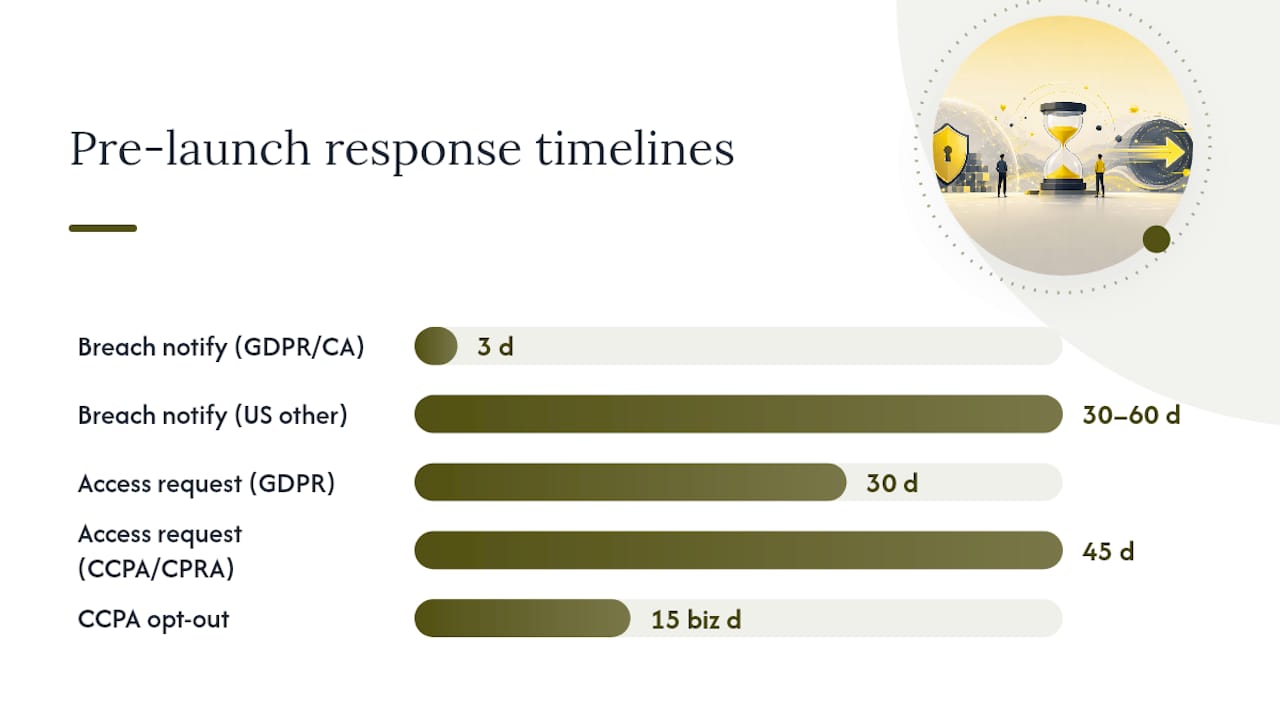
- Draft a one-page breach response checklist covering detect, contain, assess, notify (72-hour GDPR window; U.S. state timelines vary).
- Draft a DSAR response template with a 30-day response clock (GDPR) and 45-day clock (CCPA/CPRA).
Month 1–3: Governance and depth
- Conduct a Data Protection Impact Assessment (DPIA) if you process special-category data, run large-scale profiling, or use systematic monitoring.
- Run a least-privilege access review. Every team member should have access only to the data their role requires.
- Enable audit logging on databases, admin panels, and cloud storage.
- Train all staff on data handling basics, phishing recognition, and the DSAR/breach escalation path.
- Set a quarterly ROPA review in your calendar.
Timeline and cost estimates:
- DIY with free templates: $0–$500 in direct costs; 20–40 founder hours over the first month. Risk: gaps in jurisdiction-specific language.
- Paid privacy tools (Termly, iubenda, Osano): $200–$1,200/year for policy generation, cookie management, and DSAR tracking.
- Privacy counsel review: $1,500–$5,000 for a startup-focused attorney to review your policy and ROPA before significant user growth or fundraising.
If you only have time for five items before launch: publish the Privacy Policy, enable HTTPS, deploy cookie consent, create privacy@, and get a signed DPA from your payment processor. Everything else can follow in week one.
Pro Tip: Most major SaaS vendors (Google Workspace, AWS, Stripe, Mailchimp) publish pre-signed DPAs on their trust or legal pages. Download them in one sitting rather than waiting for vendor negotiations. This alone covers a large portion of your processor obligations efficiently.
Pro Tip: Embed a “privacy review” step into every product sprint. Before shipping a feature that collects new data, ask: what data does this collect, what is the lawful basis, and does the policy need updating? This is data protection by design in practice, and it costs nothing to implement.
What should your Privacy Policy actually say?
A one-to-two page policy covering the core elements is sufficient for most MVPs. PolicyForge’s startup privacy guide notes that app stores and payment processors require a privacy policy before activation, so accuracy matters from day one. The policy must reflect your actual practices; a generic template that does not match what you collect creates legal exposure and raises red flags during investor due diligence.
Required sections and their purpose:
- What we collect: Categories of personal data and how they are collected (directly from users, automatically, from third parties).
- How we use it: Specific purposes for each category. Vague language like “to improve our services” is insufficient under GDPR.
- Legal basis (GDPR): State the lawful basis for each processing purpose (contract, consent, legitimate interest, legal obligation).
- Sharing and third parties: Name the categories of recipients (processors, analytics providers, payment processors) and the purpose of sharing.
- Retention: How long you keep each category of data and the criteria used to determine retention periods.
- Your rights: List applicable rights (access, deletion, portability, correction, objection, opt-out of sale/sharing for CCPA).
- International transfers: If you transfer data outside the EU/EEA, state the transfer mechanism (Standard Contractual Clauses, adequacy decision).
- Children: State whether your service is directed at children under 13 (COPPA) or under 16 (GDPR).
- Updates: How and when you will notify users of material changes.
- Contact: Your privacy@ email and, if required, your EU representative’s contact.
Copy-ready snippets (paste and adapt):
Data we collect: We collect information you provide directly, such as your name, email address, and payment details when you create an account or make a purchase. We also collect usage data automatically, including your IP address, browser type, pages visited, and time spent on each page, through cookies and similar technologies.
How we use your data: We use your personal information to provide and operate our service (contract), send transactional communications (contract), analyze usage to improve our product (legitimate interest), and send marketing emails where you have opted in (consent). We do not sell your personal information.
Third-party sharing: We share your data with service providers who process it on our behalf, including our payment processor, cloud hosting provider, and analytics platform. These providers are contractually bound to process your data only for the purposes we specify.
Retention: We retain account data for the duration of your account and for up to 12 months after closure. Usage logs are retained for 90 days. Payment records are retained as required by applicable law.
Your rights: Depending on your location, you may have the right to access, correct, delete, or export your personal data, or to object to certain processing. To exercise any right, email privacy@[yourcompany].com. We will respond within 30 days (GDPR) or 45 days (CCPA/CPRA).
Contact: [Company Name], [Address]. Privacy inquiries: privacy@[yourcompany].com.
For cookie consent, a minimal banner reads: “We use cookies to operate this site and, with your consent, to analyze traffic and personalize content. You can accept all cookies, reject non-essential ones, or manage your preferences.” Consent must be freely given, specific, and withdrawable. Legitimate interest is not a valid basis for advertising cookies under GDPR.
Send these snippets to privacy counsel before you reach 10,000 users or begin fundraising. Ask them specifically to check your lawful-basis claims, your retention periods, and your international transfer language. The Promise covers GDPR, CCPA, and several additional state laws and is a useful structural reference for that review.
How do you manage vendors and Data Processing Agreements?
Every vendor that processes personal data on your behalf needs a DPA. No exceptions. A vendor that stores, analyzes, transmits, or otherwise handles personal data you control is a “processor” under GDPR and a “service provider” under CCPA/CPRA, and the legal requirement for a written agreement is explicit in both frameworks.
Steps to build your vendor register and collect DPAs:
- List every vendor that receives personal data: cloud host, analytics, email platform, CRM, payment processor, customer support tool, error monitoring, A/B testing, and any AI/ML services.
- Check each vendor’s trust center or legal page for a pre-signed DPA. AWS, Google Cloud, Microsoft Azure, Stripe, Mailchimp, Intercom, and most major SaaS providers publish them.
- For vendors without a pre-signed DPA, request one or use a minimum clause set (see must-haves below).
- Record EU/EEA data transfers. If a vendor stores or processes EU resident data outside the EU, confirm the transfer mechanism: Standard Contractual Clauses (SCCs), adequacy decision, or Binding Corporate Rules.
Vendor register columns to maintain:
| Column | What to Record |
|---|---|
| Vendor name | Legal entity name |
| Purpose | Specific processing purpose |
| Data types processed | Categories of personal data |
| DPA status | Signed, pending, or not required |
| Data storage location | Country/region |
| Security certification | SOC 2, etc. |
| Transfer mechanism | SCCs, adequacy, or N/A |
DPA must-haves:
- Subject matter and duration of processing
- Nature and purpose of processing
- Types of personal data and categories of data subjects
- Subprocessor restrictions (vendor must notify you before adding subprocessors)
- Security measures (encryption, access controls, incident notification)
- Deletion or return of data at contract end
- Audit rights (or equivalent third-party certification)
- International transfer mechanism where applicable
- Liability and indemnity provisions
For early-stage startups, the pragmatic priority is to use the vendor’s own DPA template rather than negotiating from scratch. Push for three minimum assurances: they will notify you of a breach within 72 hours, they will delete your data on request, and they will not use your data for their own purposes. Most enterprise vendors will agree to these without negotiation.
What operational controls do you need before launch?
Implement HTTPS, encryption at rest and in transit, multi-factor authentication (MFA), least-privilege access controls, and audit logging before your first user signs up. These are not optional enhancements; they are the baseline that regulators and auditors check first. The cybersecurity threat landscape facing startups in 2026 makes these controls more urgent, not less.
Incident response runbook (short form):
- Detect: Monitoring alert, user report, or vendor notification triggers the process.
- Contain: Isolate affected systems, revoke compromised credentials, preserve logs.
- Assess: Determine what data was affected, how many individuals, and the likely risk of harm.
- Notify regulators: GDPR requires notification to the relevant supervisory authority within 72 hours of becoming aware of a breach that poses a risk to individuals. U.S. state breach notification timelines vary (California: 72 hours for regulated data; others: 30–60 days).
- Notify affected individuals: Required when the breach is likely to result in high risk to individuals (GDPR) or when state law mandates it.
- Document: Record the breach, your assessment, and all notifications in your incident log.
DSAR and rights workflow:
- Receive requests via privacy@ inbox. Log the date received immediately.
- Verify the requester’s identity before disclosing any data (a simple email confirmation is sufficient for most cases).
- Fulfill access requests within 30 days (GDPR) or 45 days (CCPA/CPRA, with one 45-day extension permitted).
- For deletion requests, confirm deletion across all systems including backups, or document the legal basis for retention.
- For CCPA opt-out of sale/sharing, process within 15 business days.
- Log every request, your response, and the completion date.
Staff training checklist (every employee must know):
- What counts as personal data and why it matters
- How to recognize a phishing attempt
- Where to report a suspected breach (privacy@ or designated security contact)
- How to handle a DSAR (route to the privacy contact immediately)
- Password and MFA requirements
For practical training steps, the employee cybersecurity training guide from 247techify maps directly to these requirements.
Pro Tip: MFA on admin accounts, automated daily backups to an isolated location, and centralized logging provide the highest compliance value per dollar of any technical control. Implement these three before any other security investment. They are also the first things an auditor or regulator will ask about.
How do you maintain compliance as your startup scales?
Compliance is not a one-time project. Set a quarterly review cadence for your ROPA and vendor register, and schedule an annual legal review of your Privacy Policy. As your user base grows and your product adds features, new processing activities will appear, new vendors will be onboarded, and your lawful-basis claims may need updating.
Timeline and cost estimates by stage:
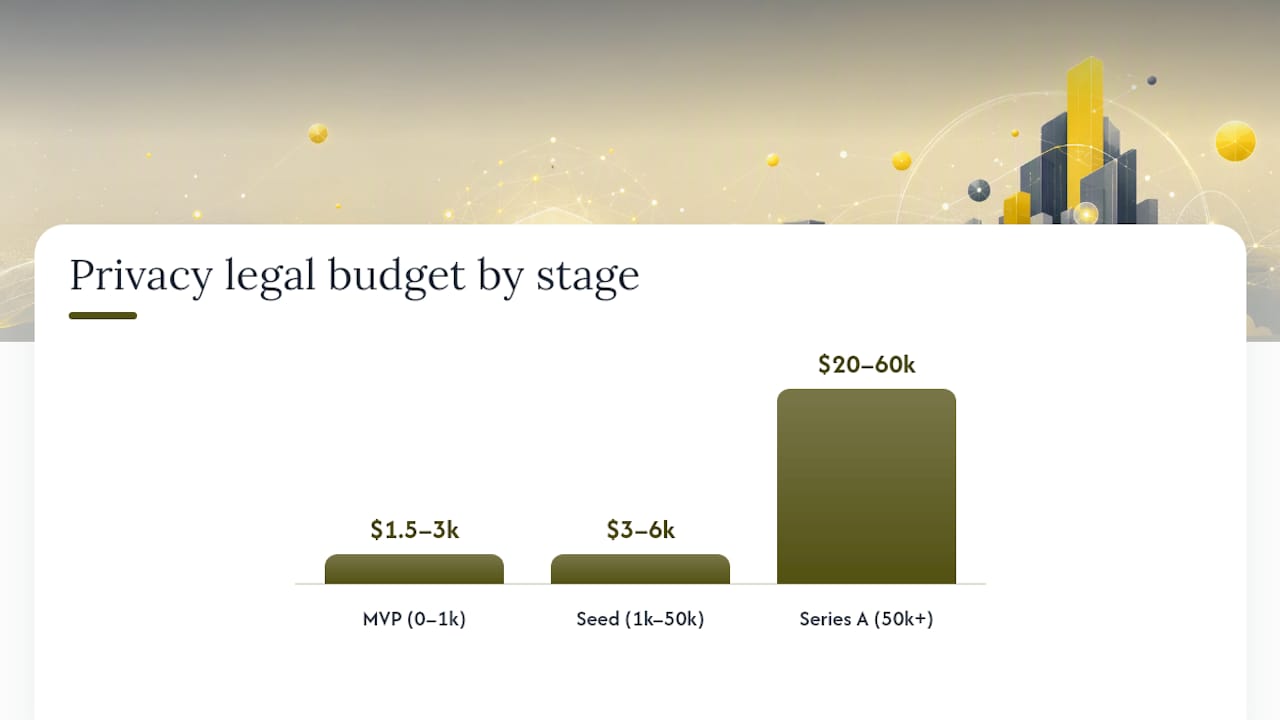
- MVP stage (0–1,000 users): 2–4 hours per quarter to review ROPA and vendor register; annual policy review with counsel at $1,500–$3,000.
- Seed stage (1,000–50,000 users): 4–8 hours per quarter; consider a part-time privacy consultant at $150–$300/hour for quarterly reviews; annual legal review at $3,000–$6,000.
- Series A (50,000+ users or regulated data): Dedicated privacy function or fractional DPO; budget $20,000–$60,000/year for counsel, tooling, and audits.
Recordkeeping checklist (what to store and for how long):
- Versions of your Privacy Policy with effective dates: retain indefinitely.
- DSAR logs (request date, type, response date, outcome): retain for 3 years minimum.
- DPIA records: retain for the life of the processing activity plus 3 years.
- Incident logs (breach date, scope, notifications sent): retain for 5 years.
- DPA copies: retain for the duration of the vendor relationship plus 3 years.
- Training records (who was trained, when, on what): retain for 2 years.
Trigger events that require immediate legal review or DPO consideration:
- You begin processing special-category data at any scale.
- You start systematic monitoring of individuals (behavioral tracking, location tracking).
- You process data on more than 5,000 EU residents in a 12-month period.
- You receive a regulatory inquiry or a formal DSAR from a regulator.
- You are preparing for a Series A fundraise or a significant enterprise contract.
The financial stakes of getting this wrong are substantial. Reuters reported that Italy’s data protection authority fined an AI company’s developer €56 million in 2025 for data protection failures. That figure is not reserved for large enterprises; regulators have demonstrated a willingness to pursue enforcement actions against companies of all sizes when violations are clear and documented.
Enforcement reality check: A €56 million fine from Italy’s data watchdog in 2025 illustrates that regulators are actively pursuing enforcement actions, including against AI-driven products. Documented controls and a maintained ROPA are your primary defense.
A data protection program that scales ties each control to a business outcome and names an owner, as Lumenalta’s nine-component framework describes. Policies without owners become ignored paperwork within six months.
U.S.-focused MVP Privacy Policy checklist and template
A U.S.-first startup that may also have EU users needs a policy that satisfies both the disclosure requirements of CCPA/CPRA and the transparency obligations of GDPR Article 13/14. The ICO’s step-by-step data protection guide and VisionCompliance’s GDPR startup guide both confirm that a short, accurate policy beats a long, inaccurate one every time.
10-point MVP checklist before you publish:
- Privacy@ email address is live and monitored.
- Cookie consent banner is deployed and blocks non-essential cookies until consent is given.
- ROPA has at least one row for your analytics tool.
- DPA is signed with your payment processor.
- Policy accurately lists every category of data you actually collect.
- Policy states the purpose for each data category.
- Policy includes a retention period for each category.
- Policy lists user rights and how to exercise them.
- Policy includes a contact address and effective date.
- Policy is linked in your website footer and app store listing.
Jurisdiction notes:
- Add GDPR-specific legal-basis language (Article 6 and Article 9 references) if you have EU/EEA users.
- Add CCPA/CPRA consumer rights language (right to know, delete, correct, opt-out of sale/sharing, limit use of sensitive personal information) if you have California users or anticipate meeting CCPA thresholds within 12 months.
- Add a “Do Not Sell or Share My Personal Information” link to your footer if you run targeted advertising to California residents.
Before you publish: Have a privacy attorney review your policy before you reach significant user growth or begin fundraising. The cost of a one-hour review ($300–$600) is a fraction of the cost of a regulatory inquiry or a failed due-diligence process. Ask them specifically to check your lawful-basis claims, your retention periods, and your international transfer language.
For startups that need implementation support beyond the policy itself, 247techify’s IT compliance and auditing services provide structured gap assessments and remediation planning that translate policy requirements into operational controls.
Privacy is a product feature, not a legal formality
The conventional framing of privacy compliance as a legal checkbox misses the most important point: your privacy posture is visible to customers, investors, and regulators before they ever read your policy. A startup that ships with HTTPS, a clear cookie banner, and a responsive privacy@ inbox signals operational maturity. One that ships without them signals the opposite, regardless of how polished the product is.
The founders who treat privacy as a trust feature rather than a compliance burden tend to move faster in the long run. They avoid the expensive retrofits that come from building data collection into a product without a lawful basis. They pass investor due diligence without scrambling to produce documentation. They handle their first DSAR without a crisis because the workflow already exists.
The balance between speed and compliance is real, but it is not as difficult as it appears. The MVP compliance stack described in this guide takes a founder 20–40 hours to implement. That is one week of focused work. The alternative, a regulatory inquiry or a failed fundraise because your data practices are undocumented, costs far more in time, money, and credibility.
When the controls become too complex to manage alongside product development, that is the signal to bring in a managed security and compliance partner. 247techify’s co-managed IT services are built for exactly this inflection point: startups that want to retain control of their product roadmap while outsourcing the operational burden of security monitoring, access management, and compliance documentation.
Privacy done right is not theater. It is the foundation that lets you scale without fear.
Sources
The following resources are the authoritative starting points for building and maintaining your data protection program:
- Getting started with data protection: a step-by-step guide | ICO
- Promise
- Data protection strategy: Key components and best practices | IBM
- Vcso
- Privacy Policy for Startups: The Complete Guide | PolicyForge
This article provides general information about data protection and privacy law. It is not legal advice. Consult a qualified privacy attorney to confirm how applicable laws apply to your specific product, user base, and business model before publishing your policy or making compliance representations to investors or regulators.
This article is general information, not a substitute for advice from a qualified lawyer. Consult a qualified legal professional about your own circumstances before acting on anything here.
FAQ
Does GDPR apply to U.S. startups with no EU office?
Yes. GDPR applies to any organization that offers goods or services to EU/EEA residents or monitors their behavior, regardless of where the organization is based. No revenue threshold applies.
What is the minimum privacy policy a startup needs at launch?
A short policy accurately describing what data you collect, why you collect it, who you share it with, how long you keep it, and how users can exercise their rights. It must be published in your website footer and any app store listing before you onboard users.
How long do you have to respond to a GDPR data subject access request?
You must respond within 30 calendar days of receiving a verifiable request. A one-month extension is permitted for complex or numerous requests, but you must notify the requester of the delay within the initial 30-day window.
When does CCPA/CPRA apply to a startup?
CCPA/CPRA applies to for-profit businesses meeting certain thresholds related to revenue, data volume, or revenue from selling personal information.
When should a startup hire a privacy attorney?
Before significant user growth, before fundraising, before processing special-category data, or upon receiving a regulatory inquiry. A one-time policy review at the MVP stage typically costs $1,500–$5,000 and is worth the investment before you scale.