
Encryption renders intercepted or stolen portal data unreadable to attackers, but it is only one layer in a defensible security architecture. Firms that treat encryption as a checkbox rather than a verified, operational control are exposed in ways that no cipher can fix. The role of encryption in client portals is to guarantee data confidentiality at every stage: in transit, at rest, in backups, and at the field level for the most sensitive records. What separates a genuinely secure portal from a marketing claim is whether key management, audit coverage, and algorithm standards can be independently verified.
Core protections to confirm:
- Encryption in transit using TLS 1.3 (reject any vendor still running TLS 1.1 or 1.2)
- Encryption at rest using AES-256 for files, database fields, and backup snapshots
- Field-level encryption for PII, PHI, and financial identifiers (SSNs, account numbers)
- End-to-end encryption for the highest-sensitivity workflows (litigation strategy, health records)
- Encrypted backups and disaster-recovery snapshots, not just primary storage
Immediate vendor questions to run now:
- What cipher suites and protocol versions do you support, and can you provide a current TLS configuration report?
- Who manages encryption keys, and can we bring our own keys (BYOK)?
- Are all backups and snapshots encrypted with the same standard as primary storage?
- Do you use a dedicated KMS or HSM for key storage, separate from the data plane?
- Do you maintain immutable, tamper-evident access logs covering every file operation and key event?
Table of Contents
- How encryption fits into a layered security model for client portals
- Which encryption types actually matter for your portal
- Key management: the control that determines who actually owns your data
- How encryption works with MFA, RBAC, and audit logs to close real gaps
- U.S. compliance expectations for encrypted client portals
- Implementation checklist: configuring and maintaining portal encryption
- What encryption does NOT protect: real failure modes to understand
- How to verify that portal encryption is actually working
- How different professional practices use encryption in portals
- Deployment timeline and cost considerations for portal encryption
- Practitioner insight: encryption is necessary but not sufficient
- What to prioritize this quarter
- Key Takeaways
- The 247techify team’s perspective on portal encryption for clients
- 247techify’s managed encryption and portal security services
- Useful sources and further reading
- FAQ
How encryption fits into a layered security model for client portals
Encryption is the last technical defense for data confidentiality, but it operates inside a stack of controls, not above them. A mature portal security model runs across five layers: network and transport, application and authentication, authorization and access control, data storage and key management, and monitoring and operations. Encryption covers the storage and transport layers. Every other layer requires its own controls.
Transport security (TLS) protects data moving between a client’s browser and the server. Storage encryption (AES-256) protects data sitting on disk, in databases, and in backup archives. Neither of those controls stops an attacker who has already authenticated as a legitimate user, which is why MFA, RBAC, and immutable audit logs are not optional additions. They address the identity and authorization layers that encryption cannot touch.
The practical implication: a portal that encrypts everything but lacks fine-grained RBAC still exposes every client’s files to any authenticated user with a broad role assignment. A portal with strong encryption and MFA but no tamper-evident audit log cannot prove, after a breach, what was accessed and by whom. Authoritative security frameworks describe a secure portal as transport security plus storage security plus operational controls, including incident response and auditing. Encryption is necessary. It is not sufficient.
A simple mental model: think of the security stack as three concentric rings. The outer ring is network and transport (TLS, firewalls, DDoS protection). The middle ring is application and identity (MFA, SSO, RBAC, session controls). The inner ring is data and keys (AES-256 at rest, field-level encryption, KMS/HSM, backup encryption). Vendors and firms share responsibility across all three rings. Confirm in writing which ring each party owns.
Which encryption types actually matter for your portal
Not all encryption is equivalent, and vendors use the terms loosely. Understanding what each type protects, and what it does not, lets you ask the right questions during procurement.

| Encryption Type | What It Protects | Verification Question | Common Tradeoffs |
|---|---|---|---|
| TLS 1.3 (in transit) | Data moving between client and server | “Show me your TLS config report and cipher suite list.” | Older clients may need compatibility fallbacks; enforce HSTS. |
| AES-256 at rest | Files and databases stored on disk | “Are backups and snapshots encrypted with the same key?” | Disk-level encryption does not protect against a compromised application layer. |
| Field-level / columnar | Specific PII/PHI fields in a database | “Which fields are individually encrypted, and with separate keys?” | Higher development cost; complicates search and reporting. |
| Client-side / E2EE | Content even from the platform provider | “Does the server ever hold plaintext, even temporarily?” | Limits server-side features: search, preview, virus scanning. |
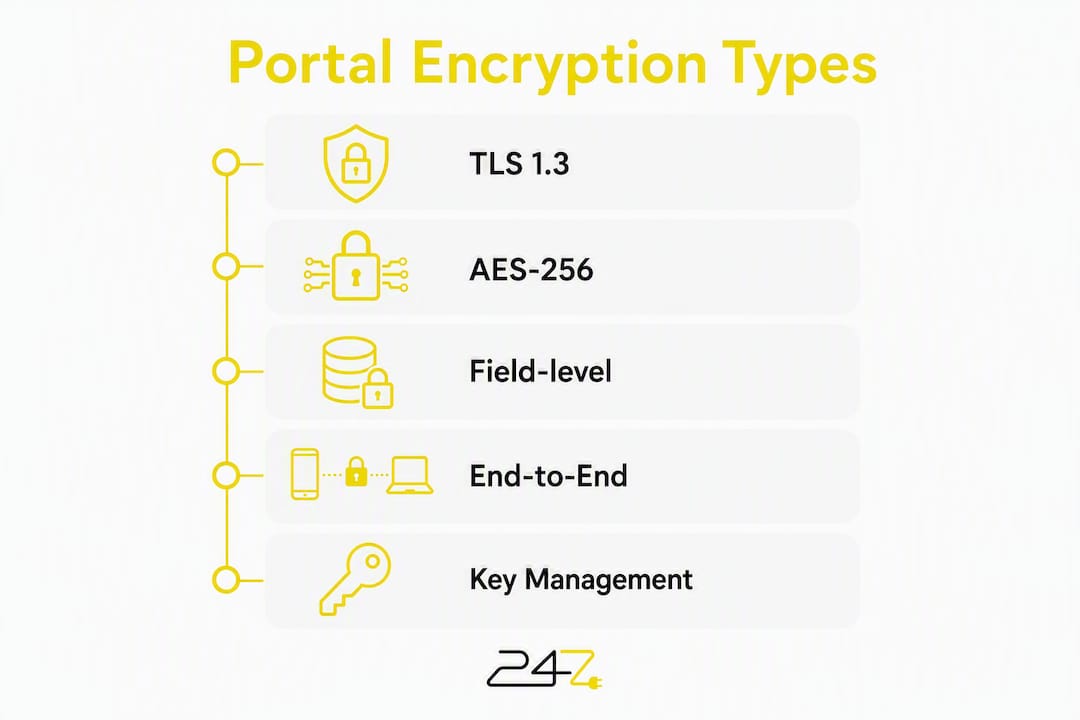
Transport encryption (TLS 1.3) protects data in motion between a user’s browser and the portal server. AES-256 for data at rest and TLS 1.3 for data in transit are the non-negotiable baselines; any vendor still running TLS 1.1 or 1.2 should be disqualified. Beyond the protocol version, verify the cipher suites (prefer ECDHE key exchange and AES-GCM), confirm HTTP Strict Transport Security (HSTS) is enforced, and check that certificate renewal is automated.
Encryption at rest covers files and database records stored on the portal’s servers. AES-256 is the standard. The critical verification point is scope: many portals encrypt primary storage but leave backup snapshots or search indices unencrypted, which creates a recoverable plaintext copy that attackers can target. Confirm in writing that backups, snapshots, and any secondary replicas carry the same encryption standard.
Field-level encryption goes further than disk-level protection by encrypting individual database columns, such as Social Security numbers, account numbers, or medical record identifiers, with their own keys. This matters when a database administrator or a compromised application account could otherwise read sensitive fields in plaintext. For law firms, accounting practices, and healthcare providers, field-level encryption for PII and PHI is a reasonable procurement requirement.
Client-side and end-to-end encryption (E2EE) prevents the platform provider from reading content at any point. Client-side encryption protects confidentiality even from the provider but reduces functionality, including server-side search, document preview, and virus scanning. For litigation strategy files or psychiatric records, that tradeoff is often worth it. For general document exchange, the operational complexity of E2EE, particularly key recovery when a user loses access, may outweigh the benefit.
Key management: the control that determines who actually owns your data
Encryption is only as strong as the controls around the keys. If an attacker, a vendor employee, or a government subpoena can access key material, the encrypted data is effectively plaintext. Key management is where most firms underinvest and where the most consequential procurement decisions live.

Vendor-managed keys are the default for most SaaS portals. The vendor generates, stores, and rotates keys on your behalf. This is operationally simple but means the vendor can technically access plaintext data, and a legal order served to the vendor can compel key disclosure. For most small and mid-sized firms, vendor-managed keys are acceptable if the vendor uses a dedicated KMS and maintains separation of duties between the team that manages keys and the team that operates the data plane.
Customer-managed keys (BYOK) let the firm generate and control the master key material, typically stored in a cloud KMS such as AWS KMS, Azure Key Vault, or GCP KMS, or in a hardware security module (HSM) the firm controls. The vendor’s system wraps data encryption keys with the firm’s master key but never holds the master key itself. This means the vendor cannot decrypt data without the firm’s cooperation, and a subpoena served to the vendor yields only ciphertext. BYOK is increasingly expected by high-risk clients as part of security due diligence.
HSMs are dedicated hardware devices that generate and store cryptographic key material in tamper-resistant hardware. Cloud providers offer HSM-backed KMS tiers (AWS CloudHSM, Azure Dedicated HSM) for firms that need the highest assurance. Verify that the vendor’s KMS or HSM is FIPS 140-2 Level 2 or Level 3 validated, which is the standard the Canadian Centre for Cyber Security and NIST reference for cryptographic module validation.
| Key Management Model | Who Can Access Plaintext | Legal/Subpoena Exposure | Operational Complexity | Typical Cost |
|---|---|---|---|---|
| Vendor-managed keys | Vendor + firm | Vendor can be compelled | Low | Included in SaaS |
| BYOK (cloud KMS) | Firm only | Vendor yields ciphertext only | Medium | KMS fees + engineering |
| Customer HSM | Firm only | Firm controls key release | High | HSM hardware + ops |
Operational controls to demand in your SLA: automatic key rotation on a defined schedule (annually at minimum, quarterly for high-sensitivity data), documented key lifecycle procedures covering generation, escrow, expiration, and destruction, a tested emergency key-revocation process with a defined recovery time objective, and audit logs of every key operation including who requested key material and when.
How encryption works with MFA, RBAC, and audit logs to close real gaps
Encryption protects data confidentiality. It does not protect against a legitimate user who abuses their access, a stolen credential that passes authentication, or an insider who exports files they are authorized to open. Closing those gaps requires layered identity and monitoring controls working in concert with encryption.
The interaction model:
- Encryption guarantees that stolen storage media or intercepted network traffic yields no readable data.
- MFA prevents credential compromise from becoming account compromise; even if a password is phished, the attacker cannot authenticate without the second factor.
- RBAC enforces least privilege, limiting what an authenticated user can access to only the files and functions their role requires.
- Immutable audit logs provide forensic evidence of every access event, file operation, and permission change, which is critical for breach investigation and regulatory response.
Concrete configuration checks to run against any portal vendor:
- MFA enforced for all users, including administrators, with support for TOTP apps or hardware tokens (not just SMS)
- SSO integration via SAML 2.0 or OIDC so that credential lifecycle (provisioning, deprovisioning) is centrally managed
- Per-file and per-folder access controls, not just role-level permissions, so that a client’s files are invisible to other clients
- Immutable audit trails with tamper-evident logging, exportable for SIEM integration, covering file views, downloads, uploads, permission changes, and failed access attempts
- Automatic session expiration and re-authentication requirements for sensitive operations
Strong authentication also connects to identity verification at the portal entry point. For firms that need to verify who is actually logging in, digital identity verification mechanisms are increasingly part of the access control stack alongside MFA.
Pro Tip: Design a test scenario where a valid user credential is compromised: simulate login from an unrecognized device, attempt to access files outside the user’s assigned role, and then revoke the session. If encryption plus RBAC plus session revocation stops the access chain at every step, the controls are working as designed. If any step fails, you have found a gap before an attacker does.
U.S. compliance expectations for encrypted client portals
Encryption is not explicitly mandated as a hard requirement under most U.S. frameworks, but regulators treat it as the clearest evidence of “reasonable security,” and its absence is routinely cited in enforcement actions.
| Regulation | Encryption Expectation | Compliance Signal |
|---|---|---|
| HIPAA | Addressable specification for PHI at rest and in transit; must document why if not implemented | AES-256 at rest, TLS 1.3 in transit, encrypted backups, key-management records |
| GLBA Safeguards Rule (16 CFR Part 314) | Requires encryption of customer financial data in transit and at rest as part of an information security program | Documented encryption policy, SOC 2 Type II from portal vendor |
| FTC Act (Section 5) | “Reasonable security” standard; unencrypted sensitive data is a per se unfair practice | Algorithm documentation, third-party pen-test reports, incident response integration |
| State breach notification laws | Many states (CA, NY, TX) provide safe harbor or reduced liability when breached data was encrypted | Encryption coverage map, key-custody records, breach-response procedures |
The GLBA Safeguards Rule at 16 CFR Part 314 explicitly requires financial institutions to encrypt customer information in transit and at rest. For healthcare, the HHS guidance on HIPAA treats encryption as an addressable specification, meaning covered entities must either implement it or document a compensating control. In practice, no regulator accepts “we chose not to encrypt” as a defensible position for PHI or financial records.
SOC 2 Type II is the most practical third-party attestation to request from a portal vendor. It covers security, availability, and confidentiality controls over a defined audit period, typically six to twelve months, and includes testing of encryption controls, access management, and incident response. Request the full report, not a summary letter, and review the exceptions section. A clean SOC 2 report with no exceptions in the encryption or access control criteria is a meaningful signal. One with repeated exceptions in those areas is a red flag regardless of the vendor’s marketing claims.
For healthcare portals specifically, the IRS Publication 4557 also provides guidance on safeguarding taxpayer data for tax preparers, requiring encryption of stored and transmitted data. Firms that handle both tax and health data face overlapping obligations that a single well-configured portal, with documented controls, can satisfy simultaneously.
Implementation checklist: configuring and maintaining portal encryption
A deployment that starts with the right configuration and then drifts is as dangerous as one that was never configured correctly. The checklist below covers pre-deployment decisions, deployment steps, and the operational practices that keep encryption effective over time.
- Map your data before you configure anything. Identify every data class the portal will handle (PII, PHI, financial records, legal documents, general correspondence) and assign an encryption requirement to each. This map drives every subsequent decision.
- Confirm algorithm and protocol choices. Require AES-256 for all data at rest and TLS 1.3 for all data in transit. Verify cipher suite configuration and reject weak suites (RC4, 3DES, export-grade ciphers).
- Define your key management model. Decide between vendor-managed keys, BYOK with a cloud KMS (AWS KMS, Azure Key Vault, GCP KMS), or a customer-controlled HSM based on your regulatory exposure and risk tolerance.
- Enforce HSTS and automate certificate management. Configure HTTP Strict Transport Security with a minimum max-age of one year and automate TLS certificate renewal to prevent expiration gaps.
- Enable field-level encryption for sensitive identifiers. SSNs, account numbers, medical record numbers, and similar fields should be encrypted at the column level with keys separate from the disk-level key.
- Verify backup and snapshot encryption. Confirm in writing that every backup, snapshot, and disaster-recovery replica is encrypted with the same standard as primary storage, and that the backup encryption key is stored separately from the backup data.
- Integrate with your KMS or HSM and set rotation policies. Configure automatic key rotation, document the rotation schedule in your SLA, and test decryptability after each rotation before the old key is retired.
- Configure immutable audit logging. Every file operation, key event, permission change, and authentication event should write to a tamper-evident log that cannot be modified or deleted by portal administrators.
- Separate production, staging, and test environments. Never use production encryption keys or production data in test environments. Maintain environment separation as a hard policy.
- Run a staged rollback plan before go-live. Test that encrypted backups can be fully restored, that key rotation does not break decryptability, and that emergency key revocation can be executed within your defined RTO.
- Schedule recurring operational tasks. Key rotation (at minimum annually), backup restore tests (quarterly), TLS configuration scans (quarterly), and penetration tests (annually or biannually).
Pro Tip: Keep a one-page runbook that maps each data class to its encryption policy, the key management model in use, the rotation schedule, and the responsible owner. When a new data type is added to the portal, the runbook forces a deliberate decision about encryption coverage before deployment, rather than after an incident.
Encrypted backups and tested restore procedures are among the most frequently skipped steps in portal deployments. Firms discover the gap only when they need to recover from ransomware or a storage failure and find that their backups are either unencrypted or encrypted with a key they can no longer access.
What encryption does NOT protect: real failure modes to understand
Encryption is not a universal defense. Understanding where it fails is as important as understanding where it works.
Portals often fail when they encrypt primary storage but leave metadata, search indices, or backups unencrypted. File names, folder structures, timestamps, and search indices can reveal sensitive information even when the file contents are encrypted. A law firm’s portal might encrypt every document but expose folder names like “Merger_Target_Acquisition_2026” in an unencrypted index. That metadata is intelligence an attacker can use.
Common failure modes:
- Compromised or improperly stored keys: if the encryption key is stored in the same system as the encrypted data, an attacker who breaches the system gets both.
- Unencrypted metadata and search indices: file names, tags, and search terms often sit outside the encryption boundary.
- Plaintext in application logs or secondary systems: error logs, debugging outputs, and analytics pipelines sometimes capture sensitive field values in plaintext.
- Unencrypted backups or snapshots: a common misconfiguration that creates a recoverable plaintext copy of all portal data.
- Authenticated insider exfiltration: a user with legitimate access can download and exfiltrate files that encryption has no power to prevent, because the user is authorized to decrypt them.
- Server-side compromise: if an attacker gains operating-system-level access to the portal server while the application is running, keys loaded in memory are accessible.
- Legal orders and subpoenas: when the vendor manages keys, a court order served to the vendor can compel key disclosure, making BYOK the only technical defense.
Mitigation controls:
- Enforce least privilege so that each user can access only the specific files their role requires.
- Separate key custody from data storage using a dedicated KMS or HSM.
- Encrypt metadata and search indices where the portal architecture permits.
- Log and alert on unusual access patterns: bulk downloads, off-hours access, access from new geographic locations.
- Require BYOK for the highest-risk data categories where vendor-side key access is unacceptable.
- Monitor the current threat landscape for credential-theft and ransomware vectors that target portal authentication rather than encryption directly.
How to verify that portal encryption is actually working
Claiming encryption and proving it are different things. The assurance activities below are what firms should require from vendors and run internally to confirm that encryption controls are functioning as specified.
| Testing Activity | Recommended Cadence | Acceptable Vendor Evidence |
|---|---|---|
| TLS/cryptographic configuration scan | Quarterly | Automated scan report (e.g., SSL Labs grade A or equivalent) |
| Penetration test (external + internal) | Annually or biannually | Full report with findings, severity ratings, and remediation evidence |
| Key-management process audit | Annually | Documented key lifecycle procedures + rotation logs |
| Backup decryption and restore test | Quarterly | Tested restore record with timestamps and responsible party |
| SOC 2 Type II audit | Annually | Full SOC 2 Type II report covering encryption and access controls |
| Certificate expiration monitoring | Continuous | Automated alerting with defined escalation path |
Security best practices recommend quarterly configuration scans and independent penetration tests with documented remediation evidence. SOC 2 Type II is the most widely accepted third-party attestation for portal vendors in the U.S. market. ISO 27001 certification is a meaningful additional signal, particularly for vendors serving multinational clients, but it does not substitute for SOC 2 in most U.S. regulatory contexts.
When reviewing a vendor’s penetration test report, look for three things: the scope (did it cover the portal application, the API layer, and the key management infrastructure?), the severity of findings, and the remediation timeline. A clean report with no high or critical findings is meaningful. A report that shows high findings closed within 30 days is also acceptable. A report that shows open high findings from the prior year is a disqualifying signal.
How different professional practices use encryption in portals
The encryption requirements for a law firm differ from those of a tax practice, and both differ from a healthcare provider. The underlying standards are the same; the risk profile and regulatory obligations are not.
Law firms handle litigation strategy, privileged communications, and settlement negotiations, all of which carry attorney-client privilege implications. The American Bar Association’s Formal Opinion 477R requires competent measures to protect client communications, which courts and bar associations increasingly interpret to include end-to-end encryption for highly sensitive matters. Key questions for law firm portal procurement: Does the portal support E2EE for specific matter folders? Can clients hold their own keys? Are audit logs exportable for discovery purposes?
Accounting and tax practices face IRS Publication 4557 requirements for safeguarding taxpayer data, plus GLBA obligations if they handle financial planning. The priority controls are encrypted transit and at-rest protections for tax returns and financial statements, encrypted backups with tested restore procedures, and detailed access logs for audit purposes. CPA firms evaluating portal vendors should ask specifically whether the vendor’s SOC 2 report covers the tax-data handling environment, not just the general platform.
Healthcare and telehealth providers operate under HIPAA, which treats encryption as an addressable specification for PHI. In practice, any covered entity that stores or transmits PHI through a portal without encryption faces significant enforcement exposure. The required vendor evidence includes AES-256 at rest, TLS 1.3 in transit, encrypted backups, and documented key-management controls. Telehealth portals add the complexity of real-time data streams, which require TLS enforcement at the session layer, not just for file transfers.
Financial advisors and RIAs face GLBA Safeguards Rule requirements and fiduciary obligations that make field-level encryption for account numbers, Social Security numbers, and portfolio data a reasonable baseline. BYOK is increasingly expected by institutional clients who want assurance that the advisor’s portal vendor cannot access their financial records. Key procurement question: does the portal support field-level encryption for financial identifiers, and can the firm demonstrate key custody separation to a compliance examiner?
Deployment timeline and cost considerations for portal encryption
Firms upgrading an existing portal or procuring a new one should plan for a phased timeline. Rushing encryption configuration to meet a deadline is how misconfigurations happen.
- Discovery and gap analysis (1–3 weeks). Inventory current encryption coverage, identify unencrypted data classes, and document the gap between current state and target state. This phase produces the data map referenced in the implementation checklist.
- Procurement and configuration (2–8 weeks). Select or configure the portal platform, negotiate SLA terms covering encryption standards and key management, configure KMS or HSM integration, and set up BYOK if required. The wide range reflects the difference between enabling a pre-built SaaS feature (2 weeks) and building a custom KMS integration (8 weeks).
- Testing and validation (2–4 weeks). Run TLS configuration scans, test backup decryption and restore, validate key rotation without data loss, and conduct a focused penetration test on the encryption and authentication layers.
- Phased rollout (2–8 weeks). Migrate client data in stages, starting with lower-sensitivity data to validate the configuration before moving PHI or privileged legal documents. Maintain parallel access to the legacy system during migration.
Primary cost drivers to budget:
- BYOK and HSM fees: cloud KMS services charge per key version and per API call; dedicated HSMs carry hardware and operational costs.
- Field-level encryption development: encrypting individual database columns requires application-layer changes that add engineering hours.
- Certificate and key lifecycle management: automation tools reduce ongoing cost but require initial setup and integration.
- Third-party audit fees: SOC 2 Type II audits and independent penetration tests carry direct costs that recur annually.
- SaaS licensing tiers: many portal vendors charge more for BYOK support, advanced audit logging, or field-level encryption as premium features.
Practitioner insight: encryption is necessary but not sufficient
What to prioritize this quarter
The highest-leverage actions are not the most technically complex. They are the ones most firms have not yet verified.
- Run a key-custody audit first. Confirm where encryption keys are stored, who can request key material, and whether key storage is separated from data storage. This single check reveals the most consequential gap in most portal deployments.
- Enforce TLS 1.3 across all endpoints. Run an SSL Labs scan or equivalent against your portal’s public endpoints. Any result below an A grade requires immediate remediation. Reject any vendor that cannot demonstrate a current A-grade configuration.
- Confirm encrypted backups with a restore test. Request written confirmation that all backups and snapshots are encrypted, then run a test restore to verify that the decryption process works end-to-end. Do not accept a vendor’s assertion without a tested result.
- Require SOC 2 Type II evidence. Request the full report, not a summary. Review the encryption and access control criteria sections for exceptions. Make SOC 2 Type II a contractual requirement for any portal handling PHI, financial records, or privileged legal documents.
- Validate MFA and RBAC configuration. Confirm that MFA is enforced for all users without exception, that role assignments follow least privilege, and that per-file access controls prevent cross-client data exposure.
Firms with sufficient internal security resources can execute this checklist independently. Those without a dedicated security architect or experienced MSP partner should bring in external support rather than leave these verifications incomplete. The cost of a missed key-management gap is orders of magnitude higher than the cost of getting it right before an incident.
Key Takeaways
Encryption protects client portal data only when key management, backup coverage, and operational controls are verified, not assumed.
| Point | Details |
|---|---|
| Encryption is the last line of defense | AES-256 at rest and TLS 1.3 in transit are the minimum baselines; verify both with documented evidence. |
| Key management determines real security | Separate key storage from data storage using a cloud KMS or HSM; require BYOK for the highest-risk data. |
| Backups and metadata are common blind spots | Confirm that every backup, snapshot, and search index is encrypted to the same standard as primary storage. |
| Compliance requires documented evidence | SOC 2 Type II, key-rotation logs, and algorithm documentation are the signals regulators and auditors expect. |
| 247techify provides managed encryption support | 247techify handles KMS integration, BYOK enablement, encryption audits, and SOC 2 readiness for firms that lack internal capacity. |
The 247techify team’s perspective on portal encryption for clients
Portal encryption projects consistently reveal the same pattern: firms have made reasonable choices about cipher standards and TLS configuration, but the key management layer is either undocumented, vendor-controlled without a BYOK option, or untested under realistic failure scenarios. The encryption is real; the operational posture around it is not.
The decision about when to manage keys in-house versus delegating to a managed partner depends on two factors: the sensitivity of the data and the internal capacity to maintain key lifecycle controls without gaps. A firm handling PHI or privileged legal documents under active litigation has a strong case for BYOK with a dedicated KMS. A small accounting practice handling general tax returns may find that a vendor with a strong SOC 2 Type II record and documented key-management procedures is sufficient, provided the SLA includes rotation schedules and audit log access.
The firms that get this right treat encryption not as a deployment task but as an ongoing operational discipline, with scheduled key rotations, tested backup restores, and quarterly configuration scans built into their security calendar.
247techify’s managed encryption and portal security services
Firms that have completed the checklist above and identified gaps in key management, backup encryption, or compliance attestation have a clear next step: close those gaps before an incident forces the issue.
247techify provides managed IT and cybersecurity services specifically designed for firms in regulated industries, including KMS and HSM integration, BYOK enablement for portals handling PHI and financial records, encryption audits against HIPAA and GLBA requirements, SOC 2 readiness support, encrypted backup and disaster recovery with tested restore procedures, and ongoing penetration testing and configuration scanning. The service model covers the full encryption lifecycle: design, implementation, rotation, audit, and incident response, so your internal team is not carrying that operational burden alone.
For firms in law, accounting, healthcare, or financial services that need a managed partner to implement and verify portal encryption controls, contact 247techify for a security assessment and get a clear picture of your current encryption posture within days, not months.
Useful sources and further reading
| Source | What It Provides |
|---|---|
| Canadian Centre for Cyber Security | Authoritative guidance on encryption technologies, use cases, and FIPS-validated module standards |
| Internet Society — What Is Encryption? | Foundational explanation of encryption mechanics and its role in securing internet communications |
| Access Now — Why Encryption Is Important | Policy-level arguments for strong cryptography; useful for compliance and regulatory conversations |
| GLBA Safeguards Rule — 16 CFR Part 314 | Primary regulatory text for financial institution encryption and information security requirements |
| IRS Publication 4557 | Safeguarding taxpayer data requirements for tax preparers, including encryption of stored and transmitted data |
| ABA Formal Opinion 477R | Bar guidance on competent security measures for attorney-client communications, including portal encryption |
| Appdeck — Secure Client Portal Guide | Practitioner guidance on AES-256, TLS 1.3, BYOK, and KMS/HSM configuration for portals |
| Moxo — What “Secure” Means in Document Portals | Practitioner analysis of encryption as last line of defense and the usability-security tradeoff |
| ScaleLabs — Secure Client Portal Systems | Testing cadence recommendations: quarterly scans, annual pen tests, SOC 2 Type II attestation |
| Utimaco — Client-Side Encryption | Technical analysis of E2EE tradeoffs: confidentiality vs. server-side functionality |
| customer-portals.com — Secure Client Portal | Guidance on partial encryption blind spots: metadata, indices, and backup snapshots |
FAQ
What is the role of encryption in client portals?
Encryption converts portal data into ciphertext that is unreadable without the correct decryption key, protecting client files and communications both in transit (via TLS 1.3) and at rest (via AES-256). It is the last technical defense for data confidentiality, but it must be paired with MFA, RBAC, and audit logging to address the full threat surface.
What is the key advantage of client-side encryption in a portal?
Client-side (end-to-end) encryption prevents the portal provider from reading sensitive content at any point, because the provider never holds the plaintext or the decryption key. The tradeoff is reduced server-side functionality: search, document preview, and virus scanning are limited or unavailable.
What are the main types of encryption used in client portals?
The four primary types are: TLS 1.3 for data in transit, AES-256 for data at rest (disk and database), field-level encryption for individual sensitive identifiers (SSNs, account numbers), and client-side or end-to-end encryption for the highest-sensitivity content. Each type protects a different part of the data lifecycle and requires separate verification.
What happens if a client portal has no encryption?
Unencrypted portal data is readable by anyone who intercepts network traffic, gains access to storage media, or obtains a backup file. Under HIPAA, GLBA, and FTC guidance, operating without encryption for sensitive client data constitutes a failure of reasonable security and triggers full breach-notification obligations in most U.S. states, with no safe-harbor protection.
How do firms verify that portal encryption is actually working?
Request a current TLS configuration scan report (SSL Labs A grade or equivalent), the vendor’s SOC 2 Type II report covering encryption controls, an independent penetration test report with remediation evidence, and a documented backup restore test confirming that encrypted backups decrypt successfully. Run configuration scans quarterly and penetration tests at least annually.