
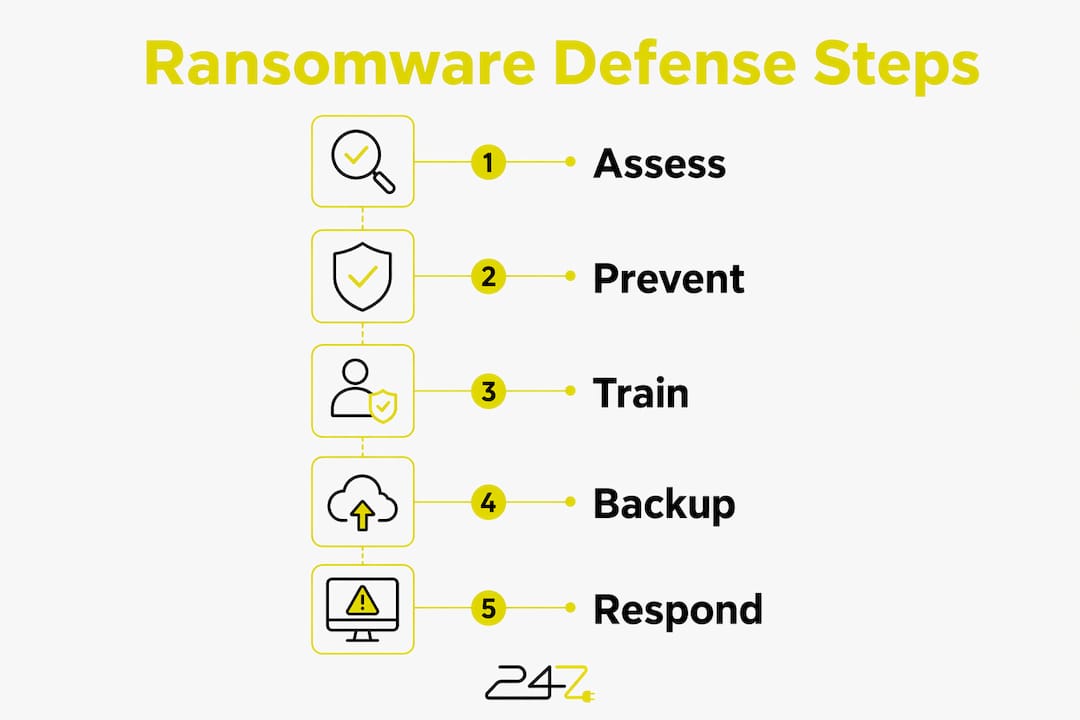
Three controls eliminate the majority of ransomware risk in an accounting office: enforcing multi-factor authentication (MFA) on every system, deploying endpoint detection and response (EDR) across all firm devices, and implementing auditable immutable backups following the 3-2-1-1-0 standard. If your firm does none of these today, the next 72 hours are your window to act before an attacker finds the gap first.
Immediate priorities for the next 24–72 hours:
- Enable MFA on all email accounts and remote access portals (Owner/Partner: assign to IT manager or MSP within 24 hours)
- Audit active user accounts and disable any that are unused or belong to former staff (IT manager: complete within 48 hours)
- Confirm that at least one backup copy is immutable and stored offsite (IT manager or MSP: verify and document within 48 hours)
- Block macro execution in Microsoft Office and enable advanced phishing filters on email (IT manager: configure within 72 hours)
- Schedule a tabletop exercise and restore test within 30 days (Partner/Owner: assign a date and responsible individual now)
Each task above has a named owner because diffuse responsibility is how ransomware protection accounting office programs fail. Assign it, document it, and move.
Table of Contents
- Why accounting firms are prime ransomware targets
- Priority technical controls every accounting office must deploy
- What does your WISP need to include, and what do regulators expect?
- How should you train accounting staff to recognize phishing?
- What to do in the first 24–72 hours after a ransomware incident
- How do you choose the right MSP or security partner for your firm?
- How do you prove your backups actually work?
- Your 30/90-day implementation plan and the 3-2-1-1-0 backup standard
- What do cyber insurers require, and what does preparedness cost?
- Key Takeaways
- Why ransomware preparedness must be a board-level decision
- 247techify can implement this plan for your accounting firm
- Authoritative sources and further reading
- FAQ
Why accounting firms are prime ransomware targets
Ransomware is malicious software that encrypts files and systems, then demands payment, typically in cryptocurrency, to restore access. Attackers increasingly combine encryption with data exfiltration, threatening to publish stolen client records unless the ransom is paid. For an accounting firm, that threat is particularly acute: your files contain Social Security numbers, bank routing details, payroll records, and tax return data that criminals can monetize immediately through fraudulent filings and identity theft.
Accounting practices are high-value targets precisely because they aggregate sensitive financial data from dozens or hundreds of clients under one roof, often with security infrastructure that does not match the value of what they protect. Small misconfigurations, unmanaged personal devices, and inconsistent patching are recurring root causes of breaches in accounting practices, according to industry field research. A forgotten email account or an unpatched remote desktop protocol (RDP) port can serve as the entry point for a ransomware strain that locks every QuickBooks file and tax application on the network within hours.
Statistic callout: The IRS notes that tax professionals are targeted by “highly sophisticated, well-funded, and technologically adept cybercriminals” because client data — bank accounts, SSNs, health insurance records — represents a “virtual goldmine” for fraudulent tax filings that are harder for the IRS to detect.
The most common delivery vectors are phishing emails with malicious attachments or links, business email compromise (BEC) that redirects ACH payments or refund transfers, credential theft through reused or weak passwords, and unpatched RDP or VPN endpoints exposed to the internet. Misconfigured cloud storage, where client files are inadvertently left accessible, is a growing secondary vector. Downtime during February or March, when tax season billing is at its peak, can cost a firm days of productivity and thousands in lost billable hours — far more than any preventive security investment.
Priority technical controls every accounting office must deploy
The controls below are ordered by impact. Implement them in sequence if resources are constrained, but do not skip any.
- MFA everywhere: Enforce MFA on email (Microsoft 365, Google Workspace), remote access (VPN, RDP), tax software portals, QuickBooks Online, and all administrative consoles. Use authenticator apps (Microsoft Authenticator, Google Authenticator) rather than SMS codes, which are vulnerable to SIM-swapping. Never exempt partner accounts from MFA — privileged accounts are the most valuable credential an attacker can steal.
- EDR/XDR on every device: Antivirus alone cannot detect the lateral movement and living-off-the-land techniques modern ransomware uses. Deploy an EDR platform with centralized telemetry so your IT manager or MSP can see anomalous process execution, credential dumping, and unusual file encryption activity in real time. Every firm-owned laptop, desktop, and server must be covered.
- Automated patch management: Unpatched operating systems and applications are the second most common ransomware entry point after phishing. Configure Windows Update for Business or a patch management tool to deploy critical patches within 72 hours of release. Tax software (Drake, UltraTax, Lacerte) and QuickBooks must be included in the patch schedule, not treated as exceptions.
- Secure email and anti-phishing controls: Configure DMARC, DKIM, and SPF on your firm’s domain to prevent spoofing. Enable advanced phishing filters and inbound link scanning in Microsoft Defender for Office 365 or Google Workspace’s security controls. Block macro execution in Office documents by default.
- Encryption at rest and in transit: Enable full-disk encryption (BitLocker on Windows, FileVault on macOS) on every laptop and workstation. Confirm that client files stored in cloud environments are encrypted at rest and that staff access tax applications over encrypted connections only.
- Least privilege and network segmentation: No staff member should have local administrator rights on their workstation unless their role requires it. Segment the network so that workstations, servers, and backup systems sit on separate VLANs. If ransomware encrypts one workstation, segmentation prevents it from reaching the file server or backup repository via lateral movement. Detailed guidance on network segmentation for small firms covers VLAN configuration and firewall rules.
Pro Tip: Disable Server Message Block (SMB) version 1 on all Windows machines immediately. SMB v1 is the protocol ransomware worms use to spread laterally across a network, and it has no legitimate use in a modern accounting office.

What does your WISP need to include, and what do regulators expect?
The FTC Safeguards Rule (16 CFR Part 314) requires every accounting firm that handles financial information to maintain a Written Information Security Plan (WISP), designate a qualified individual responsible for the program, conduct periodic risk assessments, implement MFA, and document staff security training. IRS Publication 4557 imposes parallel requirements, including access controls, encryption, secure remote access, and a defined breach response procedure. Even firms with fewer than ten employees must comply with both frameworks.
Your WISP must document, at minimum: the risk assessment methodology and results, the designated qualified individual’s name and responsibilities, access control policies, encryption standards, remote work rules, backup and recovery procedures, vendor management requirements, and the incident response plan. Regulators and insurers do not accept verbal assurances. They ask for dated, signed documents.
Key compliance insight: Cyber insurers increasingly require documented evidence of controls at renewal, not just attestations. Collect training completion certificates, backup restore-test logs signed by the responsible individual, and dated risk-assessment reports from day one. Pre-built WISP templates and compliance kits designed for accounting firms can accelerate this documentation for small practices that lack a dedicated compliance team.
Monthly and quarterly documentation tasks should be logged in a simple spreadsheet or ticketing system: date of restore test, files recovered, recovery time, tester name, and any errors. Date of phishing simulation, click rate, and remedial training completion. Date of patch audit and any outstanding critical patches. This log becomes your evidence package for auditors, insurers, and, if needed, regulators. A cybersecurity policy setup guide tailored to CPA firms can help structure these documentation cycles.
How should you train accounting staff to recognize phishing?
IRS guidance instructs tax professionals to maintain ongoing security awareness training with documented completion records, because phishing remains the primary ransomware delivery method. A single training session per year is insufficient. The recommended cadence is regular short awareness modules, phishing simulations multiple times per year, and an annual full-session refresher covering current threat scenarios.
Phishing simulation programs such as KnowBe4 or Proofpoint Security Awareness Training let you send simulated phishing emails and measure click rates. A high click rate after initial training indicates the program needs adjustment, with the target to reduce clicks substantially within several months and remedial training automatically assigned to anyone who clicks a simulated link.
Role-based training matters because the threats differ by function:
- Partners and firm owners need training on BEC scenarios, wire-transfer fraud, and tax-authority impersonation emails.
- Tax preparers need to recognize IRS-impersonation phishing and malicious PDF attachments disguised as client documents.
- Reception and administrative staff need training on credential-harvesting pages and phone-based social engineering.
- Remote staff need additional guidance on secure home network configuration and the risks of using personal devices for client work.
Keep completion certificates and remedial training records in a dedicated folder labeled by quarter and year. Employee cybersecurity training guidance for business leaders covers how to structure these records so they satisfy audit requests without manual reconstruction.
What to do in the first 24–72 hours after a ransomware incident
Speed and discipline in the first hours determine whether a ransomware incident becomes a recoverable disruption or a catastrophic data loss. Follow this sequence without deviation.
- Isolate infected hosts immediately. Disconnect affected workstations and servers from the network by unplugging ethernet cables and disabling Wi-Fi. Do not shut the machines down — memory forensics may be possible while the system is live.
- Preserve evidence before remediation. Take a memory snapshot if your EDR supports it. Preserve system logs, event viewer records, and any ransom note files. Document the time of discovery, the systems affected, and the first observed symptoms. Your forensic responder and legal counsel will need this.
- Activate your incident response plan. Notify the designated incident lead (typically the partner or IT manager), legal counsel, and your cyber insurer within the first two hours. Do not communicate about the incident over potentially compromised email accounts.
- Report to federal authorities. File a complaint with the FBI’s Internet Crime Complaint Center (IC3) at ic3.gov and report to CISA at cisa.gov/stopransomware. Contact your local FBI field office directly. Reporting does not obligate you to pay a ransom, and law enforcement may have decryption tools or intelligence relevant to the specific strain.
- Engage your cyber insurer. Call your insurer’s incident hotline, not just the general claims line. Most policies require prompt notification; delayed reporting can affect coverage. Your insurer will typically provide access to a breach coach, forensic firm, and legal counsel.
- Switch to backup recovery lanes. Stand up temporary operations using clean devices and your immutable backup copies. Communicate to clients via a pre-drafted template: state that the firm is experiencing a technical incident, that client data security is being assessed, and that you will provide updates within a defined timeframe. Do not speculate about data exposure until forensics confirm scope.
- Engage a forensic responder. Your insurer or legal counsel will recommend a qualified incident response firm. Do not attempt to remediate or rebuild systems before forensics are complete — premature cleanup destroys evidence needed for insurance claims and potential law enforcement action.
Contact list to compile now (before an incident): Incident lead (name, cell), legal counsel (name, firm, 24-hour number), cyber insurer (policy number, hotline), MSP or IT provider (emergency line), FBI local field office (number), forensic IR firm (if pre-contracted). Emergency ransomware recovery services can provide rapid forensic support when a firm lacks a pre-contracted IR partner.
How do you choose the right MSP or security partner for your firm?
Not every managed service provider is equipped to protect an accounting firm’s regulated environment. The right partner must demonstrate specific capabilities, not just list them in a proposal.
Capabilities to require in writing:
- 24/7 security monitoring with documented escalation procedures and response time SLAs (under 30 minutes for critical alerts)
- EDR deployment with telemetry access so you can review alerts independently
- Immutable backup management with hourly or near-hourly snapshots and multi-year retention
- SOC 2 Type II report or equivalent evidence for any hosted services handling client data
- Incident response retainer with a defined scope and a named forensic partner
Questions to ask during evaluation:
- What is your documented RTO and RPO for an accounting firm during tax season?
- How often do you perform restore tests, and can you show me a signed test log?
- If ransomware hits at 2 AM on March 14, what happens in the first 30 minutes?
- Do you have experience with IRS Publication 4557 and FTC Safeguards Rule compliance documentation?
Red flags to walk away from:
- No evidence of restore testing (“we back up nightly” is not the same as “we verify recovery monthly”)
- Vague SLAs with no defined response times or escalation paths
- Outsourced support without documented security controls for the subcontractor
- No SOC 2 or equivalent audit evidence for hosted environments
- Inability to produce a sample WISP or compliance documentation package
SOC-type assessments and forensic accounting collaboration increase confidence in a provider’s security posture and help quantify post-incident financial impact. Require that any prospective partner can demonstrate, not just describe, their controls.
How do you prove your backups actually work?
A backup that has never been tested is not a backup. It is an assumption. The FTC Safeguards Rule explicitly requires periodic restore testing with documented results as part of an effective security program.
- Monthly restore test: Select a sample file (a client tax return PDF, a QuickBooks backup file) from the previous night’s backup. Restore it to a clean, isolated machine. Open it and confirm it is readable and complete. Log the restore start time, completion time, any errors, and the tester’s name. Attach the signed log to your WISP documentation folder.
- Quarterly full-system restore drill: Restore a full server image or virtual machine snapshot to an isolated environment. Measure the time from initiation to a fully operational state. Compare against your documented RTO target.
- Tabletop exercise (semi-annual): Gather the partner, IT manager, and office manager. Present a scenario: “Ransomware was detected on the tax server at 6 AM on March 10. All QuickBooks and Drake files are encrypted.” Walk through the incident response plan step by step. Identify gaps in roles, communications, and recovery procedures. Document findings and assign remediation owners.
For accounting workflows, target an RTO measured in hours for critical services (tax software, client portals) during busy season, and configure managed backup services with hourly snapshots to minimize data loss during peak periods. Standard cloud provider retention windows of 30–45 days are insufficient for compliance and insurance purposes; target 1–3 years of retention. After every test and exercise, document what worked, what failed, and what changed. Insurers and auditors accept signed test logs as evidence; verbal confirmation of “we tested it” does not satisfy either.
Your 30/90-day implementation plan and the 3-2-1-1-0 backup standard
The 3-2-1-1-0 backup rule is the current standard for ransomware resilience: maintain 3 copies of data, on 2 different media types, with 1 copy offsite, 1 copy immutable (air-gapped or object-locked), and 0 errors verified during recovery testing. Default cloud retention windows of 30–45 days do not meet this standard. Target 1–3 years of backup retention for compliance and insurance purposes; default cloud retention windows of 30–45 days are insufficient.
30-day must-do checklist
| Priority | Action | Owner | Outcome |
|---|---|---|---|
| 1 | Enable MFA on all email, portals, and remote access | IT manager / MSP | Blocks credential-based attacks |
| 2 | Audit and disable unused/former-staff accounts | IT manager | Eliminates orphaned access paths |
| 3 | Deploy or confirm EDR on all firm devices | MSP | Enables lateral movement detection |
| 4 | Initiate immutable offsite backups with hourly snapshots | MSP | Meets 3-2-1-1-0 standard |
| 5 | Document WISP owner (qualified individual) and begin risk assessment | Partner/Owner | Satisfies FTC Safeguards Rule baseline |
90-day expansion checklist
- Complete full EDR rollout and confirm centralized telemetry is active.
- Implement network segmentation: workstations, servers, and backup systems on separate VLANs.
- Launch phishing simulation program and complete first round of role-based training.
- Finalize and sign the WISP, including incident response plan and vendor management section.
- Complete first monthly restore test and log the result.
- Review and update cyber insurance policy to confirm coverage aligns with documented controls.
- Schedule first tabletop exercise with partners and IT manager.
WISP checklist items mapped to deliverables:
- Risk assessment: dated, signed document identifying critical assets, data flows, and threat scenarios
- Training records: completion certificates by staff member, by module, by date
- Restore-test logs: signed monthly records showing that files were recovered without errors; logs must include recovery time and the tester’s name.
- Incident response plan: named roles, contact list, and step-by-step containment procedures
- Vendor management: list of third-party vendors with access to client data and their security evidence (SOC 2, contracts)
What do cyber insurers require, and what does preparedness cost?
Cyber insurance underwriters have tightened requirements significantly. At renewal, expect to document: MFA on all remote access and email, EDR deployment across endpoints, immutable backups with tested recovery, a signed WISP, and completed staff security training. Firms that cannot produce these artifacts face higher premiums, coverage exclusions, or outright denial.
Cost-to-value framing: The three highest-impact investments for an accounting firm, in order of cost-effectiveness, are MFA (near-zero marginal cost on existing platforms), EDR via a managed provider (typically a per-seat monthly fee), and managed immutable backups with hourly snapshots. Together, these three controls address the majority of ransomware entry points and recovery scenarios, and they generate the documented evidence insurers require at renewal. Deferring them to avoid cost is the more expensive decision when a ransomware incident during tax season can eliminate weeks of billable revenue and trigger state breach notification obligations.
Budgeting guidance: prioritize MFA and account hygiene first (no additional software cost for most firms already on Microsoft 365 or Google Workspace), then EDR through a managed provider, then immutable backup infrastructure. Network segmentation and a formal WISP can often be addressed through a one-time engagement with a qualified MSP. Compliance and auditing support from a managed provider can accelerate WISP completion and generate the documentation package insurers want at renewal.
Key Takeaways
Effective ransomware protection for an accounting office requires MFA, EDR, immutable 3-2-1-1-0 backups, a signed WISP, documented training, and a tested incident response plan — all producing auditable evidence from day one.
| Point | Details |
|---|---|
| MFA is the first control | Enable MFA on email, portals, and remote access within 24 hours; use authenticator apps, not SMS. |
| 3-2-1-1-0 backup standard | Maintain immutable, offsite backups with hourly snapshots and 1–3 years of retention to satisfy insurers. |
| WISP and FTC compliance | The FTC Safeguards Rule requires a signed WISP, risk assessment, training records, and restore-test logs. |
| Incident response contacts | Compile your insurer hotline, FBI IC3, CISA, legal counsel, and forensic IR firm contacts before an incident occurs. |
| 247techify as your security partner | 247techify delivers 24/7 monitoring, EDR, immutable backups, and WISP-ready documentation for accounting firms. |
Why ransomware preparedness must be a board-level decision
The most common failure mode in accounting firm cybersecurity is not a missing tool. It is the absence of a named owner with authority and budget. When security is delegated entirely to an IT contractor with no partner visibility, the WISP goes unsigned, restore tests go unscheduled, and training completion rates go unmeasured. Ransomware attackers count on exactly that gap.
Partners and firm owners need to treat security posture the same way they treat professional liability: as a governance obligation, not an IT task. The FTC Safeguards Rule requires a designated qualified individual responsible for the security program. That person needs a direct line to leadership, a defined budget, and the authority to enforce controls across all staff, including partners who resist MFA or use personal devices for client work.
Client trust is the firm’s most valuable asset. A ransomware incident that exposes client SSNs and tax records does not just trigger breach notification obligations under state law. It ends client relationships. The governance model that prevents that outcome is straightforward: designate the qualified individual, fund the WISP, schedule quarterly reviews with the partner group, and treat restore-test results as a standing agenda item. Security posture, like financial health, requires periodic measurement to remain meaningful.
247techify can implement this plan for your accounting firm
Accounting firms that want to move from a checklist to a fully operational security program typically need a partner who has done it before and can produce the documentation regulators and insurers require. 247techify delivers exactly that: 24/7 monitoring with sub-30-minute response, EDR across all firm devices, managed immutable backups with hourly snapshots, and WISP-ready compliance documentation that holds up at renewal.
The conversion path is straightforward. Start with a security assessment that maps your current controls against the FTC Safeguards Rule and IRS Publication 4557 requirements. From there, 247techify builds a 30/90-day roadmap tailored to your firm’s size, software stack, and busy-season constraints. Ongoing managed security covers monitoring, patching, backup verification, and the signed restore-test logs your insurer will ask for. Firms with an existing IT manager can engage through co-managed IT services to add security depth without replacing internal staff. Firms that want end-to-end coverage can move to fully managed IT and security. Request your security assessment today and get a documented gap analysis within days.
Authoritative sources and further reading
- FTC Safeguards Rule guidance: The primary regulatory reference for WISP requirements, restore testing obligations, and the documentation accounting firms must maintain.
- IRS — Protect Your Clients, Protect Yourself: IRS guidance on security awareness training, phishing risks, and the “Taxes-Security-Together” checklist for tax professionals.
- CISA — Report Ransomware: The federal reporting portal for ransomware incidents; also provides sector-specific mitigation guidance and the StopRansomware campaign resources.
- FBI — Ransomware guidance: FBI public guidance on reporting ransomware to IC3 and working with local field offices during an active incident.
- Veeam — 3-2-1-1-0 backup rule: The definitive explanation of the immutable backup standard, including retention guidance and recovery verification requirements.
FAQ
Who investigates ransomware attacks on accounting firms?
The FBI investigates ransomware incidents and directs victims to file complaints with the Internet Crime Complaint Center (IC3) at ic3.gov. CISA also accepts reports and provides technical assistance through its StopRansomware program.
What is the first thing to do when ransomware hits your office?
Immediately isolate infected machines from the network by disconnecting ethernet and disabling Wi-Fi, then notify your incident lead, legal counsel, and cyber insurer before attempting any remediation. Preserve system logs and memory state for forensic analysis.
Who do you report ransomware to in the United States?
Report to the FBI’s IC3 at ic3.gov, to CISA at cisa.gov/stopransomware, and to your local FBI field office. Also notify your cyber insurer promptly, as most policies require timely notification to preserve coverage.
Does paying the ransom restore access to your files?
The U.S. government recommends against paying ransoms because payment funds criminal operations and provides no guarantee of file recovery. Firms with tested, immutable backups following the 3-2-1-1-0 standard can restore operations without paying. Document each restore test as required by the FTC Safeguards Rule to ensure regulatory and insurer acceptance.
What is a WISP and does your accounting firm need one?
A Written Information Security Plan (WISP) is a documented security program required by the FTC Safeguards Rule and IRS Publication 4557 for any firm handling financial or tax data. It must include a risk assessment, designated qualified individual, access controls, incident response procedures, and training records.