
A healthcare network security setup is the coordinated deployment of technical controls, administrative policies, and compliance frameworks to protect electronic protected health information (ePHI) across clinical and administrative systems. The industry term for this discipline is health IT security architecture. Both terms describe the same practice: building layered defenses that satisfy HIPAA requirements, guard against ransomware, and keep patient care systems available. The NIST CSF 2.0 positions cybersecurity as a clinical safety imperative requiring executive ownership, not just an IT checkbox. This guide covers asset inventory, network segmentation, firewall configuration, identity controls, and resilience practices tailored specifically for hospitals and clinics.
What does a healthcare network security setup require before you start?
A complete asset inventory is the non-negotiable first step. You cannot protect what you cannot see. That inventory must include every endpoint, clinical workstation, imaging system, infusion pump, and IoMT device on the network. Medical device security ranks as the weakest domain in healthcare cybersecurity assessments. That finding means legacy devices and unsupported operating systems are almost certainly present in your environment right now.
Before configuring a single firewall rule, your team needs to complete these foundational preparations:
-
Asset inventory: Catalog every device, including make, model, OS version, and network location. Flag devices running unsupported software immediately.
-
Framework selection: Align your scope and maturity assessment to NIST CSF 2.0 or HITRUST CSF. Both provide tiered controls that map directly to HIPAA Security Rule requirements.
-
Business Associate Agreements (BAAs): Confirm signed BAAs with every vendor accessing ePHI. Third-party access is a primary breach vector.
-
Risk management policy: Document your risk tolerance, remediation timelines, and escalation paths before any technical work begins.
-
Cross-functional team: Include clinical informatics, compliance, legal, and operations in addition to IT. Security decisions that ignore clinical workflows fail in practice.
| Preparation Area | Key Tool or Action |
|---|---|
| Asset discovery | Network scanning tools (e.g., Nmap, Armis for IoMT) |
| Framework alignment | NIST CSF 2.0 or HITRUST CSF maturity assessment |
| Vendor risk | BAA review and third-party access audit |
| Endpoint protection | EDR solutions and vulnerability scanners |
| Policy documentation | Written risk management and remediation policy |
Pro Tip: Run your asset discovery scan during off-peak clinical hours. IoMT devices like infusion pumps can behave unpredictably under aggressive network scanning, and a disruption to a clinical device is a patient safety event.
How to implement network segmentation and firewall configuration in healthcare
Network segmentation in healthcare means dividing the network into isolated zones based on the sensitivity of the data and the function of the devices. Identity-based microsegmentation with default-deny access control lists (ACLs) outperforms broad VLAN trust models because it limits lateral movement when an attacker gains a foothold. A compromised billing workstation should never be able to reach an EHR server or a PACS imaging system.

Defining your protected surfaces
Start by mapping every protected surface: EHR systems, PACS servers, billing platforms, IoMT zones, and any system that stores, processes, or transmits ePHI. Each surface becomes its own microperimeter. Only explicitly approved traffic crosses zone boundaries.
Firewall rules that hold up under audit
Effective firewall design requires default-deny posture, explicit allowlists for clinical protocols like DICOM and HL7, and documented rationale for every rule. Undocumented rules are a compliance liability and an audit failure waiting to happen.
Key firewall configuration requirements for healthcare:
-
Default-deny inbound and outbound rules as the baseline posture
-
Explicit allowlists for DICOM (port 104), HL7 interfaces, and PACS traffic
-
Internal firewalls between clinical zones, administrative zones, and guest networks
-
A DMZ for all public-facing applications, including patient portals
-
Intrusion detection and prevention systems (IDS/IPS) augmenting perimeter and internal firewalls
-
Automatic expiration on all emergency “break-glass” access rules, with full audit logging
| Segmentation Approach | Risk Level | Best Use Case |
|---|---|---|
| Broad VLAN trust model | High | Legacy environments only, with compensating controls |
| Zone-based segmentation | Medium | Separating clinical, admin, and guest traffic |
| Identity-based microsegmentation | Low | ePHI workloads, EHR, PACS, IoMT zones |
Pro Tip: Document the business and clinical justification for every firewall rule at the time you create it. Auditors under HIPAA Security Rule reviews will ask why each rule exists. Retroactive documentation is always weaker and often incomplete.
What identity and access controls are best for healthcare network security?
Identity is the new perimeter in healthcare networks. Continuous identity validation for both users and devices reduces risk more effectively than perimeter-only defenses. This means verifying not just who is logging in, but what device they are using, whether that device meets security posture requirements, and whether the access request fits normal behavioral patterns.
Core identity and access controls every healthcare organization must implement:
-
Unique user IDs: Every clinician, administrator, and contractor gets a unique, non-shared account. Shared accounts destroy audit trail integrity.
-
Phishing-resistant MFA: Deploy hardware tokens or FIDO2 authenticators for remote access, privileged accounts, and patient portal administration. SMS-based MFA is insufficient for high-risk access.
-
Role-based access control (RBAC): Grant access based on job function, not convenience. A radiology technician does not need access to billing records.
-
Least privilege enforcement: Review and trim access rights quarterly. Privilege creep is one of the most common findings in HIPAA audits.
-
Device posture validation: Before granting network access, verify that the device has current EDR health status, up-to-date patches, and enabled disk encryption.
-
Vendor and Business Associate access: Require MFA for all third-party remote sessions. Log session start and end times, and disable standing access when not actively needed.
Zero trust principles apply directly here. No user or device is trusted by default, even inside the network perimeter. Adaptive policies that evaluate user context, device risk, and access time add another layer of control without disrupting clinical workflows.
Pro Tip: For emergency clinical access scenarios, implement time-limited privilege elevation rather than permanent admin accounts. Clinicians get the access they need in a crisis, and the elevated rights expire automatically after a defined window.
How to maintain healthcare network resilience through backup, monitoring, and incident readiness
Resilience is not a one-time configuration. It is an ongoing operational discipline. The three pillars are secure backups, continuous monitoring, and tested incident response plans.
Backup and recovery
-
Maintain at least three copies of critical data, on two different media types, with one copy stored offline and isolated from the production network.
-
Test data restoration at least twice a year to confirm ransomware recovery capability. A backup you have never restored is a backup you cannot trust.
-
Encrypt backup data at rest and in transit. Unencrypted backups are a HIPAA violation waiting to happen.
-
Store backups in geographically separate locations to protect against physical disasters.
-
Document recovery time objectives (RTO) and recovery point objectives (RPO) for every critical clinical system.
Monitoring and threat detection
Continuous monitoring requires a Security Information and Event Management (SIEM) platform ingesting logs from firewalls, endpoints, identity systems, and clinical applications. Flow log analysis catches lateral movement that signature-based tools miss. Vulnerability scanning should run on a defined schedule, with critical findings remediated within 30 days and high findings within 60 days.
-
Deploy SIEM with healthcare-specific use cases, including after-hours EHR access and bulk record exports
-
Conduct penetration testing at least annually, and after any major infrastructure change
-
Align patch management cycles to HIPAA Security Rule requirements for ongoing risk analysis and remediation
-
Maintain documented incident response plans with defined roles, communication trees, and escalation paths
Pro Tip: Map your SIEM alert thresholds to clinical workflows. An alert that fires every time a nurse accesses multiple patient records during a shift will generate alert fatigue and get ignored. Tune thresholds to flag genuinely anomalous behavior, like bulk exports at 2 a.m.
What are the most common pitfalls in healthcare network security setup?
The most dangerous mistake in health IT security setup is treating the firewall as the only line of defense. Perimeter security alone fails the moment an attacker obtains valid credentials or exploits a trusted internal connection. Generic security architectures fail in healthcare because they do not account for IoMT device traffic, clinical protocol requirements, or the regulatory nuances of HIPAA.
Common pitfalls and how to address them:
-
Over-reliance on perimeter firewalls: Deploy internal segmentation and identity-based controls. The perimeter is necessary but not sufficient.
-
Neglecting legacy medical devices: Devices running Windows XP or unsupported firmware cannot be patched. Isolate them in dedicated network segments with strict traffic controls until replacement is funded.
-
Broadly trusted VLANs: Replace implicit VLAN trust with explicit protocol allowlisting. Only necessary clinical communications should cross zone boundaries.
-
Permanent emergency access rules: Every break-glass rule must have an expiration date and an audit log. Permanent rules become forgotten attack surfaces.
-
Inadequate documentation: Undocumented configurations fail audits and make incident response slower. Document every rule, every access grant, and every exception.
-
Skipping employee training: Human error remains a primary breach vector. Phishing simulations and security awareness training reduce this risk measurably.
SentinelOne advises prioritizing security controls by risk criticality and exposure rather than attempting to secure everything equally. That approach lets resource-constrained healthcare IT teams focus effort where it matters most.
Pro Tip: Build a criticality matrix that ranks every system by its ePHI exposure and its impact on patient care if compromised. Use that matrix to drive patching schedules, segmentation priorities, and monitoring thresholds.
Key Takeaways
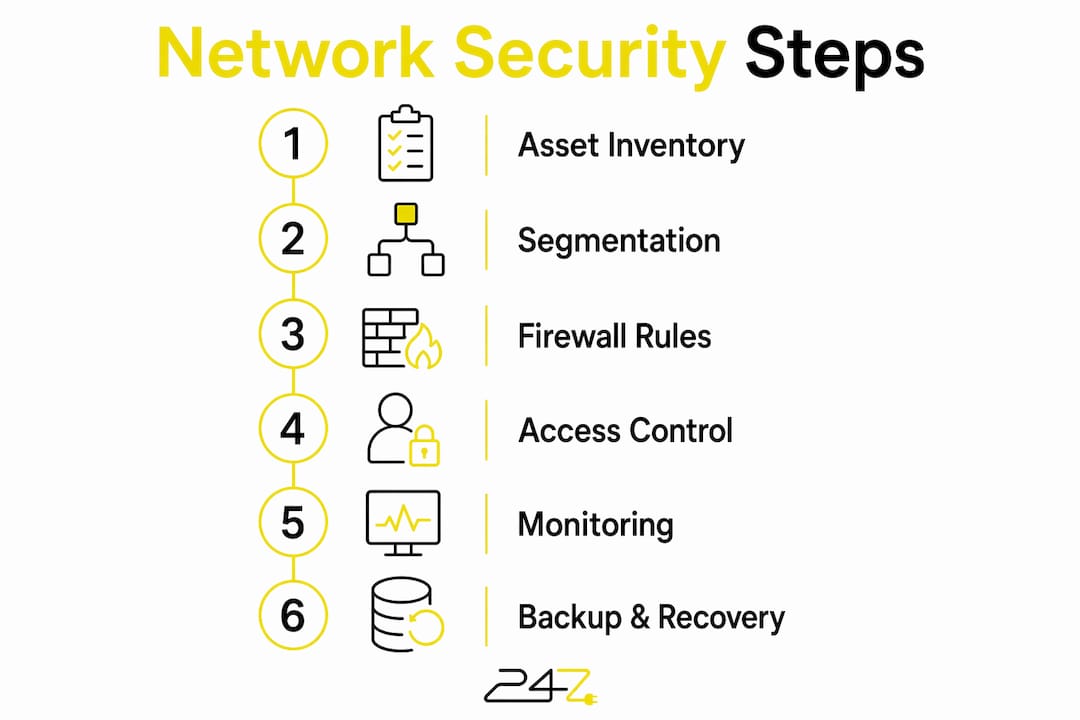
A healthcare network security setup succeeds only when asset inventory, identity-based segmentation, default-deny firewall policies, continuous monitoring, and tested backup recovery operate as an integrated system.
| Point | Details |
|---|---|
| Start with asset inventory | Catalog every device, including IoMT, before configuring any security control. |
| Segment by protected surface | Use identity-based microsegmentation with default-deny ACLs for EHR, PACS, and IoMT zones. |
| Enforce phishing-resistant MFA | Deploy FIDO2 or hardware tokens for all remote and privileged access accounts. |
| Test backups twice a year | Biannual restoration testing under NIST CSF 2.0 confirms actual ransomware recovery capability. |
| Document every rule and exception | Undocumented configurations fail HIPAA audits and slow incident response. |
Why healthcare cybersecurity demands executive ownership, not just IT effort
The most persistent gap I see in healthcare security programs is not technical. It is organizational. Hospitals that treat cybersecurity as an IT department problem consistently underinvest in the controls that matter most, because the people approving budgets do not understand the clinical risk. A ransomware attack that takes down an EHR system is not an IT outage. It is a patient safety event.
The NIST CSF 2.0 makes this explicit: CIO and CISO ownership must be embedded into procurement decisions, clinical workflow design, and vendor contracting. That means a security review happens before a new infusion pump vendor is approved, not after the devices are already on the network. Most healthcare organizations do this in reverse, and they pay for it.
Zero trust is not a product you buy. It is a design philosophy that requires continuous verification of every user and device, every time. The healthcare organizations that implement it effectively start small, typically with privileged access and remote vendor sessions, and expand from there. Trying to deploy zero trust across an entire hospital network in one project almost always fails.
Legacy device replacement is the hardest conversation in healthcare IT, because it requires capital budget approval from clinical and finance leadership. My recommendation: build the business case around patient safety and regulatory liability, not just cybersecurity. A device running an unsupported OS is a HIPAA compliance gap and a potential clinical liability. Frame it that way, and the conversation changes.
Regular maturity assessments against NIST CSF 2.0 or HITRUST give leadership a concrete benchmark. They also create a defensible record of due diligence if a breach occurs. Regulators look more favorably on organizations that can demonstrate a documented, improving security program than on those that cannot.
— Rohan
247techify provides healthcare-grade cybersecurity and network security services
Healthcare organizations face a specific combination of regulatory pressure, legacy infrastructure, and high-value data that generic IT providers are not equipped to handle. 247techify specializes in cybersecurity services built for regulated industries, including hospitals and clinics operating under HIPAA and PHIPA requirements.

247techify delivers compliance auditing, network infrastructure setup, device management, ransomware recovery, and 24/7 managed IT support with a response time under 30 minutes. The team holds a 98% client satisfaction rate across healthcare and finance clients. If your organization needs a structured path from current-state risk assessment to a fully documented, HIPAA-aligned security architecture, 247techify has the expertise to get you there. Contact 247techify to schedule a security assessment for your hospital or clinic.
FAQ
What is a healthcare network security setup?
A healthcare network security setup is the coordinated deployment of technical controls, policies, and compliance frameworks to protect ePHI across clinical and administrative systems. It includes asset inventory, network segmentation, firewall configuration, identity management, and incident response planning.
What does HIPAA require for network security?
HIPAA’s Security Rule requires covered entities to conduct ongoing risk analysis, implement access controls, audit logging, transmission encryption, and maintain documented policies for all ePHI systems. The January 2026 HHS OCR guidance reinforces that compliance requires continuous risk management, not one-time patching.
How often should healthcare organizations test their backups?
NIST CSF 2.0 recommends testing data restoration procedures at least twice a year. Biannual testing confirms that backups are actually recoverable after a ransomware attack or system failure.
What is the difference between VLAN segmentation and microsegmentation?
VLAN segmentation divides the network into broad zones but often relies on implicit trust within each zone. Microsegmentation enforces identity-based controls and explicit protocol allowlists at the workload level, which limits lateral movement and better satisfies HIPAA requirements for ePHI protection.
Why do generic security architectures fail in healthcare?
Generic architectures do not account for IoMT device traffic patterns, clinical protocol requirements like DICOM and HL7, or the regulatory nuances of HIPAA. Healthcare-specific security design must accommodate these workflows without disrupting patient care operations.