
To protect clients and comply with privacy rules, real estate professionals must collect only what’s necessary, document consent, secure data with basic technical controls, manage vendors, and adopt an incident-response plan. That is the whole job, stripped of jargon. Everything else in this client data privacy real estate guide is the how.
Three things separate brokerages that survive a privacy complaint or breach from those that don’t. First, run an information inventory this week, not this quarter, so you know exactly what personal data you’re holding and where. Second, rewrite your consent language on web forms and open-house sign-ins so it says plainly what you collect and why. Third, turn on multi-factor authentication (MFA) across email and your CRM, and confirm your backups are encrypted and tested.
- Minimize collection: ask only for what the transaction requires.
- Document consent with timestamps and clear opt-in language.
- Encrypt data in transit and at rest, and enforce MFA everywhere.
- Vet vendors contractually before handing them client data.
- Write a one-page incident response plan before you need one.
A relevant industry note: guidance from bodies like the National Association of REALTORS® frames small brokerages as high-risk targets precisely because they tend to skip these basics, not because they lack sensitive data.
Table of Contents
- What Are Your Client Data Privacy Obligations in Real Estate?
- How Should You Handle Consent and Minimize Data Collection?
- Which Security Controls Should You Prioritize First?
- What Compliance Rules Apply to Open Houses and Lead Capture?
- How Do You Build a Data Inventory and Retention Policy?
- What Should You Require From CRM and Cloud Vendors?
- What Is the Incident Response Process After a Data Breach?
- What Templates Can You Copy for Compliance Documentation?
- How Does a Managed IT Partner Support Real Estate Compliance?
- How Do You Train Employees on Client Data Privacy?
- How Do You Handle Client Requests to Access, Correct, or Delete Data?
- What Privacy-Enhancing Technologies Apply to Real Estate?
- How Do You Anonymize or Mask Client Data When Sharing It?
- How Often Should You Audit Your Privacy Practices?
- What Should Your First 90 Days of Compliance Work Look Like?
- An Honest Take on Where Brokerages Get Privacy Wrong
- Sources
- FAQ
What Are Your Client Data Privacy Obligations in Real Estate?
Your legal footing starts with Canada’s federal privacy law and gets reinforced by provincial regulators and your professional association. The Personal Information Protection and Electronic Documents Act (PIPEDA) governs how private-sector organizations, including brokerages, collect, use, and disclose personal information, and the Office of the Privacy Commissioner of Canada publishes the business guidance and complaint procedures that interpret it.
Provincial real estate regulators add practical texture to that federal baseline. The BCFSA’s privacy guidelines tell licensees to collect only the minimum information necessary for a transaction and to obtain informed consent before doing anything else with it. That single principle, minimum necessary, kills more compliance headaches than any technology purchase.
- PIPEDA sets the federal floor for consent, purpose limitation, and breach obligations.
- BCFSA and equivalent provincial regulators translate that floor into real estate specific expectations.
- The NAR Data Security & Privacy Toolkit offers a four-pillar framework (physical, electronic, training, vendor oversight) that works even without a U.S. license, since the logic is universal.
Smaller firms sometimes assume regulator guidance is aimed at big brokerages with compliance departments. It isn’t. The rules apply the moment you hold a client’s name, phone number, and financial details, regardless of headcount.
How Should You Handle Consent and Minimize Data Collection?
Valid consent is specific, informed, and provable. A checkbox that says “I agree to terms” proves nothing if a regulator asks what the client actually agreed to. Log the date, the exact language shown, and the context (web form, open house, phone call) every time someone hands you personal information.
- Ask only for fields the transaction requires. A showing request needs a name, phone number, and property interest, not a social insurance number or income details up front.
- Use an explicit opt-in checkbox separate from any “submit” button, worded in plain language: “I consent to [Brokerage Name] contacting me about this property and similar listings.”
- Timestamp and store every consent record in your CRM, tied to the specific form or interaction that generated it.
- Add a visible link to your privacy policy on every web form, landing page, and open-house sign-in sheet, not buried in a footer three clicks away.
- State your retention period in plain terms near the consent checkbox: “We retain this information for the duration of your search and up to 24 months afterward.”
Minimization also protects you operationally. Every extra field you collect is another liability if a database is ever exposed, so the fewer sensitive fields you store, the smaller your breach footprint becomes.
Pro Tip: Audit your existing web forms this month. If a field’s answer wouldn’t change how you serve that specific lead, delete the field. Fewer fields also tend to raise form completion rates.
Which Security Controls Should You Prioritize First?
The Federal Trade Commission’s framework, echoed in NAR’s toolkit, organizes data protection around four pillars: physical security, electronic security, employee training, and third-party vendor oversight. Map your spending to those four categories before buying any single tool.
Technical controls come first because they’re cheap relative to their impact. Enforce MFA on email, CRM, and cloud storage. Use TLS for anything transmitted over the web and AES-256 encryption for stored documents. Back up client files on a schedule that’s actually tested, not just scheduled, and keep endpoint protection and OS patches current on every device that touches client data, including personal phones used for work.
- Physical security: locked file storage, visitor logs, and screen locks on unattended workstations.
- Electronic security: MFA, encryption at rest and in transit, endpoint protection, and automatic patching.
- Training: recurring, scenario-based sessions, not a single onboarding slide deck.
- Vendor oversight: contractual requirements for any CRM, lead platform, or cloud provider touching client data.
Operational controls matter as much as technical ones. Role-based access control (RBAC) means your transaction coordinator doesn’t need visibility into every closed file from five years ago, and audit logging tells you who accessed what and when, which is exactly what a regulator asks for after an incident. Small brokerages that treat this as a policy exercise rather than a technical one usually end up with the wrong priority order. Cybersecurity gaps specific to real estate firms tend to concentrate in exactly these operational blind spots.
What Compliance Rules Apply to Open Houses and Lead Capture?
Open houses generate more privacy risk per square foot than almost any other part of the business, mostly because paper sign-in sheets let every visitor read every other visitor’s name and phone number. That’s the exact failure mode industry guidance on open-house data collection flags, and digital check-in tools fix it by capturing consent and timestamps privately instead.
- Make open-house sign-in voluntary and switch to a digital tablet or app that logs consent individually rather than a shared paper sheet.
- Add consent text at sign-in: “By providing your contact information, you agree to be contacted about this property. Your information is not shared with other visitors.”
- For email and text marketing, follow Canada’s Anti-Spam Legislation guidance: commercial electronic messages require express or implied consent, and you need to keep a record of how and when that consent was obtained.
- Configure your CRM to process opt-out requests immediately and permanently, not just for the next campaign.
- If you buy leads from a third-party platform, require documented proof of consent at the point of collection, plus a deletion clause if that consent is ever withdrawn.
How Do You Build a Data Inventory and Retention Policy?
You can’t protect what you can’t find. Walk through every system that touches client information, your CRM, email, cloud storage folders, phones, and the filing cabinet nobody’s opened since a past closing, and log what’s there.
- List each data category (contact details, financial documents, identification copies) and where it physically or digitally lives.
- Note who has access to each category and whether that access is still necessary.
- Separate transactional records (retain per your provincial real estate board’s requirements, often several years post-closing) from marketing data (retain only while consent remains active).
- Set a deletion trigger for each category, not just a retention start date.
- Wipe devices with certified secure-erase tools before resale or disposal, and shred physical files rather than tossing them.
The NAR Data Security & Privacy Toolkit treats the information inventory as the foundational step for exactly this reason: retention and disposal decisions are impossible until you know what you’re retaining. A confidentiality framework built for IT operations applies the same logic outside real estate, which tells you this isn’t an industry quirk. It’s baseline data hygiene.
What Should You Require From CRM and Cloud Vendors?
Every vendor touching client data extends your liability, so your contracts need teeth, not just a signature line.
- Require a data processing clause specifying what the vendor can and can’t do with client information.
- Insist on breach notification timelines in writing, ideally 24 to 72 hours from discovery.
- Demand a return-or-destroy clause for when the contract ends, so data doesn’t sit on a former vendor’s server indefinitely.
- Ask for SOC 2 certification or equivalent, and confirm where data is physically stored, since jurisdiction affects which privacy laws apply.
- Request sub-processor transparency: if your CRM vendor uses a third-party hosting provider, you need to know who that is.
A vendor risk checklist built for professional services firms covers most of these clauses in more depth and translates cleanly to brokerages managing CRM and cloud contracts.
Pro Tip: Review vendor contracts annually, not just at signing. Certifications lapse, sub-processors change, and a vendor that was compliant two years ago may not be today.
What Is the Incident Response Process After a Data Breach?
A breach without a plan turns a bad day into a bad year. Small brokerages are disproportionately exposed here, since industry data on breach consequences shows limited resources make recovery slower and legal exposure higher relative to firm size.
- Contain the incident immediately: disconnect affected systems, change credentials, and preserve logs before you touch anything else.
- Identify what data was exposed and how many clients are affected.
- Notify internal stakeholders first, then affected clients, and consult the Office of the Privacy Commissioner’s guidance on when a report to the regulator is required.
- Set a notification timeline. Days matter here, not weeks. Clients who learn about a breach from a news story instead of from you lose trust fast.
- Document every step taken, then run a lessons-learned review to close the specific gap that caused the incident.
The brokerages that recover fastest from a breach are the ones that had already written the response plan before they needed it. Improvising containment and notification under pressure is where costly mistakes happen, not in the initial breach itself.
What Templates Can You Copy for Compliance Documentation?
You don’t need custom software to operationalize any of this. A spreadsheet and two paragraphs of consent language get you most of the way there.
- Inventory checklist fields: data type, purpose of collection, storage location, access list, retention trigger.
- Open-house consent text: “By signing in, you agree [Brokerage Name] may contact you about this and similar properties. See our privacy policy at [link]. Data is retained for 12 months.”
- Web lead form consent text: “I consent to receiving communications about this property and related listings. I can withdraw consent anytime by replying STOP or contacting [email].”
| Record Type | Suggested Retention Trigger |
|---|---|
| Closed transaction file | Retain per provincial real estate board requirement, then archive or destroy |
| Active lead / prospect | Retain while consent remains active; delete after 24 months of inactivity |
| Marketing opt-in contact | Retain until opt-out; process removal within days of request |
| Open-house sign-in record | Retain 12 months, then securely delete |
How Does a Managed IT Partner Support Real Estate Compliance?
Most brokerages don’t have an in-house security team, which is exactly the gap a cybersecurity-first managed IT provider fills. 247techify builds MFA and access controls into client systems, manages encrypted backups, monitors networks around the clock, and runs incident response when something goes wrong instead of after the fact.
- 24/7 monitoring and a response time under 30 minutes when an incident is detected.
- MFA and role-based access setup across CRM, email, and cloud storage.
- Encrypted, tested backup and disaster recovery configurations.
- Compliance consulting drawing on experience with regulated industries like healthcare (HIPAA) and finance (PCI-DSS), which maps directly onto real estate’s privacy obligations.
Pro Tip: When evaluating a managed IT partner, ask for their average incident response time in writing and request a sample compliance audit report, not just a sales pitch about capabilities. Brokerages considering CRM and MLS-integrated IT support should ask specifically how the provider handles access control for transaction coordinators versus agents, since that distinction is where most access-creep happens.
How Do You Train Employees on Client Data Privacy?

A locked-down CRM means nothing if an agent emails a client’s financial documents to the wrong address because nobody trained them on double-checking recipients. Training is the pillar most brokerages skip, usually because it feels less urgent than a technology purchase, and it’s also the one that prevents the most common incidents: misdirected emails, phishing clicks, and lost devices.
Effective training isn’t a one-time onboarding video. Build a recurring cadence, quarterly at minimum, covering phishing recognition, password hygiene, and what to do if a device is lost or stolen. Use real scenarios: a fake “urgent wire transfer” email pretending to be from a lender, a text message impersonating a title company. Agents who’ve seen the trick once are far less likely to fall for it live.
Make privacy part of onboarding for every new hire and every contractor with system access, including admin staff and transaction coordinators who often handle more sensitive documents than the agents themselves. Document who completed training and when. If a breach happens and a regulator asks whether staff were trained, “we think so” is not an acceptable answer.
A structured employee training framework built for business leaders outside real estate applies almost without modification here: the mechanics of phishing and credential theft don’t change by industry, only the specific documents at risk do.
How Do You Handle Client Requests to Access, Correct, or Delete Data?
Clients have the right to ask what personal information you hold about them, to correct inaccuracies, and, in many cases, to request deletion once a transaction is complete and no legal retention requirement applies. Treat these requests as routine business, not as adversarial events.
Set up a simple process: a designated email address or contact person for privacy requests, a response timeline (30 days is a reasonable working standard under PIPEDA-aligned practice), and a verification step to confirm the requester is actually the client before you hand over or alter anything.
Access requests mean giving the client a clear summary of what you hold, not raw database exports. Correction requests mean updating the record and confirming the change back to the client. Deletion requests are trickier, since transactional records often carry a legal retention period tied to your provincial real estate board’s rules, so you’ll sometimes need to explain that full deletion isn’t possible until that period lapses, while marketing data with no such requirement can usually be deleted immediately.
Document every request and your response. If your CRM makes correction or deletion difficult, that’s a sign it’s the wrong tool for a brokerage handling ongoing privacy obligations, not just transactions.
What Privacy-Enhancing Technologies Apply to Real Estate?
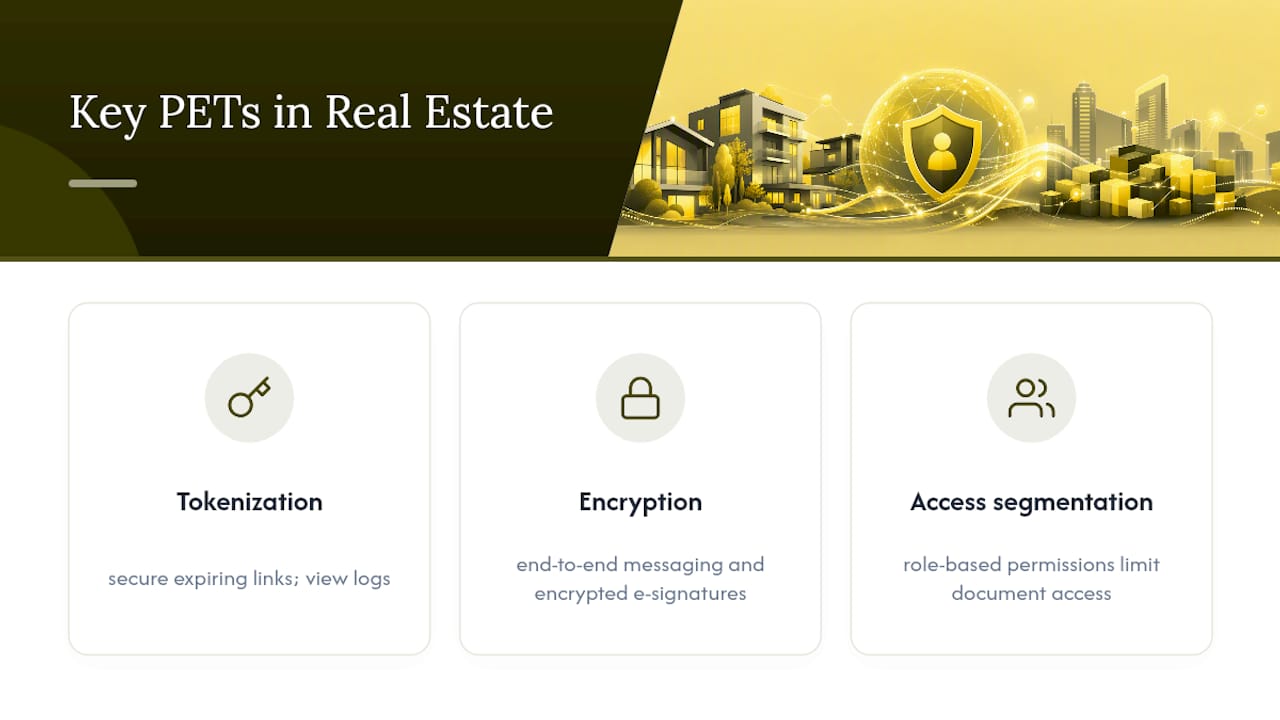
Privacy-enhancing technologies (PETs) reduce how much raw personal data moves through a transaction while still letting the deal proceed. In real estate, that mostly means tokenization, encryption, and access segmentation rather than exotic cryptography.
Tokenized document sharing replaces a client’s actual financial statement with a secure link that expires and logs every view, instead of an email attachment that lives in an inbox indefinitely. End-to-end encrypted messaging for sensitive negotiation details keeps that content out of plain-text email threads that can be forwarded or breached. Encrypted e-signature platforms with access logs handle identification documents more safely than scanned PDFs sitting in a shared drive.
Access segmentation is the simplest PET to implement immediately: give lenders, title companies, and inspectors access to only the specific documents their role requires, through a shared portal with individual permissions, rather than a single folder link that exposes everything to everyone in the transaction chain. The Government of Canada’s PIPEDA-related guidance treats this kind of purpose limitation as a core privacy principle, and PETs are simply the technical mechanism for enforcing it automatically instead of relying on staff discipline.
How Do You Anonymize or Mask Client Data When Sharing It?
Not every internal report or external partner needs the client’s full identity attached. Masking replaces sensitive fields with placeholder values for analysis or training purposes, while anonymization strips identifying details entirely so the data can’t be traced back to a specific person.
If your brokerage shares transaction data with a marketing analytics tool to measure campaign performance, mask names and exact addresses, keeping only the property type, price range, and general area. If you’re training new agents using past transaction examples, anonymize client names and specific financial figures in the case study materials. Internal reporting to brokerage leadership on lead volume rarely requires full names either, aggregate counts by source and stage usually tell the same story without exposing individual client records.
The practical rule: before sharing any dataset internally or externally, ask whether the recipient’s actual task requires a specific client’s name and financial details, or just the pattern those details represent. Most reporting, analytics, and training use cases need the pattern, not the person.
How Often Should You Audit Your Privacy Practices?
A privacy policy that sat untouched since your website launched three years ago isn’t protecting anyone anymore. Run a formal privacy and security audit at least annually, and after any significant change: a new CRM, a new lead-generation vendor, or an office move.
An audit tailored to real estate practice should walk through the same categories covered throughout this guide: confirm your data inventory is current, verify consent language on every active web form matches what you’re actually collecting, test that MFA is enforced (not just enabled) across every account, and review vendor contracts for lapsed certifications or expired data processing clauses.
Risk assessments should weight open houses and lead capture channels heavily, since those generate the highest volume of new personal data with the least oversight. Pull a sample of recent open-house sign-ins and lead form submissions and check whether consent was actually documented for each one, not assumed. If gaps show up, that’s the audit doing its job. Finding nothing wrong in a first audit is rarer than finding several small fixable issues, and either outcome is useful information for the next one.
What Should Your First 90 Days of Compliance Work Look Like?
Real estate privacy compliance works because minimizing collection, documenting consent, and layering technical controls close the specific gaps regulators and breach data both point to, not because any single tool solves the problem.
| Point | Details |
|---|---|
| Start with the inventory | You can’t protect or delete data you haven’t mapped across your CRM, email, cloud, and physical files. |
| Fix consent language first | Rewrite web form and open-house checkboxes to name exactly what’s collected and for how long. |
| Layer technical controls | MFA, encryption at rest and in transit, and tested backups close the highest-impact gaps fastest. |
| Put vendor terms in writing | Require breach notification timelines and data destruction clauses before signing any CRM or cloud contract. |
| Write the incident plan now | A response plan drafted calmly beats one improvised during an actual breach. |
An Honest Take on Where Brokerages Get Privacy Wrong
Most brokerages treat client data privacy as a legal exposure to manage rather than a service they’re providing, and that framing gets the priorities backward. Clients hand over financial details, identification documents, and personal circumstances because they trust the professional in front of them, not because a form made them. A leaked email thread or a careless CRM export damages that trust as much as any regulatory fine does.
The conventional advice, “get a privacy policy and a cyber insurance quote,” treats compliance as paperwork. It isn’t. The brokerages that actually reduce risk start with the boring stuff: knowing what data they hold, turning on MFA, and writing consent language a human can actually understand. Technology purchases matter far less than most vendors want you to believe. A brokerage with mediocre software and disciplined habits will outperform one with expensive tools and sloppy practices every time.
If there’s one place to start, it’s the inventory. You can’t secure, retain correctly, or delete what you haven’t mapped. Everything else in this guide follows from that single exercise.
— 247techify Team
Sources
- Privacy Guidelines — BCFSA
- Data privacy & security — National Association of REALTORS®
- Fightspam
- Office of the Privacy Commissioner of Canada — lnnt-e-dncl.gc.ca
FAQ
Does PIPEDA Apply to Small Real Estate Brokerages?
Yes. PIPEDA applies to any private-sector organization that collects personal information in the course of commercial activity, regardless of size, so a two-agent brokerage has the same basic obligations as a large firm.
How Long Should I Keep Client Records?
Transactional records generally follow your provincial real estate board’s retention requirement, often several years post-closing, while marketing data should be deleted once consent is withdrawn or after a defined inactivity period, such as 24 months.
What Counts as Valid Consent for Marketing Emails?
Under CASL, valid consent for commercial electronic messages requires an explicit opt-in and a recorded date, source, and wording of that consent, which your CRM should log automatically for every new contact.
Should I Use Paper or Digital Sign-In Sheets at Open Houses?
Digital sign-in tools are the stronger choice because they capture individual consent privately and log timestamps automatically, while paper sheets expose every visitor’s information to everyone else in the room.
What’s the First Thing to Do After Discovering a Data Breach?
Contain the affected systems immediately, preserve logs before making further changes, then move to internal notification, client notification, and regulator consultation on the timeline the incident’s severity requires.