
Managed IT services is defined as a contracted, proactive model where a third-party provider continuously monitors, manages, and maintains your organization’s IT infrastructure under a formal service-level agreement. This model replaces the traditional break-fix approach, where you only called for help after something failed, with a system built on prevention, accountability, and measurable outcomes. For Canadian businesses navigating compliance requirements like HIPAA and PCI-DSS, the shift to managed IT solutions represents a fundamental change in how technology risk is controlled. The Technology and Services Industry Association (TSIA) defines managed services as a repeatable, programmatic operating model tied directly to predictable business outcomes.
What is managed IT services and what does it include?
Managed IT services cover the full spectrum of IT functions your business needs to run securely and efficiently, delivered by an external provider rather than an internal team. The scope goes well beyond basic help desk support.
A standard managed IT contract typically includes:
- Network monitoring and management: Continuous surveillance of your routers, switches, firewalls, and bandwidth to catch failures before they cascade.
- Help desk and user support: Tiered support for your staff, covering password resets, software issues, and device troubleshooting, usually available 24/7.
- Cybersecurity management: Threat detection, antivirus enforcement, patch management, and incident response. This is where regulated businesses get the most value.
- Backup and disaster recovery: Automated, tested backups with defined recovery time objectives so a ransomware attack or hardware failure does not end your operations.
- Cloud and endpoint management: Provisioning, monitoring, and securing laptops, mobile devices, and cloud workloads through device management platforms.
- IT consulting and strategic planning: Access to a virtual CIO (vCIO) who aligns your technology roadmap with business goals, a function most small and mid-sized organizations cannot afford to hire internally.
The managed IT service definition matters here: this is not a one-time project or a vendor you call when things break. It is an ongoing, contractual relationship with defined deliverables and performance metrics.
Pro Tip: Before signing any managed IT contract, ask the provider to show you a sample monthly report. The quality and specificity of that report tells you exactly how accountable they will be once you are a client.

How do managed IT services improve security, compliance, and efficiency?
Security and compliance are the primary reasons regulated businesses adopt managed IT services, not cost savings alone. Access to specialized expertise in security and compliance is the leading adoption driver for organizations in healthcare, finance, and legal sectors. Building that expertise internally requires hiring certified security engineers, compliance officers, and network architects, a cost structure most organizations cannot sustain.
The operational mechanics work like this:
- 24/7 proactive monitoring: All defined infrastructure is monitored continuously under outcome-based SLAs, meaning your provider detects anomalies in real time rather than waiting for a user to report a problem.
- Compliance framework alignment: Providers like 247techify maintain active expertise in HIPAA, PCI-DSS, and PIPEDA, mapping your IT controls directly to regulatory requirements. Healthcare organizations, for example, benefit from HIPAA-compliant IT support that covers audit logging, access controls, and breach notification procedures.
- Incident response speed: 247techify guarantees a response time under 30 minutes, a metric that directly limits the blast radius of a security incident.
- Patch and vulnerability management: Unpatched systems are the entry point for the majority of successful cyberattacks. Managed providers apply patches on a defined schedule, closing vulnerabilities before attackers exploit them.
- Reduced downtime: Proactive monitoring catches hardware degradation, storage capacity issues, and network congestion before they cause outages.
The efficiency gains compound over time. When your internal IT staff stops spending hours on routine monitoring and patch cycles, they redirect that capacity toward projects that generate business value. For IT managers, this is the operational argument that justifies the contract.
What pricing models apply to managed IT services?
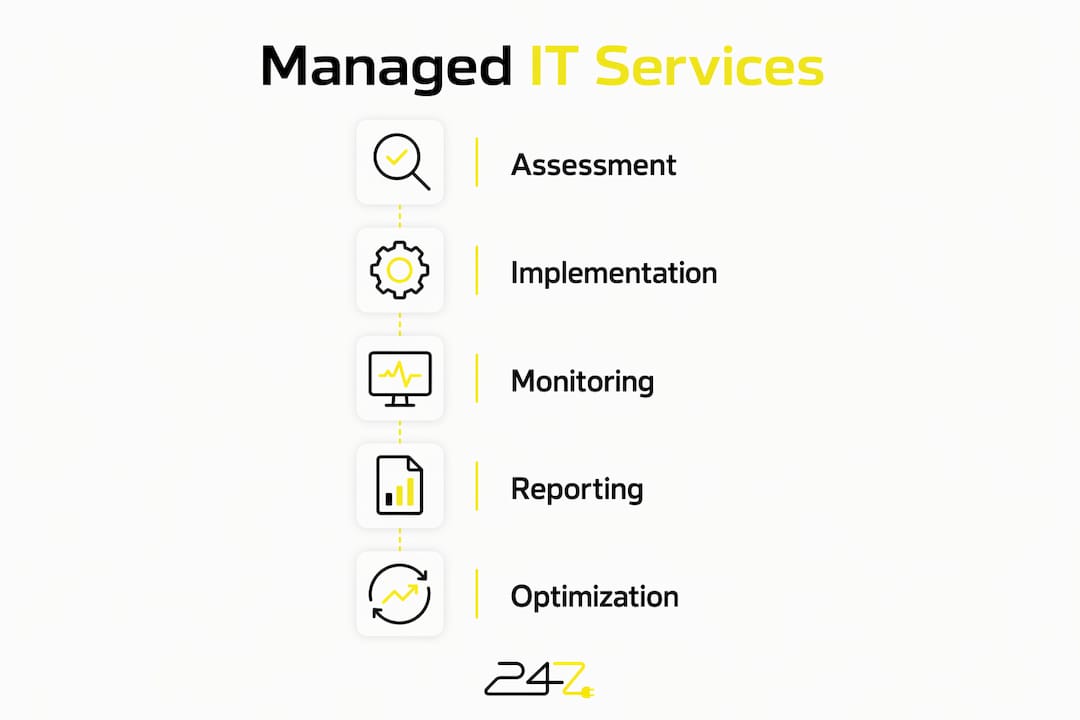
Managed IT pricing follows two dominant structures: flat monthly fees per device and per-user pricing. Flat fee models start around $35 per device per month for comprehensive endpoint management. Per-user pricing bundles all devices assigned to a single employee into one monthly rate, which simplifies billing for organizations with varied device counts.
The contrast with break-fix IT is stark. Break-fix billing is unpredictable by design. You pay nothing until something fails, then absorb the full cost of emergency labor and replacement hardware. Managed services convert that unpredictable expense into a fixed monthly line item. Proactive management reduces operational IT costs by up to 40% compared to reactive models. That reduction comes from fewer emergency incidents, lower mean time to resolution, and avoided hardware failures caught early.
Pricing tiers are influenced by several factors:
- Number of devices and users covered
- Complexity of your network and server environment
- Compliance requirements (HIPAA or PCI-DSS environments carry higher service costs)
- Whether you need on-site support in addition to remote monitoring
- SLA response time commitments
You can review MSP plan structures to understand how these tiers translate into actual service levels. The goal is to match your risk profile and operational complexity to the right tier, not to buy the cheapest plan and hope it covers your needs.
Pro Tip: When evaluating providers, compare SLA uptime guarantees and incident resolution targets, not just response times. A provider promising 15-minute response but no resolution target is measuring the wrong thing.
What does the transition to managed IT services involve?
The transition to a managed IT service model is structured and time-bound. Expecting a provider to take full control of your infrastructure on day one is unrealistic and operationally dangerous.
A standard transition follows this sequence:
- Infrastructure audit: The provider documents every device, server, network segment, software license, and configuration in your environment. This audit typically takes one to two weeks and surfaces undocumented systems and shadow IT.
- Configuration documentation: All findings are recorded in a centralized IT asset management system. This documentation becomes the operational baseline for monitoring and incident response.
- Secure remote access setup: The provider installs remote monitoring and management (RMM) agents on all covered endpoints and establishes secure access channels. This step includes multi-factor authentication enforcement and privileged access controls.
- SLA negotiation and governance: Before full activation, both parties agree on uptime targets, incident classification levels, escalation paths, and reporting cadence.
- Full service activation: The provider assumes responsibility for defined infrastructure. Internal IT staff, if present, shift to a collaborative or co-managed IT model where they focus on strategic work.
This transition requires 2–6 weeks from initial audit to full provider control. Organizations that rush this phase typically encounter gaps in monitoring coverage and unresolved access issues in the first 90 days. Patience during onboarding pays off in service quality for the life of the contract.
Complex environments, particularly those with physical servers, specialized manufacturing equipment, or multi-site networks, require hybrid remote and on-site support rather than purely remote management. A provider that claims to handle everything remotely for a multi-site organization with on-premises infrastructure is either overconfident or underselling the complexity.
Key Takeaways
Managed IT services deliver the most value when the contract is built on outcome-based SLAs, specialized security expertise, and a structured transition, not just on cost reduction alone.
| Point | Details |
|---|---|
| Core definition | Managed IT services is a proactive, contracted model replacing break-fix IT with continuous monitoring and defined outcomes. |
| Security and compliance | Providers deliver HIPAA, PCI-DSS, and PIPEDA alignment that most organizations cannot build internally at comparable cost. |
| Cost structure | Flat monthly fees starting around $35 per device replace unpredictable emergency IT spending, with up to 40% cost reduction. |
| Transition timeline | A structured 2–6 week onboarding phase covering audits, documentation, and secure access setup is required before full activation. |
| SLA accountability | Outcome-based metrics like uptime guarantees and resolution targets matter more than response time alone. |
The managed IT model rewards patience, not shortcuts
The 247techify Team has worked with Canadian businesses across healthcare, finance, and construction, and the pattern is consistent: organizations that treat managed IT as a vendor transaction rather than an operational partnership get mediocre results.
The most common mistake is signing a contract based on price and response time, then never reviewing the monthly reports. SLAs only create accountability if someone on your side reads them. We have seen organizations running on managed IT contracts for two years with unresolved vulnerabilities because no one on the client side was asking the right questions. The vCIO function exists precisely to bridge that gap, giving you a dedicated advisor who holds the provider accountable and translates technical metrics into business language.
The second misconception is that managed IT is purely a remote service. For organizations with physical servers, specialized hardware, or multi-site operations, on-site support is not optional. It is part of the service model. Any provider that cannot offer hybrid delivery for a complex environment is the wrong fit for that environment.
The third insight is counterintuitive: the best time to evaluate your managed IT provider is not during a crisis. It is during a quiet month. Pull the incident log, review patch compliance rates, and check whether your provider is proactively flagging risks or waiting for you to ask. Proactive communication is the clearest signal of a provider that operates like a partner rather than a vendor.
— 247techify Team
How 247techify supports Canadian businesses with managed IT
247techify delivers managed IT services across Canada with a cybersecurity-first approach built specifically for organizations in regulated industries. Every client gets 24/7 monitoring, a guaranteed response time under 30 minutes, and a dedicated support team that understands HIPAA, PCI-DSS, and PIPEDA compliance requirements.
The 247techify model covers the full managed IT service stack: network monitoring, endpoint management, cybersecurity, backup and disaster recovery, and strategic vCIO advisory. Pricing is transparent, with flat monthly plans structured to match your organization’s size and risk profile. Canadian businesses that need a provider with proven compliance expertise and a 98% client satisfaction rate can contact 247techify directly to schedule an infrastructure assessment and get a plan matched to their operational needs.
FAQ
What is the managed IT service definition?
Managed IT services is a proactive, contracted model where a third-party provider continuously monitors and manages your IT infrastructure under a formal service-level agreement, replacing reactive break-fix IT support.
What do managed services typically include?
Standard managed IT services include network monitoring, help desk support, cybersecurity management, backup and disaster recovery, endpoint management, and strategic IT consulting through a vCIO function.
How much do managed IT services cost?
Flat monthly pricing typically starts around $35 per device for comprehensive endpoint management, with total costs varying based on environment complexity, compliance requirements, and SLA tier.
How long does the transition to managed IT services take?
The transition requires 2–6 weeks, covering infrastructure audits, configuration documentation, secure remote access setup, and SLA finalization before the provider assumes full operational responsibility.
Why choose managed IT services over an internal IT team?
Managed IT services provide access to specialized security and compliance expertise, 24/7 monitoring, and predictable costs that most organizations cannot replicate with an internal team at equivalent investment.