
Managed IT services are defined as a proactive, fixed-fee model where an external provider handles all technology management, monitoring, and security for your business. Small businesses that adopt this model gain access to enterprise-grade tools, compliance support for standards like HIPAA and PCI-DSS, and predictable monthly costs that eliminate surprise repair bills. The managed IT services benefits for small business owners go well beyond basic tech support. This article covers the core advantages, from cost savings and cybersecurity to strategic planning and 24/7 uptime protection.
1. How managed IT services reduce costs for small businesses
Predictable IT spending is one of the most immediate advantages of outsourcing technology management. Small businesses save 25%–50% annually by switching from break-fix IT to a managed services model. That gap reflects the true cost of reactive IT: emergency repair fees, lost productivity, and the overhead of recruiting and retaining in-house technicians.
Pricing structures in 2026 typically charge $10–$35 per device per month for basic managed IT coverage, with server management running $200–$300 per month. Those flat fees replace unpredictable invoices and make annual IT budgeting straightforward. For a business running 20 devices, that translates to a known monthly line item rather than a rolling financial risk.

Environment audits from MSPs frequently uncover unused software licenses and redundant services, cutting IT spend by 10%–30% before any new tools are added. That kind of audit is often offered at no charge as part of onboarding. The savings are real and immediate.
Pro Tip: Ask any managed IT provider for a complimentary environment audit before signing a contract. The findings alone often justify the conversation, and you will know exactly what you are paying for.
- Flat monthly fees replace unpredictable break-fix invoices
- Per-device pricing scales with your headcount, not your crisis calendar
- Audits identify wasted spend on unused licenses and overlapping tools
- Predictable costs improve cash flow planning and annual budgeting
For a deeper look at cost comparisons for SMBs, 247techify has published a detailed breakdown of managed versus traditional IT expenses.
2. Embedding enterprise-grade cybersecurity into your IT plan
Small businesses are not too small to be targeted. Attackers actively pursue organizations with limited security budgets because the defenses are weaker. Managed IT providers embed tools like endpoint detection and response (EDR), multi-factor authentication (MFA), email filtering, and dark web monitoring as standard features. These are the same tools large enterprises use, delivered at a fraction of the cost.
The security layer matters because a single breach can expose customer data, trigger regulatory penalties, and destroy client trust. EDR catches threats that traditional antivirus misses by analyzing behavior rather than signatures. MFA blocks credential-based attacks even when passwords are compromised. Email filtering stops phishing before it reaches your staff.
Compliance documentation is equally critical. MSPs generate monthly security reports, change management logs, access reviews, and training records that form the paper trail regulators expect during an audit. Businesses in healthcare and finance cannot afford to reconstruct this documentation after the fact. The records need to exist before the auditor arrives.
Pro Tip: If your business handles patient data or payment card information, ask your MSP specifically how they document HIPAA and PCI-DSS controls. Vague answers are a red flag.
- Endpoint detection and response (EDR) for behavioral threat analysis
- Multi-factor authentication (MFA) to block credential attacks
- Email filtering to intercept phishing and malicious attachments
- Dark web monitoring to detect exposed credentials early
- Compliance documentation: security reports, access logs, training records
247techify’s cybersecurity services include AI-native threat detection built directly into managed IT plans, giving small businesses a security posture that matches regulated industry requirements.
3. Acting as your strategic technology advisor
Most small businesses do not have a Chief Information Officer. That gap creates a real problem: technology decisions get made reactively, without a long-term plan, and technical debt accumulates quietly. Virtual CIO services from MSPs fill that role by providing technology roadmaps, upgrade budgets, and growth-aligned IT planning.
A virtual CIO (vCIO) reviews your current infrastructure and maps it against your business goals for the next 12 to 36 months. That process surfaces aging hardware before it fails, identifies software that no longer fits your workflow, and builds a capital plan for technology investment. The result is a business that grows without dragging outdated systems along.
Technical debt is the hidden cost of deferred IT decisions. Every year a business runs on unsupported software or aging servers, the risk of failure and the cost of eventual replacement both increase. MSPs that offer strategic IT planning help you avoid that compounding problem by keeping your infrastructure current and documented.
- Technology roadmaps aligned to 12 to 36 month business goals
- Capital planning for hardware and software upgrades
- Identification and elimination of technical debt
- Scalability support as headcount and data volumes grow
- Alignment of IT investment with revenue and operational priorities
4. Proactive monitoring and 24/7 support to minimize downtime
Downtime costs small businesses more than most owners realize. Every hour a server is offline or a critical application is unavailable translates directly to lost revenue and frustrated customers. The managed IT model shifts responsibility for uptime to the provider, and that shift changes behavior fundamentally.
MSPs carry the remediation cost when something goes wrong, which means their financial incentive is to prevent problems rather than fix them after the fact. That alignment drives investment in real-time monitoring, automated alerts, and scheduled maintenance windows that happen outside business hours. Your staff never knows a patch was applied because it happened at 2 a.m. on a Sunday.
Onboarding for monitoring and security tools typically completes within 48–72 hours, with full environmental visibility established in the first week. Most businesses feel fully integrated within 30 days. That speed matters because every day without monitoring is a day of undetected risk.
247techify provides 24/7 helpdesk support with a response time under 30 minutes, covering both remote and on-site issues across Canadian businesses.
Pro Tip: When evaluating any MSP, ask for their mean time to respond (MTTR) and mean time to resolve (MTTR) metrics. Providers who track these numbers take uptime seriously. Those who cannot produce them do not.
- Real-time monitoring with automated alerts before failures occur
- Scheduled maintenance during off-hours to avoid business disruption
- 24/7 helpdesk access for staff across all time zones
- Remote resolution for most issues without waiting for an on-site visit
- Backup and disaster recovery to restore operations within hours
5. Managed IT versus traditional break-fix support
The break-fix model charges you when something breaks. The managed IT model charges you to prevent things from breaking. That distinction defines every other difference between the two approaches.
| Feature | Break-fix IT | Managed IT services |
|---|---|---|
| Cost structure | Variable, per-incident billing | Flat monthly fee per device or user |
| Security tools | Rarely included | EDR, MFA, email filtering included |
| Monitoring | Reactive, after failure | Proactive, 24/7 real-time |
| Compliance support | Not provided | Documentation and audit readiness |
| Strategic planning | Not included | vCIO services and technology roadmaps |
| Best fit | Very small teams with minimal IT needs | Growing businesses with compliance or security requirements |
Break-fix IT works for a solo operator with one laptop and no sensitive data. The moment your business handles customer payment information, employee records, or regulated health data, the break-fix model becomes a liability. The absence of monitoring means threats go undetected. The absence of documentation means audits become emergencies.
For businesses in growth mode, the advantages of managed IT compound over time. Security improves, documentation accumulates, and the technology infrastructure scales without crisis.
Key takeaways
Managed IT services deliver the most value when adopted before a security incident or compliance failure forces the issue.
| Point | Details |
|---|---|
| Cost savings are immediate | Businesses save 25%–50% annually versus break-fix IT through flat-fee pricing and audit-driven waste reduction. |
| Security is built in | EDR, MFA, email filtering, and dark web monitoring come standard, not as expensive add-ons. |
| Compliance documentation is automatic | MSPs generate monthly reports and access logs that satisfy HIPAA, PCI-DSS, and GDPR audit requirements. |
| Strategic planning closes the CIO gap | Virtual CIO services provide technology roadmaps and capital planning that most small businesses lack internally. |
| Proactive monitoring prevents downtime | Real-time alerts and off-hours maintenance stop failures before they affect business operations. |
What working with small businesses has taught us about managed IT
The most common mistake we see small business owners make is waiting for a crisis before calling an MSP. A ransomware attack, a failed server, or a compliance audit notice triggers the conversation that should have happened 18 months earlier. By that point, the cost of recovery almost always exceeds what proactive management would have cost over the same period.
The second pattern we see consistently is underestimating the value of documentation. Business owners focus on uptime and security tools, which are visible and tangible. But the compliance paper trail, the change logs, the access reviews, these are what protect a business when a regulator or a client asks hard questions. MSPs that generate this documentation automatically are worth more than their monthly fee suggests.
One caution worth stating directly: contract terms matter. High-performing MSPs favor month-to-month agreements over long-term lock-in because they earn retention through service quality, not contractual obligation. If a provider pushes a multi-year contract with steep exit penalties, treat that as a signal about how confident they are in their own performance.
The right MSP partner grows with your business. They know your infrastructure, your compliance requirements, and your growth plans. That institutional knowledge is genuinely difficult to replace, which is why choosing the right partner at the start matters more than most owners expect.
— 247techify Team
Why 247techify fits small businesses with serious IT needs
247techify delivers managed IT services built around a cybersecurity-first model, designed specifically for Canadian businesses that cannot afford downtime or compliance failures.
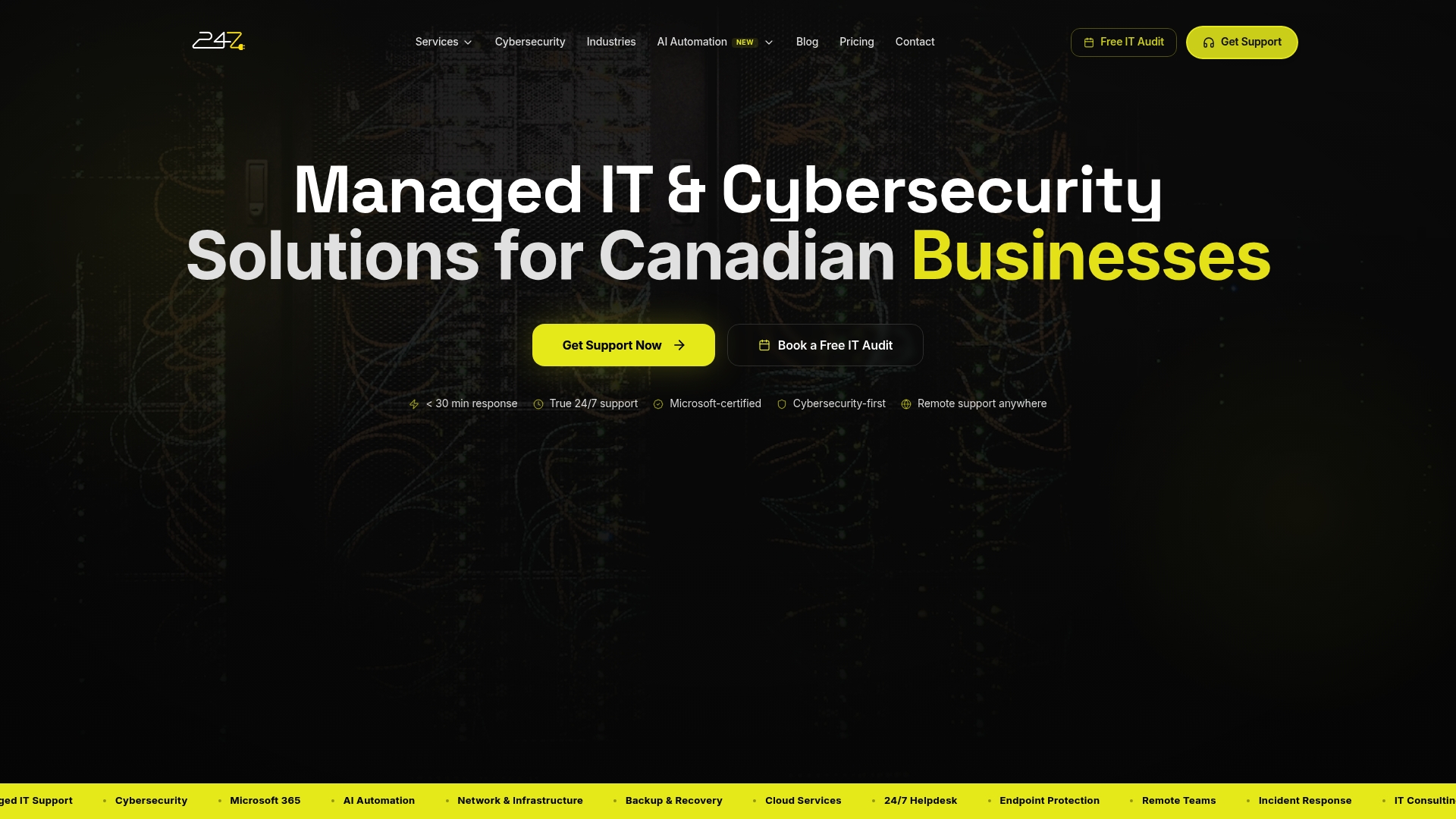
Every plan includes 24/7 monitoring, sub-30-minute response times, and embedded security tools covering EDR, MFA, and email filtering. Businesses in healthcare and finance rely on 247techify for HIPAA and PCI-DSS compliance support, including the documentation and audit readiness that regulators require. Pricing is transparent, with MSP plans structured to fit small business budgets without sacrificing enterprise-grade protection. If your business is ready to move from reactive IT to a model that prevents problems before they cost you, 247techify is the place to start.
FAQ
What are the main managed IT services benefits for small business?
Managed IT services deliver predictable costs, proactive security, compliance documentation, and 24/7 support. Small businesses save 25%–50% annually compared to break-fix IT while gaining access to enterprise-grade tools like EDR and MFA.
How much do managed IT services cost for a small business?
Pricing typically runs $10–$35 per device per month for standard coverage, with server management at $200–$300 per month. Flat monthly fees eliminate surprise invoices and simplify annual budgeting.
Why do startups need managed IT services?
Startups face the same cyber threats as large enterprises but lack the internal IT staff to respond. Managed IT services give startups immediate access to monitoring, security tools, and compliance support without the cost of hiring a full-time IT team.
How do managed IT services support regulatory compliance?
MSPs generate monthly security reports, access logs, change management records, and training documentation that satisfy HIPAA, PCI-DSS, and GDPR audit requirements. This paper trail is produced automatically as part of service delivery.
What is the difference between managed IT and break-fix IT support?
Break-fix IT charges per incident after a failure occurs. Managed IT charges a flat monthly fee and focuses on preventing failures through continuous monitoring, scheduled maintenance, and proactive security management.