
Managed services are defined as the practice of outsourcing IT operations to a third-party provider under a fixed subscription or service-level agreement, replacing unpredictable break-fix spending with proactive, continuous management. Understanding how managed services reduce IT costs is the central concern for any small or mid-sized business owner watching their technology budget grow without a clear return. The shift from reactive repairs to proactive monitoring is not cosmetic. According to Link Computer Corporation, managed IT services reduce total IT costs by decreasing outages and security incidents through continuous oversight. Providers like 247techify, operating under a cybersecurity-first model, demonstrate that this approach delivers measurable, predictable savings across staffing, tooling, and downtime.
How managed services reduce IT costs through predictable pricing
The most immediate managed services cost savings come from replacing emergency repair bills with a fixed monthly fee. Under a subscription and SLA model, costs, performance standards, and provider responsibilities are defined upfront in the contract. There are no surprise invoices after a server failure at 2 a.m. Your finance team can plan IT spending the same way it plans rent or payroll.
This predictability matters because break-fix IT spending is structurally unpredictable. A single ransomware incident or hardware failure can generate a five-figure emergency repair bill with no warning. The SLA model eliminates that exposure by shifting the financial risk of incident response to the managed service provider (MSP). CGI, one of the largest IT services firms in North America, identifies this cost alignment as a primary driver of managed services adoption among mid-market organizations.
The freed budget and mental bandwidth also redirect internal resources. When your team is not firefighting IT failures, they focus on revenue-generating work. That indirect benefit rarely appears in a cost comparison spreadsheet, but it compounds over time.
Pro Tip: Before signing any MSP contract, request a detailed SLA that specifies response times, resolution targets, and escalation paths. Vague SLAs are where hidden costs enter.
Does switching to managed services lower IT staffing costs?
The answer is yes, and the savings are larger than most business owners expect. Organizations typically save 40–60% on IT costs by replacing full-time staff with a managed services team. That figure accounts for salaries, benefits, recruitment fees, and turnover costs, all of which disappear when you move to an MSP model.

| Cost Category | In-House IT | Managed Services |
|---|---|---|
| Annual salary (mid-level engineer) | $85,000–$110,000 | Included in monthly fee |
| Benefits and payroll taxes | $20,000–$30,000 | Not applicable |
| Recruitment and onboarding | $15,000–$40,000 per hire | Not applicable |
| Specialist coverage (security, networking, compliance) | Requires multiple hires | Included in team |
| Turnover risk | High | Transferred to provider |
Onboarding a new in-house IT hire takes 3–6 months and tens of thousands of dollars before that person reaches full productivity. An MSP eliminates that ramp-up period entirely. Your business gets access to a full team of specialists covering cybersecurity, networking, compliance, and cloud infrastructure from day one.
For businesses in regulated industries like healthcare or finance, this is especially significant. Hiring a compliance specialist with HIPAA or PCI-DSS expertise as a full-time employee is expensive and competitive. An MSP like 247techify includes that expertise within the standard engagement.
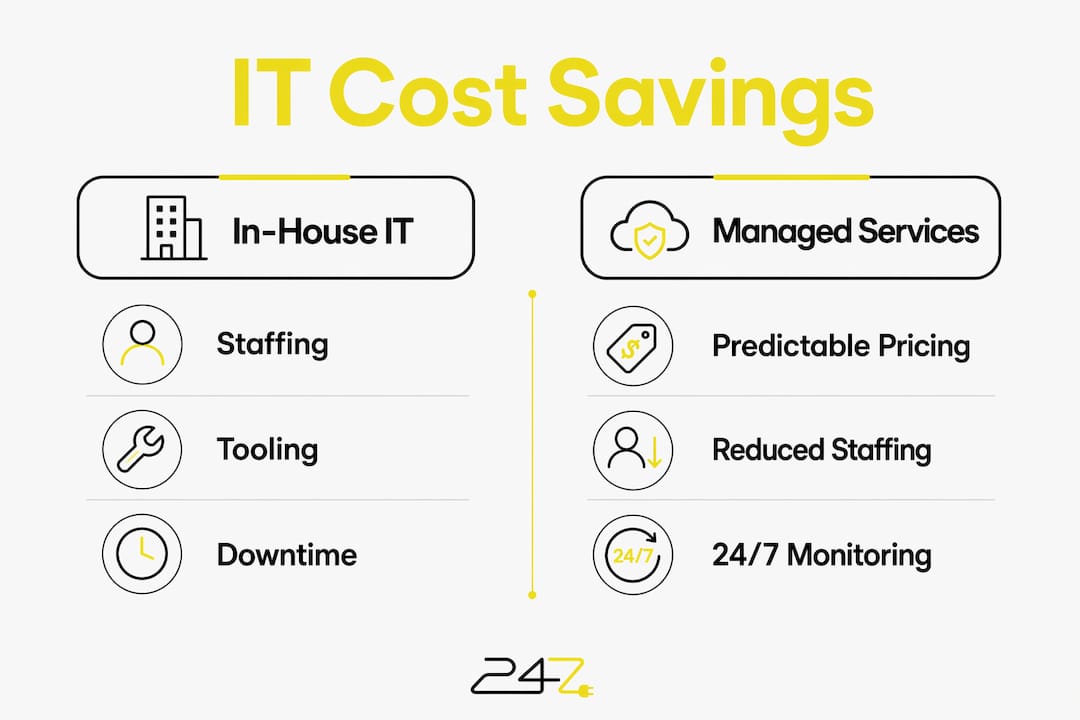
Pro Tip: When comparing MSP costs to in-house IT, calculate the fully loaded cost of your current staff, including benefits, training, and the hours your non-IT employees lose waiting for IT issues to be resolved.
How does 24/7 monitoring reduce downtime and emergency repair costs?
Downtime is one of the most expensive and underestimated IT costs for small and mid-sized businesses. 24/7 coverage and proactive detection decrease downtime costs by minimizing both the duration and frequency of outages. Every hour a system is down represents lost productivity, lost revenue, and potential customer damage that does not show up in a simple IT budget line.
Managed services address this through continuous monitoring tools that detect anomalies before they become failures. A server showing signs of overheating, a network device with degrading performance, or a backup job that silently failed at 3 a.m. are all caught and resolved before your staff arrives in the morning. Without that monitoring layer, these issues surface only after they cause damage.
The financial impact of this proactive posture includes:
-
Fewer emergency repair calls, which carry premium labor rates
-
Reduced business interruption losses from unplanned outages
-
Lower cybersecurity incident costs from early threat detection
-
Avoided data recovery expenses when backups are verified continuously
-
Faster mean time to resolution, which limits the blast radius of any incident that does occur
247techify’s model includes a response time of under 30 minutes, which directly limits how long any given incident can affect your operations. That speed is not a marketing claim. It is a contractual commitment with measurable cost implications.
What are the tooling and cloud cost savings from managed services?
Tool sprawl is a hidden cost that grows silently inside most SMB IT environments. Businesses accumulate separate vendors for endpoint detection, backup, monitoring, password management, and security awareness training, each with its own license, renewal date, and integration overhead. MSPs consolidate these tools and deliver them as a bundled service, reducing duplication and licensing fees by 20–40% compared to retail prices.
That savings figure reflects MSP partner pricing agreements with vendors like Microsoft, SentinelOne, and Veeam. Because an MSP purchases licenses at scale across its entire client base, it receives volume discounts that a single SMB cannot negotiate independently. Your business gets enterprise-grade tooling at a fraction of the standalone cost.
Cloud cost management is a separate but equally significant savings lever. Managed services reduce cloud costs by 30% on average through continuous right-sizing, reserved instance planning, and waste elimination. The key word is continuous. A one-time cloud audit produces a one-time saving. Ongoing MSP management produces sustained savings because cloud environments drift toward waste without active controls.
The cloud optimization process typically includes:
-
Right-sizing compute resources by matching virtual machine sizes to actual workload demands, eliminating over-provisioned instances.
-
Reserved instance planning by committing to one-year or three-year pricing on predictable workloads, reducing on-demand rates significantly.
-
Waste elimination by identifying and decommissioning idle resources, orphaned storage volumes, and unused licenses.
-
Continuous monitoring by tracking cloud spend in real time and alerting when usage deviates from expected patterns.
This operational discipline requires dedicated attention that most SMB internal teams cannot sustain alongside their other responsibilities. An MSP applies it systematically across every client environment.
Managed IT vs. in-house IT: what does the total cost comparison show?
The total cost of ownership comparison between in-house IT and managed services consistently favors managed services for businesses in the 20–50 user range. Annual in-house IT costs for that user segment run $210,000–$245,000 or more when accounting for loaded salaries, benefits, and downtime losses. Managed services for the same environment typically cost $60,000–$120,000 annually.
| Cost Component | In-House IT (20–50 users) | Managed Services (20–50 users) |
|---|---|---|
| Annual staffing (loaded) | $105,000–$140,000 | Included in fee |
| Tools and licensing | $30,000–$50,000 | Included in fee |
| Training and certifications | $5,000–$15,000 | Included in fee |
| Downtime losses (estimated) | $20,000–$40,000 | Significantly reduced |
| Total annual estimate | $210,000–$245,000+ | $60,000–$120,000 |
The risk-adjusted value extends beyond the direct cost comparison. A single data breach or ransomware event can cost an SMB hundreds of thousands of dollars in recovery, legal fees, and regulatory penalties. Managed services with integrated cybersecurity, such as the 247techify managed IT model, reduce that exposure through continuous threat monitoring and compliance management.
The savings are also underestimated when only direct labor is considered. Enterprise-grade expertise and avoided capital expenses represent value that does not appear in a simple headcount comparison. Access to a team with HIPAA, PCI-DSS, and cloud architecture expertise, without hiring each specialist individually, is a structural cost advantage that compounds over the life of the engagement.
Key Takeaways
Managed services deliver the greatest IT cost reductions when businesses account for staffing, tooling, downtime, and cloud waste together, not just the monthly MSP fee.
| Point | Details |
|---|---|
| Predictable pricing eliminates surprises | SLA contracts define costs upfront, removing emergency repair spikes from your budget. |
| Staffing savings are 40–60% | Replacing in-house IT with an MSP eliminates salaries, benefits, recruitment, and turnover costs. |
| 24/7 monitoring cuts downtime costs | Continuous detection resolves issues before they cause business interruptions or emergency repair bills. |
| Tooling consolidation saves 20–40% | MSP partner pricing and bundled tools reduce licensing fees compared to retail purchases. |
| Cloud management sustains 30% savings | Ongoing right-sizing and waste elimination produce continuous cloud cost reductions, not one-time gains. |
Why most SMBs underestimate the real cost of in-house IT
I have reviewed a lot of IT cost comparisons, and the same mistake appears consistently. Business owners compare the MSP monthly fee to the salary of one IT employee and conclude the numbers are close. They are not close. They are not even measuring the same thing.
The in-house model carries costs that never appear on a single line item. Recruitment fees when that employee leaves. The three months of reduced productivity while a replacement ramps up. The security tools your one IT person does not have time to manage properly. The cloud bill that grows 15% every quarter because no one is auditing it. The full failure cycle from detection through reporting requires coverage that a single internal hire cannot provide around the clock.
What I have found is that the businesses most resistant to managed services are often the ones with the highest hidden IT costs. They have normalized the chaos. A server goes down, someone calls the IT guy, the IT guy fixes it, and everyone moves on. No one calculates what that outage cost in lost productivity across 30 employees for four hours.
The businesses that make the switch and measure outcomes carefully almost always find that long-term savings come from operational simplification, not just headcount reduction. Automation, continuous monitoring, and disciplined cloud management produce savings that grow over time. That is a fundamentally different financial model than hiring and hoping.
My recommendation: before you evaluate any MSP, build a fully loaded cost model of your current IT environment. Include every tool license, every hour your non-IT staff spends waiting on IT, and every incident from the past 12 months. That number will change how you read the MSP proposal.
— Rohan
247techify’s managed IT plans for Canadian SMBs
Canadian businesses face a specific set of pressures: compliance requirements under PIPEDA, cross-border data regulations, and a cybersecurity threat environment that has intensified significantly. 247techify addresses these directly through managed IT services built around a cybersecurity-first model with 24/7 monitoring and a guaranteed response time under 30 minutes.

Plans include endpoint protection, device management, cloud cost optimization, and compliance support for regulated industries including healthcare and finance. The 98% client satisfaction rate reflects a service model built on clear SLAs and direct communication, not vague promises. If your business is ready to replace unpredictable IT spending with a fixed, accountable cost structure, 247techify’s team can assess your current environment and show you exactly where the savings are.
FAQ
What is a managed service provider (MSP)?
A managed service provider is a third-party company that manages a business’s IT infrastructure and operations under a subscription contract with defined service-level agreements. MSPs handle monitoring, security, support, and maintenance in exchange for a predictable monthly fee.
How much can a small business save with managed services?
Organizations typically save 40–60% on IT costs compared to maintaining equivalent in-house staff, according to TechProComp. For businesses with 20–50 users, annual savings can reach $90,000–$125,000 when accounting for staffing, tooling, and downtime reductions.
Does managed IT include cybersecurity protection?
Most MSPs include baseline cybersecurity tools such as endpoint detection, patch management, and threat monitoring within their standard plans. Providers like 247techify build their entire service model around cybersecurity, including compliance support for HIPAA and PCI-DSS.
How do managed services reduce cloud costs?
MSPs reduce cloud costs by an average of 30% through continuous right-sizing, reserved instance planning, and elimination of idle resources. This ongoing management prevents the cost drift that occurs when cloud environments run without active oversight.
Is managed IT suitable for businesses with existing IT staff?
Co-managed IT services allow businesses to retain internal IT staff while supplementing with MSP expertise and tooling. This model works well when an internal team handles day-to-day requests but lacks capacity for security, compliance, or cloud management.