
Financial data encryption converts readable financial information into ciphertext so only authorized parties can read it, protecting bank records, payment data, and accounting files from theft while supporting regulatory compliance. The mechanism is straightforward: an algorithm and a secret key scramble plaintext into unreadable code, and only someone holding the matching key can reverse the process. AES does the scrambling in most modern systems, while Hardware Security Modules (HSMs) guard the keys that unlock it. Organizations that get this right, including firms working with 247techify, treat encryption as infrastructure, not an afterthought.
Encryption exists to protect financial data across three distinct states:
- At rest — ledgers, backups, and stored account records sitting on a drive or in cloud storage
- In transit — payment data moving between your systems and a processor, bank, or partner API
- In use — information actively being read or processed in application memory
Key Takeaways
Financial data encryption only reduces risk when it’s paired with disciplined key management, MFA, and tested backup restores, not deployed as a standalone fix.
| Point | Details |
|---|---|
| Encrypt all three data states | Cover data at rest, in transit, and in use with FDE, TLS, and emerging techniques like homomorphic encryption. |
| Key custody beats algorithm choice | A stolen key defeats AES instantly, so HSMs and documented rotation matter more than the cipher itself. |
| Layer encryption with MFA | Credential theft bypasses encryption entirely, making multi-factor authentication a required companion control. |
| Compliance requires documentation | PCI-DSS and GLBA-style rules expect written rationale for algorithm choice, key custody, and breach-notification plans. |
| Test restores before you need them | An encrypted backup that fails to decrypt during a real incident defeats the entire purpose of encrypting it. |
Table of Contents
- What Is Financial Data Encryption Protecting Against?
- Symmetric, Asymmetric, and Hybrid Encryption Explained
- Key Management and HSMs: Who Actually Holds the Keys?
- Encryption Is One Layer, Not the Whole Shield
- When Auditors Expect Encryption, Not Just Recommend It
- A Step-by-Step Checklist for Rolling Out Encryption
- Why a Cybersecurity-First MSP Makes Encryption Rollouts Faster
- Our Take on Getting Encryption Right
- Sources
- FAQ
What Is Financial Data Encryption Protecting Against?
Every financial system has three exposure points, and each needs a different control. Data at rest, meaning files sitting on a server, laptop, or backup drive, is vulnerable the moment a device is lost, stolen, or breached by ransomware. Data in transit, like a payment record traveling from your point-of-sale system to a processor, can be intercepted mid-flight if the connection isn’t secured. Data in use, the information your accounting software is actively reading to generate a report, is the hardest to protect because it has to be readable by the application at that moment.
Here’s how the controls map to each state:
- At rest: Full-disk encryption (FDE) on laptops and servers, file-level encryption for sensitive folders, and encrypted database fields for account numbers or Social Insurance Numbers.
- In transit: TLS for anything moving over a network, end-to-end encryption (E2EE) for messaging between systems, and VPNs for remote access to internal financial tools.
- In use: Emerging techniques like homomorphic encryption, which allow computation on encrypted data without ever exposing the plaintext.
The most common failure isn’t a broken algorithm. It’s an unencrypted backup sitting on a NAS drive, or a payroll export emailed as a plain CSV. CISA’s guidance on encrypting business data is blunt about this: encrypted devices, encrypted backups, and encrypted network traffic are baseline, not optional extras.
Symmetric, Asymmetric, and Hybrid Encryption Explained
Two mathematical approaches handle nearly all financial data encryption today, and understanding the trade-off between them shapes almost every architecture decision you’ll make.
Symmetric encryption uses one key to both lock and unlock data. AES (Advanced Encryption Standard) is the industry default here because it’s fast and battle-tested. It’s what encrypts the bulk of your actual financial data, like a database of transaction records, because processing speed matters at scale.
Asymmetric encryption uses a key pair: one public, one private. RSA and ECC (Elliptic Curve Cryptography) fall into this category. They’re slower than AES, so they’re rarely used to encrypt large payloads directly. Instead, they solve a different problem: how do two parties who’ve never met securely exchange a symmetric key over an open network?
Hybrid encryption combines both: RSA or ECC encrypts a one-time AES key, then AES handles the actual data. This is how TLS, the protocol securing your banking website connection, works under the hood.
- AES: bulk data encryption, fast, symmetric
- RSA/ECC: key exchange and digital signatures, asymmetric
- Hybrid (TLS-style): the best of both, used in nearly all modern financial transactions
Looking further out, homomorphic encryption and post-quantum cryptography are becoming serious planning considerations for fintech systems that need to survive both future computing power and privacy-preserving analytics requirements.
Key Management and HSMs: Who Actually Holds the Keys?
An encryption algorithm is only as strong as the key protecting it, and a stolen key defeats even AES instantly. That’s why key management, not algorithm choice, is where most financial data encryption programs succeed or fail.
Every key has a lifecycle: it’s generated, stored, rotated on a schedule, revoked when compromised, and audited for who accessed it and when. Skipping rotation or logging is how a years-old leaked credential quietly becomes a live breach.
Hardware Security Modules (HSMs) are purpose-built devices that store cryptographic keys outside of a server’s regular memory, making them far harder to extract even if the server itself is compromised. FS-ISAC’s guidance on protecting financial data notes that HSMs help organizations meet regulatory obligations precisely because keys never touch general-purpose memory.
Before choosing a solution, ask:
- Who physically or administratively holds the keys, and can they be subpoenaed or coerced?
- What’s the recovery process if a key is lost?
- What FIPS validation level does the HSM carry?
- Are access and usage logged in a way an auditor can review?
Pro Tip: Keep your HSM or cloud KMS co-located with the systems it protects. A key vault in one region protecting data processed in another adds latency and creates a jurisdictional headache during an audit.
Encryption Is One Layer, Not the Whole Shield
Encryption stops someone from reading stolen data. It does nothing to stop someone from logging in as an authorized user in the first place. That distinction is where a lot of otherwise well-encrypted businesses still get breached.

Credential theft and phishing routinely bypass encryption entirely, because the attacker isn’t cracking ciphertext, they’re using a stolen password to access the plaintext directly, as highlighted frequently in Banking & Fintech coverage of fintech fraud. This is why multi-factor authentication and staff training function as encryption’s essential partners rather than separate concerns.
A cybersecurity-first stack layers these controls together:
- Encryption protects data if it’s stolen or intercepted
- MFA stops most credential-based logins even with a valid password
- Least-privilege access limits how much any single compromised account can reach
- Logging and monitoring catch failed decrypt attempts and unusual access patterns before they become a breach
Test your backup restores regularly. An encrypted backup you can’t actually decrypt during a real incident isn’t a safety net, it’s a liability you discover at the worst possible moment.
When Auditors Expect Encryption, Not Just Recommend It
For regulated financial businesses, encryption often isn’t a best practice you can defer. It’s a documented requirement examiners will specifically ask about.
PCI-DSS mandates encryption for cardholder data both at rest and in transit. GLBA-style safeguards rules require financial institutions to protect customer records with administrative, technical, and physical controls. Gowling WLG’s analysis of encryption’s legal obligations points out that regulated entities also carry breach-notification duties, meaning your encryption choices directly affect what you’re legally required to disclose after an incident.
When auditors review your controls, they typically check:
- Algorithm strength and whether outdated ciphers are still in use
- Who holds encryption keys and how that custody is documented
- Whether HSMs or equivalent hardware protection are in place for high-risk workloads
- Separation of duties between who manages keys and who manages the data they protect
- Access logging tied to specific individuals, not shared accounts
Document every choice as you make it. An auditor asking “why AES-256 here and not elsewhere” wants a written rationale, not a shrug.
A Step-by-Step Checklist for Rolling Out Encryption
Start narrow and build outward. Trying to encrypt everything simultaneously usually stalls the whole project.
- Inventory your sensitive financial data. Find every place payroll files, bank records, and payment data actually live, including forgotten spreadsheets and old backups.
- Classify by risk. Not every file needs the same protection; prioritize anything tied to payment credentials or personal financial identifiers.
- Apply state-appropriate encryption. Full-disk encryption on endpoints, file-level encryption on shared drives, TLS on every API and web connection.
- Encrypt backups specifically. An unencrypted backup undoes every other control you’ve put in place.
- Set up key management. Choose between an HSM and a cloud KMS based on your compliance obligations and existing infrastructure.
- Enable MFA everywhere financial data is accessible, not just on your primary login.
- Configure logging and retention, then actually review the logs.
- Run a restore drill. Confirm your encrypted backups decrypt and restore correctly before you need them in an emergency.
Quick wins like full-disk encryption and MFA can go live within days. A full rollout with HSM integration and documented key custody policies typically takes several weeks to a few months, depending on system complexity.
Pro Tip: If step five stalls your team for more than a week, that’s usually the signal to bring in an MSP rather than keep troubleshooting HSM integration solo.
Why a Cybersecurity-First MSP Makes Encryption Rollouts Faster
Encryption done right touches your infrastructure, your compliance documentation, and your incident response plan simultaneously, which is exactly where most in-house IT teams run out of bandwidth. 247techify approaches this as a cybersecurity-first managed IT provider, with 24/7 support and a response time under 30 minutes when something goes wrong.
Businesses in regulated industries, healthcare and finance especially, work with 247techify specifically for experience navigating HIPAA and PCI-DSS requirements, backed by a 98% client satisfaction rate.
Practical services that directly support the checklist above include:
- Compliance audits that map your current encryption posture against PCI-DSS or GLBA-equivalent requirements
- HSM integration and key-management operations, including rotation schedules and access logging
- Encrypted backup configuration paired with regular restore testing
- Incident response planning for when a control fails despite best efforts
If you’re unsure where your current setup stands, a security review through 247techify’s managed IT services is the fastest way to get a concrete remediation roadmap instead of a vague sense of risk.
Our Take on Getting Encryption Right
The conventional advice on financial data encryption spends too much time on algorithm selection and not enough on the boring operational work that actually determines whether it holds up. AES versus a weaker cipher rarely decides the outcome of a breach anymore. Key custody does. Whether your backups actually restore does. Whether an auditor can trace who touched a key and when does.
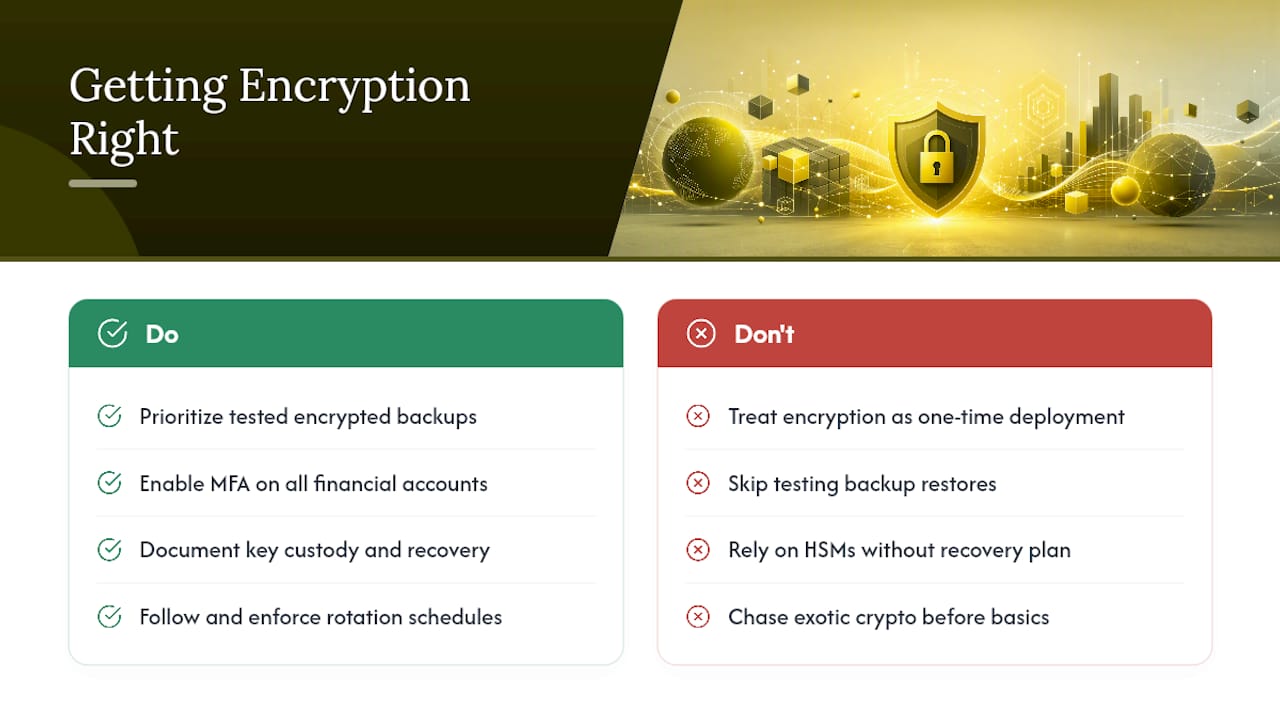
Where most businesses go wrong is treating encryption as a one-time deployment instead of an ongoing operational discipline. A rotation schedule nobody follows is functionally the same as no rotation schedule. An HSM without documented recovery procedures is a single point of failure, not a safeguard.
If you’re prioritizing, start with backups and MFA before you chase exotic cryptography. Homomorphic encryption and post-quantum readiness matter for long-term planning, but they solve problems most mid-sized financial businesses aren’t facing yet. Get the fundamentals operationally solid first, encrypted backups you’ve actually tested, MFA on every account that touches financial data, and a documented key custody process, before layering on anything more advanced.
— 247techify Team
This article is general information, not a substitute for advice from a qualified financial advisor. Consult a qualified financial professional about your own circumstances before acting on anything here.
Sources
- Using encryption to keep your sensitive data secure — Canadian Centre for Cyber Security
- Encrypt business data — CISA
- Protecting financial data with encryption controls — FS-ISAC
- Encryption techniques for financial data security in fintech applications — ResearchGate
FAQ
What Is Financial Data Encryption in Simple Terms?
Financial data encryption is the process of converting readable financial information, like account numbers or transaction records, into unreadable ciphertext so only someone with the correct key can access it.
Is Encryption Required by Law for Financial Businesses?
Regulated entities under frameworks like PCI-DSS and GLBA-style safeguards rules are often legally required to implement encryption controls and document breach-notification procedures.
What’s the Difference Between an HSM and a Cloud KMS?
An HSM is dedicated hardware that keeps cryptographic keys out of a server’s regular memory, while a cloud KMS offers similar key-management functions as a managed service; the choice affects FIPS validation level, co-location, and audit requirements.
Does Encryption Alone Protect Against a Data Breach?
No. Encryption protects data if it’s stolen, but it doesn’t stop credential theft or phishing, which is why MFA, access controls, and monitoring need to work alongside it.
How Long Does It Take to Implement Financial Data Encryption?
Quick wins like full-disk encryption and MFA can be live within days, while a full rollout with HSM integration and documented key management typically takes several weeks to a few months.