
Shadow IT risks come down to five things: lost visibility into where company data lives, direct data exposure through unmanaged apps, compliance violations that trigger fines, an attack surface that expands faster than your security team can track it, and cost sprawl from redundant, unbudgeted tools. The immediate fix is not a policy memo. It’s discovery. Pull DNS and proxy logs, audit OAuth grants in your identity provider, and get any high-risk app you find enrolled in single sign-on or isolated within 72 hours.
Three signals tell you an unauthorized tool deserves attention now rather than next quarter:
- It holds an unfederated OAuth grant with broad scopes (think Files.ReadWrite.All or full mailbox access).
- It stores company data on infrastructure IT never provisioned or inspected.
- It’s a generative AI tool processing customer or employee PII with no data-handling agreement in place.
Pro Tip: Don’t try to block your way out of this problem. Fast-track approval for low- and medium-risk tools removes the reason people go around you in the first place, and it’s cheaper than chasing shadow deployments after the fact.
Key Takeaways
Reducing shadow IT risk requires continuous discovery, OAuth-level visibility, and a fast-track approval process that beats the workaround on speed.
| Point | Details |
|---|---|
| Discover before you enforce | Combine DNS/proxy logs, OAuth audits, and SaaS discovery tools since no single method finds everything. |
| Watch OAuth grants closely | Broad scopes like Files.ReadWrite.All on unrecognized apps are among the highest-risk findings in any audit. |
| Treat AI tools as a category | Public generative AI processing PII or proprietary data needs the same scrutiny as any unmanaged SaaS app. |
| Build a fast-track path | Approving low-risk requests within three to five business days removes the incentive to go around IT. |
| Document controls for insurers | Unmanaged assets can jeopardize cyber-insurance claims if a breach traces back to them. |
| Consider managed support | 247techify offers 24/7 discovery, SSO onboarding, DLP deployment, and compliance audits for regulated industries. |
Table of Contents
- Understanding Shadow IT Risks: Definition and Modern Examples
- Why Employees Turn to Shadow IT in the First Place
- The Core Risks of Shadow IT and How to Spot Them
- Practical Mitigations: Discovery, Controls, and Governance That Actually Work
- How to Triage Discovered Shadow Assets
- What Happens If Shadow IT Causes a Breach
- When Managed IT Services Close the Shadow IT Gap
- A Practitioner’s View on Balancing Governance and Speed
- Get Shadow IT Under Control With Help That Moves as Fast as Your Teams Do
- Sources
- FAQ
Understanding Shadow IT Risks: Definition and Modern Examples
Shadow IT is any technology, application, or device used for work without the knowledge or approval of the IT department. That definition hasn’t changed in a decade. What has changed is the sheer variety of things that now qualify.
In 2026, shadow IT extends well past the classic image of an employee signing up for a random file-sharing site. It now includes generative AI tools, low-code platforms, and unmanaged cloud resources that departments spin up without ever looping in IT. Here’s what actually shows up in a typical discovery scan:
- Unsanctioned SaaS — marketing automation, project trackers, or file converters purchased on a department card.
- OAuth-integrated apps — third-party tools granted persistent access to Microsoft 365 or Google Workspace through a single “Allow” click.
- Personal cloud storage — Dropbox, personal Google Drive, or iCloud accounts holding client files.
- Browser extensions with broad permissions — grammar checkers, PDF tools, or AI assistants that can read every page a browser tab loads.
- Public generative AI tools — employees pasting contracts or source code into a chatbot to save time.
- Low-code and no-code workflows — automations built in Power Automate or Zapier that touch sensitive systems without a security review.
- Developer-spun cloud resources — a test database or storage bucket left running, and unmonitored, long after the project ends.
- Unmanaged personal devices and IoT — a smart speaker on the office network, or a personal laptop used to check email.
Zero-touch cloud sign-up and one-click AI access mean an employee can provision real infrastructure in under a minute, no procurement ticket required. That’s the shift IT teams have to plan around: shadow IT used to require some technical initiative. Now it just requires a credit card and a web browser.
Why Employees Turn to Shadow IT in the First Place
Speed, gaps in approved tools, procurement friction, and the rise of remote and hybrid work explain most shadow IT adoption. Employees rarely go rogue out of malice. They go around IT because the sanctioned path is slower than the deadline in front of them.
The pattern repeats across nearly every organization:
- Productivity pressure — a marketer needs a tool today, not after a three-week vendor review.
- Slow procurement — formal approval cycles that take weeks push people toward instant sign-ups.
- Departmental budgets and direct-card purchases — finance approves the spend without ever notifying IT.
- Developer agility — engineers spin up cloud instances to hit sprint deadlines, planning to “clean it up later.”
- Easy access to AI and low-code tools — no installation, no IT ticket, just a browser tab and a login.
Industry data backs this up: employees consistently choose unapproved tools because approved alternatives are slow, clunky, or simply unavailable, and a significant portion of total SaaS spending at most companies happens without IT’s knowledge. Every barrier your process adds is a data point in someone’s decision to work around you.
The Core Risks of Shadow IT and How to Spot Them
Five risks dominate every shadow IT conversation with a board or a regulator, and they compound each other. Losing visibility makes data exposure more likely. Data exposure makes compliance violations more likely. And every one of them widens the attack surface an incident responder has to search when something goes wrong.
-
Loss of visibility and control. You cannot secure what you cannot see. Once a tool operates outside IT’s inventory, patch cycles, and access reviews, it becomes a blind spot by default. Watch for: unexplained data flows in network logs, employee-reported tools that never appear in your asset management system, and departments that can’t name what software they’re running. The business impact shows up during audits, when nobody can produce a complete list of systems touching regulated data.
-
Data exposure and intellectual property leakage. Unsanctioned apps rarely meet the same encryption, access-control, or retention standards as approved systems. Generative AI tools are the newest version of this problem: pasting proprietary code or customer PII into a public model can permanently expose that data outside company control, with no way to retract it. Signs to watch for include outbound traffic to consumer AI domains and file uploads to personal cloud accounts from corporate devices.
-
Compliance and regulatory violations. GDPR, HIPAA, and PCI-DSS all assume you know where regulated data lives and who can touch it. Shadow IT breaks that assumption. A healthcare practice that lets staff use an unapproved scheduling app with patient data has a HIPAA problem the moment that data leaves managed infrastructure, regardless of whether anything was ever stolen. Fines, mandatory disclosures, and remediation audits follow.
-
Attack-surface expansion and OAuth risk. This is the one most security teams underestimate. Unfederated OAuth tokens and broad API scopes are among the most persistent shadow IT risks because a token grant gives a third-party app standing, programmatic access to email, files, or calendars, often indefinitely, completely bypassing network-level defenses like firewalls or VPN policies. If you see a Files.ReadWrite.All grant sitting on dozens of user accounts for an app nobody in IT recognizes, that’s a five-alarm finding, not a footnote.
By the numbers: Because unmanaged applications sit outside centralized security controls like encryption, MFA, and patch management, security researchers treat shadow IT as a functional insider threat, even when no employee acted with bad intent.
- System inefficiencies and cost sprawl. Multiple departments licensing overlapping tools wastes budget and creates integration headaches when data lives in five disconnected systems instead of one. Finance sees this as duplicate line items; IT sees it as five more places an incident responder has to check during a breach.
Practical Mitigations: Discovery, Controls, and Governance That Actually Work
Reducing shadow IT risk follows a simple sequence: discover what’s out there, tier it by risk, then apply controls and offer sanctioned alternatives. Skipping straight to enforcement without discovery just pushes usage further underground.
Discovery methods worth running in combination, since no single method catches everything:
- DNS and proxy log analysis to spot traffic to unrecognized SaaS and AI domains.
- CASB or SaaS discovery platforms that flag app usage across the network.
- IdP and OAuth audits to surface every third-party grant tied to Microsoft 365 or Google Workspace.
- Expense and credit-card statement review to catch tools purchased outside procurement.
- Endpoint agents that report installed software and browser extensions.
Once discovery surfaces an asset, the right controls depend on what it is. SSO and identity provider enrollment closes the biggest access-control gap. Data loss prevention (DLP) policies stop sensitive files from leaving through unmanaged channels. A CASB or SASE layer adds visibility and policy enforcement for cloud traffic. Endpoint detection and response (EDR) covers the device layer, and network or DNS monitoring catches what endpoint tools miss.
Governance closes the loop. Stand up a fast-track approval process that reviews low-risk requests within three to five business days, build a risk-tier matrix (approve, tolerate, conditional, block), maintain a catalog of pre-approved alternatives so employees have somewhere to go, and loop finance into procurement so new subscriptions trigger an IT review automatically.
Pro Tip: Enroll your highest-frequency, lowest-risk apps into SSO first. That single move usually closes more identity exposure than months of chasing edge cases, and it buys you goodwill to enforce DLP on the apps that actually handle sensitive content.
How to Triage Discovered Shadow Assets
Once you’ve found a shadow asset, the decision sequence is: collect evidence, classify by sensitivity and integration depth, then decide whether to fast-track, condition, block, or migrate it.
- Collect evidence. Identify the business owner, the OAuth scopes or permissions granted, the type of data involved, the number of active users, and whatever security controls the vendor already has in place.
- Compute a risk score. A three-tier framework works well in practice: low-risk tools get tolerated, medium-risk tools get conditional approval with added controls, and high-risk tools get migrated to an approved alternative or blocked outright.
- Decide and set a timeline. An AI tool processing PII with no data agreement gets blocked or migrated within days. Personal cloud storage holding company files gets a fast, mandatory migration to sanctioned storage. A developer-created cloud database gets brought under monitoring immediately, even if it stays in production.
What Happens If Shadow IT Causes a Breach
An unmanaged asset complicates incident response from the first minute, and it can jeopardize your cyber-insurance claim if the policy requires proof of managed security controls on every affected system.
The moment a shadow asset is implicated in an incident, move through this checklist:
- Isolate the asset from the network immediately.
- Capture logs and any OAuth tokens tied to the app before access gets revoked.
- Revoke federated access and any API grants.
- Preserve evidence in a form legal and compliance teams can use.
- Notify stakeholders according to your existing incident response policy.
Insurance impact: Cyber insurers can deny claims outright when a breach originates from an unvetted or unmanaged application, since most policies require documented proof of managed controls. Engage your insurer early and document every remediation step. That paper trail matters as much as the fix itself.
When Managed IT Services Close the Shadow IT Gap
Internal IT teams often lack the bandwidth for continuous discovery, and that’s exactly where managed services providers earn their keep, offering round-the-clock monitoring, identity onboarding, and remediation speed that a stretched in-house team can’t sustain alone.
MSP capabilities worth evaluating include:
- 24/7 monitoring and continuous SaaS/OAuth discovery.
- SSO onboarding for every newly discovered application.
- DLP policy deployment tuned to your regulatory environment.
- Fast-track vendor risk assessments so approvals don’t stall.
- Incident response with defined escalation paths.
- Procurement support that flags new purchases before they become shadow assets.
Before signing anything, ask a prospective provider about their discovery SLA, their hands-on experience with your identity provider, their CASB and DLP depth, and their guaranteed breach response time. A credible MSP should walk you through a 30/60/90-day plan: discovery and inventory in the first month, SSO and DLP rollout in the second, and full governance with fast-track approvals running by day 90.
A Practitioner’s View on Balancing Governance and Speed
The organizations that actually reduce shadow IT risk aren’t the ones with the strictest policy. They’re the ones whose sanctioned path is faster than the workaround. Block a tool without offering an alternative, and you haven’t solved the problem. You’ve just made it harder to see.
Pro Tip: Guarantee a response within three to five business days on every low-risk app request. That single commitment does more to shrink shadow IT than any acceptable-use policy we’ve seen enforced by threat alone.
Get Shadow IT Under Control With Help That Moves as Fast as Your Teams Do
Most internal IT teams already know where their shadow IT problem lives. What they lack is the bandwidth to run continuous discovery, onboard every new app into SSO, and roll out DLP without pulling staff off other priorities. 247techify’s cybersecurity-first managed IT services build that capacity in as an ongoing function rather than a one-time project, backed by 24/7 support and a response time under 30 minutes when something needs immediate attention.

Quick wins clients typically see include:
- SaaS and OAuth discovery that maps unmanaged apps within the first weeks of onboarding.
- Identity provider (SSO) enrollment for high-frequency tools to close access gaps fast.
- DLP policy deployment tuned for regulated data in healthcare, finance, and legal environments.
- Compliance audits aligned to standards like HIPAA and PCI-DSS for teams that can’t afford a gap.
If your team is regulated, handling sensitive client data, or simply tired of finding new shadow apps every quarter, request an assessment through 247techify’s managed IT services or ask about a dedicated compliance audit to see exactly where your current exposure stands.
Sources
- Shadow IT guidance
- FFIEC IT Handbook: Shadow IT
- What Is Shadow IT and How to Discover and Manage It (2026)
FAQ
Is shadow IT an insider threat?
It functions as one. Shadow IT is rarely malicious, but unmanaged apps bypass core security controls like encryption, MFA, and patching, producing the same exposure a deliberate insider threat would create.

What are common examples of shadow IT?
Unsanctioned SaaS subscriptions, OAuth-connected third-party apps, personal cloud storage, browser extensions with broad permissions, public generative AI tools, low-code automations, and developer-created cloud resources are the most common examples in 2026.
What does “shadow IT” mean?
Shadow IT means any technology, application, or device employees use for work without the knowledge or approval of the IT department, including tools purchased directly by a department or spun up by developers outside formal review.
How quickly should IT respond to a newly discovered shadow app?
Low-risk tools should get a decision within three to five business days through a fast-track approval process; high-risk findings involving PII or broad OAuth scopes should be triaged and remediated within days, not weeks.
Can a managed IT provider reduce shadow IT risk faster than an internal team?
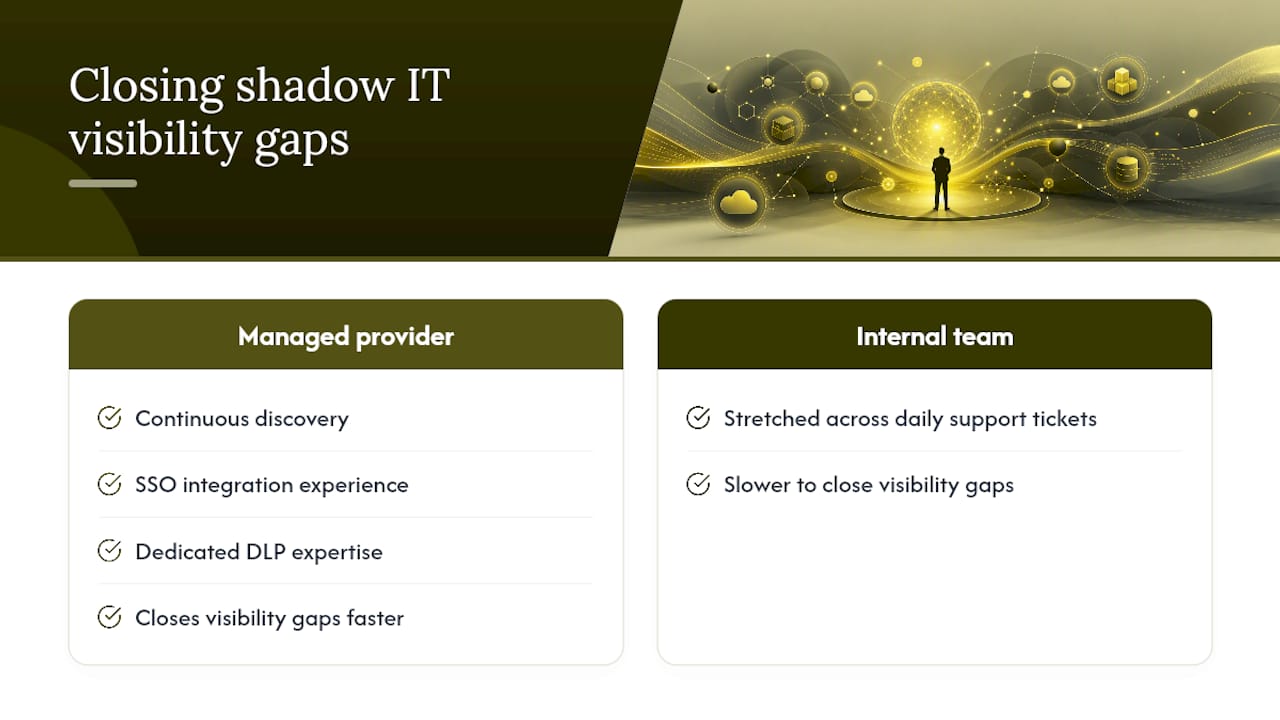
Yes, in most cases. A managed services provider with continuous discovery, existing SSO integration experience, and dedicated DLP expertise, like 247techify, can typically close visibility gaps faster than an internal team already stretched across daily support tickets.