
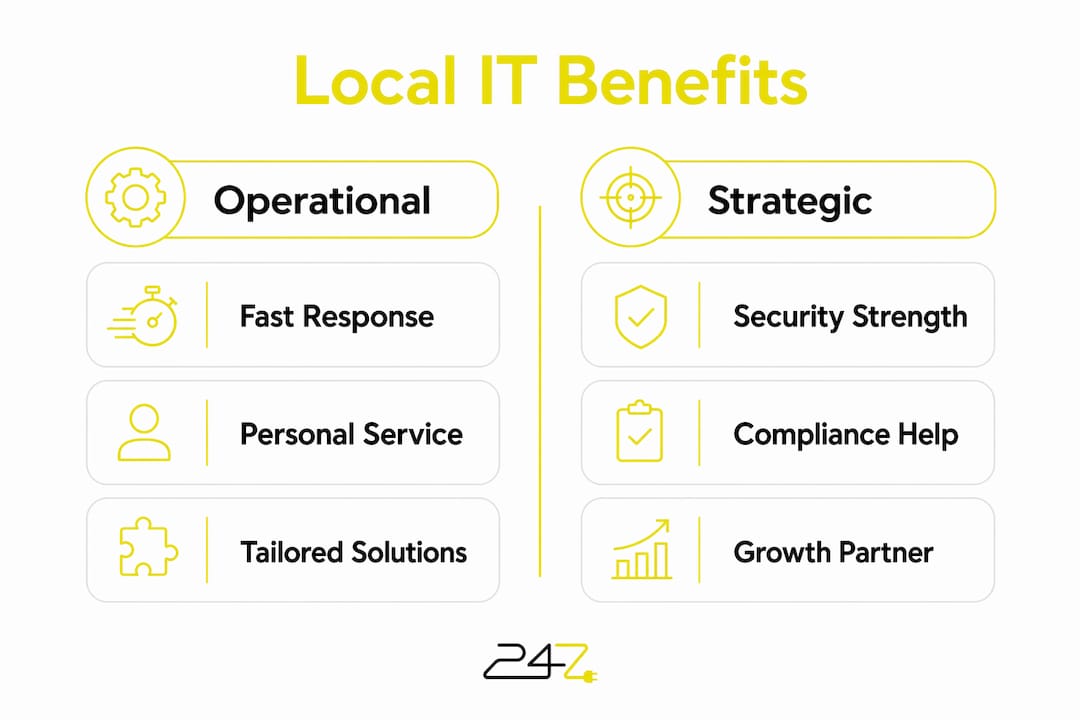
Local IT support for businesses is not a convenience — it is a competitive necessity. For small and medium-sized businesses, the role of local IT support spans proactive system monitoring, rapid on-site response, cybersecurity enforcement, regulatory compliance, and long-term technology planning. Unlike national providers managing thousands of accounts from a distance, a local IT partner develops deep familiarity with your specific environment, your workflows, and the risks your industry actually faces. The result is faster problem resolution, fewer disruptions, and technology that works in service of your business goals rather than against them.
Key contributions local IT support delivers to SMBs:
- Proactive monitoring that catches system failures before they interrupt operations
- On-site response within hours, not days, for hardware and infrastructure issues
- Tailored security postures built around your actual risk profile, not a generic template
- Compliance guidance specific to your industry and region
- Strategic technology planning aligned with where your business is headed
Table of Contents
- How local IT support enhances operational efficiency for SMBs
- How local IT expertise strengthens your business security
- Cost-effective, tailored IT solutions for small businesses
- Why local proximity gives you faster, more personal service
- How local IT support becomes a strategic growth partner
- Why long-term client relationships define local IT quality
- Common IT challenges local support resolves effectively
- Local vs. remote IT support: what actually differs
- How to choose the right local IT support provider
- How local IT support helps businesses meet compliance requirements
- What business improvements local IT support actually produces
- 247techify: cybersecurity-first managed IT for businesses that cannot afford downtime
- Key Takeaways
- FAQ
How local IT support enhances operational efficiency for SMBs
Downtime is expensive. When systems fail, employees stop working, customers go unserved, and revenue stalls. Proactive monitoring and maintenance by local IT teams prevent most potential system failures before they ever disrupt operations, which is a fundamentally different posture than waiting for something to break.
Local providers also design solutions around your actual workflows. A national provider applies standardized configurations across its entire client base. A local team understands that your accounting software, your point-of-sale system, and your staff’s daily habits all interact in ways that a generic playbook cannot anticipate. That context translates directly into fewer tickets, faster resolutions, and employees who spend their time on productive work rather than fighting technology.
- Automated patching and endpoint monitoring handled in the background
- Custom configurations aligned to specific business processes
- Faster diagnosis because the technician already knows your environment
- Reduced IT frustration for staff, which directly supports productivity
Businesses with local IT support experience fewer disruptions and faster recovery, with measurable gains in employee satisfaction and overall output.
How local IT expertise strengthens your business security
Cybersecurity cannot be treated as a separate conversation from IT support. User devices, email systems, cloud identities, backups, and vendor access all connect. If no single team owns that connection, gaps stay open and attackers find them.

Local IT providers bring a critical advantage here: they understand your specific risk profile. A financial services firm in one city faces different threats than a medical practice in another. National providers frequently apply standardized security policies across their entire client base, which means the controls protecting a retail business may not adequately protect a healthcare organization handling protected health information. Local support builds a security posture calibrated to your industry, your data, and your team’s actual behavior.
Staff training is another layer national providers routinely skip. Local IT support often includes training employees to properly use security tools, which is one of the most direct ways to prevent breaches and maintain compliance. For industries subject to HIPAA compliance requirements or PCI-DSS standards, that training is not optional.
- Endpoint detection and response deployed and actively managed
- Multi-factor authentication enforced across accounts and cloud platforms
- Email security with DMARC, DKIM, and SPF configurations
- Incident response planning with documented containment and recovery steps
- Regular vulnerability assessments tied to your actual technology stack
Cost-effective, tailored IT solutions for small businesses
Maintaining a full-time in-house IT department is expensive and often impractical for SMBs. Salary, benefits, training, and the reality that one or two internal staff cannot cover every discipline — networking, cloud, security, compliance — create significant gaps. Businesses can reduce overall IT expenditure significantly by choosing managed local IT support instead.

The cost advantage goes beyond the monthly fee. A local IT partner can audit your existing software licenses, SaaS subscriptions, and vendor agreements to identify waste. According to analysis from SRS Networks highlighted by Cyber Command, a local IT partner can often recover 10–30% of IT spending through software and vendor consolidation alone. Many SMBs are paying for unused seats, redundant tools, or services that no longer match their needs.
Tailored packages also eliminate the problem of paying for capabilities you do not use. Local providers scope their agreements to your actual environment: covered users, devices, locations, security tools, and project boundaries defined in writing.
- Predictable monthly costs replacing unpredictable break-fix expenses
- No overpaying for enterprise-scale services an SMB does not need
- Scalable agreements that expand as headcount and complexity grow
- Managed IT services benefits include cost savings that compound over time as the provider optimizes your stack
Why local proximity gives you faster, more personal service
Speed matters when systems go down. Local IT support provides on-site technicians within hours, a response window that national providers simply cannot match. For a medical office, delayed physical support disrupts patient flow. For a law firm, it stalls access to document systems during critical deadlines. The business logic is straightforward: waiting a day or two for someone to physically arrive is costly in ways that extend well beyond the repair bill.
Beyond speed, the relationship itself changes the quality of support. When you call a local provider, you reach a technician who already knows your systems, your team, and your history. There is no 30-minute briefing before diagnosis begins. That institutional knowledge compounds over time, producing faster resolutions and smarter recommendations with every interaction.
- Direct communication with known technicians, not rotating call-center staff
- Flexible scheduling around your business hours and urgent needs
- On-site visits for hardware failures, network issues, and infrastructure work
- Accountability driven by local reputation, not a distant corporate policy
How local IT support becomes a strategic growth partner
The most valuable local IT relationships move well beyond break-fix support. A provider who only shows up when something breaks is a vendor. A provider who brings a forward-looking technology roadmap aligned to your business goals is a partner.
That distinction has real operational consequences. When a local IT team understands your growth plans, they can prepare your infrastructure before new hires arrive, before a second location opens, or before a new software platform gets deployed. Deployments go faster, transitions are less disruptive, and your team’s learning curve is shorter because the provider already knows your environment.
Local providers also act as a liaison between you and your other technology vendors — internet providers, SaaS platforms, phone systems, copier vendors. When something fails, you should not have to decide which vendor is responsible. A mature local IT partner keeps vendor records current, tracks contract renewals, and pushes the right provider when support stalls.
Pro Tip: When evaluating a local IT partner, ask specifically about their technology roadmap process. A provider who can show you a 12–18 month infrastructure plan tailored to your business goals is operating as a strategic advisor, not just a helpdesk.
For SMBs considering a blended model, co-managed IT services allow an internal IT generalist to handle day-to-day requests while an external local provider covers after-hours monitoring, security operations, and strategic planning.
Why long-term client relationships define local IT quality
The accountability built into a local IT relationship is structural, not incidental. A national provider losing one SMB account is a rounding error. A local provider losing a client in the community they operate in carries real reputational consequences, and that shapes how they show up every day.
Over time, a local IT team develops what amounts to institutional knowledge of your business. They know which systems are aging, which staff members need extra support, and which compliance deadlines are approaching. That depth of context cannot be replicated by a provider who resets the relationship every time you call. IT support providers embedded in the local community build trust-based relationships that improve service quality and accountability in ways that scale with your business.
Common IT challenges local support resolves effectively
Local IT teams handle a specific category of problems that remote-only providers cannot address efficiently:
- Hardware failures: failed drives, malfunctioning workstations, server issues requiring physical replacement
- Network infrastructure: cabling problems, switch failures, Wi-Fi dead zones, and ISP circuit outages
- New office build-outs: structured wiring, equipment installation, and network configuration for new locations
- Security incidents: physical verification of network equipment storage, access controls, and device disposal
- Compliance audits: on-site documentation reviews, access control verification, and staff training sessions
- Vendor coordination: managing finger-pointing between internet providers, SaaS vendors, and hardware suppliers when multi-system failures occur
Remote tools handle the majority of daily tickets effectively. On-site capability closes the gap for everything that requires physical presence, which tends to be exactly the category of problem that causes the most disruption.
Local vs. remote IT support: what actually differs
The combination of cloud platforms and local IT support provides both technological flexibility and the contextual support needed for smooth operations. The two are not in competition. The real comparison is between local providers who combine remote monitoring with on-site capability versus purely remote or national providers who lack physical presence.
| Dimension | Local IT support | Remote/national provider |
|---|---|---|
| On-site response | Hours | Days, or not available |
| Institutional knowledge | Builds over time | Resets each call |
| Security customization | Tailored to your risk profile | Standardized across client base |
| Compliance expertise | Regional and industry-specific | Generic frameworks |
| Vendor coordination | Active liaison role | Typically out of scope |
| Accountability | Community reputation at stake | Corporate policy only |
For SMBs with a physical office and any on-premises infrastructure, a provider with genuine local presence and documented on-site dispatch capability is the stronger choice. Remote IT support remains valuable as the primary channel for daily tickets, but it cannot substitute for physical presence when hardware, cabling, or infrastructure work is required.
How to choose the right local IT support provider
Proximity alone does not make a great IT partner. These are the criteria that separate a genuine local partner from a local alternative to a national provider:
- Documented SLAs: confirmed response times, covered scope, and escalation paths in writing
- Cybersecurity depth: proactive monitoring, MFA enforcement, endpoint detection, and incident response — not just antivirus
- On-site dispatch clarity: specific criteria for when a technician is dispatched versus when issues are resolved remotely
- Compliance experience: ask directly about HIPAA, PCI-DSS, or CMMC 2.0 depending on your industry
- Strategic planning process: quarterly business reviews, infrastructure roadmaps, and hardware lifecycle tracking
- Vendor relationship management: ask whether they coordinate with your ISP, SaaS vendors, and hardware suppliers
- Team continuity: confirm that the technicians who answer your calls are the same ones who know your environment
Local IT support providers worth partnering with demonstrate operational maturity, serious cybersecurity capability, and the willingness to show up for strategic conversations, not just support tickets.
How local IT support helps businesses meet compliance requirements
Regulated industries face compliance obligations that generic IT support cannot adequately address. Healthcare organizations must satisfy HIPAA requirements covering data access controls, audit logs, and breach notification procedures. Financial services firms navigate PCI-DSS standards governing payment data. Contractors working with federal agencies increasingly face CMMC 2.0 requirements.
Local IT providers with knowledge of regional compliance requirements understand the specific frameworks your industry demands. They configure systems to meet those standards, document controls for audit purposes, and train staff on the behaviors that keep your organization in compliance. 247techify’s compliance and auditing services are specifically structured for regulated industries, covering the technical and procedural requirements that auditors examine.
Compliance is not a one-time project. Access controls need regular review, software patches must be applied on schedule, and staff turnover creates new risk with every onboarding cycle. A local IT partner manages that ongoing process so compliance does not slip between annual audits.
What business improvements local IT support actually produces
The practical outcomes of strong local IT support show up in specific, measurable ways across different business types:
A medical practice with proactive monitoring and documented incident response avoids the patient flow disruptions and potential HIPAA violations that follow an unmanaged security incident. A law firm with proper permission design in Microsoft 365 prevents client matter exposure that could trigger professional liability. A field-service company with vendor coordination built into its IT agreement stops losing hours to finger-pointing between its ISP, EHR platform, and phone system when connectivity issues arise.
The firms that extract the most value from local IT support treat it as an operating model, not a repair service. When systems stay available, risk is lower, and staff can work without friction, IT functions as a genuine business asset rather than a recurring source of disruption.
247techify: cybersecurity-first managed IT for businesses that cannot afford downtime
247techify delivers managed IT services built around a cybersecurity-first model, with a guaranteed response time of under 30 minutes and 24/7 monitoring that catches threats before they become incidents. For SMBs in regulated industries — healthcare, finance, legal — that combination of speed and security depth is the difference between a manageable situation and a costly breach. 247techify’s managed IT services cover proactive monitoring, endpoint protection, compliance support for HIPAA and PCI-DSS, and vendor coordination, all under a predictable monthly agreement with no hidden project fees. With a 98% client satisfaction rate and deep experience in the compliance frameworks that regulated industries require, 247techify operates as a strategic partner, not just a helpdesk. If your current IT support is reactive, slow, or disconnected from your compliance obligations, contact 247techify to assess your environment and build a support model that actually protects your business.
Key Takeaways
Local IT support delivers measurable advantages in operational efficiency, security, compliance, and cost control that remote or national providers cannot replicate for SMBs with physical offices and regulated data.
| Point | Details |
|---|---|
| Proactive monitoring prevents failures | Local teams catch most system issues before they disrupt operations or cost revenue. |
| On-site response within hours | Local providers dispatch technicians in hours; national providers often take days. |
| Security tailored to your risk profile | Local IT builds controls around your actual industry, data, and team behavior. |
| Compliance expertise built in | Local providers manage HIPAA, PCI-DSS, and audit requirements as an ongoing service. |
| 247techify’s cybersecurity-first model | 247techify combines under-30-minute response, 24/7 monitoring, and compliance support for regulated SMBs. |
FAQ
What is the role of local IT support for businesses?
Local IT support handles proactive monitoring, on-site troubleshooting, cybersecurity enforcement, compliance management, and strategic technology planning for small and medium-sized businesses. Its core function is keeping operations running while preventing the disruptions that cost revenue and expose data.
How does IT support help a business operate more efficiently?
IT support reduces downtime through proactive maintenance, resolves issues faster through institutional knowledge of your environment, and frees employees from technology frustrations that interrupt productive work.
What are common IT support tasks a local provider handles?
Common tasks include patch management, endpoint monitoring, hardware replacement, network troubleshooting, user account administration, vendor coordination, backup validation, and compliance documentation.
How important is local IT support for regulated industries?
For industries subject to HIPAA, PCI-DSS, or similar frameworks, local IT support is critical. Local providers configure systems to meet specific compliance requirements, train staff on required behaviors, and maintain the documentation auditors examine.
When does local IT support outperform a remote-only provider?
Local IT support outperforms remote-only providers whenever physical presence is required: hardware failures, network cabling, new office infrastructure, on-site security verification, and compliance audits that require in-person documentation review.