
Any business that accepts, processes, stores, or transmits cardholder data must meet PCI DSS — no exceptions based on size, revenue, or transaction volume. The fastest, lowest-cost path for most small businesses is to keep card data off your systems entirely by using a hosted checkout or tokenization, then validate with SAQ A. That single architectural decision can dramatically reduce your compliance burden and cut annual costs to a few hundred dollars rather than tens of thousands.
Copy this into your operations calendar right now: (1) confirm your merchant level with your acquiring bank, (2) verify your checkout uses hosted redirect or tokenization, (3) complete the correct SAQ, (4) schedule quarterly ASV scans only if your setup requires them. The sections below give you timelines, cost ranges, and the vendor questions you need to execute each step.
Key Takeaways
PCI DSS compliance for small businesses is achievable and affordable when you prioritize scope reduction first: move to hosted checkout or tokenization, validate with SAQ A, and maintain a documented annual compliance calendar.
| Point | Details |
|---|---|
| Scope reduction is the priority | Hosted checkout or tokenization can dramatically reduce your compliance burden and qualify you for SAQ A. |
| Most small businesses are Level 4 | Level 4 merchants validate via SAQ rather than a costly QSA audit; confirm your level with your acquiring bank in writing. |
| ASV scans are required when internet-facing | Quarterly ASV scans from a PCI SSC-listed vendor are mandatory if any in-scope system is reachable from the public internet. |
| Annual cost varies by SAQ path | SAQ A paths typically cost a few hundred to a couple thousand dollars a year; SAQ D paths can reach tens of thousands. |
| 247techify manages the compliance cycle | 247techify handles SAQ evidence, ASV scheduling, and incident response coordination for small businesses. |
Table of Contents
- Which small businesses must be PCI compliant?
- Merchant levels explained: which one applies to your business?
- The 12 PCI DSS requirements in plain language
- How to become PCI compliant: the 7 core steps
- Which SAQ type applies to your payment setup?
- Using Stripe, Square, and PayPal: shared responsibility and scope reduction
- ASV scans and QSAs: when you need external validation
- Common PCI compliance mistakes small businesses make
- How to keep PCI compliance after validation
- When to DIY and when to hire a compliance partner
- A pragmatic take on PCI compliance for small businesses
- 247techify handles PCI compliance so you don’t have to
- Sources
- FAQ
Which small businesses must be PCI compliant?
PCI DSS scope is broader than most owners expect. The standard applies to any system, person, or process that stores, processes, or transmits cardholder data, or that can affect the security of the cardholder data environment (CDE). If your business touches payment card data in any form, you are in scope.
Ask yourself these questions:
- Do you accept card payments in person, online, by phone, or by mail? If yes, PCI applies.
- Do you store card numbers, CVVs, or magnetic stripe data anywhere — including spreadsheets, email inboxes, or paper forms? Each of those is a scope expansion.
- Do you use a third-party payment page but also run analytics scripts or chat widgets on the same page? Those scripts can pull your web server into scope.
- Do you record phone calls that capture card numbers? Call logs with card data are in-scope systems.
Common small-business scenarios that trigger PCI obligations include Level 4 retailers using countertop terminals, restaurants with tableside payment devices, e-commerce shops using embedded payment forms, volunteer-run charity donation pages, and phone-order businesses. Edge cases to watch: partial outsourcing via iframe or JavaScript elements (Stripe Elements, for example) does not fully remove your web server from scope unless specific script-integrity controls are in place. A spreadsheet with even one saved card number is a CDE. These details determine which SAQ you complete and how much work is ahead of you.
Merchant levels explained: which one applies to your business?
Your merchant level is set by your acquiring bank based on annual card transaction volume. It determines whether you self-assess with an SAQ or undergo a full on-site audit led by a Qualified Security Assessor (QSA).
| Merchant Level | Annual Transaction Volume | Validation Method | Typical Cost/Complexity |
|---|---|---|---|
| Level 1 | Over 6 million Visa/Mastercard transactions, or any merchant that has suffered a breach | Report on Compliance (ROC) by a QSA, plus quarterly ASV scans | High — significant costs |
| Level 2 | 1–6 million transactions annually | SAQ + quarterly ASV scans; some acquirers require QSA | Moderate |
| Level 3 | under 1 million e-commerce transactions annually | SAQ + quarterly ASV scans | Low to moderate |
| Level 4 | Under 1 million total transactions | SAQ + quarterly ASV scans if internet-facing systems are in scope | Low — typically a few hundred to a few thousand dollars |
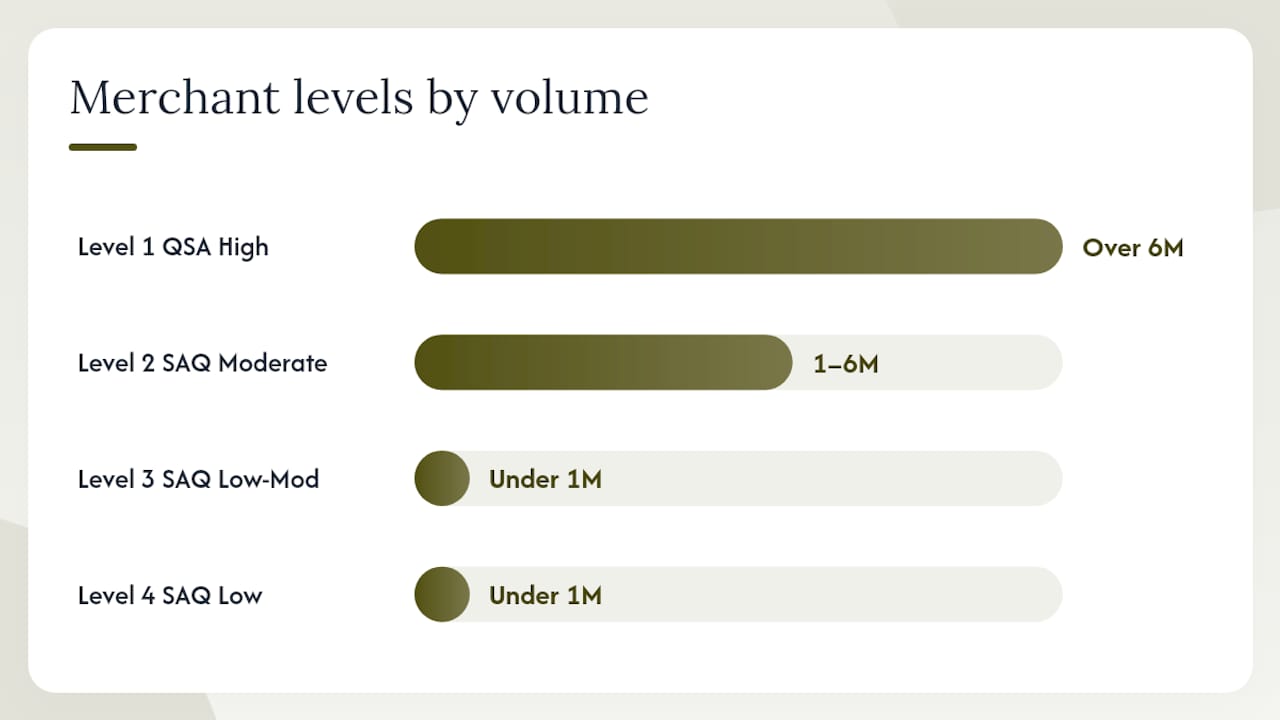
Most small U.S. businesses fall into Level 4, which means self-assessment via an SAQ rather than a costly on-site audit. The practical consequence is significant: a Level 4 merchant using a fully hosted checkout can complete SAQ A in under an hour. Confirm your level in writing with your acquiring bank and save that confirmation as compliance evidence — acquirers occasionally reclassify merchants after a breach, and documented confirmation protects you.
The 12 PCI DSS requirements in plain language
PCI DSS v4.0 organizes its controls into 12 requirements across six goals. The table below gives you a plain-language translation and one concrete action per requirement.
| Req. | Plain-Language Summary | One Practical Action |
|---|---|---|
| 1 | Install and maintain network security controls (firewalls, segmentation) | Deploy a firewall between your CDE and the internet; document the ruleset |
| 2 | Apply secure configurations to all system components | Change all default passwords on terminals, routers, and servers before deployment |
| 3 | Protect stored account data | Stop storing CVVs and full magnetic stripe data; use tokenization for any stored PANs |
| 4 | Protect cardholder data in transit | Enforce TLS 1.2 or higher on every page that touches payment data |
| 5 | Protect all systems against malware | Deploy endpoint protection on every in-scope system and schedule automatic updates |
| 6 | Develop and maintain secure systems and software | Apply security patches within one month of release; use a vulnerability management policy |
| 7 | Restrict access to system components and cardholder data by business need | Implement role-based access control; document who can access what and why |
| — | Identify users and authenticate access | Enable MFA for all administrative access to in-scope systems |
| — | Restrict physical access to cardholder data | Lock server rooms; log visitor access; destroy physical media containing card data |
| — | Log and monitor all access to network resources and cardholder data | Enable audit logging on all in-scope systems; review logs at least daily |
| — | Test security of systems and networks regularly | Run quarterly ASV scans if internet-facing; conduct annual penetration testing |
| 12 | Support information security with organizational policies and programs | Write and distribute a security policy; train staff annually; maintain an incident response plan |
Pro Tip: Requirements 3 and 4 are where scope reduction pays the biggest dividend. If your hosted checkout provider handles all card data storage and transmission, you may be able to mark those requirements as “not applicable” on your SAQ — confirm this with your acquirer before filing.
Evidence to collect for each requirement: firewall configuration exports, change-management logs, patch records, access control lists, MFA enrollment screenshots, ASV scan reports, staff training sign-offs, and your written security policy. A folder with these documents is your compliance evidence package.
How to become PCI compliant: the 7 core steps
Achieving PCI compliance follows seven ordered steps, and the time each takes depends almost entirely on how much card data touches your own systems.
-
Determine your merchant level. Contact your acquiring bank, confirm your annual transaction volume by card brand, and get the level assignment in writing. This single step defines every subsequent requirement.
-
Map your cardholder data environment. Inventory every system, application, and person that stores, processes, or transmits card data. Include your payment terminal, e-commerce platform, any third-party integrations, and network segments. A network security checklist helps you document segmentation boundaries accurately.
-
Select the correct SAQ. Match your payment architecture to the right SAQ type (see the SAQ section below). Choosing the wrong SAQ is one of the most common and costly mistakes small businesses make.
-
Remediate gaps against the 12 requirements. Work through each SAQ question. Where your answer is “no,” document the gap and fix it — patch the system, change the default password, enable MFA, or reconfigure the network segment.
-
Run quarterly ASV scans if required. Merchants with internet-facing systems in scope must use an Approved Scanning Vendor. Schedule the first scan early so you have time to remediate any high-severity findings before your attestation deadline.
-
Complete the SAQ or ROC. Answer every question honestly. If you cannot answer “yes” to a control, document a compensating control or remediation plan. Level 1 merchants submit a full Report on Compliance prepared by a QSA.
-
File your Attestation of Compliance (AoC) with your acquiring bank. The AoC is the signed declaration that you have completed the SAQ and met all applicable requirements. Keep a copy; acquirers can request it at any time.
Timeline and cost by SAQ path:
- SAQ A (fully hosted checkout, no card data on your systems): days to a few weeks; annual cost typically a few hundred to a couple thousand dollars, including any ASV scan fees.
- SAQ A-EP (e-commerce with JavaScript elements on your page): two to six weeks; costs rise due to script-integrity controls and potential ASV scans.
- SAQ D (in-house processing or storage): three to six months for a first-time implementation; costs can reach several thousand to tens of thousands of dollars depending on scope and whether a QSA is engaged.
Which SAQ type applies to your payment setup?
The Self-Assessment Questionnaire is the primary validation tool for Level 2–4 merchants. Choosing the wrong one either leaves you under-protected or forces you to answer controls that don’t apply to your setup.
Quick-match guide:
- SAQ A: Your checkout fully redirects to a third-party hosted payment page (Stripe Checkout, PayPal-hosted page, Square’s hosted form). Card data never touches your server. This is the shortest SAQ — roughly 22 questions — and the lowest compliance burden.
- SAQ A-EP: You use a JavaScript-based payment form (Stripe Elements, Braintree Drop-in UI) embedded on your own web page. Your server delivers the page, which means it can affect payment security. Script-integrity controls and ASV scans are typically required.
- SAQ B: You use standalone dial-up or IP-connected terminals that are not connected to other systems. Common for small retail or restaurant countertop setups.
- SAQ B-IP: IP-connected terminals (PTS-approved devices) that are isolated from other network systems. Requires ASV scans.
- SAQ C: Payment application systems connected to the internet but not storing card data. Covers most POS software environments.
- SAQ D: Everything else — merchants that store card data, use virtual terminals on general-purpose computers, or have complex environments. The longest SAQ, with over 200 questions.
The practical consequence of SAQ choice is significant. SAQ A generally requires no ASV scans and minimal documentation. SAQ D may require quarterly ASV scans, a penetration test, and a full policy library. If you are unsure which SAQ applies, confirm with your acquiring bank or a QSA before you start — filing the wrong SAQ is not a defense against a breach investigation.
Using Stripe, Square, and PayPal: shared responsibility and scope reduction
A compliant processor reduces your scope. It does not eliminate your compliance obligation. This is the most common misconception in small-business payment security, and it is the one that gets merchants fined after a breach.
Here is what shared responsibility actually means in practice:
- What the processor covers: The processor’s infrastructure — its servers, encryption in transit, tokenization engine, and data centers — is covered by its own PCI DSS certification. You can request their Attestation of Compliance to confirm this.
- What remains your responsibility: How you collect card data on your side. If you embed a JavaScript payment form on your own web page, your web server is in scope. If you take card numbers over the phone and type them into a virtual terminal on a shared computer, that computer is in scope.
Stripe offers hosted checkout (Stripe Checkout) and JavaScript elements (Stripe Elements). Hosted Checkout qualifies you for SAQ A. Stripe Elements keeps your web server in scope and typically requires SAQ A-EP.
Square provides hardware terminals with point-to-point encryption (P2PE) and a hosted checkout option. Properly configured, Square’s hardware and hosted checkout can qualify you for SAQ A or SAQ B.
PayPal offers hosted payment pages that redirect buyers off your site. When used as a full redirect, this qualifies for SAQ A. PayPal’s embedded buttons on your own page may expand scope.
Vendor documents to request from any processor:
- Their current Attestation of Compliance (AoC)
- P2PE validation certificate (if applicable)
- Hosted checkout architecture diagram confirming card data never touches your server
- Tokenization documentation showing how stored tokens are managed
- Whether ASV scan bundling is available through their platform
Pro Tip: For phone-order businesses, DTMF channel separation — where the customer enters card digits via keypad tones that are never recorded or heard by your staff — can remove phone payments from your CDE entirely. Ask your telephony provider whether their system supports DTMF masking.
ASV scans and QSAs: when you need external validation
Not every small business needs an ASV scan or a QSA. The trigger is your payment architecture, not your size.
Quarterly external vulnerability scans by an Approved Scanning Vendor are required whenever you have internet-facing systems in scope — meaning any server, firewall, or application that is reachable from the public internet and sits within your CDE. An ASV report must show no high-severity (CVSS 4.0+) unresolved findings to be considered passing. Acquirers will not accept a DIY Nessus export or an internal scan report as a substitute for a signed ASV report.
A QSA-led Report on Compliance is required for Level 1 merchants and for any merchant whose acquirer mandates it. Some acquirers require a QSA for Level 2 merchants or after a confirmed breach regardless of level. A QSA conducts an on-site or remote assessment, reviews your evidence, and signs the ROC.
Deliverables to request and retain as evidence:
- Signed quarterly ASV scan reports (passing status confirmed)
- Remediation validation if any findings required fixing between scans
- QSA-signed ROC (Level 1 or acquirer-mandated)
- Attestation of Compliance signed by both the merchant and the QSA or assessor
Find official registries for both ASV and QSA vendors at pciSecurityStandards.org. Using a vendor not on the PCI SSC list means your scan results may not be accepted by your acquirer — a costly mistake to discover after the fact.
Pro Tip: Schedule your first ASV scan at least six weeks before your AoC filing deadline. High-severity findings require remediation and a rescan, and that cycle can take two to four weeks. Starting late is the single most common reason merchants miss their attestation window.
Common PCI compliance mistakes small businesses make
Most small-business breaches trace back to a short list of avoidable errors. Here are the ones that appear most frequently, along with immediate fixes:
- Storing card data in spreadsheets or email. Fix: audit your file shares and email archives this week; delete any stored card numbers and replace the workflow with a tokenized vault or hosted checkout.
- Assuming the processor’s compliance covers you. Fix: request your processor’s AoC, read the scope section, and confirm what merchant-side controls remain your responsibility.
- Using embedded JavaScript without script-integrity controls. Fix: add Subresource Integrity (SRI) hashes to all third-party scripts on your payment page, or switch to a full hosted redirect to drop out of SAQ A-EP scope entirely.
- Not scheduling ASV scans. Fix: if your setup requires scans, book a recurring quarterly slot with a PCI SSC-listed ASV today and add the dates to your compliance calendar.
- Default passwords on terminals and routers. Fix: change every default credential on every in-scope device before it goes live, and document the change in your configuration log.
- No incident response plan. Fix: write a one-page plan that names who to call (acquirer, card brands, forensic investigator, legal counsel), what systems to isolate, and which state breach-notification laws apply to your customer base.
Red-flag signals that warrant an immediate call to your acquirer or a QSA: unexplained card declines across multiple customers, audit log files that are missing or wiped, unknown administrator accounts appearing on in-scope systems, or customer reports of fraudulent charges tracing back to your location. These are indicators of active compromise, not compliance gaps — treat them as incidents, not IT tickets.
How to keep PCI compliance after validation
Compliance is not a project with an end date. It is an ongoing program with a predictable cadence.
Daily and weekly tasks: Apply security patches to in-scope systems within your documented patch window. Verify endpoint protection is active and updated on every device in the CDE. Review critical logs — authentication failures, firewall denials, and admin account activity — at least daily. Confirm MFA is enforced for all administrative access.

Quarterly tasks: Run ASV scans if required and remediate any findings before the next scan cycle. Review access control lists and remove accounts for staff who have left or changed roles. Complete a vulnerability remediation cycle and document the results. Review your vendor AoCs to confirm your processors remain compliant.
Annual tasks: Re-scope your CDE to account for new systems, integrations, or business changes. Complete and submit your SAQ or ROC. Renew your AoC with your acquiring bank. Conduct staff security awareness training and collect sign-offs as evidence. Review and update your written security policy and incident response plan.
Incident response quick steps: Isolate affected systems from the network immediately. Preserve logs and do not wipe or reimage systems before a forensic investigator can review them. Notify your acquiring bank and card brands as required by your merchant agreement. Engage a PCI Forensic Investigator (PFI) if card data may have been compromised. Follow applicable state breach-notification laws — most U.S. states require notification within 30–72 hours of discovery.
Pro Tip: Build a simple compliance calendar in your project management tool with four quarterly ASV scan dates, one annual SAQ completion date, one annual staff training date, and monthly patch-review reminders. Sharing that calendar with your IT partner or MSP creates accountability and gives you a documented audit trail.
When to DIY and when to hire a compliance partner
The decision to handle PCI compliance internally or hire a managed IT or compliance partner comes down to five factors: your internal technical capacity, your transaction volume and merchant level, your time-to-compliance requirement, your risk tolerance, and your ability to maintain ongoing evidence.
If you are a Level 4 merchant using a fully hosted checkout with no in-scope servers, a technically capable owner can complete SAQ A without external help. If you run an e-commerce site with embedded JavaScript, manage a POS system connected to your business network, or process card data in any in-house system, the evidence management and remediation work justifies professional support.
When evaluating a managed IT or compliance partner, use these questions:
- Can you provide examples of SAQ types you have supported for merchants at my transaction volume?
- Do you have a sample Attestation of Compliance you can share (redacted)?
- Are you a PCI SSC-listed QSA or ASV, or do you work with one? Who specifically?
- How do you handle P2PE and tokenization documentation for third-party processors?
- What is your incident response SLA, and does it cover after-hours notification to acquirers?
- How do you price compliance work — fixed annual fee, hourly, or included in a managed services plan?
- Will you provide a written roadmap and an annual compliance calendar?
Confirm in writing which compliance tasks the partner owns and which remain your responsibility. That document is itself a piece of compliance evidence — it defines your shared-responsibility boundary and protects you if an acquirer questions your validation process.
Pro Tip: Prefer a partner who delivers a short written roadmap on day one — a one-page document listing your current SAQ path, required scans, remediation priorities, and annual deadlines. A partner who cannot produce that within the first week is unlikely to keep you on track for your attestation deadline. IT compliance and auditing services that include evidence collection and SAQ support are the most efficient way to close that gap.
A pragmatic take on PCI compliance for small businesses
The single most effective move any small-business owner can make is to descope aggressively before spending a dollar on controls. Most of the complexity and cost in PCI compliance comes from having card data touch systems you own. Move to a hosted checkout, enable tokenization, and use P2PE-certified terminals — and the compliance burden shrinks from a multi-month project to a few hours of self-assessment.
That said, scope reduction is not a one-time decision. Every new integration, every new payment channel, and every new employee with system access is a potential scope expansion. The businesses that stay compliant without drama are the ones that treat their compliance calendar the way they treat their tax calendar: scheduled, documented, and non-negotiable.
247techify’s compliance-focused managed IT approach handles SAQ evidence collection, ASV scheduling, and incident response coordination — so your team is not scrambling to reconstruct a year’s worth of logs the week before your AoC is due. Confirm any acquirer-specific requirements in writing before you start; some acquirers impose tighter deadlines or additional controls beyond the PCI SSC baseline.
247techify handles PCI compliance so you don’t have to
Small businesses that accept card payments face a real security and compliance obligation — and the cost of getting it wrong is not just a fine. A confirmed breach triggers forensic investigation fees, card-brand assessments, and potential loss of your ability to accept cards entirely.
247techify’s compliance-focused managed IT services give you a dedicated team that maps your CDE, selects the correct SAQ, schedules and manages ASV scans, collects and organizes evidence, and files your AoC on time. With a response time under 30 minutes and 24/7 monitoring, 247techify keeps your payment environment under continuous watch — not just at annual attestation time. For businesses that want to keep internal control while outsourcing compliance operations, co-managed IT is also available. Contact 247techify to get a written compliance roadmap for your specific SAQ path.
Sources
The sources below are the authoritative starting points for U.S. merchants validating PCI compliance. Save these links as part of your compliance evidence folder.
- Merchant resources - PCI Security Standards Council
- PCI DSS Compliance for Small Business: Requirements Guide (2026) — SmallBizHandbook
- Approved Scanning Vendors - PCI Security Standards Council
- Small Business PCI Compliance: What Actually Applies
FAQ
Do small businesses need PCI compliance?
Yes. Any business that accepts, processes, stores, or transmits payment card data must meet PCI DSS requirements, regardless of size or annual revenue. There is no small-business exemption.
Can I do PCI compliance myself?
A Level 4 merchant using a fully hosted checkout can complete SAQ A without professional help — it covers roughly 22 questions and requires no ASV scans. More complex setups involving embedded JavaScript, in-house processing, or stored card data typically require a QSA or managed IT partner to complete accurately.
Do I need to be PCI compliant if I use Square?
Using Square reduces your scope but does not eliminate your compliance obligation. Square’s hardware and hosted checkout can qualify you for SAQ A or SAQ B, but you remain responsible for how you collect data, how your network is configured, and whether your staff follows secure procedures.
What companies need to be PCI compliant?
Any company that accepts payment cards — retailers, restaurants, e-commerce shops, nonprofits taking donations, and phone-order businesses — must comply with PCI DSS. The standard applies to all card brands (Visa, Mastercard, American Express, Discover) and all merchant sizes.