For U.S. small and mid-sized practices, the most defensible choice in 2026 is a managed, HIPAA-focused MSP that enforces multifactor authentication (MFA), encrypts ePHI at rest and in transit, delivers 24/7 monitoring with a documented incident response SLA, conducts annual Security Risk Assessments (SRAs), and signs a Business Associate Agreement (BAA) before touching a single record. The HIPAA Security Rule under 45 CFR Part 160 and Subparts A and C of Part 164 sets the legal floor; the HHS/ONC Security Risk Assessment Tool and HHS Office for Civil Rights (OCR) guidance define how you prove you cleared it.
Start here, in the next 30 days:
- Run the HHS/ONC SRA Tool on every system that stores or transmits ePHI and export the evidence report.
- Enable MFA on all remote access, admin accounts, and EHR logins for all users, including clinicians and part-time staff, as this is critical to securing ePHI.
- Verify that every vendor handling ePHI has a signed, current BAA on file.
- Confirm that at least one backup copy is offline or immutable and that a restore test has been completed in the last 90 days.
- Engage a managed security provider that can provide evidence of security controls and a written incident response playbook before you sign a contract.
Key Takeaways
The single most critical action for any small or mid-sized practice in 2026 is to enforce MFA and encrypted, tested backups immediately, then build the documented SRA and managed monitoring layer around those controls.
| Point | Details |
|---|---|
| MFA and encryption first | Enable MFA for all users on all ePHI access points and full-disk encryption before any other project. |
| Signed BAAs required | Every vendor touching ePHI needs a current, signed BAA reviewed at least annually. |
| Annual SRA with HHS tool | Use the HHS/ONC SRA Tool to produce exportable audit evidence every year. |
| Immutable backups, tested | Follow the 3-2-1 rule and document quarterly restore tests with RTO and RPO targets. |
| 247techify managed services | 247techify provides 24/7 monitoring, compliance audits, and incident response with a BAA and sub-30-minute response time. |
Table of Contents
- What are the best EMR security solutions in 2026?
- How do you vet a managed EMR security provider?
- What does a realistic implementation timeline look like?
- What do the core technical controls actually do?
- How do you document compliance for an OCR audit?
- How should you respond to an EMR security incident?
- Why do small practices usually need a managed security partner?
- What gaps do we see most often in small-practice SRAs?
- 247techify’s managed EMR security services for U.S. practices
- Sources
- FAQ
What are the best EMR security solutions in 2026?
Proposed 2026 HIPAA Security Rule updates eliminate the “addressable vs. required” distinction that let small practices defer controls like encryption and MFA. Every practice now needs a documented, enforceable baseline. The controls below are no longer optional.
Core technical controls:
- MFA on all ePHI access points: EHR logins, VPN, cloud consoles, and admin accounts.
- Encryption at rest and in transit: full-disk encryption on workstations and servers; TLS 1.2 or higher for all data in motion.
- Endpoint Detection and Response (EDR): captures process creation, lateral movement, and telemetry with at minimum 90 days of retention for audit evidence.
- Centralized logging/SIEM: access logs, admin actions, and backup events aggregated and retained for six years per HIPAA record guidance.
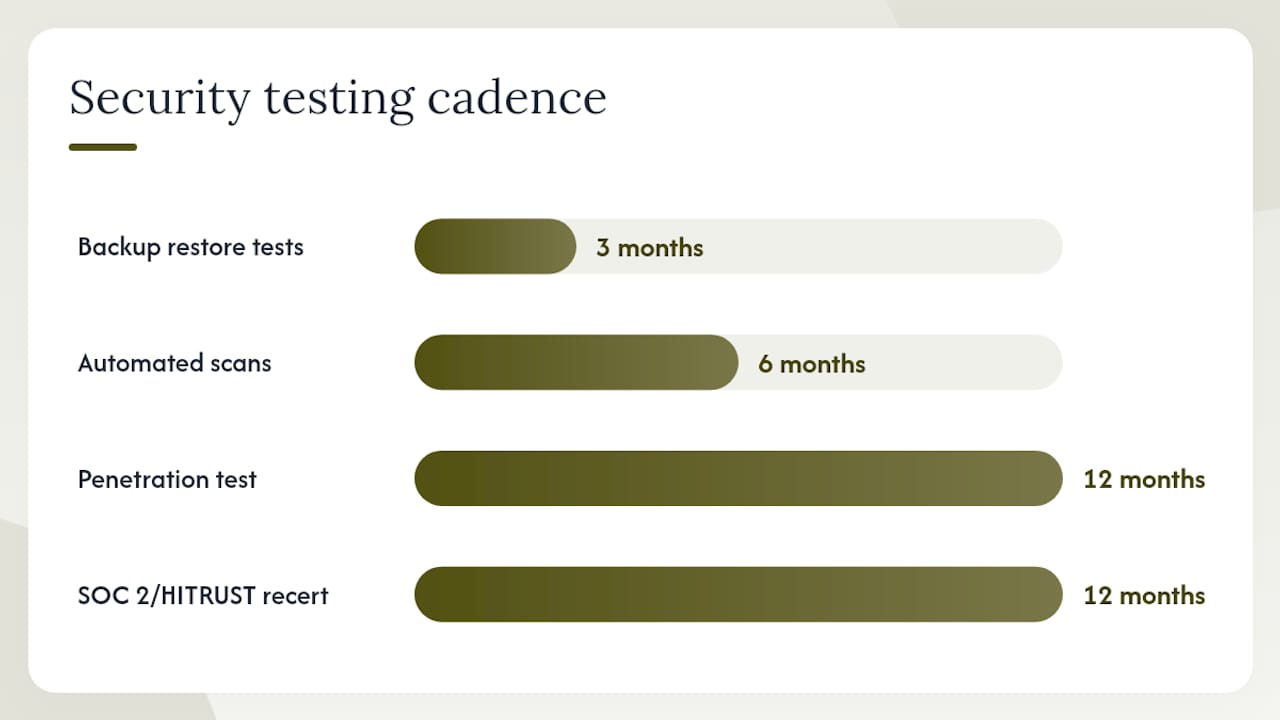
- Automated vulnerability scanning at least every six months, plus an annual professional penetration test.
Managed service capabilities:
- 24/7 monitoring and alerting with a documented time-to-detect and time-to-respond SLA.
- Incident response with 24-hour notification to covered entities when a breach is confirmed.
- Immutable or offline backups following the 3-2-1 backup rule, with quarterly tested restores.
Operational controls:
- Annual SRA with asset inventory and data-flow mapping.
- Signed BAAs for every vendor that touches ePHI, reviewed annually.
- Role-based access and least-privilege enforcement, plus regular patch management and staff phishing simulations.
Pro Tip: If your budget is constrained, MFA plus encrypted, tested backups plus a signed BAA with your EHR vendor closes the three gaps OCR auditors flag most often. Start there before anything else.
How do you vet a managed EMR security provider?
The proposed rule changes make vendor selection a compliance decision, not just a procurement one. Use this checklist on every discovery call.
Decision criteria:
- BAA availability and scope: does it cover all services the MSP delivers to your environment?
- SOC 2 Type II or HITRUST certification as independent evidence of control effectiveness.
- 24/7 SOC monitoring with written SLAs for time-to-detect and time-to-respond.
- Documented incident playbooks and breach-notification support, including OCR reporting templates.
- Encryption and backup architecture: where is ePHI at rest, who holds the keys, and how are restores tested?
- Annual penetration testing cadence with written remediation tracking.
- Explicit mapping of controls to 45 CFR Part 164 administrative, technical, and physical safeguards.
Questions to ask on the call: How do you enforce MFA for all users, including clinicians on mobile devices? Where exactly does ePHI sit at rest, and who controls the encryption keys? How often do you test restores, and can you show me the last test report? How do you update BAAs when your service scope changes?
Red flags: refusal to sign a BAA, no documented SRA process, vague answers about encryption key management, no immutable or offline backup option, and missing written SLAs for incident response.
Pricing expectations: most managed EMR security engagements for small practices combine per-user licensing for endpoint protection and MFA, a flat managed detection fee, backup storage costs, and project fees for remediation work. A small clinic of 5–15 users typically sees a different total cost of ownership than a mid-sized group of 50 or more, primarily because SIEM tuning and penetration testing are fixed costs that don’t scale linearly with headcount.
| Evaluation Dimension | What to Look For |
|---|---|
| Compliance evidence | SOC 2 Type II or HITRUST report, dated within 12 months |
| Monitoring SLA | Documented time-to-detect and time-to-respond commitments |
| Backup architecture | Immutable or offline copy, quarterly restore tests, documented RTO/RPO |
| Annual testing cadence | Automated scans every six months; professional pen test annually |
| BAA status | Signed before service delivery begins; reviewed annually |
What does a realistic implementation timeline look like?
Resource-constrained practices need a phased approach. Trying to deploy everything at once usually means nothing gets deployed correctly.
Phase 0 (Week 1): Identify where ePHI lives across workstations, servers, and cloud services. Enable MFA on remote access and admin accounts. Verify backup integrity and confirm BAAs exist for critical vendors.
Phase 1 (Months 1–3):
- Deploy 24/7 managed monitoring and alerting.
- Enforce full-disk encryption on all workstations and servers.
- Roll out a password manager and MFA for all staff accounts.
- Begin automated vulnerability scanning.
Phase 2 (Months 3–9):
- Implement network segmentation to isolate EMR systems from general office traffic.
- Deploy EDR across all endpoints.
- Stand up centralized logging and begin SIEM tuning.
- Conduct vendor verification audits and update BAAs.
Phase 3 (Months 9–12):
- Commission the annual professional penetration test.
- Formalize SRA documentation and compile an audit evidence folder.
- Run a tabletop incident response exercise with clinical and administrative staff.
- Remediate all high-risk findings from the pen test and SRA.
Internal time commitment for a small practice is typically 4–8 hours per month for oversight and policy review; the managed service provider handles daily operations.
What do the core technical controls actually do?
MFA requires two independent factors: something you know (password) and something you have (FIDO2 hardware key, push-based authenticator like Microsoft Authenticator, or proximity badge). Apply it to EHR access, admin accounts, remote VPN, and cloud consoles. Push-based authenticators reduce friction for clinical staff without weakening the control.
Encryption at rest means full-disk encryption (BitLocker on Windows, FileVault on macOS) for laptops and workstations, plus storage-level encryption for servers and cloud volumes. In transit, enforce TLS 1.2 or higher with modern cipher suites. A critical operational benefit: OCR’s encryption safe harbor means a lost encrypted laptop is not a reportable breach if the key was not compromised.
EDR must capture process creation events, lateral movement indicators, and network telemetry. Retain that telemetry for at minimum 90 days so investigators can reconstruct an attack timeline during an incident.
Logging/SIEM must aggregate access logs, admin actions, and backup completion events. Retain logs for six years to align with HIPAA’s record retention guidance. Set alert thresholds for after-hours admin logins, bulk record exports, and failed authentication spikes.
Vulnerability scanning and pen testing: run automated scans at least every six months and commission a professional penetration test annually. Document every finding and its remediation status; that paper trail is what OCR auditors want to see.
Pro Tip: Set session timeouts to 15 minutes for EHR workstations, enforce a minimum 12-character password with complexity requirements, and use least-privilege role templates so clinical staff cannot access billing records and billing staff cannot access clinical notes.
How do you document compliance for an OCR audit?
HIPAA compliance for MSPs requires a specific evidence set, and OCR auditors expect to see it organized and dated. Build this folder now, not after you receive an audit letter.
Core documentation set:
- Annual SRA with asset inventory and data-flow map, produced using the HHS/ONC SRA Tool.
- Risk Mitigation Plan with named owners and remediation timelines.
- Signed BAAs for every vendor that handles ePHI, with annual review dates.
- Incident and breach logs, including near-misses.
- Penetration test reports with remediation tracking.
- Backup and restore test records with dates and outcomes.
- Staff training rosters and phishing simulation results.
- Access review logs and change management records.
Map each control to 45 CFR Part 164: administrative safeguards (workforce training, SRA, contingency planning), technical safeguards (MFA, encryption, audit logs, automatic logoff), and physical safeguards (workstation controls, device disposal). The HHS/ONC SRA Tool exports a structured report you can attach directly to your evidence folder. Retain all policies, SRA artifacts, and remediation evidence for an extended period per HIPAA requirements.
How should you respond to an EMR security incident?
Speed and documentation discipline during an incident determine both your recovery time and your OCR exposure. Follow this sequence: discovery, containment, investigation, eradication, recovery, post-incident review.
Incident response essentials:
- Assign roles before an incident: who declares containment, who contacts the MSP, who notifies the practice owner or compliance officer.
- Containment means isolating affected systems from the network immediately, not after investigation.
- Breach notification: if ePHI was accessed or exfiltrated, notify OCR within 60 days of discovery for breaches affecting 500 or more individuals; smaller breaches go into the annual log. Proposed rule tightening may shorten these windows, so build for 30-day readiness now.
- Backups: follow the 3-2-1 rule (three copies, two media types, one offsite/offline), test restores quarterly, and document your Recovery Time Objective (RTO) and Recovery Point Objective (RPO).
- Run tabletop exercises at least annually with clinical staff, administrative staff, and your MSP. Capture lessons learned and update the playbook within 30 days.
Pro Tip: The moment you suspect an incident, start a timestamped evidence log: every action taken, every system touched, every person notified. That log is your primary defense in an OCR investigation.
Why do small practices usually need a managed security partner?
The compliance gap is structural, not a matter of effort. 2026 rule changes require continuous monitoring, annual penetration testing, documented SRAs, and 24-hour breach notification capabilities that a two-person office IT setup cannot sustain.
A qualified managed security provider delivers:
- SOC/SLA proof: written time-to-detect and time-to-respond commitments that function as audit evidence.
- Documented SRA processes: annual assessments with asset inventories and remediation tracking that practices can hand directly to OCR.
- Centralized logging and SIEM: continuous aggregation of access and admin events that no small practice can staff internally around the clock.
- BAA coverage: a signed agreement that transfers specific compliance obligations and creates a documented chain of accountability for ePHI.
- Tested incident response: regular drills and a written playbook, so the first time your team executes the plan is not during an actual breach.
The cost of a managed service is almost always lower than the combined cost of a breach, an OCR penalty, and the staff time required to rebuild documentation from scratch after an audit.
What gaps do we see most often in small-practice SRAs?
The pattern is consistent: practices assume their EHR vendor’s BAA covers their entire compliance program. It does not. Independent practice guidance is explicit on this point: an EHR vendor’s BAA covers the vendor’s obligations, not the practice’s own administrative, technical, and physical safeguards. The practice still owns the SRA, the workforce training, the access reviews, and the incident response plan.
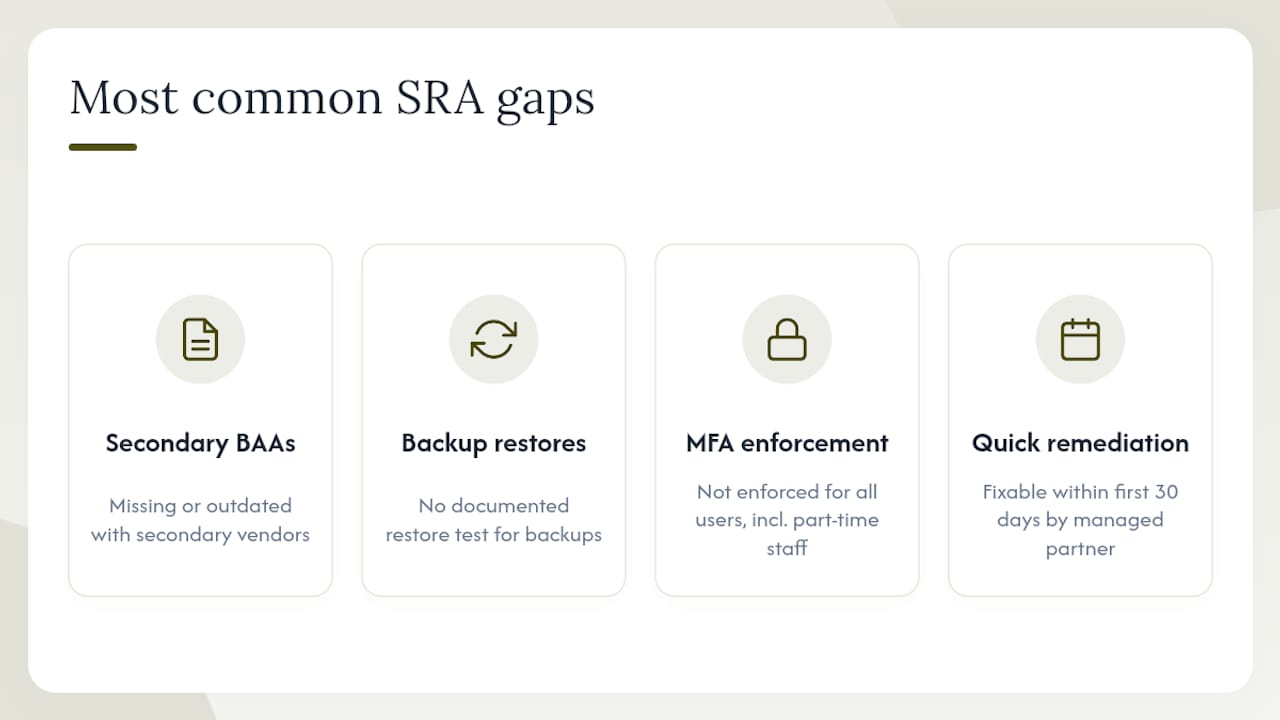
The three gaps that create the most OCR exposure are missing or outdated BAAs with secondary vendors (billing services, cloud storage, IT support), no documented restore test for backups, and MFA not enforced for all users including part-time clinical staff. These are also the fastest to close. A managed partner with a structured onboarding process can address all three within the first 30 days of engagement, before longer-term projects like network segmentation and SIEM tuning are complete. Every MFA recommendation in the article applies to all users, including clinicians and part-time staff.
Practices that treat compliance as a one-time project rather than a continuous operational discipline are the ones that face the most difficult OCR conversations. The 247techify approach to patient data protection treats the SRA as a living document, updated whenever the asset inventory changes, not just once a year on a fixed calendar date.
247techify’s managed EMR security services for U.S. practices
Practices that need 24/7 monitoring, documented SRAs, immutable backups, and incident response without building an internal security team have a direct path forward with 247techify’s managed IT and compliance services.

247techify delivers continuous threat monitoring mapped to HIPAA’s logging requirements, MFA and encryption deployments aligned to 45 CFR Part 164 technical safeguards, and cloud backup and disaster recovery with immutable copies and quarterly tested restores. Every engagement begins with a signed BAA and a structured HIPAA readiness assessment completed within the first 30 days. The compliance auditing service produces the SRA documentation, risk mitigation plan, and audit evidence folder OCR expects to see. Response time is under 30 minutes, with a 98% client satisfaction rate across regulated industries.
and.
Request your HIPAA readiness assessment today and know exactly where your practice stands before the next OCR audit cycle.
Sources
- Security Rule | HHS
- Small practices face growing cybersecurity burden as federal rules tighten | Physicians Practice
- HIPAA Security Rule Update: How the Proposed Changes Hit Small Practices Hardest - Axeleos Inc.
- HIPAA Compliance for Independent Medical Practices: The Complete 2026 Guide | Patient Protect
- HIPAA compliance for MSPs: what’s changing and what to do
This article is general information, not a substitute for advice from a qualified doctor. Consult a qualified healthcare professional about your own circumstances before acting on anything here.
FAQ
What does the HIPAA Security Rule require for EMR protection?
The HIPAA Security Rule under 45 CFR Part 160 and Subparts A and C of Part 164 requires administrative, physical, and technical safeguards for all ePHI. Covered entities and business associates must conduct annual SRAs, enforce access controls, encrypt ePHI, and maintain documented policies retained for at least six years.
Is MFA mandatory for EMR systems under 2026 rules?
Proposed 2026 updates treat MFA as a mandatory control, removing the prior “addressable” flexibility that allowed practices to defer it. Practices should enforce MFA for all users on all EHR logins, remote access, and admin accounts now.
What is the 3-2-1 backup rule for healthcare practices?
The 3-2-1 rule means maintaining three copies of data on two different media types, with one copy stored offsite or offline. For EMR environments, at least one copy should be immutable, and restores should be tested quarterly with documented RTO and RPO outcomes.
How does 247techify support HIPAA compliance for small practices?
247techify provides 24/7 threat monitoring, MFA and encryption deployments, immutable cloud backups with tested restores, annual SRA documentation, and incident response, all under a signed BAA and with a response time under 30 minutes.
What is the OCR breach notification deadline?
For breaches affecting 500 or more individuals, covered entities must notify OCR within 60 days of discovery. Smaller breaches are logged and reported annually. Proposed rule changes may tighten these timelines, so building toward 30-day readiness is the prudent standard now.