
The dominant types of managed IT service models your organization will encounter are: fully managed (MSP), co-managed, project-based, staff augmentation, break/fix, and outcome-based (gainshare) — each mapping to a distinct business outcome and risk profile, and each governed by SLAs that should be designed around measurable results, not ticket counts.
- Fully managed (MSP): Transfers all day-to-day IT operations to a provider; best for risk reduction, compliance, and continuous coverage without building an internal team.
- Co-managed: Splits responsibilities between your internal IT staff and an MSP; best for mid-market organizations that need specialist coverage or after-hours depth.
- Project-based: Scoped, time-limited delivery; best for one-off migrations, infrastructure overhauls, or compliance audits.
- Staff augmentation: Embeds external specialists into your team under your direction; best for scaling engineering capacity without a long-term headcount commitment.
- Break/fix: Reactive, per-incident support; best for very small operations with minimal IT complexity and low downtime tolerance.
- Outcome-based (gainshare): Ties provider compensation to a defined business result; best for organizations with mature governance and measurable KPIs.
Providers like 247techify operate under ITIL-aligned governance frameworks, delivering SLA-backed managed IT solutions to Canadian businesses across these models.
Key Takeaways
The right managed IT service model is determined by your risk exposure, internal IT capacity, and compliance obligations — not by price alone.
| Point | Details |
|---|---|
| Match model to outcome | Fully managed suits SMBs with no internal IT; co-managed fits teams needing specialist depth or 24/7 coverage. |
| SLA design is non-negotiable | Require defined response times by severity, MTTR targets, and SLA credits before signing any managed engagement. |
| Canadian compliance drives model choice | PIPEDA and PHIPA obligations affect data residency, breach notification, and provider selection for regulated industries. |
| Red flags signal fast rejection | No written SLA, unclear data residency, and no documented onboarding process are disqualifying criteria. |
| 247techify for Canadian SMBs | 247techify’s cybersecurity-first, 24/7 managed IT model with a 98% satisfaction rate is structured for regulated Canadian businesses. |
Table of Contents
- What are managed IT services, and how does an MSP differ from SaaS?
- Common managed IT service types you can outsource
- How engagement and delivery models actually work
- Pricing and contract models: what they mean for your budget
- SLAs, governance, reporting, and Canadian compliance
- Benefits and risks across engagement models
- How to choose the right managed IT model and vendor
- How 247techify approaches managed IT service models for Canadian businesses
- The model most Canadian SMBs should actually choose
- 247techify: managed IT services built for Canadian businesses
- Sources
- FAQ
What are managed IT services, and how does an MSP differ from SaaS?
A managed IT service is an ongoing outsourcing arrangement where a third-party provider, called a Managed Service Provider (MSP), assumes operational responsibility for a defined set of IT functions under a formal Service Level Agreement. The MSP owns the delivery process, the tooling, and the accountability for outcomes. Your organization pays a recurring fee and receives a predictable, governed service in return.
The distinction from SaaS matters for procurement decisions. A SaaS vendor licenses you software and is responsible for platform uptime, but you operate the software yourself. An MSP is responsible for the outcome of the IT function, not just the availability of a tool. If your endpoint protection fails to catch a threat, the MSP’s SLA is implicated; if your SaaS antivirus subscription lapses, that is your operational failure. Ownership of the result is the dividing line.
ITIL and formal ITSM practices are the governance backbone most credible MSPs reference. ITIL-aligned service delivery recommends writing SLAs that map to measurable business outcomes rather than activity metrics alone — a principle that separates a well-structured managed engagement from a glorified help desk contract.
For a deeper primer on what managed IT services cover, the 247techify guide for business leaders is a useful starting point.
Common managed IT service types you can outsource
Managed IT services span four practical families: infrastructure, protection, support, and strategic. Most organizations buy a mix rather than a single service, weighted to their current risk exposure and growth stage.
Infrastructure services
- Managed network: Covers LAN/WAN monitoring, firewall management, SD-WAN, and connectivity. A business buying this typically has multi-site operations or remote workers and cannot afford network downtime.
- Managed cloud: Includes cloud provisioning, cost governance, Microsoft Azure or AWS environment management, and Microsoft 365 administration. Public cloud end-user spending continues to grow, making managed cloud a front-of-mind capability for any organization planning digital transformation.
Protection services
- Managed cybersecurity: Threat monitoring, endpoint detection and response (EDR), SIEM management, and incident response. Managed security is frequently the fastest-growing service type because of rising ransomware costs — and it is often the primary reason organizations move to a managed model in the first place.
- Backup and disaster recovery (BDR): Automated backup, offsite replication, recovery time objective (RTO) and recovery point objective (RPO) management. The buyer signal: any organization subject to PIPEDA, PHIPA, or PCI-DSS that cannot afford data loss.
Support services
- Help desk / end-user support: Tier 1–3 remote and on-site support for employees. Typically the first service organizations outsource, and the one most visible to staff.
- Remote monitoring and management (RMM): Continuous device and server monitoring with automated alerting and patch management. Buyers here want proactive issue detection before users notice a problem.
Strategic services
- Virtual CIO (vCIO) / IT advisory: Fractional strategic leadership for organizations without a full-time CIO. Covers technology roadmaps, vendor management, and budget planning.
- Managed communications / VoIP: Hosted phone systems, unified communications, and collaboration platform management.
- Compliance and advisory: Audit preparation, policy development, and ongoing compliance monitoring for regulated industries. Particularly relevant for Canadian healthcare and financial services organizations navigating PHIPA and PIPEDA requirements.
Pro Tip: Don’t buy every service family at once. Map your top three risk exposures first — typically security, uptime, and compliance — then add infrastructure and strategic services as your managed relationship matures.
How engagement and delivery models actually work
Understanding the type of service is only half the decision. How that service is packaged, who controls what, and how it is delivered determines your governance burden, your cost structure, and your exit options.
Engagement models
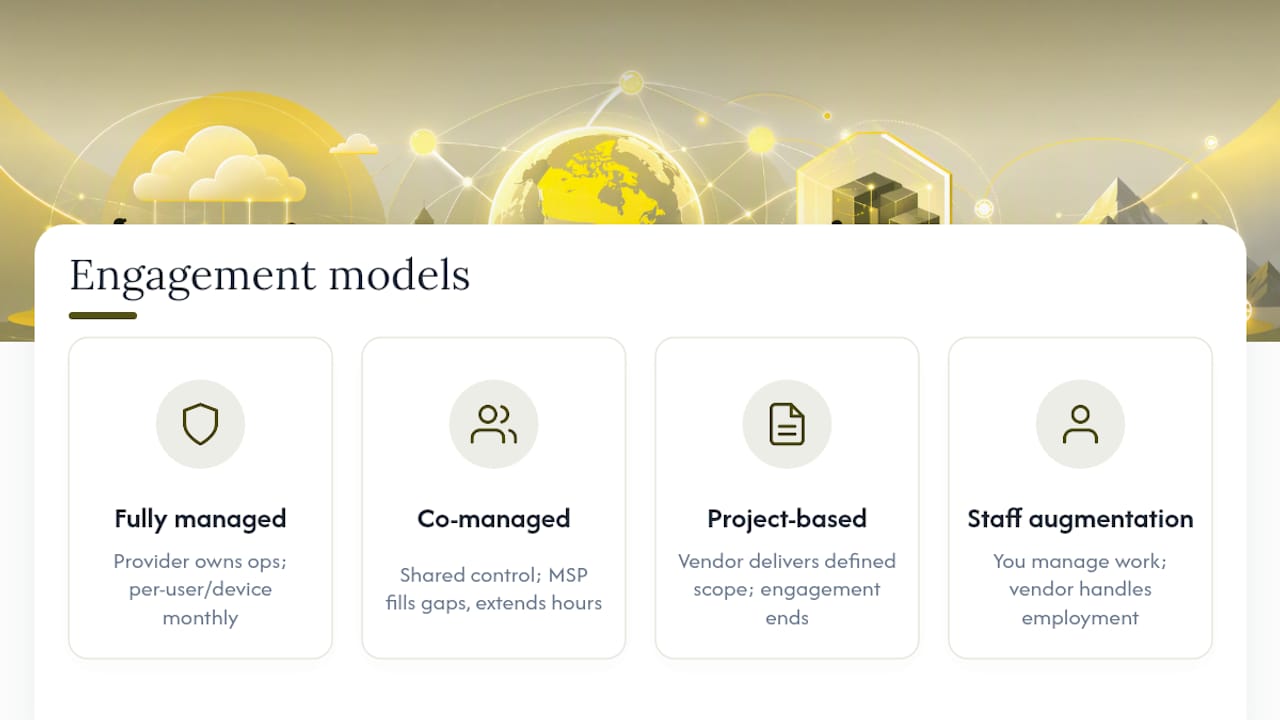
Fully managed (MSP): The provider owns all tools, processes, and day-to-day decisions within the agreed scope. Your internal team is a stakeholder, not an operator. This model suits organizations with smaller internal IT teams that want to transfer operational risk entirely, and it is typically billed per-user or per-device on a monthly subscription.
Co-managed: Your internal IT staff retain control of strategic decisions and certain functions; the MSP fills coverage gaps, provides specialist depth (e.g., cybersecurity), or extends hours. This is the dominant model for mid-market organizations with a small internal IT team who need extended coverage without hiring a night shift. 247techify’s co-managed IT services are structured precisely for this split.
Project-based: A vendor takes complete responsibility for a defined scope and timeline — a cloud migration, a network refresh, a compliance audit. Project-based outsourcing hands full delivery accountability to the vendor, with your team acting as a sponsor and acceptance authority. No ongoing SLA; the engagement ends at delivery.
Staff augmentation: External specialists work under your direction, using your tools and processes. You manage the work; the vendor manages the employment relationship. Best for scaling a development or security team for a defined period without permanent headcount.
Break/fix: Reactive, per-incident support with no ongoing contract. The provider responds when called. This model carries the highest per-incident cost and zero proactive coverage — acceptable only for organizations with minimal IT complexity and a high tolerance for unplanned downtime.
Outcome-based (gainshare): Provider fees are tied to a measurable business result — uptime above a threshold, a reduction in security incidents, or a compliance certification achieved. Requires mature governance and well-defined KPIs on both sides.
Delivery methods
Remote delivery is the default for most managed services and carries the lowest cost. On-site delivery is necessary for physical infrastructure work, regulated environments requiring in-person access controls, or organizations with strict data residency requirements. Hybrid delivery combines both: remote for monitoring and help desk, on-site for hardware and compliance-sensitive tasks.

When to choose which model
| Organization profile | Primary goal | Recommended model |
|---|---|---|
| SMB, no internal IT staff | Full risk transfer, 24/7 coverage | Fully managed MSP |
| Mid-market, 1–5 IT staff | Specialist depth + after-hours | Co-managed |
| Any size, defined IT project | One-off delivery, fixed scope | Project-based |
| Tech company, scaling engineering | Temporary capacity, your direction | Staff augmentation |
| Very small business, low IT complexity | Lowest upfront cost | Break/fix |
| Enterprise, mature KPIs | Align provider incentives to outcomes | Outcome-based |
Pricing and contract models: what they mean for your budget
1. Per-user pricing
A flat monthly fee per employee covered, regardless of device count. Predictable and easy to budget; scales directly with headcount. Typical for fully managed and co-managed engagements.
2. Per-device pricing
A monthly fee per managed endpoint (workstation, server, mobile device). More granular than per-user and better suited to organizations with high device-to-user ratios, such as manufacturing or healthcare environments.
3. Per-incident (break/fix)
Billed only when something breaks. No predictability, no proactive coverage. Per-incident rates are typically the highest cost-per-hour of any model, and they create a perverse incentive: the provider earns more when things go wrong.
4. Fixed-fee (all-inclusive)
A single monthly fee covering all services in the agreed scope. Maximizes budget predictability and aligns provider incentives with keeping your environment stable. The most common structure for fully managed MSP contracts.
5. Tiered pricing
Multiple service tiers (e.g., Essential, Business, Enterprise) at different price points, with each tier adding service depth. Useful for organizations that want to start lean and expand coverage over time.
6. Outcome-based / gainshare
Provider compensation is partially or fully tied to achieving a defined result. Requires precise KPI definition upfront and a governance structure capable of measuring and auditing those KPIs. Rare in the SMB market; more common in enterprise or government contracts.
Contract terms to watch: minimum term length (typically 12–36 months), early termination clauses, SLA credit mechanisms, onboarding fees, and who owns the tooling and licensing at contract end. A provider that owns your monitoring tools and refuses to transfer data at offboarding has significant leverage over you.
Pro Tip: To compare per-user and per-device quotes on equal footing, multiply each by 12 to get an annual figure, then add estimated onboarding fees and any tooling costs the contract excludes. That total cost of ownership (TCO) number is the only fair comparison point.
For a detailed breakdown of how managed services affect SMB cost structures, see how managed services reduce IT costs.
SLAs, governance, reporting, and Canadian compliance
A well-written SLA is the single most important document in a managed engagement. It defines what you are buying, how performance is measured, and what happens when the provider falls short. ITIL-aligned governance frameworks recommend designing SLAs around measurable business outcomes — zero downtime for critical clinical systems, audit-ready compliance posture — not just ticket resolution counts.
SLA checklist
- Availability target: Expressed as a percentage (e.g., 99.9% uptime for critical systems), with explicit exclusions for maintenance windows.
- Response time by severity: P1 (critical) response within 15–30 minutes; P2 (high) within 2–4 hours; P3 (medium) within 8 hours; P4 (low) within 24–48 hours.
- Mean Time to Detect (MTTD) and Mean Time to Resolve (MTTR): Both should be defined and tracked separately — detection speed matters as much as resolution speed in a security context.
- Maintenance windows: Scheduled downtime must be pre-approved and excluded from availability calculations with advance notice requirements.
- SLA credits: Define the credit mechanism (percentage of monthly fee) triggered by each tier of SLA breach. Credits with no teeth are decorative.
- Reporting cadence: Monthly operational reports minimum; quarterly business reviews for strategic alignment.
KPIs to request from your MSP
- Uptime percentage by system tier
- Incident volume and trend (month-over-month)
- Patch compliance rate (target: 95%+ within defined windows)
- Backup success rate and last verified restore date
- Mean Time to Detect security events
- Open vulnerability count and age
Canadian compliance considerations
PIPEDA governs how personal information is collected, used, and disclosed by private-sector organizations across Canada. Provincial health privacy legislation — most notably PHIPA in Ontario — imposes additional obligations on organizations handling personal health information. Both frameworks affect how your MSP stores, processes, and transfers data, and both require documented data handling agreements with your provider.
When evaluating an MSP for a regulated industry engagement, request their data residency policy (Canadian data centers are often a contractual requirement), their breach notification procedures, and documented evidence of prior compliance work in your sector. 247techify’s compliance and auditing services are specifically structured for Canadian regulated-industry requirements.
Market context: Gartner forecasts worldwide public cloud end-user spending to reach $723 billion in 2025, a trajectory that makes managed cloud governance and data residency controls an urgent priority for any Canadian organization moving workloads off-premises.
Benefits and risks across engagement models
| Engagement model | Key benefits | Primary risks | Mitigation |
|---|---|---|---|
| Fully managed | Predictable cost, 24/7 coverage, full risk transfer | Vendor lock-in, loss of internal IT knowledge | Exit clauses, knowledge-transfer obligations in contract |
| Co-managed | Retains internal control, fills specialist gaps | Unclear responsibility boundaries | Written RACI matrix; documented escalation paths |
| Project-based | Fixed scope and cost, fast delivery | Scope creep, no ongoing support post-delivery | Detailed SOW, acceptance criteria, and warranty period |
| Staff augmentation | Flexible capacity, your direction | Slow ramp-up, knowledge leaves with the contractor | Documented handover requirements; overlap periods |
| Break/fix | Lowest upfront commitment | Unpredictable cost, no proactive coverage | Acceptable only for non-critical, low-complexity environments |
Risk mitigation priorities:
- Require a documented onboarding plan with milestones before signing — providers who cannot produce one are signaling process immaturity.
- Build a descope or exit plan into the contract from day one, including data export formats and tool access transfer timelines.
- Schedule quarterly governance reviews with defined agenda items: SLA performance, open risks, roadmap alignment.
- Mandate knowledge-transfer obligations: all runbooks, credentials, and configuration documentation must be maintained in a format your team can access independently.
Time-to-value by model: Fully managed engagements typically reach operational stability within 30–90 days, depending on environment complexity. Co-managed arrangements can be productive within two to four weeks because your internal team provides continuity. Project-based engagements deliver value at the defined milestone. Break/fix has no ramp period but also no proactive value accumulation.
For a detailed look at managed IT benefits for small businesses, including cost modeling for Canadian SMBs, that resource covers the financial case in depth.
How to choose the right managed IT model and vendor
The CompTIA buying guide for managed services frames procurement as an outcome-first process. That framing is correct. Start with what your business needs to be true about IT — not with a list of services.
Selection checklist
- Define outcomes first. What does IT failure cost your business per hour? What compliance obligations must be met? What is your internal IT team’s actual capacity versus what is needed?
- Map your risk and skill gaps. Identify the three functions where a failure would cause the most business damage. Those are your non-negotiable managed service requirements.
- Shortlist engagement models. Use the table in the engagement models section to narrow to two or three candidate models based on your organization size and control preference.
- Request an SLA-first proposal. Any provider who cannot produce a draft SLA with defined response times, MTTR targets, and credit mechanisms in the first proposal round is not ready to be your MSP.
- Run a pilot or proof of value. A 30-day pilot on a defined scope (e.g., help desk for one department) reveals process maturity faster than any reference call.
Vendor questions to ask
- What are your guaranteed response and resolution times by severity level, and what SLA credits apply when you miss them?
- How do you handle escalations, and who is my named escalation contact above the help desk?
- Who owns the monitoring tools and licensing — and what happens to my data and configurations if we terminate?
- What is your documented onboarding process, and what are the milestones and timelines?
- Where is my data stored, and can you confirm Canadian data residency for all primary and backup copies?
- What regulated-industry engagements have you completed, and can you provide documentation of your compliance experience (PIPEDA, PHIPA, PCI-DSS)?
- How is pricing structured, and what is explicitly excluded from the fixed fee?
Decision matrix
| Organizational trait | Best-fit model |
|---|---|
| No internal IT, small employee count | Fully managed MSP |
| Internal IT team, needs 24/7 or specialist depth | Co-managed |
| Defined project, internal team to own post-delivery | Project-based |
| Tech team, needs temporary specialist capacity | Staff augmentation |
| Minimal IT, very low complexity | Break/fix |
Red flags: reject quickly if you see these
- No written SLA or vague “best effort” language in the proposal.
- Provider cannot explain where your data is stored or who has access to it.
- No documented onboarding process or defined go-live milestones.
- Pricing excludes common services (patching, after-hours support, security incidents) that will appear as add-on charges.
- No reference clients in your industry or of comparable size.
For a structured managed IT services selection guide tailored to Canadian business leaders, that resource covers the full RFP process in detail.
How 247techify approaches managed IT service models for Canadian businesses
247techify operates with a cybersecurity-first philosophy, which means security is not a bolt-on service tier — it is the foundation of every managed engagement. For Canadian businesses in regulated industries, that distinction matters: a provider who treats security as an add-on will always be slower to detect and respond to threats than one whose monitoring infrastructure is built around threat detection from the ground up.
Core proof points:
- 24/7 support with a sub-30-minute response target: Critical for organizations where downtime has direct revenue or patient-safety implications.
- 98% client satisfaction rate: Reflecting consistent service delivery across fully managed and co-managed engagements.
- Regulated-industry experience: Active engagements in healthcare, finance, legal, and real estate — sectors where PHIPA, PIPEDA, PCI-DSS, and HIPAA compliance are operational requirements, not aspirational goals.
- Service breadth across all major model types: Fully managed IT, co-managed IT, Microsoft 365 management, backup and disaster recovery, endpoint protection, cloud services, AI automation, and compliance consulting — covering the full service taxonomy described in this article.
- Canadian data residency: Data handling practices aligned with PIPEDA and provincial privacy requirements.
247techify’s client satisfaction rate reflects a service model built on proactive monitoring, documented escalation paths, and quarterly governance reviews — not reactive ticket resolution.
For organizations in Toronto, Mississauga, and cities across Canada, 247techify’s managed IT engagements are structured to match the engagement model that fits your current IT maturity, then evolve as your needs change.
The model most Canadian SMBs should actually choose
For the majority of Canadian small and mid-sized businesses — those with fewer than 200 employees, limited internal IT capacity, and at least one regulated-industry obligation — the fully managed MSP model, with a cybersecurity-first provider and a well-drafted SLA, is the right starting point. Co-managed is the correct next step once you have internal IT staff who need specialist backup rather than full replacement.
The mistake most organizations make is choosing a model based on price rather than risk exposure. Break/fix feels cheaper until a ransomware incident costs $50,000 in recovery time. Staff augmentation feels flexible until the contractor leaves and takes institutional knowledge with them. The model that protects your business from its most probable and most costly failure mode is the one worth paying for.
247techify: managed IT services built for Canadian businesses
Canadian businesses in healthcare, finance, legal, and real estate face a specific combination of regulatory pressure, cybersecurity risk, and limited internal IT capacity that generic IT support contracts are not designed to address. 247techify’s cybersecurity-first managed IT model is built around that reality: 24/7 monitoring, a sub-30-minute response target, and compliance expertise covering PIPEDA, PHIPA, and PCI-DSS — delivered under a structured SLA with documented onboarding and quarterly governance reviews.
Whether you need a fully managed engagement that transfers all IT operational risk, or a co-managed arrangement that extends your internal team’s coverage, 247techify structures the engagement around your outcomes, not a generic service catalog. Plans for Canadian businesses start from $1,099/month. Contact 247techify through the managed IT services Canada page to request an SLA-first proposal and a no-obligation assessment of which model fits your organization.
Sources
- Gartner: Worldwide public cloud end-user spending forecast (press release)
- Freshworks: What are Managed IT Services? Definition, Types, & Benefits
- CompTIA: Buying guide for managed service
FAQ
What are the different types of MSPs?
MSPs are typically categorized by scope: fully managed (the provider runs all IT operations), co-managed (shared responsibility with an internal team), and specialist MSPs focused on a single domain such as cybersecurity, cloud, or communications. Most Canadian SMBs work with a generalist MSP that covers multiple service families under one SLA.
What is the managed services model?
The managed services model is an ongoing outsourcing arrangement where a provider delivers defined IT functions under a Service Level Agreement, typically billed on a per-user or per-device monthly subscription. KORE1 notes it is often the best fit for organizations under roughly 500 employees that need predictable IT costs and proactive coverage without building a full internal team.
What is the difference between an MSP and SaaS?
An MSP is accountable for the outcome of an IT function and owns the delivery process end-to-end; a SaaS vendor licenses you software and is responsible only for platform availability, while you operate the tool yourself. The critical distinction is who bears responsibility when the IT function fails to protect or support your business.
How do I choose the right managed IT model?
Start by defining what IT failure costs your business per hour and which compliance obligations you must meet, then map those requirements to the engagement models in this guide. Request an SLA-first proposal from any shortlisted provider, and run a 30-day pilot before committing to a full-term contract.
What Canadian regulations affect managed IT service choices?
PIPEDA applies to all private-sector organizations handling personal information across Canada, and PHIPA governs personal health information in Ontario. Both frameworks require documented data handling agreements with your MSP, Canadian data residency for regulated data, and defined breach notification procedures — all of which should appear explicitly in your SLA.