
HIPAA is a U.S. federal law, and it does not automatically apply to Canadian organizations. It applies the moment your organization handles U.S. Protected Health Information on behalf of a U.S. Covered Entity, or signs a Business Associate Agreement. The immediate action for any Canadian healthcare administrator: map whether you touch U.S. PHI right now, and confirm whether a BAA governs that relationship. If neither applies, PIPEDA and your provincial health law still do.
TL;DR:
- Canadian organizations handling U.S. Protected Health Information for U.S. covered entities must have a Business Associate Agreement and verify their contact with U.S. PHI.
- HIPAA obligations apply based on the data handled and relationship, not the organization’s location, with U.S. clients often requesting HIPAA-compliant evidence early in procurement.
- A unified compliance program covering HIPAA, PIPEDA, and provincial laws can meet all requirements, focusing on access control, audit logs, encryption, risk assessment, and vendor oversight.
- Proper BAA clauses should specify security commitments, breach notifications, subprocessor obligations, audit rights, and data disposal, while Canadian laws require compliance with local consent and breach rules.
- Staff training should explicitly address U.S. PHI, breach response, and specific HIPAA requirements, with documentation preparation necessary before regulatory or client inquiries.
Table of Contents
- Who in Canada Actually Needs to Follow HIPAA
- HIPAA vs PIPEDA vs Provincial Health Laws: What Actually Differs
- Technical and Administrative Safeguards That Satisfy Both Frameworks
- Contracts, BAAs, and Vendor Management
- Breach Notification: Two Clocks, One Incident
- A 90-Day Action Plan for Canadian Healthcare Organizations
- How Provincial Differences Change Your Obligations
- Training Your Team to Handle U.S. Patient Data
- Our Take: Build One Program, Not Two
- How 247techify Supports HIPAA and PIPEDA Readiness
- Where to Verify These Rules Yourself
- Sources
- FAQ
Who in Canada Actually Needs to Follow HIPAA
The trigger is the data, not the border. HIPAA attaches when a Canadian organization becomes a “Business Associate,” meaning it handles U.S. PHI for a “Covered Entity,” typically a U.S. hospital, insurer, or health plan. That handling almost always comes with a Business Associate Agreement, and Canadian vendors providing services like billing, EHR hosting, transcription, or telehealth to U.S. covered entities commonly qualify.
Practical scenarios that create the obligation:
- A Toronto medical billing company processes claims for a U.S. physician group.
- A Vancouver software vendor hosts electronic health records for a California clinic network.
- A transcription service in Halifax converts dictation from a U.S. telehealth provider.
- An analytics firm in Calgary runs population health reports on de-identified U.S. patient data that still touches identifiable fields upstream.
If your organization fits none of these, HIPAA is not your governing law. But U.S. clients frequently request HIPAA-aligned evidence during procurement even when the legal trigger is thin, so it pays to know where you stand before a contract negotiation puts you on the spot.
HIPAA vs PIPEDA vs Provincial Health Laws: What Actually Differs
Canada has no single law equivalent to HIPAA. Instead, PIPEDA sets a federal private-sector baseline, and provinces layer on health-specific statutes: PHIPA in Ontario, HIA in Alberta, and Quebec’s Loi 25. HIPAA covers U.S. covered entities and their business associates. PIPEDA and provincial custodial laws cover Canadian private-sector organizations and health information custodians, full stop, regardless of any American connection.
Consent works differently, too. PIPEDA operationalizes ten fair information principles, including purpose limitation and data minimization, that don’t map cleanly onto HIPAA’s permitted-disclosure model. PHIPA’s “circle of care” doctrine lets custodians share information for direct patient care without express consent each time, a concept HIPAA approaches through its treatment, payment, and operations exceptions, but the two frameworks don’t align term for term.
Enforcement is diverging fast. Provincial regulators historically favored investigation and remediation over fines, but Quebec’s Loi 25 reforms and rising healthcare breach activity have sharpened enforcement intensity across the country. Key differences to track:
- Scope: HIPAA binds U.S. entities and their BAs; PIPEDA/provincial law binds Canadian custodians outright.
- Consent: Circle-of-care sharing under PHIPA versus HIPAA’s TPO exceptions.
- Cross-border transfers: HIPAA attaches to the data and relationship, not geography; PIPEDA demands transparency when data crosses the border regardless.
- Enforcement trajectory: Provincial penalties are climbing, not shrinking.
Our breakdown of Canadian data privacy laws covers where each provincial statute applies in more depth.
Technical and Administrative Safeguards That Satisfy Both Frameworks
Here’s the good news: you don’t need two compliance programs. The HIPAA Security Rule’s administrative, physical, and technical safeguards map closely onto what PIPEDA and provincial laws already expect, so one well-built program can satisfy both.
Build it in this order:
- Access control. Unique user IDs, multifactor authentication, and single sign-on so every action traces to a person, not a shared login.
- Audit logging. Centralized, tamper-resistant logs for any system touching PHI, retained long enough to reconstruct an incident timeline.
- Encryption. Data encrypted in transit and at rest, with your organization retaining control of the encryption keys, not just the vendor.
- Risk analysis. A documented, periodic risk assessment that names specific threats to your PHI systems, not a generic checklist.
- Policies and training. Written policies covering access, retention, and incident response, backed by staff training records you can produce on demand.
- Vendor oversight. A data flow map showing exactly where PHI travels, who touches it, and under what contract.
Pro Tip: Auditors and U.S. clients almost never ask to see your firewall configuration first. They ask for your risk analysis document and your training records. Build those two artifacts before you spend a dollar on new tools.
Our patient data protection tools guide walks through vendor selection criteria for each of these controls.
Contracts, BAAs, and Vendor Management
A Business Associate Agreement is the legal mechanism that shifts HIPAA obligations onto a vendor, and without one, that vendor remains exposed regardless of how strong its technical controls are. Every BAA you sign, or ask a subcontractor to sign, needs these minimum elements:
- Explicit security commitments matching Security Rule categories (administrative, physical, technical).
- Breach notification obligations with a defined timeline, ideally faster than HIPAA’s own default.
- Subcontractor flow-down language, so any sub-processor inherits the same obligations you signed up for.
- Right-to-audit clauses letting you or the U.S. client verify controls, not just take a vendor’s word for it.
- Data return or destruction terms specifying what happens to PHI when the contract ends.
For Canadian operations, layer PIPEDA and provincial expectations into the same contract: purpose limitation clauses, data residency disclosures, and breach reporting language that satisfies your provincial regulator alongside the U.S. client. Vendors serving healthcare transcription or documentation workflows should review resources like Live Caption AI’s HIPAA compliance coverage for implementation specifics relevant to subcontracted service providers.
Breach Notification: Two Clocks, One Incident
HIPAA gives Business Associates and Covered Entities defined notification timelines once a breach involving unsecured PHI is discovered. PIPEDA and provincial laws run on a different standard entirely: a “real risk of significant harm” test that triggers reporting to the Office of the Privacy Commissioner or your provincial equivalent.
- Preserve incident evidence immediately: logs, access records, and a timeline of discovery.
- Sequence notifications so U.S. contractual deadlines and Canadian regulatory deadlines are both met, not just the one that feels more urgent.
- Coordinate public communications with legal counsel before either regulator hears from a journalist first.
Rising healthcare breach activity and tightening provincial enforcement mean the non-regulatory fallout, lost contracts, lawsuits, reputational damage, often outweighs the fine itself.
A 90-Day Action Plan for Canadian Healthcare Organizations
Don’t try to fix everything at once. Sequence it:
- Days 1 to 15: Inventory every system and vendor touching U.S. PHI. Confirm which BAAs exist and which are missing.
- Days 15 to 45: Run a documented risk assessment. Deploy MFA and encryption anywhere gaps surface.
- Days 45 to 75: Update policies, retrain staff, and run a tabletop breach exercise with your incident response team.
- Days 75 to 90: Assemble your audit package, risk analysis, training logs, BAAs, vendor contracts, so it’s ready before a client or regulator asks.
Escalate to legal counsel the moment a contract requires a BAA you don’t fully understand, or when a breach touches both U.S. and Canadian regulated data simultaneously. A compliance-focused managed IT partner earns its cost fastest at exactly that decision point.
How Provincial Differences Change Your Obligations
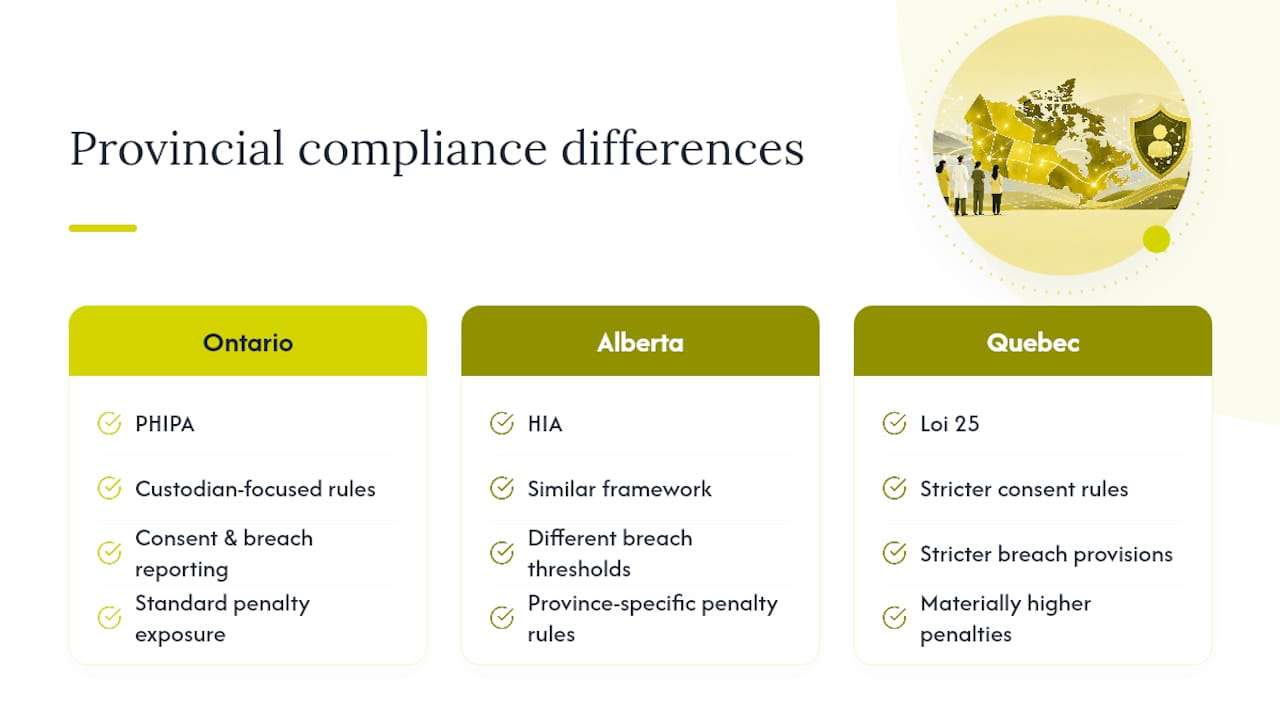
A clinic in Ontario, a health tech vendor in Alberta, and a hospital network in Quebec all face different baseline rules even before HIPAA enters the picture. Ontario’s PHIPA governs health information custodians directly and sets its own consent and breach reporting standards. Alberta’s HIA does something similar but with different thresholds for what counts as a reportable incident. Quebec’s Loi 25 has moved fastest and hardest, introducing stricter consent requirements and materially higher penalty exposure than most other provinces.
This matters for HIPAA overlay work because your provincial law is your floor, not your ceiling. A Quebec-based vendor handling U.S. PHI has to satisfy Loi 25’s stricter consent and breach provisions and HIPAA’s Business Associate obligations simultaneously. An Alberta vendor might have more flexibility on some consent mechanics but faces its own HIA-specific breach thresholds. There’s no shortcut where meeting one province’s standard automatically satisfies another’s, and there’s certainly no shortcut where meeting HIPAA substitutes for provincial compliance.
The practical fix is building your safeguards to the strictest applicable standard across every province you operate in, then treating HIPAA requirements as an additional layer on top rather than a separate track. Organizations that operate in multiple provinces, or serve clients across provincial lines, should map each province’s specific consent and breach rules before assuming a single national policy covers them. A policy written to Ontario’s PHIPA standard will not automatically satisfy Quebec’s Loi 25 obligations, and treating them as interchangeable is one of the more common compliance gaps administrators discover during an audit.
Training Your Team to Handle U.S. Patient Data
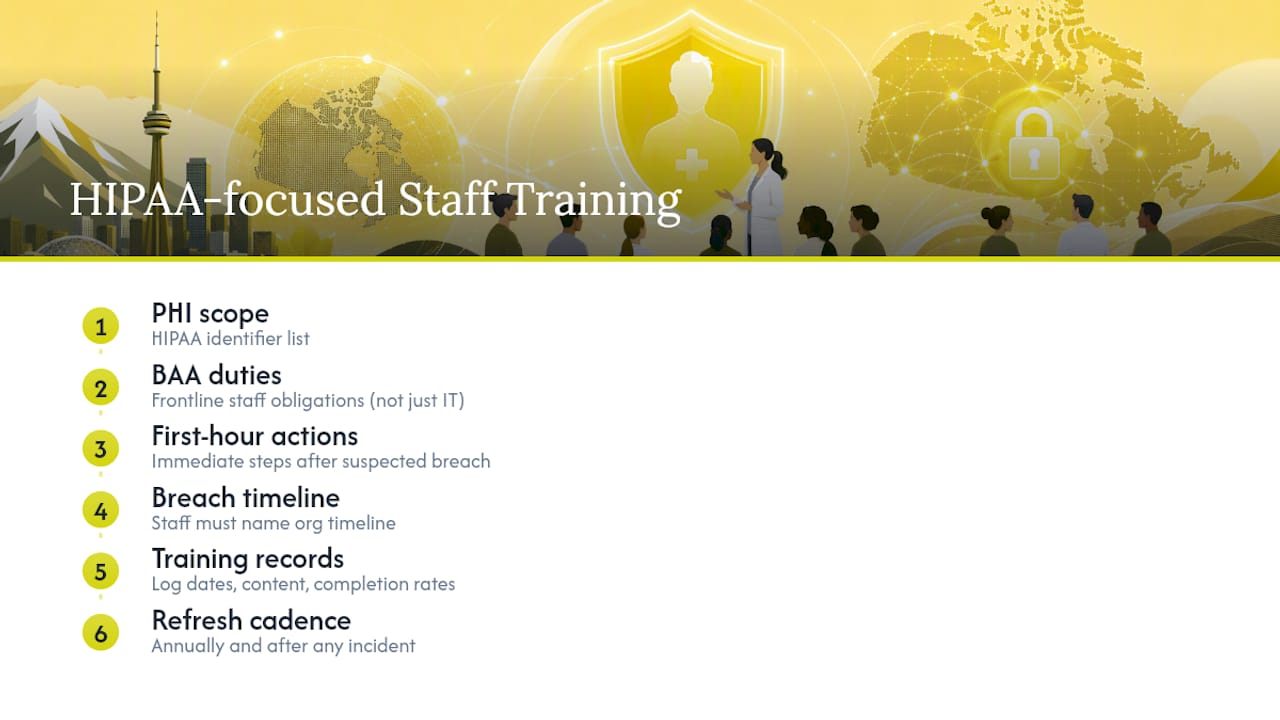
Generic privacy training doesn’t cut it once your staff touches U.S. PHI. The concepts your team already knows, PIPEDA’s consent principles, provincial breach thresholds, need a second layer specific to HIPAA’s Business Associate obligations, because the two frameworks use different vocabulary for overlapping ideas.
Effective programs cover three things explicitly: what counts as PHI under HIPAA’s broader identifier list, what the BAA actually requires of frontline staff (not just IT and legal), and what to do in the first hour after a suspected breach. Staff handling billing, transcription, or EHR support for U.S. clients should be able to name their organization’s breach notification timeline without checking a document, because in a live incident there usually isn’t time to look it up.
Training records matter as much as the training itself. U.S. covered entities and their auditors routinely request evidence of staff training dates, content, and completion rates, not just a policy stating training happens. Refresh annually at minimum, and refresh immediately after any near miss or actual incident, since a stale training record is one of the more obvious deficiencies flagged during vendor due diligence. Role-specific modules, one for support staff, another for engineers with system access, tend to stick better than a single generic session covering everyone at once.
Our Take: Build One Program, Not Two
Most Canadian healthcare vendors treat HIPAA and PIPEDA compliance as parallel tracks, running separate audits, separate policy documents, separate training sessions. That’s backward, and it’s expensive. A single, evidence-led compliance program that maps HIPAA Security Rule controls directly onto PIPEDA and provincial requirements avoids duplicate work and actually holds up better under scrutiny, because your evidence tells one consistent story instead of two documents that don’t quite match.
The bigger misconception we see is administrators assuming HIPAA readiness is optional until a U.S. contract explicitly demands it. In practice, U.S. covered entities request HIPAA-aligned evidence, risk analyses, training logs, signed BAAs, during procurement long before any contract is signed. Waiting until you’re asked means scrambling under a deadline instead of walking into that conversation with documentation already assembled.
Since the 2013 HIPAA Omnibus Rule, Business Associates carry direct legal liability, not just contractual exposure. That single change should have shifted how every Canadian vendor servicing U.S. healthcare clients thinks about this. It’s not a box to check for a specific client. It’s a standing legal responsibility the moment U.S. PHI enters your systems.
— 247techify Team
How 247techify Supports HIPAA and PIPEDA Readiness
247techify approaches this the way we approach every regulated client: cybersecurity first, with compliance built into the infrastructure instead of bolted on afterward. Our team runs the risk assessments, deploys the MFA and encryption controls, and assembles the audit documentation that clinics and health tech vendors need to satisfy both HIPAA and PIPEDA obligations at once.
What sets this apart from hiring a generalist IT contractor is the specific overlap: compliance auditing built around regulated industries like healthcare, paired with 24/7 support and a rapid response time under 30 minutes if an incident ever does occur. Clinics and healthcare vendors get one team handling both the technical safeguards and the documentation trail, rather than juggling a security vendor and a compliance consultant who don’t talk to each other. If you’re not sure whether your current setup would survive a client’s due diligence request tomorrow, that’s the exact gap our healthcare IT support services are built to close.
Start with a compliance assessment through our managed IT services for Canadian businesses page, and we’ll tell you plainly where your BAAs, safeguards, and documentation stand before a client or regulator asks first.
Where to Verify These Rules Yourself
Regulatory guidance changes, so confirm current requirements directly with the source before finalizing any policy.
- Office of the Privacy Commissioner of Canada: the authoritative source on PIPEDA’s fair information principles and federal enforcement.
- HIPAA Journal’s Canada coverage: tracks how HIPAA’s Business Associate rules apply to Canadian vendors specifically.
- Your provincial privacy commissioner (Ontario’s IPC, Alberta’s OIPC, or Quebec’s CAI): the specific body enforcing PHIPA, HIA, or Loi 25 in your jurisdiction.
This article is general information, not a substitute for advice from a qualified doctor. Consult a qualified healthcare professional about your own circumstances before acting on anything here.
Sources
- Office of the Privacy Commissioner of Canada — PIPEDA overview
- HIPAA Journal — HIPAA and Canada
- SecuritComply — HIPAA for Canadian companies handling US health data
FAQ
Is HIPAA required in Canada?
No. HIPAA is a U.S. federal law and doesn’t apply automatically in Canada. It applies only when a Canadian organization handles U.S. Protected Health Information under a Business Associate Agreement with a U.S. Covered Entity.
What are examples of HIPAA violations?
Common violations include operating without a signed BAA while handling U.S. PHI, failing to encrypt PHI in transit or at rest, missing breach notification deadlines, and allowing subcontractors to access PHI without flow-down security obligations.
Who needs to be HIPAA compliant?
U.S. Covered Entities (providers, insurers, health plans) and their Business Associates, including any Canadian vendor providing billing, hosting, transcription, or telehealth support to a U.S. healthcare client, must be HIPAA compliant.
Is PIPEDA the same as HIPAA?
No. PIPEDA is Canada’s federal private-sector privacy law and applies to Canadian organizations directly, while HIPAA is a U.S. law governing American covered entities and their business associates. The two share overlapping safeguard concepts but differ in scope, consent rules, and enforcement.