
The strongest alternatives to ellwoodtechnology.ca are cybersecurity-first managed IT providers that publish tiered SLAs, hold verifiable compliance credentials (SOC 2 Type II, HIPAA, PCI-DSS), and can demonstrate a documented incident-response runbook. The recommended next step is to scope your requirements this week and request proposals from 3–5 qualified providers using a structured MSP evaluation process that runs 6–8 weeks.
Shortlist of provider categories to evaluate:
- 247techify — cybersecurity-first managed IT with 24/7 support, compliance auditing, and under-30-minute response commitment; strong fit for regulated Canadian businesses
- Security-first regional MSP — local onsite escalation, hardware procurement, and compliance mapping for SMBs with physical office infrastructure
- National MSSP — 24/7 SOC coverage, MDR, and SIEM for distributed enterprises that need follow-the-sun monitoring
- National IT solutions provider — broad managed services, licensing, and procurement depth for organizations with complex vendor ecosystems
- Ellwood Technology (original vendor, for context) — Canadian IT services provider; the baseline you are comparing against
Scope your requirements first. Then request proposals from 3–5 providers and run a side-by-side SLA and compliance comparison before signing anything.
Table of Contents
- Which ellwoodtechnology.ca alternatives should you contact first?
- Provider profiles: who fits your situation
- How to run a multi-week RFP for your next MSP
- What SLA metrics and compliance checks should you demand?
- How to vet incident response and exit terms
- Key Takeaways
- Why cybersecurity-first posture changes the entire MSP relationship
- 247techify fits the evaluation criteria you just built
- Useful sources and references
- FAQ
Which ellwoodtechnology.ca alternatives should you contact first?
| Provider Category | Best For | Pricing Model | SLA Commitments | Security Services | Compliance Support | Onboarding | Geographic Coverage |
|---|---|---|---|---|---|---|---|
| Security-first MSP (e.g., 247techify) | Regulated SMBs (healthcare, finance) | All-inclusive per-user/month | 15-min critical, 1-hr high, 4-hr normal | MDR, patching, vCISO, SIEM | SOC 2 II, HIPAA, PCI-DSS mapping | 30–60 days | Canada-wide |
| National MSSP | Distributed enterprises, 24/7 SOC needs | Tiered; SOC add-on common | 15-min critical response | MDR, SOC, threat hunting | SOC 2 II, HIPAA | 90 days | North America |
| National IT solutions provider | Complex procurement, multi-site licensing | Per-device or project-based | Varies by contract tier | Managed security add-on | PCI-DSS, HIPAA (add-on) | 30–60 days | North America |
| Regional MSP / reseller | Lean internal IT, onsite escalation priority | Per-device or per-user | 4-hr standard; critical varies | Endpoint protection, patching | Framework support varies | 6–8 weeks | Regional |
Contact first based on your profile:
- Regulated SMB (healthcare, finance, legal): Start with a security-first MSP. Compliance mapping and documented audit trails are standard, not an add-on.
- Distributed enterprise with no internal SOC: A national MSSP gives you follow-the-sun coverage and dedicated threat analysts without building an internal team.
- Mid-market with existing internal IT: A co-managed model from a security-first MSP fills skill gaps while preserving your team’s control over day-to-day operations.
- Hardware-heavy or multi-site procurement: A national IT solutions provider or regional reseller handles procurement depth and onsite escalation more efficiently.
Tiered pricing proposals often omit after-hours coverage and advanced security from the base rate. Build a normalized scope-of-work matrix and price it consistently across every quote you receive — otherwise you are comparing the cheapest proposal against the most comprehensive one.
Provider profiles: who fits your situation
Ellwood Technology (the vendor you are comparing against)
Ellwood Technology is a Canadian IT services provider. If you are searching for alternatives, you are likely evaluating whether a different provider offers stronger security posture, clearer SLAs, or more explicit compliance credentials. Use the criteria in this article to benchmark any incumbent vendor, including Ellwood.
247techify
247techify leads with cybersecurity rather than treating it as an add-on, which matters most for businesses in regulated verticals. The service model covers managed IT and cybersecurity with 24/7 support, a stated response time under 30 minutes, and compliance auditing for HIPAA and PCI-DSS. vCIO planning and proactive vendor management are included as standard, not billed separately. Best for: Canadian SMBs in healthcare, finance, or real estate that need compliance evidence and a single accountable partner.

National MSSP (MDR/SOC-focused)
This category covers providers whose core product is a 24/7 Security Operations Center with MDR, SIEM correlation, and threat hunting. They suit distributed enterprises that generate enough log volume to justify dedicated analyst coverage. Watch for: client-to-analyst ratios that inflate during growth phases, and contracts that separate monitoring from remediation, which slows response times and muddies accountability during an actual incident.
National IT solutions provider
Providers in this category carry deep procurement relationships, broad licensing programs, and multi-vendor management across large device fleets. Security services are typically available as add-ons rather than core deliverables. Best for: organizations with complex hardware refresh cycles or multi-site licensing needs. Watch for: vague definitions of “cybersecurity” in the base contract and vCIO services that are marketing language rather than a named, dedicated resource.
Regional MSP / reseller
Regional providers offer onsite escalation speed and local account management that national providers rarely match. Hardware procurement and break-fix response are strengths. Security depth varies significantly; always ask for the specific tools in their stack and the certifications held by the engineers who will manage your account, not just the sales team.
How to run a multi-week RFP for your next MSP
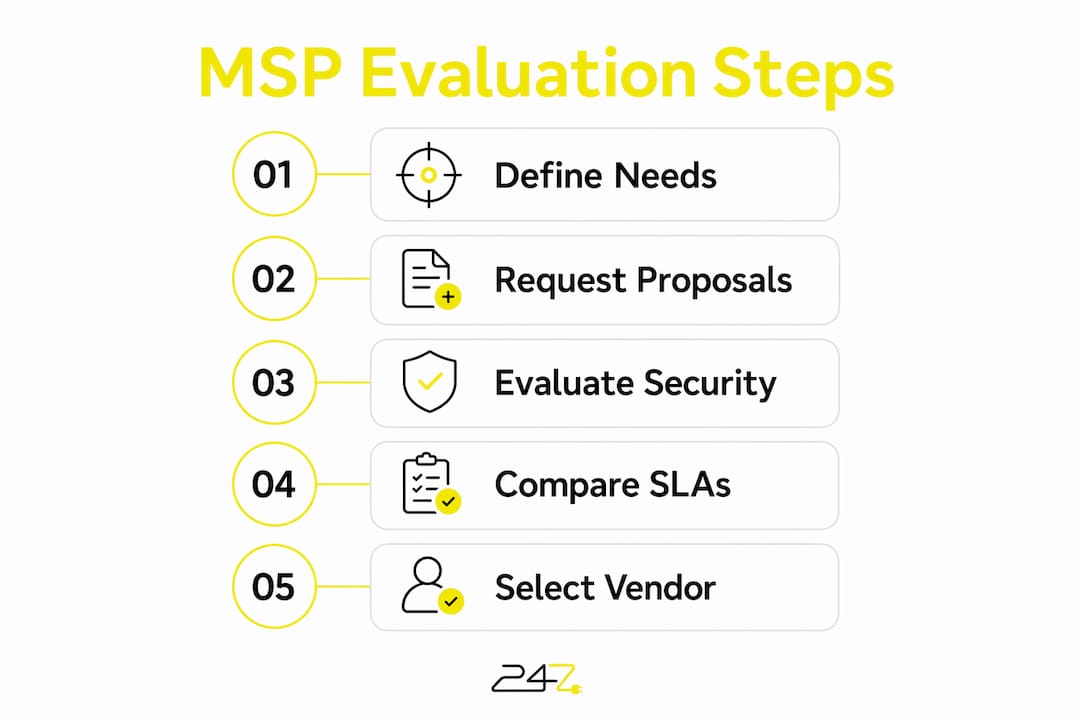
A rigorous MSP evaluation runs 6–8 weeks and produces a defensible decision. Here is the phased timeline:
- Weeks 1–2: Scope. Document current environment, compliance obligations, SLA expectations, and any gaps in your existing coverage. Identify 3–5 candidate providers.
- Weeks 3–4: RFP and proposals. Issue a written RFP to 3–5 shortlisted providers. Require responses on: scope of services, SLA tiers, security tooling stack, compliance framework mapping, onboarding plan, and transition/exit terms.
- Weeks 5–6: Demos and reference checks. Run structured demos focused on your actual environment. Conduct at least two reference calls per finalist using the questions below.
- Weeks 7–8: Selection and contract negotiation. Compare normalized quotes, negotiate SLA penalties and exit terms, and confirm compliance evidence before signing.
RFP checklist items to require in writing:
- Named SLA tiers with response and resolution targets (not just “best effort”)
- Security tooling stack: EDR platform, SIEM, patch management cadence
- Compliance framework mapping to SOC 2 Type II, HIPAA, or PCI-DSS as applicable
- Documented onboarding plan with milestone dates
- Transition and exit terms: data export format, access handover timeline, cost responsibility
Structured reference-check questions:
- What does a typical week of proactive communication look like from your team?
- How do you handle a compliance audit request from our regulator?
- Describe the worst incident in the past year and exactly how your team responded.
- What was the time from detection to containment, and who made the call to escalate?
Pro Tip: Separate bundled add-ons for vCIO planning, AI governance, and vendor management when comparing quotes. These are often where the real difference between providers lives — and tiered proposals frequently hide them inside a base rate that looks competitive until you price them out individually.
What SLA metrics and compliance checks should you demand?
SLA tiers to require in every contract:
- Severity 1 / Critical: 15-minute response; covers active breaches, complete outages, and ransomware events
- Severity 2 / High: 1-hour response; covers partial outages, degraded security monitoring, or compliance-critical system failures
- Severity 3 / Normal: 4-hour response; covers standard service requests and non-urgent issues
Response time means a qualified engineer acknowledges the ticket and begins diagnosis. Resolution time is a separate commitment — require both in writing, with financial penalties for breach.
Compliance verification checklist:
- Request the date of the provider’s most recent SOC 2 Type II report and ask to review the summary
- Ask for a sample 90-day compliance posture report produced after onboarding — this shows whether they identify specific control gaps or just confirm “no issues found”
- Confirm team certifications: CISSP for senior security staff, ISO 27001 lead auditor where applicable
- Request a penetration test summary from the past 12 months and ask how findings were remediated
- Verify continuous vulnerability management: ask how often scans run and how patch deployment is tracked
Pro Tip: Insist the provider show you exactly how your controls map to the relevant compliance framework. A provider who responds with “we support compliance” without producing a controls matrix is telling you something important about how they will handle your next audit.
How to vet incident response and exit terms
Incident response questions to ask every finalist:
- What happens in the first two hours after a confirmed breach? Get a step-by-step answer, not a summary.
- Who is on shift at 2 a.m. on a Saturday? A staffed SOC with a senior analyst is a different product than automated ticketing with a callback queue.
- Can you share a redacted runbook or evidence of a tabletop exercise conducted in the past year?
- Ask references specifically: how did the provider perform under a high-severity incident, and what would they change about the response?
Commercial exit terms to require before signing:
- Data export format and timeline (standard formats, not proprietary)
- Documented transition plan with named milestones
- Access handover timeline for credentials, documentation, and tooling
- Clear statement of who covers data migration costs if you exit before contract end
Red flags that predict transparency problems:
- Evasive or generic answers to the first-two-hours question (“we follow our process”)
- Exit clauses described as “administrative” with no documented handover procedure
- No runbook, no tabletop exercise history, and no willingness to share either
- Monitoring and remediation split between two separate teams or vendors, which creates accountability gaps during an actual incident
Key Takeaways
The most defensible way to replace ellwoodtechnology.ca is to run a multi-week RFP, demand tiered SLAs with financial penalties, require compliance framework mapping, and carefully evaluate every finalist’s incident-response capability before signing.
| Point | Details |
|---|---|
| Run a structured RFP | A 6–8 week evaluation with 3–5 proposals produces a defensible, comparable shortlist. |
| Demand tiered SLAs | Require 15-minute critical, 1-hour high, and 4-hour normal response commitments in writing with penalties. |
| Require compliance mapping | Ask for SOC 2 Type II, HIPAA, or PCI-DSS framework mapping and a 90-day compliance posture report post-onboarding. |
| Stress-test references | Ask references to describe the worst incident in the past year and the provider’s exact response. |
| 247techify as a shortlist candidate | 247techify covers cybersecurity-first managed IT, compliance auditing, and 24/7 support for regulated Canadian businesses. |
Why cybersecurity-first posture changes the entire MSP relationship
Most MSP comparisons focus on price per user and helpdesk ticket speed. Those metrics matter, but they measure the wrong thing for businesses operating under HIPAA, PCI-DSS, or any regulated data environment. The real question is whether your provider can tell you, in specific terms, what your current control gaps are and what they are doing about them this month.
Providers who lead with security posture tend to communicate differently under pressure. They surface problems before they become incidents. They produce compliance evidence that survives an audit rather than a summary PDF that says “compliant.” The difference between a provider who treats cybersecurity as a core deliverable and one who treats it as a checkbox shows up most clearly at 2 a.m. when something goes wrong.
247techify’s cybersecurity-first model, 24/7 coverage, and compliance auditing capabilities reflect exactly the criteria this evaluation framework prioritizes. Reduced downtime, fewer security incidents, and a clearer compliance posture are measurable outcomes, not marketing language.
247techify fits the evaluation criteria you just built
If the checklist above describes what you need, 247techify is built to meet it. The service model covers managed IT services with cybersecurity as the foundation, not an add-on: 24/7 support with a sub-30-minute response commitment, HIPAA and PCI-DSS compliance auditing, vCIO planning, and proactive vendor management. For mid-market teams with existing internal IT, the co-managed IT model preserves your team’s control while closing the security and compliance gaps that most regional MSPs leave open.
Request a quote or review the full service catalog to see how 247techify maps to your specific compliance obligations and SLA requirements.
Useful sources and references
The sources below supply the procurement frameworks, SLA guidance, and compliance criteria referenced throughout this article.
- SerenIT — How to Evaluate an MSP: Source for the 6–8 week RFP timeline and the 3–5 proposal shortlist guidance.
- DizzyJournal — How to Choose a Cybersecurity Provider: Source for the compliance posture report requirement and the 90-day post-onboarding framework mapping check.
- itreviews — How to Choose an MSP: Source for provider model guidance (MSP vs. MSSP vs. VAR vs. co-managed).
- managedserviceprovider.co — Cybersecurity Partner Checklist: Source for the RFP checklist items, red flags, and reference-check question structure.
- BrightWorks IT — How to Choose a Managed IT Provider: Source for security-first MSP value-adds (tiered SLAs, vCIO, transparent pricing).
- 247techify — Managed IT Services Canada: Primary landing page for service scope and quote requests.
- 247techify — IT Compliance & Auditing Canada: Service page detailing compliance auditing capabilities for regulated-industry buyers.
FAQ
What are the best alternatives to ellwoodtechnology.ca for Canadian businesses?
The strongest ellwoodtechnology.ca alternatives are cybersecurity-first MSPs that publish tiered SLAs, hold SOC 2 Type II or HIPAA compliance credentials, and provide a documented incident-response runbook. 247techify is a direct candidate for regulated Canadian businesses in healthcare, finance, or real estate.
How long does it take to switch MSP providers?
A structured evaluation runs 6–8 weeks from scoping to contract signature, with onboarding typically adding 30–60 days depending on environment complexity and compliance requirements.
What SLA tiers should I demand from any MSP alternative?
Require appropriate response times for critical, high-priority, and normal incidents, with financial penalties for breach written into the contract.
How do I verify a provider’s compliance capabilities before signing?
Ask for the date of their most recent SOC 2 Type II report, a sample 90-day compliance posture report from a current client, and a controls matrix showing how your specific obligations map to their service delivery.
What is the biggest red flag when evaluating MSP alternatives?
A provider who cannot describe, step by step, what happens in the first two hours after a confirmed breach is telling you their incident response is not practiced. Treat evasive answers to that question as a disqualifying signal.