
Medical device security is a patient-safety, operational, financial, and regulatory imperative — not an optional IT concern. Ransomware has affected 67% of healthcare organizations in 2024, and when connected devices are compromised, the consequences extend far beyond data loss: infusion pumps can deliver incorrect doses, ventilator alarms can be suppressed, and diagnostic systems can return manipulated readings that delay or misdirect treatment.
The immediate stakes, in plain terms:
- Patient harm: Compromised device integrity can alter therapy delivery or mask critical alerts.
- Operational downtime: Ransomware and device outages force patient diversions and canceled procedures.
- PHI exposure: Connected devices often transmit or store protected health information, creating HIPAA liability.
- Regulatory action: The FDA can pursue enforcement against manufacturers and, indirectly, health systems that fail to remediate known vulnerabilities.
Table of Contents
- What “medical device security” actually covers
- Core vulnerabilities that put devices at risk
- How device vulnerabilities translate into real-world harm
- What U.S. regulations and standards require
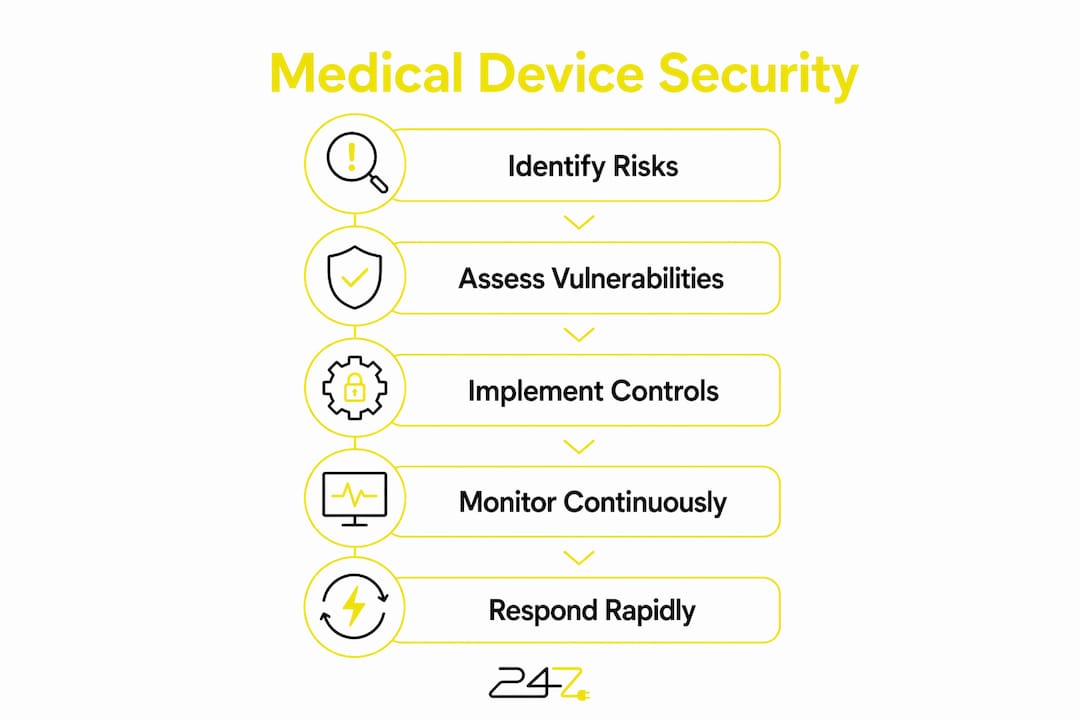
- Practical mitigations: what to do first
- What manufacturers are responsible for
- Incident response: what to do when a device is compromised
- Closing the governance gap with a lifecycle approach
- Key Takeaways
- A practitioner note from the 247techify Team
- FAQ
- Authoritative sources to consult
What “medical device security” actually covers
Medical device security, often called IoMT (Internet of Medical Things) security, refers to the technical and governance controls that protect networked clinical devices from unauthorized access, manipulation, and disruption across their entire operational lifecycle. The scope is broader than most teams initially assume.
Device categories that fall within this perimeter include:
- Implantables: Pacemakers, neurostimulators, insulin pumps with wireless telemetry.
- Diagnostic systems: Imaging equipment (MRI, CT, X-ray), laboratory analyzers, and point-of-care testing units.
- Patient monitors: Bedside vital-sign monitors, pulse oximeters, and fetal monitors.
- Infusion and delivery systems: IV pumps, anesthesia machines, and ventilators.
- Wearables and remote monitoring: Continuous glucose monitors, cardiac event monitors, and Hospital-at-Home devices.
- Hospital infrastructure: Nurse-call systems, building management systems integrated with clinical networks, and medication dispensing cabinets.
The attack surface spans device firmware, manufacturer update servers, hospital networks, cloud data repositories, and third-party integrations. Ownership of each layer is fragmented across clinical engineering, IT, procurement, and the OEM — which is precisely why gaps persist. For teams managing hospital network security, understanding where the device perimeter ends and the network perimeter begins is the first practical challenge.
Core vulnerabilities that put devices at risk
The following risks appear most frequently in clinical environments and carry the highest potential for patient harm or operational disruption.
-
Legacy and unsupported operating systems. A significant proportion of connected devices run end-of-life OSes — Windows XP and Windows 7 remain common in imaging suites — making standard endpoint protection tools incompatible. These devices cannot be patched through normal channels, leaving known vulnerabilities permanently open.
-
Weak or default credentials. Many devices ship with factory-set usernames and passwords that clinical staff never change. An attacker with network access can authenticate in seconds, gaining full administrative control over device configuration.
-
Unencrypted communications. Devices that transmit telemetry, waveform data, or medication records over unencrypted protocols expose PHI and allow man-in-the-middle attacks that can alter the data in transit before it reaches the EHR.
-
No asset inventory or tracking. You cannot protect what you cannot see. Health systems routinely discover hundreds of unmanaged devices on their networks during security assessments — devices that have never appeared in a CMMS or IT asset register.
-
Absent or delayed patch processes. Even when patches exist, clinical workflows, FDA validation requirements, and vendor approval cycles can delay deployment by months. That window is actively exploited.
-
Supply-chain and hardware backdoors. Documented supply-chain vulnerabilities have enabled remote code execution in patient monitors through compromised firmware introduced before the device reached the hospital. Hardware provenance is rarely verified at procurement.
-
Insecure third-party integrations. Middleware platforms, PACS systems, and EHR connectors often have broader network access than the devices themselves. A compromise in an integration layer can pivot laterally to dozens of connected devices simultaneously.
The most dangerous category is integrity attacks — not ransomware or data theft, but silent manipulation of device outputs. A compromised infusion pump that delivers 10% above the prescribed dose, or a monitor whose alarm thresholds have been quietly altered, produces clinical harm with no visible system outage. These attacks are harder to detect than an availability incident and can persist unnoticed for extended periods.

How device vulnerabilities translate into real-world harm
The clinical, operational, and financial consequences of a compromised device ecosystem are concrete and well-documented.
Clinical impact centers on delayed or incorrect care. Cyberattacks have rendered medical devices and hospital networks inoperable, forcing patient diversions, postponing surgeries, and disrupting medication administration. When a ransomware payload encrypts device management servers, clinical staff revert to manual processes — increasing error rates and extending treatment timelines.
Operational disruption compounds quickly. A single compromised network segment can take dozens of devices offline simultaneously. Incident recovery in healthcare environments typically involves extended downtime because clinical validation requirements slow the reimaging and redeployment process.
Financial and legal consequences include:
- HIPAA breach notification costs and potential civil monetary penalties from the HHS Office for Civil Rights.
- FDA enforcement actions against manufacturers, including warning letters, recalls, and market withdrawal.
- Remediation and forensic investigation costs, which can run into the millions for a mid-size health system.
- Reputational damage that affects patient trust and referral volumes — a dimension explored further in 247techify’s analysis of cybersecurity’s role in patient trust.
The broader cybersecurity threat environment facing healthcare in 2026 makes this calculus more urgent: threat actors specifically target healthcare because the sector’s tolerance for downtime is near zero, which increases the probability of ransom payment.
What U.S. regulations and standards require
The regulatory framework governing medical device cybersecurity in the U.S. has grown substantially since 2022, and compliance expectations now extend from premarket design through postmarket lifecycle management.
-
FDA Section 524B (FD&C Act). Section 524B requires manufacturers submitting 510(k), PMA, De Novo, or HDE applications for “cyber devices” to include a software bill of materials (SBOM), a vulnerability management plan, and evidence of secure development practices. This obligation took effect in March 2023 and applies to all new submissions for qualifying devices.
-
FDA premarket guidance (2025 update). The FDA’s updated final guidance, published June 2025, reinforces the Security Product Development Framework (SPDF) and integrates cybersecurity risk management into ISO 13485-aligned quality management systems. Manufacturers that fail to remediate identified vulnerabilities may face enforcement actions, including recalls and market withdrawal.
-
HIPAA. The HIPAA Security Rule requires covered entities and business associates to implement technical safeguards protecting electronic PHI — which includes data transmitted or stored by connected devices. Device-related breaches trigger breach notification obligations under the HIPAA Breach Notification Rule.
-
AAMI/ANSI standards. AAMI SW96 provides guidance on medical device security risk management, aligned with ISO 14971. Health systems and manufacturers use it to structure threat modeling and risk acceptance decisions.
-
NIST controls. NIST SP 800-53 and the NIST Cybersecurity Framework provide the control catalog most U.S. health systems map to for network segmentation, access control, and incident response planning. NIST IR 8259 addresses IoT device cybersecurity baselines directly applicable to medical devices.
A comprehensive review of the standards landscape identified persistent fragmentation across ISO, NIST, HIPAA, and HITRUST frameworks — a gap that creates compliance blind spots when organizations treat each standard in isolation rather than mapping them to a unified control set.
Practical mitigations: what to do first
The following controls are sequenced by impact-to-effort ratio for a typical health system with constrained security resources.
- Build a complete device inventory with SBOM data. No segmentation or patch program works without knowing what is on the network. Require SBOMs from vendors at procurement and use network discovery tools to identify unmanaged devices.
- Segment legacy devices immediately. Place end-of-life devices on isolated VLANs with strict firewall rules limiting communication to only the clinical systems they require. This is the single highest-value compensating control for unpatchable devices.
- Enforce least-privilege access and strong authentication. Eliminate default credentials on day one. Require multi-factor authentication for administrative access to device management consoles.
- Encrypt communications in transit and at rest. Prioritize TLS enforcement on device-to-server communications and verify that data-at-rest encryption is enabled on devices that store PHI locally.
- Establish a patch and vulnerability management cadence. Define SLAs with vendors for patch delivery timelines and track time-to-patch as a KPI. For devices where vendor patches are unavailable, document compensating controls formally.
- Deploy continuous monitoring and MDR. Fewer than 1 in 5 healthcare security leaders are extremely confident in their ability to detect and contain device-targeted attacks. Managed Detection and Response services, such as those provided by ASTIA’s MDR offering, extend detection capability to IoMT environments without requiring large in-house SOC teams.
- Define vendor security SLAs in contracts. Require patch notification timelines, coordinated vulnerability disclosure processes, and incident response cooperation as contractual obligations before procurement.
Pro Tip: For legacy devices that cannot be patched or segmented immediately, implement application-layer controls — such as protocol-aware firewalls that inspect and block anomalous device commands — as a bridging measure while longer-term remediation is planned.
What manufacturers are responsible for
Security-by-design is not a marketing claim — it is an FDA-enforceable obligation for any manufacturer submitting a premarket application for a cyber device. The engineering controls manufacturers must deliver include:
- Secure SDLC and SPDF adoption: Threat modeling, security requirements, and penetration testing integrated into the product development lifecycle, aligned with FDA’s QMS guidance.
- Roots of Trust and secure boot: Hardware-anchored cryptographic verification that prevents unauthorized firmware from executing at startup.
- Code signing and authenticated update channels: All firmware updates must be cryptographically signed, and update delivery mechanisms must authenticate both the source and the integrity of the payload.
- SBOM publication and maintenance: A complete, machine-readable SBOM enables health systems to assess exposure when new CVEs are published against third-party components embedded in the device.
- Supply-chain integrity controls: Hardware provenance tracking and chiplet-level isolation reduce the risk of backdoors introduced during manufacturing or distribution.
Health systems should require these capabilities in procurement contracts. Specifically, ask vendors to provide their SBOM, their coordinated vulnerability disclosure policy, their patch delivery SLA, and evidence of penetration testing conducted against the current firmware version.
Pro Tip: During procurement, request the vendor’s postmarket cybersecurity maintenance plan in writing. A vendor that cannot produce one is signaling that your security team will own all postmarket risk with no manufacturer support.
Incident response: what to do when a device is compromised
Speed and clinical continuity are the two priorities when a device compromise is detected. The following playbook reflects current FDA and HIPAA expectations.
- Detect: Correlate anomalous device behavior (unexpected network connections, configuration changes, alarm suppression) with SIEM or MDR alerts. Do not wait for a confirmed breach to act.
- Isolate: Immediately segment the affected device or network VLAN from the broader hospital network. Preserve forensic evidence — do not power off devices unless patient safety requires it.
- Trigger clinical continuity: Activate manual monitoring protocols and fallback devices per your downtime procedures. Notify charge nurses and attending physicians of affected device status.
- Coordinate with the vendor and biomedical engineering (BME): Contact the manufacturer’s security response team. BME must assess whether the device can continue clinical use under compensating controls or must be taken offline.
- Escalate to legal and compliance: Determine whether PHI was accessed or exfiltrated. HIPAA breach notification obligations begin from the date of discovery, with a 60-day notification window for covered entities.
- Notify regulators if required: FDA expects manufacturers to report certain cybersecurity vulnerabilities through established channels. Health systems should coordinate with their manufacturer contact on whether a MedWatch or MDR report is warranted.
Regulatory reporting timelines and clinical continuity planning are areas where IT management for healthcare organizations benefits from specialized operational support rather than generic IT incident response procedures.
Closing the governance gap with a lifecycle approach
Medical device cybersecurity must be treated as a system-level safety issue, not an IT problem. The governance framework that prevents recurring vulnerabilities assigns explicit ownership at each lifecycle stage:
- Design: OEM owns threat modeling, SPDF adoption, SBOM generation, and secure update architecture.
- Procurement: Health system security and clinical engineering jointly evaluate vendor security posture, SBOMs, and patch SLAs.
- Deployment: IT owns network segmentation and access control; BME owns device configuration and clinical validation.
- Operations: Security operations owns continuous monitoring, vulnerability tracking, and time-to-patch KPIs.
- Decommissioning: IT and clinical engineering jointly manage data sanitization and network removal.
Suggested KPIs for program maturity: percentage of devices with current SBOM on file, mean time-to-patch for critical CVEs, detection-to-containment time for device anomalies, and percentage of legacy devices on isolated segments. For resource prioritization, score devices on a matrix of clinical criticality (life-sustaining vs. diagnostic vs. administrative) crossed with exploitability (internet-facing, legacy OS, known CVEs) — address the high-criticality, high-exploitability quadrant first.
Key Takeaways
Medical device security is a patient-safety and regulatory requirement that demands cross-functional governance across manufacturers, health systems, and security teams — starting with asset inventory, network segmentation, and vendor accountability.
| Point | Details |
|---|---|
| Patient safety is the primary driver | Integrity attacks can alter dosing or suppress alarms without triggering visible outages. |
| Ransomware prevalence is high | 67% of healthcare organizations reported experiencing ransomware incidents in 2024. |
| FDA Section 524B is enforceable | New cyber device submissions must include SBOMs, vulnerability plans, and SPDF evidence. |
| Segmentation is the top compensating control | Isolating legacy devices on VLANs limits lateral movement when patches are unavailable. |
| Fewer than 1 in 5 leaders feel confident | Continuous monitoring and MDR investment directly address the detection and containment gap. |
A practitioner note from the 247techify Team
The conversation about medical device security too often stalls at the IT layer. CISOs focus on network controls, and clinical leadership assumes the FDA handles device safety. Neither assumption is wrong, but together they create a governance gap where no one owns the full lifecycle.
The most effective programs we have seen assign the CISO accountability for detection and response, the Chief Medical Officer accountability for clinical continuity planning, and biomedical engineering accountability for device configuration and vendor coordination. Those three roles, meeting monthly with a shared risk register, resolve more vulnerabilities than any single technology investment.
The first tactical step is not a tool purchase. It is a cross-functional meeting with those three stakeholders, a current device inventory on the table, and a question: which of these devices, if compromised tonight, would directly harm a patient? Start there. The regulatory and technical work follows naturally once clinical criticality is the organizing principle.
If your organization needs support building that program, 247techify’s cybersecurity services and compliance auditing capabilities are designed for exactly this environment.

FAQ
What is medical device security and why does it matter?
Medical device security covers the technical and governance controls that protect networked clinical devices from unauthorized access, manipulation, and disruption. It matters because compromised devices can directly harm patients through altered therapy delivery, suppressed alarms, or delayed diagnoses.
Which U.S. regulations govern medical device cybersecurity?
The primary authorities are FDA Section 524B of the FD&C Act, which mandates cybersecurity documentation in premarket submissions for cyber devices, and the HIPAA Security Rule, which requires technical safeguards for electronic PHI transmitted or stored by connected devices.
What is the biggest cybersecurity risk specific to medical devices?
Integrity attacks — silent manipulation of device outputs such as dosing parameters or alarm thresholds — pose the greatest clinical danger because they can cause patient harm without triggering a visible system outage or availability alert.
How should a health system prioritize device security with limited resources?
Score devices by clinical criticality crossed with exploitability, then address the life-sustaining devices with known CVEs or legacy operating systems first. Network segmentation and strong authentication deliver the highest risk reduction per dollar for constrained budgets.
What must manufacturers include in a premarket submission under Section 524B?
Under Section 524B of the FD&C Act, manufacturers must submit a software bill of materials (SBOM), a plan to monitor and address post-market vulnerabilities, and evidence of secure development practices for any device that qualifies as a “cyber device.”
Authoritative sources to consult
- FDA Section 524B guidance: The primary regulatory document outlining premarket cybersecurity submission requirements for cyber devices, including SBOM and vulnerability management plan expectations.
- FDA updated final guidance (June 2025): Finalizes SPDF requirements and QMS integration guidance; supersedes the September 2023 version.
- FDA consumer update on device cybersecurity: Plain-language summary of FDA authority, enforcement posture, and manufacturer obligations.
- U.S. GAO report GAO-24-106683: Federal assessment of agency coordination gaps and recommendations for FDA and CISA collaboration on device security.
- AAMI SW96: ANSI/AAMI standard for medical device security risk management, aligned with ISO 14971 — the primary standard for structured threat modeling in clinical device programs.
- NIST SP 800-53 and NIST IR 8259: Control catalog and IoT device baseline guidance used by U.S. health systems for network segmentation, access control, and incident response mapping.
- IEEE SA — medical device data risks: Research-backed analysis of connected device vulnerabilities and the confidence gap in healthcare security programs.
- MDPI integral security pillars review: Comprehensive analysis integrating ISO, NIST, HIPAA, and HITRUST frameworks across 47 scientific articles and 27 CVE analyses — useful for standards mapping in internal briefings.
This article provides general informational guidance on medical device cybersecurity and does not constitute legal, regulatory, or clinical advice. Confirm current requirements with the FDA, HHS Office for Civil Rights, or a qualified compliance professional for your specific situation.
Recommended
- Telehealth Cybersecurity: What Healthcare Teams Must Know | 247Techify
- Healthcare Network Security Setup for Hospitals | 247Techify - IT Managed Service Provider Ontario
- How Patient Data Is Protected Digitally in 2026 | 247Techify
- Patient Data Protection Tools for Healthcare: 2026 Guide | 247Techify