
A phishing attack is a social-engineering cyberattack in which an adversary impersonates a trusted entity to trick you into surrendering credentials, transferring money, or installing malware. The consequences are direct: account takeover, financial loss, and data breaches that can take months to contain.
If you suspect a phishing attempt right now:
- Don’t click any link or open any attachment in the suspicious message.
- Verify the sender by contacting the organization through an official phone number or website you already know, not one provided in the message.
- Change passwords and enable MFA immediately on any account you may have interacted with.
Table of Contents
- What is a phishing attack, and how does it work?
- What are the main types of phishing attacks?
- How do you spot a phishing message?
- What should you do immediately if you were phished?
- How do you defend against phishing attacks?
- Why is AI making phishing more dangerous?
- Why training alone won’t protect your organization
- What laws and regulations govern phishing in the United States?
- Notable phishing attacks that changed how organizations defend themselves
- How phishing has evolved since the 1990s
- Key Takeaways
- The real problem with how most organizations approach phishing
- Useful sources and reporting channels
- FAQ
What is a phishing attack, and how does it work?
Phishing is fundamentally a social engineering problem: attackers exploit human trust because it is almost always easier than breaking strong technical defenses. The attack sequence follows a predictable playbook, even when the delivery channel changes.
Research and targeting. Before sending a single message, attackers gather intelligence. They scrape LinkedIn profiles, corporate websites, and public records to build a profile of the target, their role, their manager’s name, and the tools their company uses. That reconnaissance feeds directly into the bait.
Crafting the bait. The attacker then constructs a message that appears to come from a trusted source, using display name spoofing (the visible name looks right, but the actual sending address does not), look-alike domains with subtle typos (“micros0ft.com”), or reply-chain compromise where a real, previously hijacked email thread is continued with a malicious payload attached.
Delivery. Email remains the dominant channel, but phishing attacks reach victims through SMS, phone calls, social media direct messages, QR codes, and even compromised legitimate websites. A QR code on a printed poster in a coffee shop can redirect a smartphone camera straight to a credential-harvesting page.

Manipulation. The message applies psychological pressure: urgency (“Your account will be suspended in 24 hours”), authority (“This is your CEO”), or curiosity (“You have a pending package delivery”). These triggers push victims to act before they think.
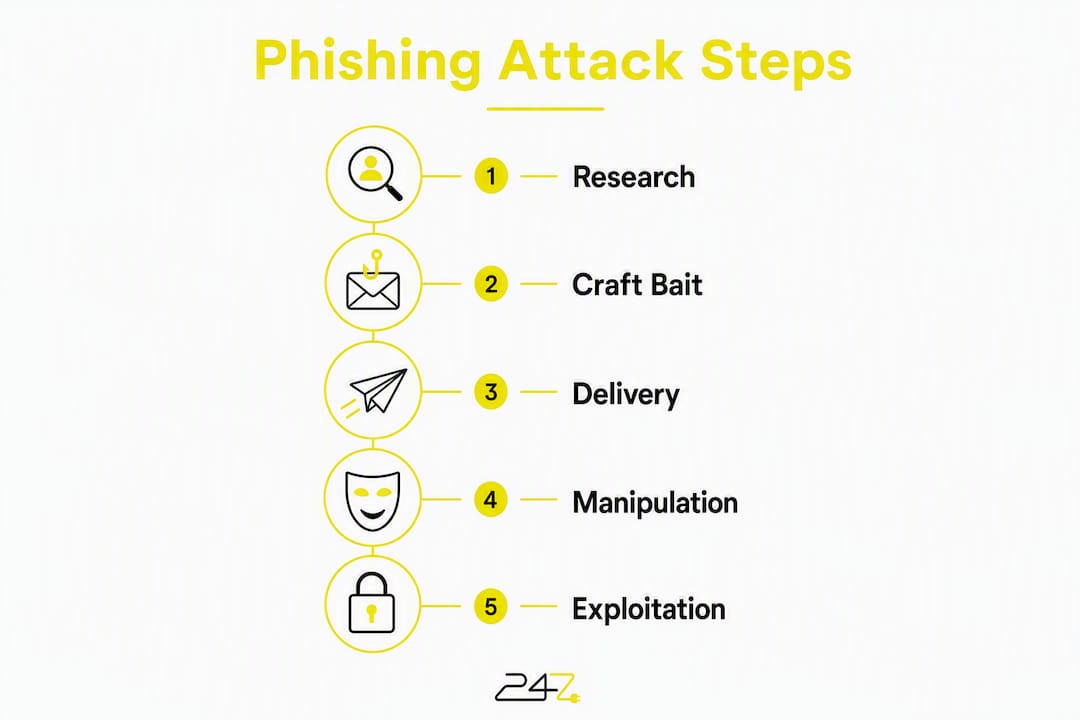
Exploitation. The victim clicks a link and enters credentials on a fake login page, opens an attachment that drops malware, or approves a wire transfer. At that point, phishing becomes the entry point for ransomware deployment, BEC fraud, and large-scale data exfiltration.

Modern redirector services and chains of compromised legitimate sites make the final landing page nearly impossible to identify from a casual URL glance, which is why technical controls matter as much as user awareness.
What are the main types of phishing attacks?
Phishing is not a single tactic. Understanding the types of phishing helps you recognize which attacks are most likely to target you or your organization.
- Spear phishing: A targeted message built from personal or company details gathered during reconnaissance. Attackers scrape LinkedIn and corporate sites to personalize messages with the victim’s name, job title, and recent activity, making them far more convincing than generic blasts.
- Whaling: Spear phishing aimed at executives, board members, or high-value employees. The financial and strategic risk is severe because these targets have authority to approve significant transfers or access sensitive systems.
- Business Email Compromise (BEC): The attacker either compromises a real internal email account or spoofs one convincingly to request fraudulent invoice payments, payroll redirects, or wire transfers. No malware is involved, which helps it bypass many filters.
- Clone phishing: A legitimate email that was previously delivered is copied, its links or attachments replaced with malicious versions, and resent as a “follow-up.” The victim recognizes the thread and lowers their guard.
- Smishing: Phishing delivered via SMS. Short messages impersonating delivery services, banks, or government agencies include shortened URLs that are difficult to inspect before tapping.
- Vishing: Voice-based phishing, where a caller impersonates tech support, a bank fraud department, or a government agency to extract credentials or payment details in real time.
- Social media and QR phishing: Malicious links embedded in direct messages, fake brand accounts, or QR codes posted in physical locations redirect victims to credential-harvesting pages or malware downloads.
How do you spot a phishing message?
Most phishing messages share identifiable patterns. Run through this checklist before acting on any unexpected request:
- Unexpected request: You were not expecting this message, and it asks for credentials, payment, or sensitive data.
- Urgency or fear: Language like “act immediately,” “your account is at risk,” or “final notice” is designed to short-circuit careful thinking.
- Generic greeting: “Dear Customer” or “Hello User” instead of your actual name signals a mass-blast campaign.
- Mismatched sender address: The display name looks right, but the actual email address uses a different domain or a subtle typo.
- Suspicious links: Hover over any link (on desktop) before clicking. The URL that appears in the status bar often differs from the anchor text. Copy the link into a plain text editor to inspect it without risk.
- Look-alike domains: Attackers register domains like “paypa1.com” or “microsoft-support.net.” Check for number-for-letter substitutions, extra hyphens, and unusual top-level domains.
- Unexpected attachments: Unsolicited invoices, shipping notifications, or “shared documents” are common malware delivery vehicles.
Pro Tip: Even a message that passes all these checks can be a phishing attempt. Redirector services and compromised legitimate sites can make the URL look clean. For any high-risk request (password reset, wire transfer, payroll change), verify out of band: call the sender on a known number or confirm through a separate app.
Warning signs of phishing include unexpected requests for sensitive data, urgent payment demands, and links that redirect to unfamiliar domains. When in doubt, do not interact with the message at all.
What should you do immediately if you were phished?
Act fast. The window between clicking a malicious link and a full account compromise can be minutes.
- Stop interacting. Close the browser tab or email immediately. Do not click anything else in the message.
- Disconnect from the network if you opened an attachment or downloaded a file. Isolating the device limits lateral movement if malware was installed.
- Preserve evidence. Do not delete the message. Capture the full email headers (in most clients: View > Show Original or similar) before taking further action.
- Reset compromised passwords from a known-clean device, not the one that may be infected. Prioritize email, banking, and any account where you reused that password.
- Enable or reconfigure MFA on affected accounts, preferring phishing-resistant options (hardware keys, passkeys) over SMS codes.
- Run a full security scan using up-to-date antivirus or EDR software on any device that interacted with the message.
- Notify your financial institution immediately if any payment was made or banking credentials were entered. Request a transaction freeze if necessary.
- Report the incident. Individuals should report to the FTC at reportfraud.ftc.gov and the FBI’s Internet Crime Complaint Center (IC3). Businesses must notify their IT team or MSP and activate their incident response plan.
- Monitor for identity theft. If personal information was exposed, visit identitytheft.gov for a personalized recovery plan.
The NCSC recommends resetting compromised passwords immediately, enabling phishing-resistant MFA, notifying impacted institutions, and running security scans as the core damage-limitation sequence.
How do you defend against phishing attacks?
Layered defenses are the only reliable answer. No single control stops every phishing variant, but combining technical safeguards, secure habits, and policy controls reduces exposure dramatically.
Technical controls
- SPF, DKIM, and DMARC: Email authentication standards that verify a sending server is authorized to send on behalf of a domain (SPF), cryptographically sign messages (DKIM), and instruct receiving servers what to do with failures (DMARC). Together they block most domain spoofing at the mail server level.
- Phishing-resistant MFA (WebAuthn/U2F): Hardware security keys and passkeys cannot be phished because authentication is bound to the legitimate domain. SMS-based MFA is better than nothing but can be bypassed by SIM-swapping or real-time phishing proxies.
- Secure email gateways: Filter inbound messages for known malicious domains, suspicious attachments, and impersonation patterns before they reach the inbox.
- URL rewriting and sandboxing: Rewrite links at delivery time so they are scanned when clicked, and detonate suspicious attachments in an isolated environment before delivery.
- Endpoint detection and response (EDR): Monitors device behavior in real time to catch malware that bypasses signature-based antivirus.
- Password managers: Autofill credentials only on the exact registered domain, which means they will refuse to fill on a look-alike site.
User habits and policy controls
- Limit account privileges so that a compromised user account cannot access systems beyond what the role requires.
- Keep separate accounts for business and personal use to contain blast radius.
- Maintain regular, tested backups so ransomware delivered via phishing does not become an existential event.
- Apply security patches promptly; many phishing payloads exploit known, patched vulnerabilities.
| Control category | Problem it addresses | Expected effectiveness |
|---|---|---|
| Email authentication (SPF/DKIM/DMARC) | Domain spoofing and sender impersonation | High for spoofed domains; limited against compromised accounts |
| Phishing-resistant MFA (WebAuthn/U2F) | Credential theft and account takeover | Very high; eliminates credential replay attacks |
| Secure email gateway | Malicious links, attachments, and known phishing domains | High for known threats; limited against novel or targeted attacks |
| Endpoint protection (EDR) | Malware delivered via attachments or drive-by downloads | High for behavioral detection; requires up-to-date deployment |
| Tested backups | Ransomware and data destruction following a breach | High for recovery; does not prevent initial compromise |
Microsoft Security identifies phishing-resistant MFA, careful handling of links and attachments, and layered technical controls as the core prevention stack.
Why is AI making phishing more dangerous?
Generative AI has removed the most reliable tell in phishing detection: poor grammar and awkward phrasing. Attackers now produce highly polished, context-aware messages that match a target organization’s communication style, reference real internal projects, and contain no obvious errors. The 2026 threat landscape reflects this shift clearly.
Three trends are accelerating the risk:
- AI-generated text: Messages indistinguishable from legitimate internal communications, customized at scale for thousands of targets simultaneously.
- Voice deepfakes: Synthetic audio that impersonates a known executive or colleague in a vishing call, used to authorize fraudulent transfers or extract credentials over the phone.
- Redirector chains and compromised sites: Attackers route victims through multiple legitimate-looking URLs before landing on the harvesting page, defeating URL reputation checks.
Practical adaptations for this environment: require out-of-band confirmation for any high-value transaction (a separate phone call to a known number, not a number provided in the message), enforce phishing-resistant MFA across all accounts, and adopt a zero-trust posture toward unexpected requests regardless of how legitimate they appear.
Why training alone won’t protect your organization
Phishing is a social-engineering problem at its core, and humans are not reliable security controls under sustained, sophisticated attack. Over-relying on user training is a strategic failure; professional-grade defenses prioritize automated technical safeguards alongside awareness programs.
An effective organizational posture combines:
- Phishing-resistant MFA enforced across all accounts, especially email and financial systems.
- Secure email gateways and EDR deployed and actively monitored, not just installed.
- Targeted phishing simulations with immediate, personalized follow-up remediation rather than generic annual training. Structured employee cybersecurity training tied to simulation results produces measurably better outcomes.
- A documented incident response plan that every relevant employee knows exists and knows how to activate.
- Out-of-band verification procedures for wire transfers, payroll changes, and credential resets, written into policy so employees have authority to pause and verify without fear of reprimand.
Pro Tip: Prioritize phishing-resistant authentication and automated threat detection over repeated user-only training. A hardware security key stops a credential-theft attack even when the user clicks the link; a training module does not.
What laws and regulations govern phishing in the United States?
Phishing is a federal crime in the United States. The Computer Fraud and Abuse Act (CFAA) criminalizes unauthorized access to computer systems, which phishing-enabled intrusions directly violate. The CAN-SPAM Act governs deceptive commercial email, and wire fraud statutes (18 U.S.C. § 1343) apply to phishing schemes that involve financial transfers.
For regulated industries, the reporting obligations are more specific. HIPAA requires covered entities to report breaches of protected health information, including those caused by phishing, to the Department of Health and Human Services. PCI-DSS mandates incident response procedures and breach notification for payment card data. The SEC’s cybersecurity disclosure rules require public companies to report material cybersecurity incidents, including phishing-driven breaches, within four business days of determining materiality.
Individuals should report phishing to the FTC and the FBI’s IC3. Businesses in regulated industries should also consult legal counsel to determine whether a phishing incident triggers state breach notification laws, which now exist in all 50 states with varying thresholds and timelines.
This is general information, not legal advice. Confirm current reporting obligations with a qualified attorney or your compliance officer.
Notable phishing attacks that changed how organizations defend themselves
The 2016 Democratic National Committee breach began with a spear-phishing email sent to campaign chairman John Podesta. A security aide mistakenly described the malicious link as “legitimate” rather than “illegitimate,” Podesta entered his credentials, and attackers gained access to roughly 60,000 emails. The incident demonstrated how a single credential compromise, enabled by one convincing email, can produce geopolitical consequences.
The 2020 Twitter Bitcoin scam used vishing and social engineering against Twitter employees to gain access to internal admin tools. Attackers then hijacked verified accounts belonging to public figures to promote a Bitcoin fraud. No sophisticated malware was involved; the entire attack relied on manipulating people over the phone.
The 2021 Colonial Pipeline ransomware attack was traced to a compromised VPN password, likely obtained through a prior phishing campaign. The resulting shutdown of fuel distribution across the U.S. East Coast illustrated how phishing serves as the entry point for attacks with critical infrastructure consequences.
Each of these cases reinforces the same point: phishing is the primary entry point for large-scale attacks, and once a trusted account is compromised, the blast radius expands rapidly.
How phishing has evolved since the 1990s
The term “phishing” emerged in the mid-1990s, when attackers used AOL Instant Messenger to impersonate AOL staff and trick users into surrendering account credentials. The “ph” spelling was borrowed from the “phreaking” community, which had long used creative spelling to signal membership in underground hacking culture.
Through the early 2000s, phishing scaled with email adoption. Mass-blast campaigns impersonating banks and PayPal became common, and the attacks were easy to spot: broken English, generic greetings, and obvious domain mismatches.
The 2010s brought spear phishing and BEC to prominence. Attackers shifted from volume to precision, using automated reconnaissance to personalize messages at scale. Nation-state actors adopted spear phishing as a primary intrusion vector, and financial losses from BEC reached billions of dollars annually according to FBI IC3 reporting.
The current era is defined by AI augmentation. Generative models remove the linguistic errors that trained users to distrust certain messages, voice synthesis enables real-time impersonation, and redirector infrastructure makes URL inspection unreliable. The attack surface has also expanded to every device a person carries, including smartphones and smart speakers.
Key Takeaways
Phishing remains the most common entry point for data breaches and financial fraud because it targets human trust directly, making layered technical defenses and phishing-resistant authentication non-negotiable for any organization.
| Point | Details |
|---|---|
| Core definition | Phishing impersonates trusted entities to steal credentials, deliver malware, or trigger fraudulent transfers. |
| Immediate actions | Stop interacting, reset passwords from a clean device, enable phishing-resistant MFA, and notify your bank and IT team. |
| Top technical controls | Deploy SPF/DKIM/DMARC, phishing-resistant MFA (WebAuthn/U2F), a secure email gateway, and EDR on all endpoints. |
| AI raises the bar | AI-generated messages remove grammar errors; verify high-risk requests out of band regardless of how legitimate they appear. |
| Report every incident | Report to the FTC at reportfraud.ftc.gov and the FBI IC3; businesses must also activate their incident response plan. |
The real problem with how most organizations approach phishing
Phishing is persistent, adaptive, and increasingly automated. The organizations that manage it best are not the ones with the most security awareness posters; they are the ones that have made it technically difficult to exploit a successful phish. Phishing-resistant MFA means a stolen password is not enough. A secure email gateway means most malicious messages never reach the inbox. EDR means malware that does land gets caught before it spreads.
Training matters, but it is a last line of defense, not a first one. A well-crafted spear-phishing message, polished by generative AI and built on accurate reconnaissance, will fool a trained employee. The technical controls will not. If your organization is still treating annual security awareness training as its primary phishing defense, the architecture needs to change before the next incident does it for you.
If you have experienced a suspected phishing incident or want to assess your organization’s current exposure, 247techify’s managed IT services include 24/7 threat monitoring, incident response, and phishing-resistant authentication deployment for businesses across Canada.
Useful sources and reporting channels
Authoritative references for verification, reporting, and deeper learning:
- How To Recognize and Avoid Phishing Scams — FTC consumer guidance
- Report Fraud to the FTC — official U.S. phishing and fraud reporting portal
- Identity Theft Recovery — identitytheft.gov, for victims whose personal data was exposed
- Phishing Guidance — National Cyber Security Centre (NCSC), UK
- What Is Phishing? — IBM Security
- What Is Phishing? — Microsoft Security
- What Is a Phishing Attack? — Cloudflare Learning
- What Is Phishing? — McAfee
- What Is a Phishing Attack? — Sophos
- Cybersecurity threats and defenses — 247techify resource library
For incident response support or to discuss phishing defenses for your business, contact 247techify directly through the services overview page.
FAQ
What is a phishing attack in simple words?
A phishing attack is when a scammer pretends to be someone you trust, such as your bank or employer, to trick you into giving up your password, personal information, or money.
How do I know if I got phished?
Warning signs include unexpected requests for sensitive data, urgent payment demands, and links that redirected you to an unfamiliar site. If you entered credentials or made a payment after clicking a suspicious link, treat it as a confirmed incident and follow the response steps above.
Can I get phished just by opening an email?
Opening an email is usually harmless, but attackers can use tracking pixels to confirm your address is active, or exploit email clients that automatically load external content. The real risk begins when you click a link or open an attachment.
How do I remove a phishing attack from my device?
Disconnect the device from the network, run a full scan with up-to-date antivirus or EDR software, and reset all passwords from a separate clean device. If malware is confirmed or suspected, contact a professional IT provider rather than attempting manual removal, as some threats persist through standard scans.
Where do I report a phishing email in the United States?
Report phishing to the FTC at reportfraud.ftc.gov and the FBI’s Internet Crime Complaint Center at ic3.gov. You can also forward phishing emails to phishing@irs.gov if they impersonate the IRS, or to the Anti-Phishing Working Group at reportphishing@apwg.org.