
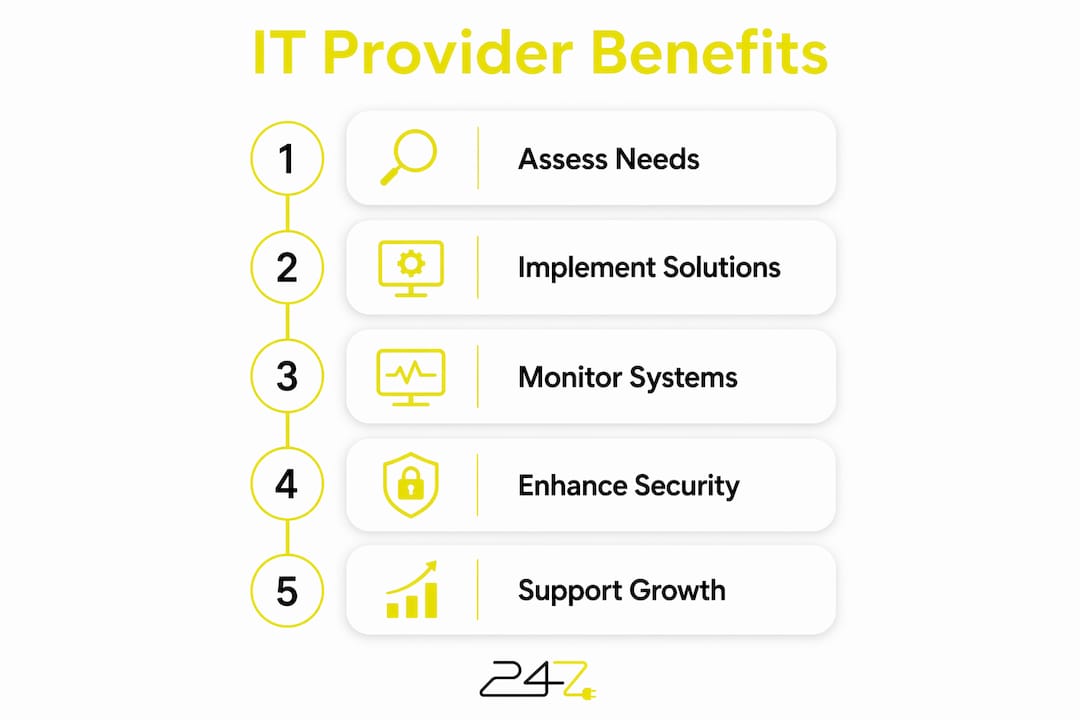
An IT service provider is defined as a specialized partner responsible for managing, securing, and optimizing a company’s technology systems so the business can operate without interruption. The role of IT service provider has expanded well beyond fixing broken hardware. By 2026, these providers act as strategic growth partners, helping businesses with digital transformation, workflow optimization, and cybersecurity. For Canadian business leaders in regulated industries like healthcare and finance, understanding what IT providers actually do, and what they should do, is the difference between a technology investment that pays off and one that quietly drains resources.
What services and responsibilities fall under the role of an IT service provider?
IT service providers, formally known as Managed Service Providers (MSPs) when operating under a subscription model, cover a wide range of functions that most internal teams cannot handle alone. Their responsibilities span routine maintenance, security, infrastructure, and strategic advisory work.
The core service categories include:
- Routine IT management: Software updates, patch management, system monitoring, and helpdesk support keep daily operations running without disruption.
- Cybersecurity: Providers conduct vulnerability assessments, manage access controls, run incident response plans, and monitor threats continuously to protect business continuity.
- Cloud and infrastructure services: Providers manage cloud migrations, server configurations, backup systems, and disaster recovery planning to protect data and uptime.
- Compliance support: For businesses subject to HIPAA or PCI-DSS, providers implement and audit controls that satisfy regulatory requirements.
- Strategic advisory: Providers evaluate your technology roadmap, recommend investments, and align IT decisions with business goals rather than just reacting to problems.
The advisory function is where modern providers separate themselves from older break/fix models. A qualified IT consulting partner improves decision-making and prepares businesses for future growth rather than just resolving immediate technical problems. That shift from reactive technician to proactive advisor defines the current standard.
Pro Tip: When evaluating a provider’s scope, ask specifically whether they include a quarterly technology review. Providers who only show up when something breaks are still operating on a break/fix model, regardless of what their contract says.

How do IT service providers enhance operational efficiency?
Operational efficiency is the most immediate and measurable benefit of working with an IT provider. The mechanism is straightforward: when your internal team stops spending time on patch cycles, printer issues, and software licensing, they redirect that capacity toward work that actually grows the business.
Here is how that efficiency gain plays out in practice:
- Offloading routine maintenance frees internal teams to focus on strategic digital transformation and business initiatives. Providers act as force multipliers for internal IT staff, not replacements.
- Access to specialized expertise removes the need to hire full-time specialists in areas like network security, cloud architecture, or compliance auditing. You get that expertise at a fraction of the cost of building it internally.
- ITSM best practices such as ITIL-aligned service management reduce unplanned downtime by standardizing how incidents, changes, and requests are handled. Fewer surprises mean fewer disruptions to your operations.
- Workflow automation support allows providers to identify repetitive manual processes and implement tools that handle them automatically, from automated backups to scheduled compliance reporting.
- Predictable costs through SLAs let finance teams budget accurately. MSPs operating under subscription models with defined service level agreements eliminate the unpredictable cost spikes that come with reactive IT spending.
The efficiency argument becomes especially clear for small and mid-sized businesses. A company with a two-person internal IT team cannot realistically cover cybersecurity monitoring, cloud management, compliance, and helpdesk support simultaneously. Partnering with a provider fills those gaps without the overhead of five additional hires.
Pro Tip: Before signing with any provider, request a sample SLA and look specifically at response time guarantees and escalation procedures. A provider that cannot define these clearly will not perform well under pressure.
How do IT service providers strengthen cybersecurity and risk management?
Cybersecurity is where the IT service provider impact is most urgent. A single data breach can cost a business its client relationships, regulatory standing, and operational continuity. Providers address this risk through layered, proactive measures rather than waiting for an incident to occur.
The core cybersecurity functions providers deliver include:
- Continuous monitoring: Providers watch network traffic, endpoint activity, and system logs around the clock. Threats are identified before they escalate into breaches.
- Vulnerability assessments: Regular scans identify weaknesses in software, configurations, and access policies before attackers exploit them.
- Access control management: Providers implement least-privilege access policies and multi-factor authentication, limiting the damage any single compromised credential can cause.
- Incident response planning: A documented response plan means your team knows exactly what to do when an attack occurs. Without one, the response is improvised and slow.
- Employee security training: Human error remains the leading cause of successful cyberattacks. Providers run phishing simulations and awareness programs to reduce that risk.
- Backup and disaster recovery: Proactive cybersecurity measures include tested backup systems that restore operations quickly after ransomware or hardware failure.
The table below shows how a proactive provider model compares to a reactive approach across key risk areas:
| Risk area | Reactive model | Proactive provider model |
|---|---|---|
| Threat detection | After breach occurs | Continuous real-time monitoring |
| Vulnerability management | On request or after incident | Scheduled assessments and patching |
| Employee training | One-time onboarding | Ongoing simulations and updates |
| Disaster recovery | Untested or ad hoc | Regularly tested and documented |
| Compliance auditing | Annual or reactive | Continuous control monitoring |
For businesses in regulated industries, the compliance column matters most. HIPAA and PCI-DSS both require documented controls and audit trails. A provider who treats compliance as a continuous process, not an annual checkbox, keeps your business out of regulatory trouble.
What factors should businesses consider when choosing an IT service provider?
Choosing the wrong provider costs more than choosing no provider at all. A misaligned partnership creates dependency without value, and switching mid-contract is expensive and disruptive. The selection criteria that matter most are not the ones most businesses focus on.
The right IT service provider aligns with your business vision and anticipates challenges rather than just responding to them. That means evaluating providers on their advisory capacity, not just their technical checklist. Ask how they have helped similar businesses plan for growth, not just how fast they resolve tickets.
Effective IT provider partnerships have a clear division of responsibility: providers manage operations and security, while businesses retain control over strategic technology decisions. This boundary matters. A provider who makes unilateral decisions about your infrastructure without consultation is a liability, not a partner.
Pricing transparency is a non-negotiable criterion. MSPs operating under subscription models with clear SLAs give you predictable costs and defined accountability. Providers who quote vaguely or bill hourly for everything create budget uncertainty and misaligned incentives. They profit from your problems rather than from preventing them.
Finally, evaluate the provider’s capacity to grow with you. A provider who is excellent at supporting a 20-person company may not have the infrastructure or expertise to support you at 200 people. Ask directly about their largest current clients, their cloud capabilities, and their approach to co-managed IT if you already have internal IT staff who need a capable partner rather than a replacement.
Key Takeaways
IT service providers deliver the most value when treated as strategic partners responsible for security, efficiency, and long-term technology alignment, not just technical support vendors.
| Point | Details |
|---|---|
| Providers are strategic partners | Modern IT providers advise on growth and digital transformation, not just fix technical problems. |
| Efficiency comes from offloading | Delegating routine maintenance frees internal teams to focus on business-critical work. |
| Cybersecurity requires proactive layers | Continuous monitoring, access controls, and tested recovery plans prevent breaches before they occur. |
| Selection criteria go beyond price | Evaluate alignment with your roadmap, advisory capacity, and SLA transparency over cost alone. |
| Clear labor division protects control | Providers manage operations and security; your business retains authority over strategic tech decisions. |
What we have learned from watching businesses choose IT providers
The most common mistake we see is businesses selecting a provider based on the lowest monthly rate and then spending the next 18 months managing the consequences. A provider priced below market is almost always cutting corners somewhere, whether in monitoring coverage, response staffing, or compliance expertise.
The second mistake is treating the IT provider relationship as purely transactional. The businesses that get the most from their providers are the ones who include them in quarterly planning conversations, share their growth targets, and ask for technology recommendations proactively. Viewing IT providers as strategic partners rather than commodity vendors is what transforms technology from a cost center into a competitive advantage. That mindset shift is not abstract. It shows up in concrete outcomes: faster incident resolution, fewer compliance gaps, and technology investments that actually support where the business is going.
The third pattern we observe is businesses underestimating the importance of cybersecurity depth. A provider who offers “basic security” as a line item is not a cybersecurity partner. Real security requires continuous monitoring, documented incident response, and regular employee training. If your current or prospective provider cannot describe their threat detection process in specific terms, that is a serious gap.
— 247techify Team
How 247techify supports your IT and security goals
247techify delivers managed IT services and cybersecurity solutions built specifically for Canadian businesses that cannot afford downtime or data breaches. The 247techify model combines 24/7 monitoring, a response time under 30 minutes, and deep expertise in compliance standards including HIPAA and PCI-DSS. Whether your business needs fully managed IT, a co-managed IT partnership that works alongside your internal team, or dedicated cybersecurity protection, 247techify structures its services around your specific risk profile and growth plans. With a 98% client satisfaction rate and transparent pricing starting from $59 per month, 247techify gives business leaders the clarity and confidence to make technology work for them.
FAQ
What is the role of an IT service provider?
An IT service provider manages and secures a company’s technology systems, covering routine maintenance, cybersecurity, cloud infrastructure, and strategic advisory functions. Modern providers act as growth partners, not just technical support staff.
How do IT service providers improve operational efficiency?
Providers free internal teams from routine maintenance tasks, deliver specialized expertise without full-time hiring costs, and use ITSM best practices to reduce unplanned downtime and support workflow automation.
What cybersecurity services do IT providers typically offer?
IT providers deliver continuous threat monitoring, vulnerability assessments, access control management, incident response planning, employee security training, and tested backup and disaster recovery systems.
How should a business evaluate an IT service provider?
Evaluate providers on their alignment with your business roadmap, transparency in SLA terms and pricing, advisory capacity, and ability to scale with your growth, not on price alone.
What is the difference between a managed service provider and a break/fix IT vendor?
A managed service provider operates proactively under a subscription model with defined SLAs, while a break/fix vendor only responds after a problem occurs and bills hourly, creating misaligned incentives and unpredictable costs.