
IT regulatory compliance is defined as the process of aligning information technology systems, controls, and processes with applicable laws, industry standards, and regulatory frameworks to protect data integrity and meet legal obligations. The role of IT in regulatory compliance has expanded from a back-office function to a board-level priority, driven by frameworks like GDPR, HIPAA, SOC 2, and ISO 27001. GDPR non-compliance fines reach up to €20 million or 4% of annual global turnover. That single figure explains why business leaders and compliance officers can no longer treat IT governance as optional.
How does IT support compliance frameworks and regulatory requirements?
IT systems are the operational backbone of every compliance program. They enforce policies, restrict access, encrypt sensitive data, and generate the audit trails that regulators demand as evidence. Without IT infrastructure doing this work automatically, compliance becomes a manual, error-prone process that breaks down at scale.

The most common frameworks your organization will encounter each carry specific IT requirements:
| Framework | Core IT Requirement | Key Risk Area |
|---|---|---|
| GDPR | Data minimization, encryption, breach notification | Personal data exposure |
| HIPAA | Access controls, audit logs, data integrity | Protected health information |
| SOC 2 | Availability, confidentiality, processing integrity | Service organization trust |
| ISO 27001 | Information security management system (ISMS) | Enterprise-wide risk |
| PCI DSS | Cardholder data protection, network segmentation | Payment fraud |
One of the most underused efficiencies in compliance management is control mapping. One well-run control can satisfy multiple regulatory frameworks simultaneously, reducing audit burden. A properly configured access control policy, for example, can satisfy HIPAA’s minimum necessary standard, SOC 2’s logical access criteria, and ISO 27001’s access management requirements all at once. High-performing compliance teams build unified control libraries mapped to multiple frameworks to scale this approach effectively.
Automated compliance platforms take this further by enabling continuous monitoring and evidence collection. Rather than scrambling to gather documentation before an audit, IT systems capture logs, flag exceptions, and store evidence in real time. This shifts compliance from a periodic event to an ongoing operational state.
- Policy enforcement: IT systems apply rules automatically, removing human discretion from high-risk decisions.
- Access control: Role-based and attribute-based access models restrict data to authorized users only.
- Encryption: Data at rest and in transit is protected against unauthorized interception.
- Audit trails: Immutable logs record every access, change, and exception for regulatory review.
- Continuous monitoring: Automated alerts detect misconfigurations or violations within minutes.
Is IT compliance the same as IT security?
IT security and IT compliance are related but distinct disciplines, and confusing them creates dangerous gaps in your program. IT security is proactive and threat-focused; IT compliance is reactive and evidence-focused. Security asks, “Are we protected?” Compliance asks, “Can we prove we followed the rules?”
Security teams build defenses against active threats: firewalls, intrusion detection, endpoint protection, and incident response. Compliance teams document that those defenses exist, function correctly, and meet the specific criteria defined by a regulatory body. A firewall that blocks attacks but lacks proper logging fails a compliance audit even though it works perfectly from a security standpoint.
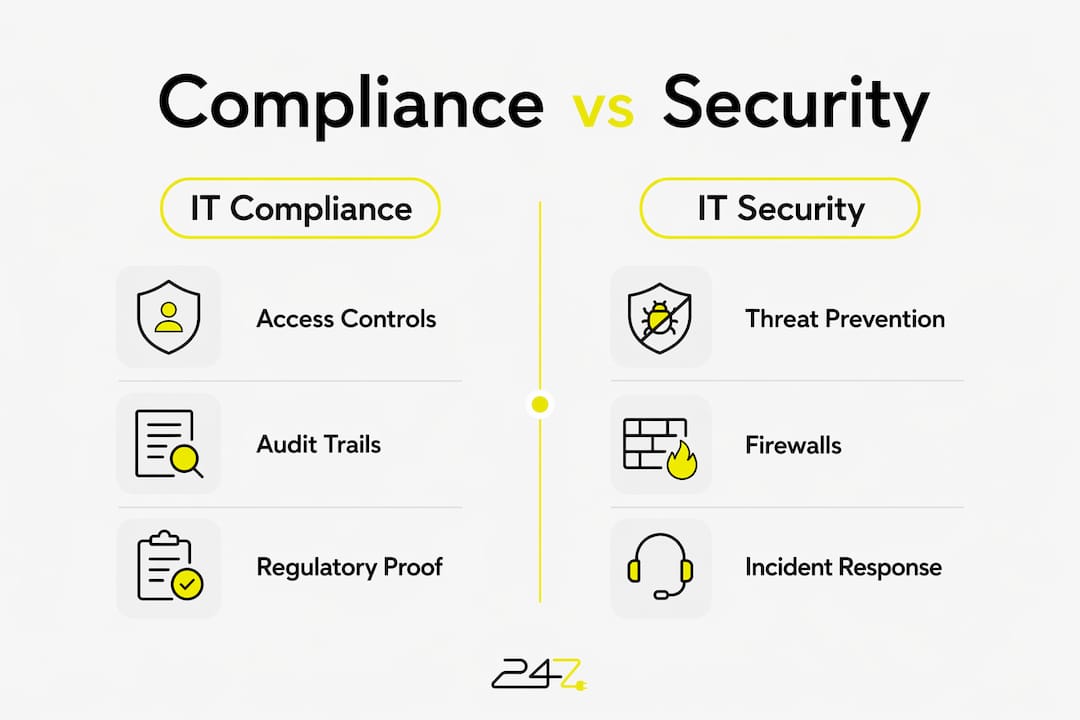
The overlap between the two functions is where the real value lives. Access controls, for instance, serve both purposes simultaneously. A least-privilege policy reduces the attack surface for insider threats while also satisfying HIPAA and SOC 2 audit requirements. Incident response plans protect the business from breach damage while also fulfilling the mandatory notification timelines required by GDPR. Reviewing the 2026 cybersecurity threat landscape shows how tightly these two functions must coordinate to prevent both breaches and audit failures.
Pro Tip: Assign a compliance owner who sits in regular meetings with the security team. When these two functions operate in separate silos, organizations routinely pass audits while remaining genuinely vulnerable, or maintain strong security while failing regulatory reviews.
The practical integration point is evidence. Security tools generate logs, alerts, and reports. Compliance programs consume that output as audit evidence. When IT security and compliance functions share tooling and reporting pipelines, both programs get stronger without duplicating effort.
What are the most effective IT compliance strategies?
Effective IT compliance strategies share a common foundation: they start with risk, not rules. Building compliance programs without a prior risk assessment leads to policies nobody follows and controls that address the wrong threats. The risk assessment identifies what data you hold, where it lives, who can access it, and what the realistic threat scenarios are. Every policy and control flows from that baseline.
The following sequence reflects how high-performing organizations structure their IT compliance programs:
- Conduct a formal risk assessment. Map all data assets, classify them by sensitivity, and identify applicable regulatory frameworks before writing a single policy.
- Form a dedicated GRC team. 91% of organizations use a dedicated Governance, Risk, and Compliance team to centralize leadership and enforce policies. This team owns the compliance program and coordinates across IT, legal, and operations.
- Deploy automated monitoring. Continuous compliance monitoring detects misconfigurations or policy violations in minutes, shifting from reactive to proactive posture. Manual reviews cannot match this speed or coverage.
- Implement identity governance. Automated identity governance platforms monitor user permissions and enforce least-privilege policies, reducing insider risk. They flag over-privileged accounts and simplify audits without manual effort.
- Build an incident response plan. Define roles, escalation paths, and notification timelines before an incident occurs. Regulators evaluate your response plan as part of compliance reviews.
- Train staff continuously. Technical controls fail when employees do not understand why they exist. Regular training on data handling, phishing recognition, and access policies reduces human error, which remains the leading cause of compliance failures.
Pro Tip: Assign a single program owner with authority to enforce compliance decisions across departments. Compliance programs decay when they lack a dedicated owner and a sustainable operating cadence. Without ownership, compliance becomes everyone’s responsibility and no one’s priority.
The importance of IT in compliance also extends to SaaS management. Modern organizations manage over 100 SaaS applications on average, and each application represents a potential compliance gap if not properly governed. Automated SaaS discovery tools identify unauthorized applications, enforce data residency requirements, and flag apps that store regulated data outside approved environments.
What are the biggest challenges in IT compliance programs?
IT compliance programs fail in predictable ways. Recognizing these failure patterns early saves significant remediation cost and regulatory exposure.
- Manual monitoring at scale is unsustainable. With the average organization running over 100 SaaS applications, manual compliance checks cannot keep pace with the volume of configuration changes, access events, and data flows that require review.
- Skipping the risk assessment. Organizations that start with framework selection instead of risk analysis build compliance programs around the wrong controls. The result is a program that looks complete on paper but fails to address actual organizational risk.
- Over-scoping in early stages. Pursuing SOC 2, ISO 27001, HIPAA, and PCI DSS simultaneously before controls are mature creates audit fatigue and dilutes focus. Start with the framework most relevant to your customers or regulators, then expand.
- Automating before defining controls. Manual evidence collection without testable controls leads to excessive data storage with no real audit value. Automation amplifies whatever control structure exists. If controls are poorly defined, automation generates noise, not evidence.
- Shadow IT. Employees using unauthorized applications to handle regulated data create compliance gaps that IT teams cannot see or control. Shadow IT is not a user behavior problem. It is a governance gap that requires both technical discovery tools and clear acceptable-use policies.
“The most dangerous compliance gap is the one you cannot see. Shadow IT, unmonitored SaaS applications, and undocumented access paths do not appear in audit logs because they were never brought under governance in the first place. By the time a regulator finds them, the exposure has already occurred.”
Technology and regulatory adherence require ongoing attention, not annual reviews. Compliance programs that operate on a once-a-year audit cycle miss the configuration drift, personnel changes, and new application deployments that accumulate between reviews. A network security checklist reviewed quarterly catches these gaps before they become findings.
Key Takeaways
IT regulatory compliance succeeds when risk assessment drives control design, automation handles monitoring at scale, and a dedicated GRC team owns the program with a consistent operating cadence.
| Point | Details |
|---|---|
| Risk assessment comes first | Define data assets and threats before writing policies or selecting frameworks. |
| Control mapping reduces audit burden | One well-designed control can satisfy GDPR, HIPAA, SOC 2, and ISO 27001 simultaneously. |
| Automation is not optional at scale | Organizations managing 100+ SaaS apps cannot sustain manual compliance monitoring. |
| Security and compliance must integrate | Shared tooling and reporting pipelines strengthen both programs without duplicating effort. |
| Program ownership drives results | 91% of high-performing organizations assign a dedicated GRC team to enforce compliance. |
What we have learned about IT compliance after years in the field
The most common mistake we see business leaders make is treating compliance as a project with a finish line. They pursue a SOC 2 report or a HIPAA attestation, achieve it, and then reduce investment until the next audit cycle. The program decays. Controls drift. Staff turnover erases institutional knowledge. By the time the next audit arrives, the organization is rebuilding from scratch.
Compliance is a continuous operational function, not a certification sprint. The organizations that handle audits with the least disruption are the ones that run their compliance program the same way they run their finance function: with dedicated ownership, regular reporting, and a defined cadence of reviews and updates.
We have also seen the limits of automation firsthand. Automated tools are powerful, but they amplify whatever control structure sits beneath them. Organizations that deploy compliance management software before defining and testing their controls end up with dashboards full of data and no clear picture of actual risk posture. The discipline of defining controls first, testing them manually, and then automating evidence collection is slower upfront but produces audit-ready programs that hold up under scrutiny.
The cultural dimension of compliance is consistently underestimated. Technical controls can restrict access and generate logs, but they cannot prevent an employee from emailing a spreadsheet of customer records to a personal account if that employee does not understand why the policy exists. Training is not a checkbox. It is the mechanism that makes every other control more effective.
IT governance in compliance works best when it is treated as a cross-functional discipline, not an IT department responsibility. Legal, HR, operations, and finance all generate and handle regulated data. When compliance officers and IT leaders build programs together, the controls reflect actual business processes rather than theoretical frameworks.
— 247techify Team
How 247techify supports your IT compliance program
Regulated industries like healthcare and finance face compliance requirements that change faster than most internal IT teams can track. 247techify works with Canadian businesses to build and maintain IT environments that meet HIPAA, PCI-DSS, and SOC 2 requirements, with 24/7 monitoring and a response time under 30 minutes. Our IT compliance and auditing services give compliance officers the documented evidence and control frameworks they need for audit readiness year-round. For organizations that want to extend their internal team’s capacity without replacing it, our co-managed IT services provide expert compliance support alongside your existing staff. With a 98% client satisfaction rate, 247techify delivers the reliability that regulated businesses require.
FAQ
What is the role of IT in regulatory compliance?
IT systems enforce access controls, encrypt data, generate audit trails, and enable continuous monitoring, giving organizations the technical controls and documented evidence required to meet regulatory standards like GDPR, HIPAA, and SOC 2.
How does IT compliance differ from IT security?
IT security focuses on preventing threats proactively, while IT compliance focuses on proving adherence to regulatory requirements through documented evidence. Both functions are necessary and work most effectively when integrated.
Why is a risk assessment required before building a compliance program?
Starting a compliance program without a risk assessment produces policies and controls that address the wrong threats. A risk-based approach identifies actual data assets and vulnerabilities, ensuring controls are relevant and auditable.
What is a GRC team and why does it matter?
A Governance, Risk, and Compliance team centralizes compliance leadership, enforces policies across departments, and maintains the operating cadence that keeps compliance programs from decaying between audit cycles. 91% of organizations use a dedicated GRC team.
How does automation improve IT compliance?
Automated platforms monitor configurations, flag policy violations in minutes, govern user access permissions, and collect audit evidence continuously, replacing manual processes that cannot scale across modern cloud and SaaS environments.