
Managed IT support is defined as an ongoing service where a third-party provider assumes full responsibility for monitoring, maintaining, and securing a business’s entire IT environment. Understanding how managed IT support works is the first step toward making a deliberate technology decision rather than a reactive one. The industry term for this model is Managed Services, delivered by a Managed Service Provider (MSP). For Canadian small and mid-sized businesses facing growing cybersecurity threats and tighter compliance requirements, the shift from break-fix IT to a proactive managed model is not optional. It is a business continuity decision.
How managed IT support works: core operations and daily functions
Managed IT support operates through a continuous cycle of monitoring, response, maintenance, and reporting. The provider does not wait for something to break. Instead, the entire IT environment stays under active surveillance around the clock.
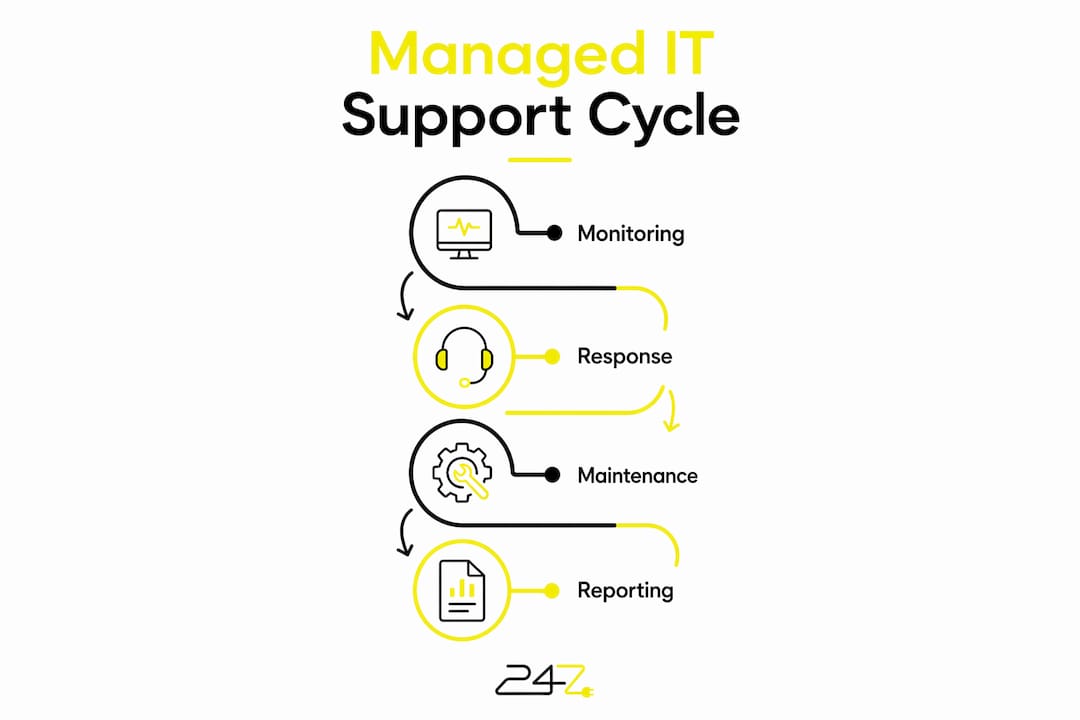
The foundation of this model is Remote Monitoring and Management (RMM) software. MSPs use RMM tools to deploy patches, run automated scripts, and resolve many issues remotely, which significantly reduces on-site visits and business disruption. When a server’s memory usage spikes or a hard drive begins showing failure indicators, the RMM platform generates an alert before the device fails. That early warning is what separates managed IT from traditional break-fix support.
Daily operations inside a managed IT agreement typically include:
- Continuous 24/7 monitoring of servers, endpoints, and network devices for performance and availability
- Tiered help desk support with SLA-backed response times, where critical issues receive attention within 15 minutes and standard requests within a few hours
- Automated patch management that applies operating system and application updates on a scheduled basis to close known security gaps
- Backup management with documented Recovery Point Objectives (RPO) and Recovery Time Objectives (RTO), tested regularly to confirm actual recoverability
- Scheduled maintenance windows for hardware checks, firmware updates, and system health reviews
Pro Tip: Ask any prospective MSP to show you a sample RMM alert report from the past 30 days. A provider with genuine proactive monitoring will have hundreds of resolved alerts that never became user-facing problems.
A comprehensive disaster recovery plan includes defined RPO and RTO targets and regular testing. That testing matters because an untested backup is not a backup. It is a false sense of security.

How does managed IT support protect against cybersecurity threats?
Cybersecurity is not an add-on in a well-structured managed IT agreement. It is the core architecture. 43% of cyber attacks target small businesses, which makes SMBs a primary attack surface, not an afterthought for threat actors.
A layered security approach inside a managed IT package typically covers:
- Endpoint Detection and Response (EDR): Monitors every device for behavioral anomalies and contains threats before they spread across the network
- Firewall management and email filtering: Blocks malicious traffic at the perimeter and intercepts phishing attempts before they reach employee inboxes
- Multi-factor authentication (MFA): Adds a second verification layer that stops credential theft attacks even when passwords are compromised
- Security awareness training: Reduces human error, which remains the leading cause of successful breaches
- Regular vulnerability assessments: Identify unpatched systems, misconfigured services, and exposed ports before attackers do
Compliance support is a direct extension of this security work. HIPAA, PCI-DSS, and SOC 2 frameworks each require documented controls, audit trails, and regular assessments. MSPs with certified staff handle audit preparation and compliance documentation, which removes that burden from internal teams and reduces the risk of regulatory penalties.
Pro Tip: “Managed IT” is not a standardized term. Service scope varies widely among providers. Prioritize providers with an integrated cybersecurity-first approach rather than those offering only basic maintenance with security as an optional upgrade.
247techify structures its service model around this cybersecurity-first principle. For businesses in regulated industries like healthcare and finance, that distinction determines whether a compliance audit results in a clean report or a costly finding.
What is the strategic value of virtual CIO services?
Most business owners evaluate MSPs on help desk speed. That is the wrong metric. Virtual CIO (vCIO) services that align IT spending with business strategy deliver more long-term value than fast ticket resolution alone.
A vCIO function inside a managed IT agreement works through a structured process:
- IT roadmapping: The vCIO maps your current technology stack against your three-year business goals and identifies gaps, redundancies, and upgrade timelines.
- Budget planning: Rather than reacting to surprise hardware failures, the vCIO builds a capital expenditure forecast so IT costs appear in your annual budget as planned line items.
- Quarterly business reviews (QBRs): Regular meetings translate IT performance data into business language, showing how uptime, security posture, and system performance connect to revenue and risk.
- Vendor and license management: Centralized vendor management gives MSPs faster escalation paths and often better pricing than individual business accounts can negotiate. It also consolidates billing and reduces the administrative hours your team spends managing software renewals.
Most decision-makers underestimate vendor management as a service component. The time saved managing Microsoft 365 licenses, internet service contracts, and hardware warranties alone often justifies a portion of the monthly MSP fee.
Pro Tip: During provider evaluation, ask specifically whether vCIO services are included or billed separately. Providers who bundle strategic planning with operational support treat IT as a business function. Those who separate it treat IT as a cost center.
What are the real benefits of managed IT support for small businesses?
The financial case for managed IT support rests on cost predictability and access to expertise that would otherwise require multiple full-time hires. According to Deloitte’s Global Outsourcing Survey, 59% of businesses cite cost reduction as the primary reason for outsourcing IT functions. That figure reflects a structural reality: a single internal IT hire works 40 hours per week with expertise limited to their background, while an MSP provides continuous multi-specialist coverage across networking, security, cloud, and compliance.
The operational impact shows up quickly. Within the first 90 days, managed IT engagements typically produce measurable results including reduced help desk wait times, resolved ticket backlogs, and identified security vulnerabilities that had gone undetected. Medium-term benefits include fewer downtime incidents and technology improvements that compound over time.
| Benefit | Practical impact |
|---|---|
| Cost predictability | Fixed monthly fee replaces unpredictable emergency repair costs |
| Reduced downtime | 24/7 monitoring catches hardware and performance issues before failure |
| Expert team access | Multi-specialist coverage without adding headcount |
| Compliance support | Audit-ready documentation for HIPAA, PCI-DSS, and SOC 2 |
| Strategic alignment | vCIO services connect IT spending to business goals |
For an SMB with an internal IT generalist, a quality MSP acts as a force multiplier. The internal person focuses on strategic projects and business-facing work while the MSP handles routine monitoring, patching, and security response. That division of labor is more productive than asking one person to do everything.
The break-fix alternative carries a hidden cost that rarely appears in budget comparisons: unplanned downtime. When a server fails on a Tuesday afternoon without a managed IT agreement in place, the business pays emergency labor rates, waits for parts, and absorbs lost productivity across every affected employee. Managed IT converts that unpredictable risk into a known monthly expense.
Key Takeaways
Managed IT support delivers the most value when it combines proactive monitoring, layered cybersecurity, and strategic planning under a single, predictable monthly agreement.
| Point | Details |
|---|---|
| Proactive monitoring prevents failures | RMM tools detect hardware and performance issues before they cause downtime. |
| Cybersecurity must be built in | 43% of cyber attacks target small businesses, making layered security non-negotiable. |
| vCIO services drive strategic value | Quarterly business reviews align IT spending with long-term business goals. |
| Cost predictability replaces risk | Fixed monthly fees eliminate unpredictable emergency repair expenses. |
| Provider scope varies widely | Prioritize MSPs with integrated cybersecurity-first service scopes over basic maintenance providers. |
What SMBs consistently get wrong when choosing an MSP
The 247techify team has worked with Canadian businesses across healthcare, finance, and professional services for years. The pattern we see most often is this: business owners select an MSP based on price and help desk response time, then discover 18 months later that their provider has no real security depth and no strategic planning capability.
Speed matters. A response time under 30 minutes for critical issues is a reasonable baseline expectation. But speed without security expertise is a liability. An MSP that resolves tickets quickly but misses a misconfigured firewall rule or skips vulnerability assessments is not protecting your business. It is managing your helpdesk.
The providers worth partnering with treat compliance as a core competency, not a checkbox. They know the difference between HIPAA’s technical safeguard requirements and PCI-DSS’s network segmentation rules. They can produce audit documentation on demand. They conduct security awareness training that changes employee behavior, not just satisfies a policy requirement.
The other underestimated factor is the role of IT service providers in vendor escalation. When your internet service provider causes an outage, an MSP with an established relationship and a business account escalation path resolves it faster than you can navigating a consumer support queue. That capability has real dollar value attached to it.
Choose your MSP the way you choose a law firm or an accountant. Look for depth, specialization, and a long-term partnership mindset. The cheapest option rarely delivers the outcome your business actually needs.
— 247techify Team
247techify’s managed IT services for Canadian SMBs
247techify delivers proactive managed IT services built specifically for Canadian small and mid-sized businesses that cannot afford downtime, data breaches, or compliance failures. The service model combines 24/7 monitoring, a cybersecurity-first security stack, and vCIO-level strategic planning under a predictable monthly fee.
Every engagement includes endpoint protection, patch management, backup and disaster recovery, and compliance support for regulated industries including healthcare and finance. The team maintains a 98% client satisfaction rate and a response time under 30 minutes for critical issues. For businesses that already have an internal IT person, co-managed IT services provide the specialist depth and after-hours coverage that a single hire cannot deliver alone. Contact 247techify to request a no-obligation IT assessment and see exactly where your current environment stands.
FAQ
What is managed IT support?
Managed IT support is a service model where a third-party provider continuously monitors, maintains, and secures a business’s IT infrastructure for a fixed monthly fee. The provider proactively prevents problems rather than responding after failures occur.
How does managed IT support differ from break-fix IT?
Break-fix IT charges per incident after something fails. Managed IT support covers ongoing monitoring and maintenance, which reduces the frequency and cost of failures before they affect operations.
What security services are included in managed IT support?
A comprehensive managed IT package includes endpoint detection and response, firewall management, email filtering, multi-factor authentication, security awareness training, and regular vulnerability assessments.
How quickly does managed IT support respond to critical issues?
SLA-backed managed IT agreements address critical issues within 15 minutes and standard requests within a few hours, with 24/7 coverage ensuring no issue waits until business hours.
How do I choose the right managed IT support provider?
Evaluate providers on cybersecurity depth, compliance expertise, and whether vCIO services are included. Response time matters, but security capability and strategic planning determine long-term value.